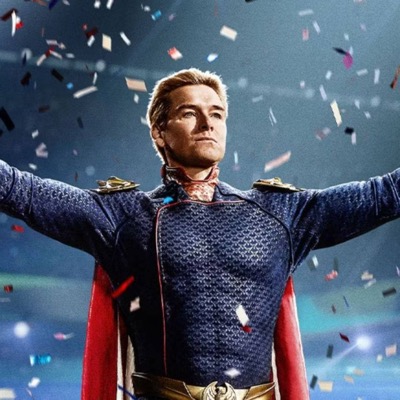
Homelander — Character Arc
Played by Antony Starr · Seasons 1-5
The most powerful man on earth who needed a mother's approval, then a crowd's, then God's — and kept lowering the bar each time.
Played by Antony Starr · Seasons 1-5 · The Boys (Prime Video)
Who Homelander was at the start
Vought built him in a lab, raised him in isolation, handed him the American flag, and pointed him at a camera. Antony Starr plays a man who has never been told no by anyone willing to say it twice. The costume is a product. The smile is a threat in a different key.
The need underneath is visible in S1E04, when Homelander lays his head against Madelyn Stillwell's chest and nurses. He is not doing it for sex. He is doing it for reassurance — the oldest reassurance a body knows. The performance of control and the hunger for containment are the same man in the same cape.
He performs father, husband, hero, and patriot without understanding what any of those words mean to someone who wasn't manufactured.
Season 1 — The Product Compliant With Its Own Packaging
The S1 version of Homelander is still useful. He is dangerous the way a faulty reactor is dangerous — because the thing running him is not conscience but the fear of exposure.
The pivot is S1E08. When Madelyn finally confirms Becca's baby, Homelander performs rage, performs love, and when she says she loves him — genuinely, it seems — he says "Thank you" and lasers her eyes out. Not because he stopped believing her. Because she had already served her function. He brings Ryan to the body. "I'm your father," he tells the boy, "and we are a family." The sentence is a property transfer.
Turning point: S1E08 — the domestic scene arranged like a photo op for an audience of nobody. He has everything he wanted. He is already bored.
Season 2 — Stormfront Teaches Him He Can Want More
Stormfront does not create his fascism. She names it. She tells him the crowd loves him because they are frightened, not good, and fear is the real currency. He believes the operating principle — not her ideology, which he doesn't interrogate. Her white-supremacist conviction gets her burned, and he watches without grief. What he takes is the ambition, not the uniform.
The season ends on a rooftop in S2E08, alone while a crowd chants below. A milkshake hits someone. Someone shoves back. Homelander watches, then smiles — the first genuine one in the series, uncontrolled, private. Someone just committed violence without being asked. The crowd only needs a target and his implicit permission.
Turning point: S2E08 — the rooftop. The thing Stormfront told him is confirmed in real time: the crowd's love and the crowd's violence are the same emotion aimed in different directions. He can aim them.
Season 3 — The Mask Falls Off on Live Television
Stan Edgar is removed. The corporate leash is gone. Homelander, freed from management, immediately shows what he was without it.
The S3E02 birthday special is the pivot. Edgar has just told him, with corporate pleasantness, that his numbers are down and Starlight is carrying him. Homelander takes the stage for his own birthday celebration, listens to Starlight announce a charity donation in his name, and stops her mid-sentence. The speech he gives is a relief, not a rant: "I am done apologizing. I am done being persecuted for my strength. You people should be thanking Christ that I am who and what I am, because you need me." The crowd does not boo. The crowd cheers harder.
Then S3E08 gives it the fulcrum. At a rally, a protester calls him a fascist. Someone in the crowd shoves back. A bystander gets struck and killed in the chaos. Homelander looks at the crowd. He laughs — slowly, experimentally, like testing ice. The crowd follows. They cheer. He says, "I can do whatever I want." He means it now in a way he did not in Season 1.
Turning point: S3E08 — "I can do whatever I want." The laugh. The moment he understood that the crowd will ratify anything, including a murder, as long as he frames it as strength.
Season 4 — Building a God Out of Wreckage
By S4, Sister Sage is running his strategy because Homelander refuses to. He uses Splinter — a supe who can multiply into clones — to spread his presence, which is the show's bluntest joke: the most loving relationship he sustains is with a version of himself he controls.
Ryan mirrors him. By S4E08, Ryan fires lasers at Grace Mallory during Butcher's rescue attempt — lethal force in a crisis, protecting the person who raised him. His father's exact shape.
S4E08 ends with Homelander declaring martial law. He does not seize the presidency. He sidesteps it. No accountability in a title he doesn't need.
Turning point: S4E08 — martial law. He stops working within the system and acknowledges, publicly, that he is the system now.
Season 5 (through E07) — The Franchise Becomes the State
The branding operation has become a state religion. In the S5E07 Oval Office scene, he demands that the Democratic Church of America become the official national faith, orders troops into sanctuary cities, bans abortion, and mandates breastfeeding while outlawing nut milk. The last two items are policy in the same way the S1E04 breastfeeding scene was intimacy — a fixation dressed up as governance.
When Calhoun says dissolving Congress requires authority he doesn't have, Homelander calls Ashley in to read the president's mind. She reports he considers Homelander "a tiny bit psychotic." Homelander frames that as wavering faith, says he's disappointed, and kills him.
In S5E04 he already killed Sister Sage — not because she betrayed him, but because she was too autonomous to function as a mirror. He eliminates the one person who could have gotten him a durable win because she had opinions about how to get it.
The Soldier Boy scene in S5E07 is the season's cleanest X-ray. Homelander shows him plans for HomeLand — an amusement park with a "Soldier Boy! Father of God" section and a nightly parade. Soldier Boy says the V1 was for Clara, not for family, and announces he's leaving for Bogotá. Homelander performs calm — "Good luck, son. I love you." — then freezes him in cryosleep. When Homelander screamed "I am God!" seconds earlier, it was not a proclamation. It was a question requiring confirmation from the one person whose opinion he cannot manufacture.
Turning point: S5E07 — he kills Calhoun for doubting him and freezes Soldier Boy for refusing to confirm him. The same move: punish the witness.
Who Homelander is right now (entering the finale)
He has a dead president, a state religion, martial law, and a son being shaped into a successor. He does not have a peer, a strategist, or a check. Oh Father runs focus groups on whether the public will accept him as God. The most recent result was six out of thirty. That is the tell. He is not primarily worried about the Boys or Kimiko's radiation project. He cannot absorb the 22 percent who believe — which means he cannot stop noticing the 78 percent who don't.
The martial law and the state religion are not consolidations of power. They are attempts to compel the remaining majority into the room where the crowd sounds like love.
He has everything the story's first season positioned as his goal and none of the things he actually wanted, which were never governance but confirmation. The finale has no choice but to test him on the one thing he cannot laser — whether the thing he built is real, or just a crowd that can be scattered.
Antony Starr has been playing a nine-year-old who is also invincible for five seasons. The nine-year-old is winning.