Itaewon Class Episode 15 Recap: Sae-ro-yi Kneels To Save Yi-seo From Geun-won
Itaewon Class, Season 1, Episode 15 JTBC / Netflix · Written by Gwang-jin · 2020
Sae-ro-yi wakes from an old grief and chooses the people still waiting for him.
Park Sae-ro-yi (Park Seo-joon) has spent fifteen years proving that Chairman Jang Dae-hee cannot buy his pride.
The harder question is what happens when pride is no longer the point.
That question arrives through violence first. Jo Yi-seo (Kim Da-mi) is gone. Jang Geun-soo (Kim Dong-hee) is trapped with her. Sae-ro-yi is unconscious after a hit-and-run that rhymes too closely with the night his father died. Jang Geun-won (Ahn Bo-hyun) has come back from prison with no plan except punishment, and the damage lands on everyone who ever tried to survive near Jangga.
This penultimate chapter gathers old debts, puts them in one ugly room, and makes every character choose what their life has been teaching them.
Yi-seo and Geun-soo wake up tied in Geun-won’s hideout
Geun-won does not return as a polished villain. He returns as a man who has swallowed his father’s cruelty so completely that it has started eating him from the inside.
The first half keeps Yi-seo and Geun-soo in captivity, and that trap exposes two very different failures. Geun-won wants Sae-ro-yi to suffer because Sae-ro-yi is still alive. Geun-soo wants to believe he had no choice because wanting Yi-seo turned him into someone he barely recognizes.
Yi-seo has no patience for either excuse.
She is terrified, yes. She knows Sae-ro-yi may have been hurt because he came for her. But she is also still Yi-seo, which means fear does not make her soft. She clocks Geun-won’s need to torment her. She clocks the loose way she has been tied compared with Geun-soo. She clocks the opening before anyone else does.
Her harshest scene is with Geun-soo, and it lands because she refuses to flatter his self-pity. He did not become Sae-ro-yi’s rival by being brave. He went to Jangga, played dirty when things got difficult, and lost himself. When he says not everyone can be like Sae-ro-yi, Yi-seo gives him the answer he needs and hates: he is wrong.
That is why Yi-seo’s loyalty remains such a sharp character study. She is not morally gentle. She is not suddenly kind because she is in love. She still cuts people where they are weakest.
But Sae-ro-yi is the one exception she has chosen. Not because he fixed her. Because he gave her a rule worth testing herself against.
Seung-kwon walks back into his old world as IC’s director
Choi Seung-kwon’s return to the gang office could have been a simple action detour. Instead, it becomes a payoff years in the making.
He knows the room. He knows the men. He knows exactly how they will talk to him, because he used to belong to that logic. Violence, status, fear, usefulness. The old Seung-kwon would have answered a kick with a punch and called it dignity.
This Seung-kwon calls the police.
It is funny for about two seconds, then it becomes moving. He lets them hit him because he is no longer trying to prove he can hit harder. He has a title now. He has a company. He has a boss who taught him that a criminal record does not get to write the rest of his life.
When one of the men asks who would believe an ex-con, Seung-kwon does not crumble. He says the police will believe him because he is now the director of IC Co.
That line is not about vanity.
It is about worth.
For years, Sae-ro-yi has treated people as if their future mattered before the world agreed. Ma Hyun-yi’s quiet dignity, Kim To-ni’s place at DanBam, Seung-kwon’s second life, Yi-seo’s strange brilliance - all of that comes back here. DanBam was never just the starting point for a business empire. It was the first place where people who had been measured badly were allowed to become more than the label.
So when Seung-kwon warns the gang boss not to hurt Yi-seo or Geun-soo, the threat carries real weight. He is not pretending to be reformed. He is choosing the person Sae-ro-yi believed he could be.
Soo-ah resigns from Jangga after ten years of evidence
Oh Soo-ah (Kwon Nara) has always been the hardest person in this story to reduce.
Soo-ah is Sae-ro-yi’s first love, Jangga’s loyal employee, and the woman who knew the truth, hated the truth, lived next to the truth, and kept choosing the safer room anyway.
This is where she finally stops.
Her confrontation with Chairman Jang Dae-hee (Yoo Jae-myung) is not loud at first. She brings him the CCTV proof tying Geun-won’s people to Yi-seo and Geun-soo. She tells him that his old decisions made Geun-won capable of this. She gives him the chance to act like a father, or at least like a man who understands that kidnapping and attempted murder cannot be filed under company risk.
He chooses Jangga again.
That is the last door closing for Soo-ah. She has spent ten years gathering Jangga’s irregularities: borrowed-name stocks, slush funds, illegal requests, bribery. Her resignation is not impulsive. It is patient. It is the answer she has been delaying since the day Sae-ro-yi’s father died.
The important detail is that Soo-ah does not pretend her delay was noble. Yi-seo’s earlier words come back through her choice. Sticking to your principles is hard, yes, but sometimes that difficulty becomes a comfortable excuse. Soo-ah knows she made herself comfortable for too long.
So she leaves.
Not because Sae-ro-yi picked Yi-seo. Not because she needs to win a romance. Because Jangga has asked too much of her for too long, and she finally refuses to keep paying.
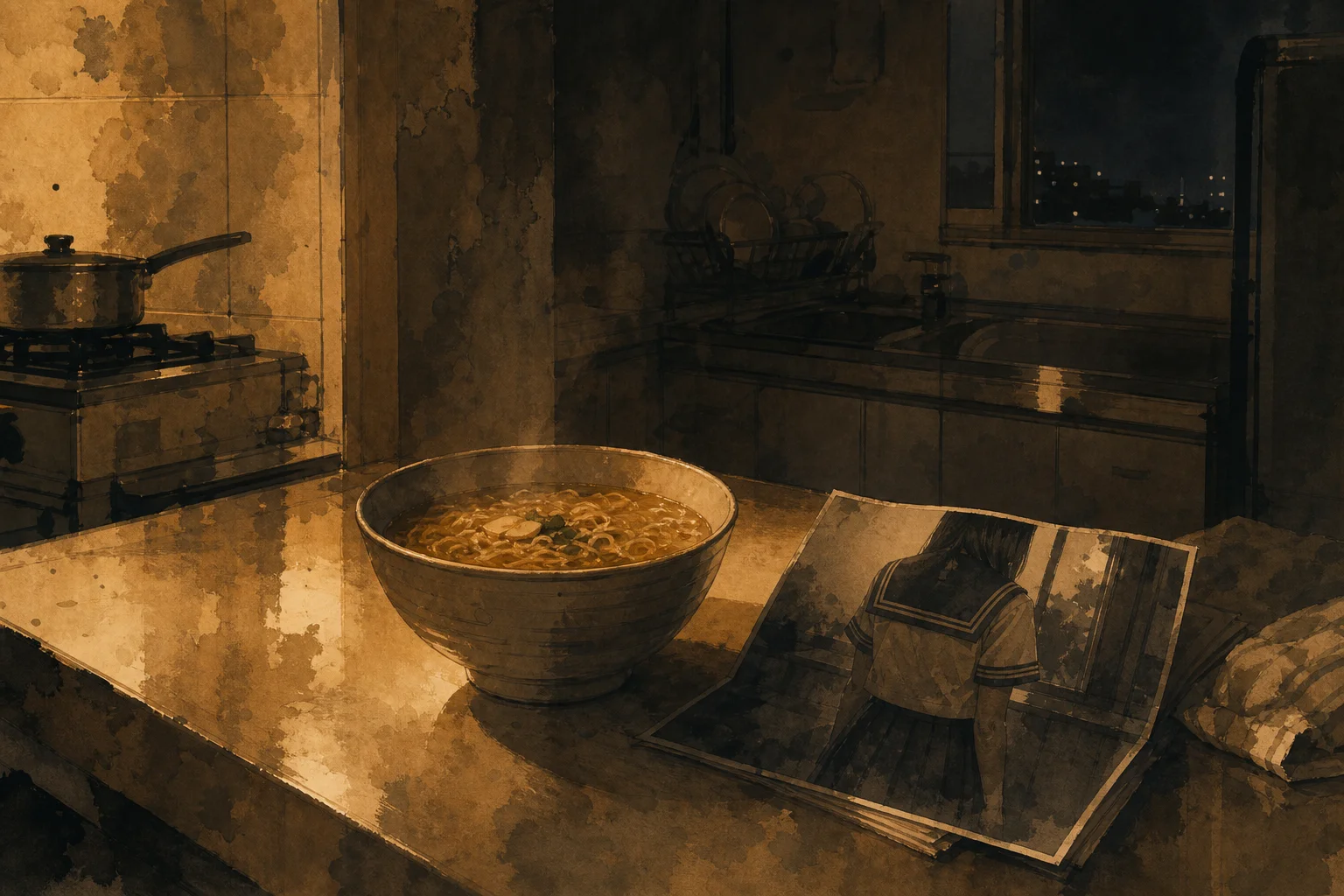
Sae-ro-yi says goodbye to his father and wakes up
Sae-ro-yi’s near-death meeting with his father is the emotional center.
That sequence could have been pure sentiment. Instead, Sae-ro-yi admits something he has rarely had the space to say: living has been difficult.
His father’s death gave him purpose, but purpose can still be heavy. Sae-ro-yi built his life on endurance. He told himself he could do this. He told himself everything would be fine. He kept moving through prison, poverty, revenge, DanBam, IC, Jangga, and every lonely night in between.
Then, in that dreamlike walk with his father, he says the quiet part. Hatred was hard to live on.
It matters that he does not follow his father across the bridge. He almost has the exit he has been denied for fifteen years: rest, reunion, no more painful nights. But he remembers the people still alive around him. Friends who need him. A future he wants to see. Yi-seo waiting on the other side of his own fear.
The quoted Nietzsche line, “Was that life? Well then! Once more!” could feel grand in another drama. Here it feels simple. Sae-ro-yi is not choosing revenge again. He is choosing life again.
When he wakes, he cries in front of Yi-seo, and she does not know what the tears mean. That is right. She has watched him as a boss, a target, a dream, a man to follow, and the only person she loves. She has almost never seen him as a son who still misses his father.
For a moment, she does.
What works
The father-son farewell gives the penultimate chapter its emotional pull. Sae-ro-yi’s pain has always been visible, but this is the rare stretch where he names the burden instead of turning it into discipline. His choice to live is not a rejection of grief. It is grief becoming something he can carry without letting it drive every step.
Seung-kwon’s material is also excellent. His police-station tactic, his director title, and his warning to the old gang all pay off years of DanBam found-family work without turning him into a mascot for redemption.
Soo-ah’s resignation is another strong turn. Her file of Jangga crimes gives her agency that has nothing to do with being chosen romantically. She has been complicit, and that remains true. She still does the right thing after years of doing the survivable thing.
And Geun-won is frightening because he is not softened. His call to Chairman Jang is a confession and an accusation. He wanted to be a proud son. He was taught to see Sae-ro-yi as livestock. He learned not to feel guilty. That does not excuse him. It makes Chairman Jang’s legacy uglier.
What stumbles
The kidnapping plot leans hard into thriller mechanics after so many business-boardroom episodes. The warehouse, the hired men, the repeated hostage movement, and Geun-won’s timing all push the drama close to melodrama.
It mostly holds because the character work is strong, but the external danger is less interesting than the moral danger around it. Soo-ah walking into Chairman Jang’s office with ten years of evidence is more gripping than the chase beats. Seung-kwon refusing his old life is more memorable than the gang scuffle.
There is also less room for Hyun-yi and To-ni than the ensemble deserves this close to the finale. Hyun-yi’s presence beside Yi-seo in the hospital still matters, especially after everything DanBam has given her, but Sae-ro-yi, Soo-ah, Seung-kwon, and the Jang family take the focus here.
What this sets up for Episode 16
The finale now has three fights to finish.
First, Sae-ro-yi has to save Yi-seo without turning back into the boy who could only live through rage. His confession to Soo-ah is already out in the open. He likes Yi-seo. He is afraid losing her would destroy him. That clarity changes everything.
Second, Soo-ah has lit the fuse under Jangga. Her resignation file is not a personal goodbye note. It is ten years of receipts waiting to become public.
Third, Chairman Jang finally gets the humiliation he once demanded from Sae-ro-yi. The kneeling scene is brutal because it should feel impossible. For fifteen years, Sae-ro-yi’s back has been the one thing Jang could not bend.
Then Yi-seo’s life is on the line, and Sae-ro-yi drops to his knees.
There is no surrender in it. There is no shame. He has found something larger than winning.
When he says there is nothing easier than this, the answer is clear. Pride mattered when it was all he had left. Love matters more now.
Rating: 8.8/10
More episodes from Itaewon Class — Slow-burn revenge built on a single Itaewon pub, episode by episode. Jump to any episode in the season:
Where to go next
Reviewed by Mira Vance · QuizFandom Editor & Lead Reviewer. Every rating is an honest per-watch assessment from the desk that also writes the quizzes — not a press release rehash.