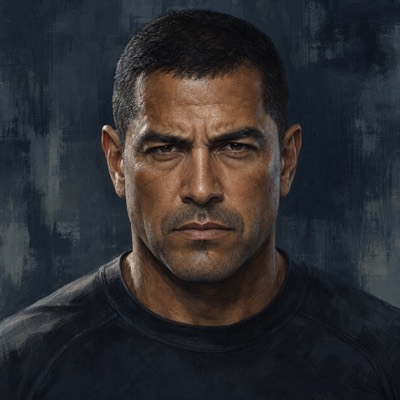
Domingo "Ding" Chavez — Character Arc
Played by Michael Peña · Season 4 + Ghost War
A paramilitary officer who followed orders for fourteen months and came back carrying seven graves and a mission no one officially sanctioned.
Played by Michael Peña · Season 4 + Ghost War · Tom Clancy’s Jack Ryan (Prime Video)
Who Chavez was when introduced (S4)
Season 4 opens with a file, not a face. Jack Ryan pulls Domingo Chavez’s name from Pluto’s mission logs — it appears on every operation, which is itself the problem. When Chavez finally surfaces in Episode 2, he introduces himself by pointing a gun at Jack’s head in the dark of Jack’s own apartment. He is not a villain making an entrance. He is a CIA paramilitary operations officer who spent fourteen months embedded in the Marquez cartel through his cousin Marin, believing he was running a sanctioned black-ops chain designed to eliminate cartel competition. Seven of his men are dead. He thinks Jack shut the operation down and got them killed. That is the ground floor: Chavez arrives as grief wearing a tactical vest, demanding that someone with authority admit what was done with his team.
Season 4 — The Instrument Learns Who Pulled the Trigger
The turning point that reshapes Chavez from a threat into a partner is not a speech. It is a piece of paper. When Jack shows him Miller’s signature running through every Pluto file, Chavez goes quiet in a way that reads differently from rage. He already suspects the operation was dirty — Chao Fah Sein told him months ago that whoever was running them in Washington was in the triad’s pocket — but he has been working from Chao Fah’s word against his own instincts about the chain of command. Miller’s name on the page gives the betrayal a face.
What Chavez does with that knowledge in Episode 2’s confrontation scene draws the clearest line through his character. He doesn’t hand the evidence to Jack. He goes to Miller directly, with photographs of his seven dead teammates. He tells Miller to read their names. When Miller hesitates, Chavez tells him he doesn’t deserve to touch them. This is Chavez’s morality in its clearest form: accountability is not a bureaucratic outcome. It is a thing done in a room, face to face, where the man responsible has to hear the names spoken.
Episode 3 moves Chavez from lone operator to reluctant team member. Jack finds him at his uncle’s house in Central California — field craft built from a tattoo tracing back to church records, not databases. A quiet family dinner with Chavez warning his tio that cartel people may come looking through family signals the reason he went dark: he is protecting the people he still has. He agrees to Jack’s plan not because Jack persuades him, but because burning every rung of Pluto’s ladder is what he was already planning. Jack just provides resources.
The Mexico port raid is Chavez’s most controlled and most personal scene. When Marin, cornered after the Navy seizure, invokes Chavez’s father as leverage, Chavez answers with the line that cuts deepest into his biography: “I don’t have many memories of him, and those that I do, I wish to forget.” The lineage he cares about is not blood. It is the seven teammates who are no longer alive. His anger nearly breaks the interrogation, but he holds, because the next address — Dubrovnik, Josip Olafsky’s private marketplace — matters more than scoring right now. Episodes 4 and 5 follow that logic: Chavez is the operational calculation while Jack runs institutional pressure. When Chao Fah’s defection finally tips the balance in Episode 5, Chavez’s read is flat and immediate — “Well, I’d say Chao Fah just gave us the upper hand” — with no ceremony attached.
The Season 4 finale closes with a rare still moment. Jack has been labeled a liability by the Senate committee. Standing in the aftermath of everything they burned down together, Chavez tells him not to take a break: “What kind of defeatist shit is that?” It is the closest Chavez gets to a declaration of loyalty in four episodes, delivered like a mild complaint. When Jack says he’ll see him around campus, Chavez watches him go and says nothing more. The partnership worked. It also cost both men things they are not discussing yet.
Ghost War — The Name on the Roster
In Ghost War, Chavez is a small presence inside a story that has moved its weight onto Jack, Greer, and the Starling legacy. He appears on the margins of the operation — the existing Ghost War review notes he is “not a meaningful part of the story on screen” — but his presence still registers as continuity. He is the indicator that Jack’s post-Season 4 world has left him somewhere adjacent to the official machinery, available to be called but not central to the mission Crown has engineered. Ghost War belongs to Greer’s guilt and Jack’s resistance to being pulled back in. Chavez’s reduced role in that story reflects the movie’s deliberate narrowing: the Starling thread is about the men who built it and the men who were shaped by it, and Chavez is neither. He belongs to Jack’s more recent history.
Who Chavez is right now (after Ghost War)
Chavez ends Ghost War as a man without a clean institutional address. Season 4 cleared his name but cost him the operation he built, the men he served with, and his working relationship with the cartel network that was also his cover. Ghost War confirms he has remained close enough to the field to be placed in proximity to Jack’s missions, but not close enough to carry one.
What the show has established about Chavez across both installments is simpler and more durable than any mission brief: he measures loyalty in dead weight. His seven teammates are not motivation in the abstract — they are specific people whose names he forced a former CIA director to hear aloud. He does not trust institutions because institutions told him his mission was clean. He trusts people who have shown they will not look away from the actual cost.
That moral grammar means Chavez functions best when the operation has a human center. Chao Fah was the center in Season 4. Jack is something more complicated — not a target, not exactly a friend, but someone whose methods and his own produced the same outcome when they ran together. At the end of Ghost War, Chavez is still circling the same old question the series keeps handing its field officers: whether an instrument can survive knowing how it has been used.
The answer, for Chavez, seems to be: only if you keep count of the names.