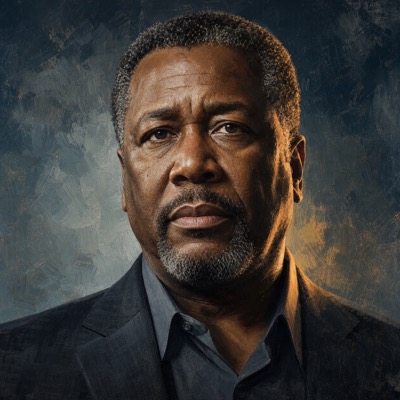
James Greer — Character Arc
Played by Wendell Pierce · Seasons 1-4 + Ghost War
A Muslim convert, former Marine, and failed station chief who spent four seasons learning that power costs exactly as much as he always knew it would.
Played by Wendell Pierce · Seasons 1-4 + Ghost War · Tom Clancy’s Jack Ryan (Prime Video)
Who Greer was at the start
James Greer arrives at T-FAD carrying the wreckage of Karachi. He had been chief of station before something went wrong and Langley pulled him back. His supervisor calls T-FAD a “second chance,” then adds that not many people on that floor thought he deserved even that. Greer still wears his wedding ring though Jasmine is already at her lawyer’s. He tells Jack he is happy to be in one place for a while. He means it, and he is lying to himself. His job is to manage analysts; his instinct is to run operations. The gap between those two things is where Wendell Pierce builds everything that follows.
Season 1 — Exile and Reentry
Greer’s first act as group chief is his first admission: he introduces himself to T-FAD by noting he was chief of station in Karachi, and the information lands in the silence before he moves on. Pierce plays the reference as a man keeping a door shut.
What forces it open is Jack. The two argue constantly — Greer thinks Jack is reckless, Jack thinks Greer is hiding behind a desk — and both are right. When the Suleiman operation accelerates, Greer goes into the field rather than stay behind. His supervisor later praises the transfer to Moscow deputy chief of station as “a great job for him,” which is technically accurate and diplomatically opaque.
His parting scene with Jack is the season’s clearest window into his faith. He went to pray for the first time in a long time, he says, and it was good. He quotes the Prophet: “No man is a true believer unless he desires for his brother that which he desires for himself.” He delivers it as information rather than counsel — a man processing something he nearly lost. He heads to Moscow deputy chief of station with a faith partially reclaimed.
Season 2 — Capture and the Prayer That Held
Venezuela breaks him, then does not.
When the operation collapses, Greer is taken and held in a jungle camp, beaten by guards who are corrected by Reyes — not because the abuse is wrong, but because Greer is valuable leverage. His heart condition becomes urgent. The camp gives Pierce very little dialogue, and he uses the silence precisely.
The turning point comes in a cell late in Episode 7. After the violence and the isolation, Greer begins to pray. “Allahu Akbar,” then Arabic, then silence, then again. The camera does not cut away. His faith is not invoked as comfort or plot device — it is what a man who converted and means it does when there is nothing else. The prayer holds.
When Jack reaches him in Episode 8, Greer is barely upright. He calls Jack “fucked in the head” as a greeting. Jack jokes he still has time to leave him behind. Pierce and John Krasinski let exhaustion sit underneath the banter — men using irritation to avoid naming fear.
On the boat afterward, Greer tells Jack he used to be able to read a room so precisely he could sense a sweat response before it arrived. He says that is gone. He is handing Jack the field, not giving up on the work.
Season 3 — The Office, Which Is Also the Operations Room
Greer is Deputy Director of Operations. He has institutional authority and a partnership with Elizabeth Wright built on competence rather than proximity. He tells Jack he plans to keep his head down, earn out, and retire. Jack knows he is wrong before Greer does.
The turning point in Episode 1 is low-key and load-bearing. Jack shows Greer the TracEuro financial transactions, and Greer’s first move is muscle memory: he recognizes the app because they used it in Karachi. The reference no longer arrives as confession — it is just data, integrated without self-consciousness. He has absorbed the failure rather than walling it off. When Jack’s freelancing on the Sokol Project strains the sanctioned operation, Greer works the institutional side without abandoning him. He is most useful as someone who can price both the desk and the field accurately, and has no illusions about either.
Season 4 — Acting Director
Wright becomes Acting Director after Director Miller’s removal. Greer becomes Deputy Director — she tells him to stop calling her “ma’am” in the same breath as the congratulations. When Wright is consumed by Senate confirmation hearings, Greer holds the operational side as the Mexican cartel threat widens.
His clearest moment comes in the Senate hearing sequence in Episode 6, confronting a senator whose greed let the cartel operation survive inside the agency’s blind spots. “And I pray to God,” Greer says, “that you were ignorant to her greater ambition.” The language of prayer arrives here as it did in the Venezuela cell — not as ornamentation but as the vocabulary he reaches for when something actually matters. He tells the senator that blindness of that magnitude is as good as pulling the trigger. The gallery murmurs. Greer does not adjust the statement.
When Wright’s confirmation is secured, his tenure ends. He held the agency through a domestic penetration threat without requiring the center to collapse. He did it from behind a desk. He has made peace with what a desk can do.
Ghost War — Faith in the Light
Greer is Director of the CIA. A funeral mid-film places him at a graveside on a call from the agency; the man beside him says she was the light in the darkness. Greer absorbs it.
When a foreign intelligence operative tests whether institutional years have cost him the capacity for direct action, Greer answers with the vocabulary he reaches for when something matters: “I will always have faith in the light. Faith in the men and women who hold the spears, the ones who are brave enough to poke holes in the dark.” The operative says he got Greer wrong. Greer does not argue.
Who Greer is right now (after Ghost War)
His final scene is characteristically dry. He recommends Jack as deputy director to the President, then finds him in a corridor: “You know, you really should quit.” Jack: “So should you.”
Neither of them will. Pierce has earned the right to make that point without fanfare. Greer has been a Marine, a convert, a fallen station chief, a T-FAD exile who quoted the Prophet to an analyst heading to Moscow, a Venezuelan hostage who prayed in Arabic while beaten, a DDO who folded Karachi into analysis without flinching, an Acting Director who told a senator that blindness in service of greed is as good as pulling the trigger. He is at the top of the institution he spent four seasons being reassigned away from. He is standing next to the man he recruited, suggesting they both might stop, knowing they will not — the only kind of faith the show has ever let him state plainly.