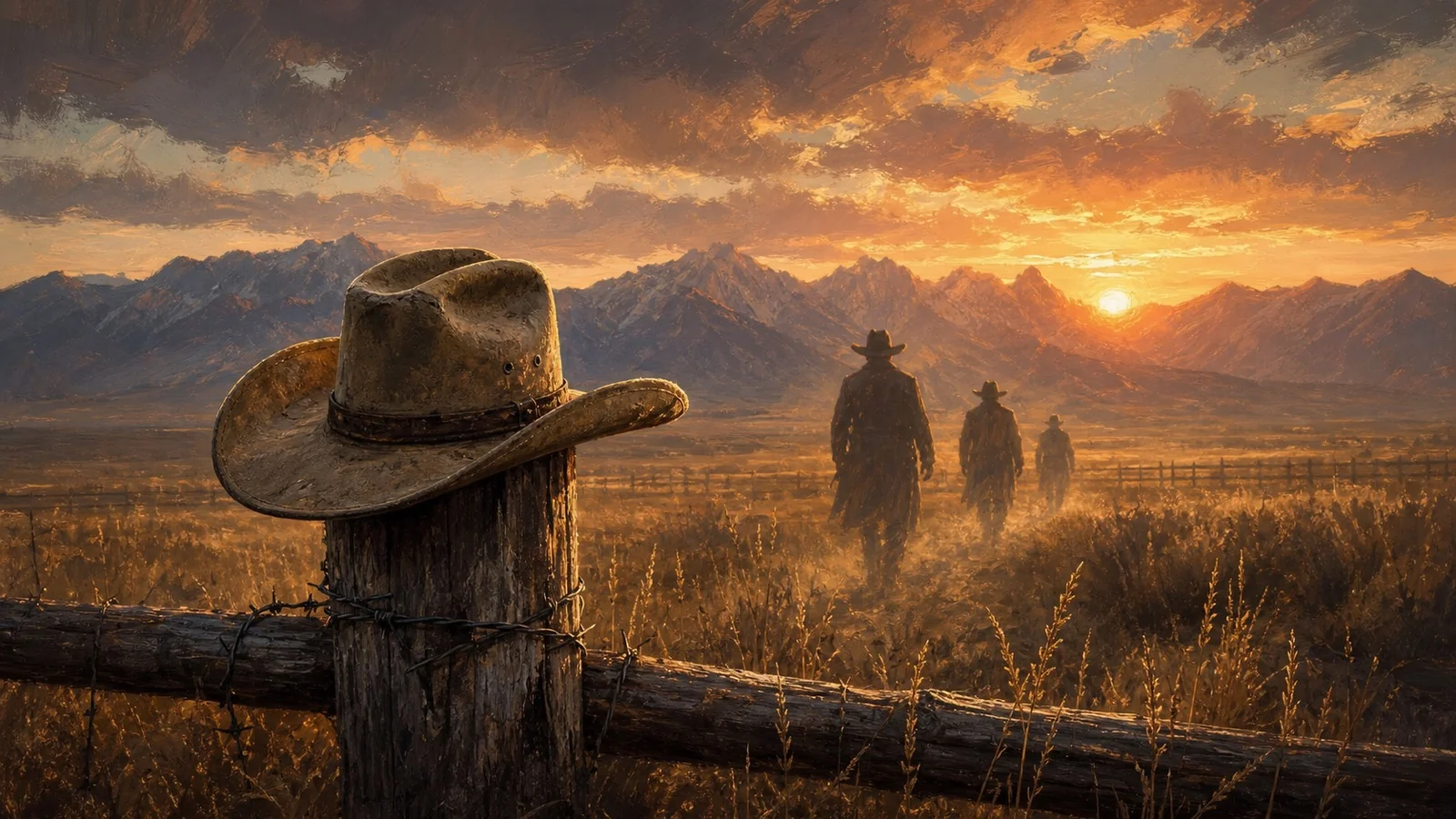
Spencer to John Dutton: The 100-Year Bridge
The land did not pass clean. Every generation of Dutton men paid a price to hold it, and the ledger only closed when no son was left to carry it.
The Yellowstone spans a hundred years of screen time and never quite explains how the ranch got from Spencer Dutton in 1923 to John Dutton III in 2018. That is not an omission — it is the design. What you cannot fully account for, you cannot easily give away. John III spent five seasons fighting to keep the Yellowstone in Dutton hands without knowing what Jacob Dutton endured to make that possible, without knowing that John Dutton Sr. (1923) died on a road in Montana before his boy could walk, without knowing that the name he carried was given to a child by a woman who did not survive the birth.
This is what the chain looked like up close.
Spencer’s choice — return when leaving was safer
Brandon Sklenar plays Spencer Dutton as a man who has made the sensible calculation: East Africa gives him purpose without obligation. He earns a living hunting what kills people — a cleaner arrangement than the ranch, which asks you to kill for it indefinitely, with no ceiling and no contract.
Cara’s letters break the geometry. She does not write to shame him. When Spencer reads her account of the Banner Creighton ambush — Jacob shot, several hands dead — he does not move immediately. He orders another drink. The pause is the character: once he decides to move toward Montana, Africa ends. He knows that before he moves.
What delays him further is Donald Whitfield’s legal interference, which strands Spencer and Alexandra on the wrong side of the Atlantic. He cannot buy passage; the paperwork has been engineered against him. Two oceans between a man and his blood, with lawyers standing in the gap.
When he arrives in S2E07, the Yellowstone is under gunfire. There is no homecoming score, no family on a porch. Cara’s first words after the shooting stops: “Dang it, Spencer, I didn’t even get to fire a shot.” His answer to where Jacob is: “He’s at the hospital. With my wife.” The reunion is all shorthand — the register of people who do not have time for the reunion they earned.
Alexandra says it plain before he arrives: “War is what you came home for.” He went home because Cara wrote him and because returning — late, dirty, carrying a marriage nobody had met — was the thing the Dutton men do when the land calls. James Dutton came west for much the same reason. Each generation acts like the choice is new.
John Sr. and the holdover generation
John Dutton Sr. (1923) dies in the third episode of 1923, shot in a road ambush arranged by Banner Creighton’s men. James Badge Dale plays him as the man the entire Dutton project was building toward — steady, unhurried, already fluent in the ranch’s actual demands rather than its mythology. Cara Dutton names him exactly in S1E02: “John is the most deliberate man I’ve ever met.” She means he does not mistake urgency for wisdom. The show gives him that quality and then takes him before it can develop.
His death is structural, not dramatic. Creighton’s men understand that continuity lives in the quietest people, not the loudest ones. Jacob is the patriarch and will survive the season. Spencer is the warrior and will return. John Sr. is the spine — the working link between the generation that built the ranch and the generation that will inherit it. Kill the spine and the rest of the body has to find new alignment.
What survives him is a name. Emma, refusing surgery and facing her own death in childbirth later that same season, names the boy she chooses to deliver: “I’m going to name him John. After his brother.” The response from the attending — “He’d like that. But he’d like a world you’re still in more” — is the only tenderness the show allows the moment before it moves on.
That child — John Dutton, the second — becomes the first link across the franchise’s long gap. He is born into a ranch still contested, to a mother who will not survive to raise him, in a year when the patriarch has been shot and the most dangerous nephew only just arrived from Africa. He inherits nothing clean. He inherits a name that already cost two lives and a family that has learned to carry casualties the way other families carry heirlooms.
Jacob and Spencer hold the ranch through the 1920s range war. Jack Dutton, John Sr.’s firstborn, carries it into the generation that bridges the gap years. The exact line to John III remains deliberately unresolved, but the principle holds: “John Dutton III descends from the surviving Dutton line after the 1883 settlement and 1923 range war.” You do not need to know precisely which branch carried the name. You can feel the weight of it.
John III inherits the ledger
Kevin Costner walks into S1E01 of Yellowstone already behind. He puts a dying horse down at first light, alone, without ceremony, before the first line of dialogue — a man who understands mercy as mastery, who will extend the same precision to everything he loves before the show ends.
He is fifth generation on the Yellowstone. In S5E01 he tells his children what that means: “We measure every decision against what is good for the ranch. The ranch comes first. Do you understand me?” He ran for Governor as a weapon for the land. The voters got a rancher; the ranch got a signing pen in the executive office.
What John III inherits from the 1923 generation is not land but method. Jacob Dutton’s method — Harrison Ford plays him as the patriarch who ran the ranch the way a man holds a wound, tight and constant — absorb the casualties, hold the line, outlast the next enemy. The enemy in 2018 files injunctions rather than drawing rifles, but the arithmetic is identical — someone always wants the Yellowstone, and keeping it requires spending something you cannot replace. John’s ledger includes a firstborn son dead in S1, an adopted son who orders his murder, a daughter he turned into a weapon, and a son who came back from war unable to explain what the coming back cost.
His answer to the development threat is Jacob’s answer updated for the century: you do not beat the political class at its own game, you become it. The move works until it stops working. “All I have ever tried to do is protect this family. Most of the time, from itself.” He says this in S3E06 as confession and indictment simultaneously. He has been accurate on the protection. It is not enough.
The S5E14 succession crisis
John Dutton III is murdered before the final season ends. What follows in the last episode is the franchise’s most honest accounting of what the male line actually accomplished: Kayce and Beth are left to do the one thing John never could.
Thomas Rainwater arrives at the ranch with the only deal that works. The inheritance tax on the Yellowstone is beyond what any Dutton heir can pay. Corporations have the money, but as Rainwater says in S5E14: “Only corporations have the money to buy your land. And then it is land no more. Subdivisions, shopping centers and condos, airports and ski resorts. Everything they flee they will recreate on your land.” There is only one alternative.
His terms are $1.25 an acre — the original government price when the land was taken from Rainwater’s people — with two conditions: the Dutton family keeps East Camp, and the reservation can never develop or sell the Yellowstone. “Your people are buried in that land and so are mine. It is sacred. And that’s how we will treat it.”
Kayce takes the deal to Beth. Beth is okay with it.
Rainwater closes with the most unsentimental summary the show manages: “I made a promise to your father once that I would one day have this land. I’m sure he took it as a threat. And at the time, that’s how I meant it.” He meant it as a threat for thirty years. What changed was not sentiment but the arithmetic of what sacred means and who is equipped to hold it.
John spent five decades fighting to keep the Yellowstone in Dutton hands. His children kept it by giving it away. He would have hated it. It was probably the only correct answer left.
What the male line stops carrying
The chain breaks at John III. Not because he failed the ranch — he held it against enemies who should have won three times. It breaks because the method ran out of road. You can only spend so many people before the family itself is the casualty. Lee is gone. Jamie is excised. Kayce has his own land, a vision that told him the ranch and his family were two different choices. John made the ranch the answer to every question. His children learned to ask different ones.
What Beth Dutton and Carter inherit is not the Yellowstone — that goes to the reservation, correctly, at a price that acknowledges the original taking. What they inherit is the Dutton instinct stripped of its anchor: the willingness to hold something past the point where anyone else would let go, to absorb damage that would break a different family. Beth carries this without acreage. In Dutton Ranch she and Rip are testing whether the instinct survives when the enemies are new and the name means nothing yet.
Spencer returned from Africa because Cara’s letters made return feel survivable. John III held the Yellowstone because he had no language for letting it go. Beth releases it because she has always known, better than her father, that the Dutton thing was never really about the acreage.
Jacob could have told him that. “He holds the ranch the way a man holds a wound — tight, because loosening it would kill him.” That description fits every man in the chain from Spencer crossing two continents to John putting a horse down in the dark. What Beth does at the end is the harder version: she loosens the hold deliberately, and survives.