Bridgerton S02E7 Recap: "Harmony" — Everyone Pays for Silence
What happens — the short version (spoilers)
- Violet and Lady Danbury march the Bridgertons and Sharmas into public with a story of mutual understanding.
- Queen Charlotte accuses Eloise of being Lady Whistledown and gives her three days before royal punishment.
- Penelope considers turning herself in, then decides Whistledown must wound Eloise to make the Queen doubt the accusation.
- Mary admits Kate carried too much after Appa died, while Edwina asks whether Kate ever believed in happy endings.
- Whistledown publishes Eloise's association with political radicals, emptying Violet's harmony ball of any public victory.
- Anthony and Kate kiss after he says he wants to run away with her; by morning, Kate has ridden into the storm and fallen.
After one ruined wedding, the Bridgertons and Sharmas try to smile their way through disgrace while every private longing starts collecting interest.
Bridgerton, Season 2, Episode 7 — “Harmony” Netflix
London wakes up ravenous.
Edwina has walked away from the altar. Anthony has become a jilted groom in public and a man cornered by his own feelings in private. Kate has kissed the man her sister meant to marry, then gone back to breathing as if lily soap can quiet a heart that knows exactly what happened.
It cannot.
That is the trouble with “Harmony.” Everyone knows the correct notes. Violet and Lady Danbury know the story that must be told. Anthony knows the duty he keeps choosing. Kate knows the apology she owes. Penelope knows what Eloise does not. Edwina knows more than anyone hoped she would.
Everyone has become fluent in silence, and silence has finally turned expensive.
Violet and Lady Danbury send the Bridgertons and Sharmas into public
Violet’s morning plan is pure Mayfair survival: everyone will promenade together, look respectable, and repeat the same explanation until society grows bored. The wedding ended because of a “mutual understanding” between Edwina and Anthony. No scandal. No ill will. No open wound for the ton to poke with a gloved finger.
The children are not quite sold.
Eloise asks if all this is truly happening because a woman changed her mind. Benedict reaches for a cake joke because someone in the room has to act like a brother. Anthony arrives late and raw, and one sour comment from Eloise about a respectable family needing a gentleman at its head catches him where he is already bleeding.
Still, the families go out.
Lady Danbury calls it “straight into the fire,” which is correct and also a little generous. Fire has warmth. The promenade has people turning their backs in broad daylight.
Lady Danbury and Violet choose dignity as their weapon, but the ton refuses to be conquered politely. Lord Fife can barely hide his appetite. Miss Patridge is hurried away. Lady Featherington offers sympathy sharpened into performance, reminding Violet of Colin’s broken engagement to Marina.
Edwina notices everything. She is not a fainting almost-bride waiting to be managed. When the families decide a ball might prove there is no bitterness between them, Edwina cuts straight through the lace: Anthony and Kate have been so good at hiding their feelings in public that hiding them a little longer should not trouble them.
Queen Charlotte accuses Eloise of being Lady Whistledown
Eloise says she is shopping for gloves.
Instead, Queen Charlotte has her intercepted in a carriage and goes straight for the throat. Eloise visited the printer shop during Anthony’s wedding, and Her Majesty has decided that the answer is obvious: Eloise must be Lady Whistledown.
The accusation is absurd. It is also dangerous.
Queen Charlotte builds a case out of Eloise’s behavior, her disdain for society, and the convenient fact that Whistledown rarely targets her. Even Eloise’s failure to identify the writer last season now looks, to the Queen, like strategy. Eloise tries denial. The Queen hears rivalry.
Whistledown could become an ally to the Crown. Eloise, if she were sensible, could use the paper for royal purposes instead of ridicule and gossip. If she refuses, Queen Charlotte gives her three days before she uses her resources to crush her “like a serpent.”
Eloise has spent the season desperate for a life larger than balls and dance cards. Now power arrives in the ugliest possible costume.
She runs to Penelope in a panic. Eloise has kept every issue of Whistledown, two copies each, and suddenly that devotion looks like evidence. She worries about Theo too, because the palace has seen enough of him to make him vulnerable.
Penelope tells her to stay away from Theo and wait for Whistledown to publish again. If the real writer prints, Eloise can prove she is innocent.
It is sensible advice from the guilty person in the room.
That makes it cruel before Penelope has even decided how cruel she is willing to be.
Penelope looks for a way to save Eloise
Penelope’s visit to Madame Delacroix turns private guilt into business risk.
Her Majesty is involved now. The dressmaker did not sign up to help a gossip writer pick a fight with the Queen of England. Penelope reminds her that both of their businesses have profited, but profit does not make a royal threat easier to swallow.
Then Penelope admits the thing she usually keeps hidden under calculation: “I do not know what to do.”
Her best friend is in trouble because of her. Eloise could be ruined. The Bridgertons could be punished. Madame Delacroix offers the clean answer Penelope cannot take easily: turn herself in.
Penelope knows the Queen may not believe her. She would look like a loyal friend making a desperate confession.
So Madame Delacroix gives her the uglier answer.
A lady would never wear a dress she knows makes her look hideous. By the same logic, Eloise would never write something about herself that damaged her own reputation. If Whistledown wounds Eloise, perhaps the Queen will stop believing Eloise is Whistledown.
Penelope says she could never ruin her friend.
She means it when she says it. That is the misery of the choice. Penelope sees the door, hates the door, and later walks through it because Eloise is preparing to do something even more reckless.
Eloise plans to confess falsely. She will publish a counterfeit Whistledown paper, give the Queen the ally she wants, buy time, and then hunt down the real writer. She thanks Penelope for being loyal in every circumstance.
Penelope receives the gratitude like a sentence.
Anthony apologizes to Lady Mary while Edwina confronts Kate
Anthony tries, in his stiff and wounded way, to behave decently.
At the public rooms, Anthony approaches Lady Mary and apologizes. He says he never intended to cause her family such strife. Lady Mary could have scorched him. Instead, she lets honesty into the conversation.
She has been absent too long.
When her husband died, Mary says, she should have taken on the family’s burden. Kate carried too much for them. Mary finally names the cost, even if Kate is not there to receive it.
Edwina is receiving costs of her own.
She and Kate stand together while the story about the wedding spreads. Kate asks what it will take for Edwina to forgive her. She says she will apologize every day if she must. Edwina does not soften. She remembers the books Kate read to her from Appa’s library, the true love stories, the happy endings against all odds.
Then she asks the question Kate cannot dodge: did Kate ever believe those stories, or was everything a lie?
Kate says she believes in true love and happy endings because she saw Appa and Mama. Edwina answers with the part Kate never let herself dwell on: even that love ended in tragedy.
“Happy endings do not exist, Kate,” Edwina says. “At least not in real life.”
That is not childish bitterness. It is a young woman trying to build a self from the wreckage of the self everyone else arranged for her. Edwina was told to trust Kate, Anthony, the rules of courtship, the Queen’s favor, and her own role as diamond. Every one of those promises cracked in public.
So when Anthony finds Kate alone and says they kissed, Kate refuses the truth out loud. “We did not.” Nothing happened. Nothing could have happened. He was her sister’s intended. There is no world in which they could kiss.
Kate is not lying because she believes it. She is lying because if she says the truth, Edwina’s ruined wedding becomes only the beginning.
Lady Whistledown empties Violet’s harmony ball
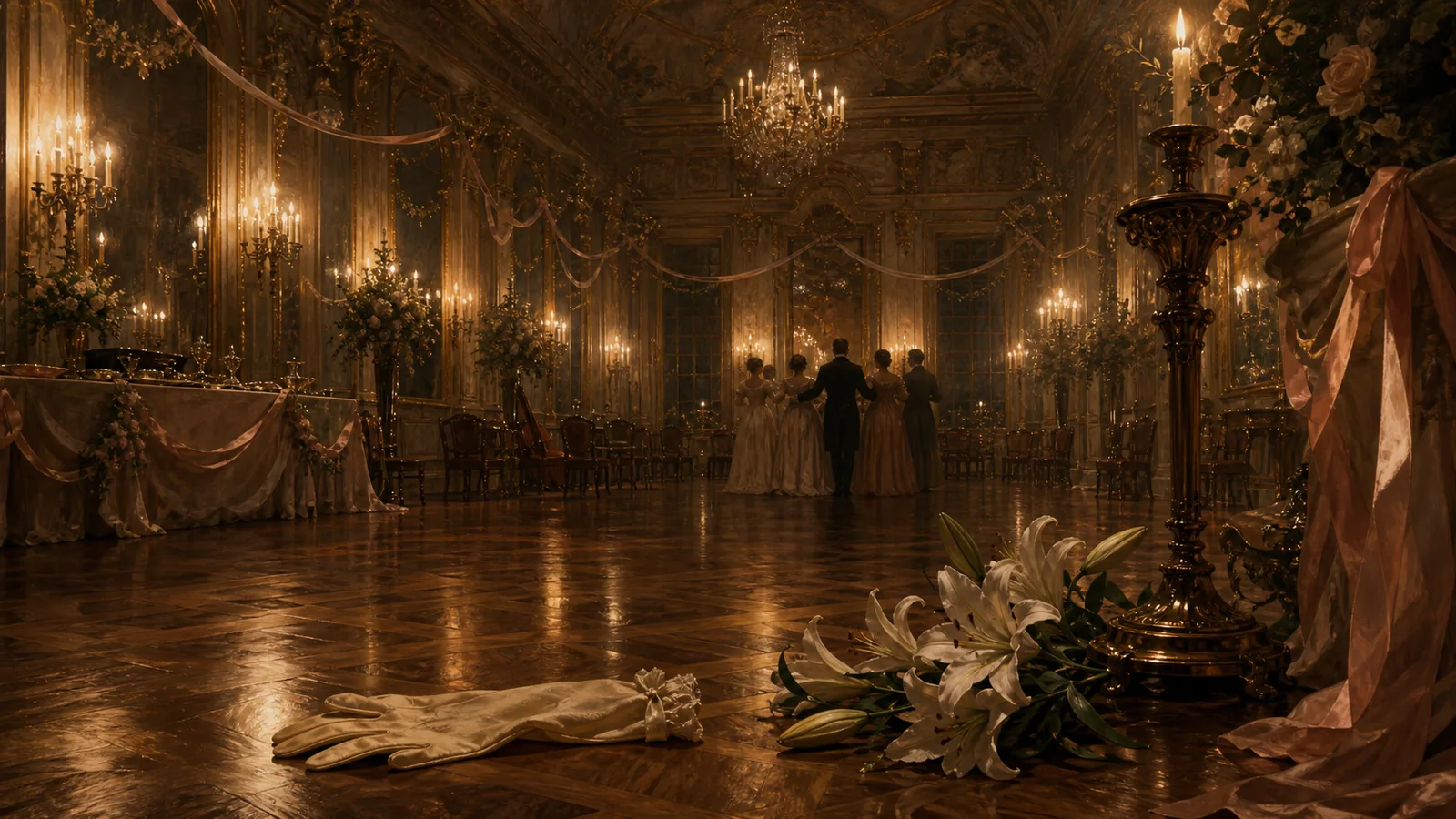
Violet’s ball is supposed to be the cure.
The theme is harmony. The invitations go out. The family is drilled into cheerful unity. Daphne cannot attend because Augie is still coughing, but Violet pushes on.
Then no one comes.
For a moment, the emptiness is almost funny. All that food, all that music, all that effort, and the ton has decided absence will speak louder than attendance. Benedict tries to escape to his studio. Anthony stops him and insists there will be dancing.
Hyacinth gets pulled downstairs, Gregory wants his turn, Lady Danbury claims Benedict, and the room finally fills with laughter. The dance is not successful as strategy. It is successful as family.
Then Whistledown arrives.
Penelope’s paper does what Madame Delacroix suggested. It names Eloise as a young woman associating, unchaperoned, with improper company: political radicals. It is not a confession. It is a wound placed carefully enough to make Eloise look unlike Whistledown and damaged enough to make the Queen reconsider.
Violet reads it in horror. Eloise hears her life change in front of the people who love her. Across the street, Lady Featherington is delighted because the Bridgertons’ disgrace gives her the opening she wants. She tells Jack to seal the agreement with Colin.
Penelope saves Eloise from one danger by feeding her to another.
There is no neat moral escape here. Eloise was about to confess to something she did not do and become the Queen’s puppet. Penelope stops that. She also betrays her friend in print, using the secret Eloise trusted her with.
Harmony, indeed.
Anthony and Kate stop denying what happened
After the failed ball, Edwina asks to go home. Kate reaches for tenderness and gets the answer she has earned. Edwina says Kate does not truly care what she wants. When Kate calls that cruelty, Edwina refuses the accusation.
“Do not dare try to make me out to be the cruel one.”
Edwina may not know who she truly is yet, but she knows she is kinder-hearted than Kate. Her anger comes from love curdled by humiliation. Kate is devastated, and Edwina is not wrong to be furious. The sisters have been living inside the same sacrifice from opposite ends.
Kate goes outside. Anthony follows.
Of course they argue.
They argue because arguing is the only language they have allowed themselves in public. He calls her obstinate, inflexible, unyielding. She throws the same energy back at him: he is a man used to getting his way and giving orders.
Anthony finally says what he has been swallowing. He has never met anyone like her. It is maddening how much she consumes him. His family is on the brink of ruin, he believes his siblings and mother despise him, he has lived so much of his life for them, and still all he can think about and breathe for is Kate.
Kate tries to stop him.
He keeps going. He wants to be nowhere except with her. He wants to run away with her. He names the forbidden desire, then the scent that has stayed with him since the conservatory terrace.
“Lilies.”
That one word reaches back to Kate’s bath at the start, to the soap meant to calm her nerves, to the proof that neither of them has forgotten a single dangerous detail.
Kate tells him he must stop. Kate insists her choices have been for her family. Anthony knows that defense.
Then he asks the question both of them have avoided: before what? Before they both finally do something for themselves?
They kiss. Anthony says he will stop. Kate says, “Do not stop.”
By morning, Anthony is at Lady Danbury’s door asking for Kate. She is gone, and so is one of the horses. The storm has not passed. He rides out after her, finds her in the rain, and calls her name just before the horse rears and Kate falls.
For once, denial is useless.
Verdict
“Harmony” is a strong penultimate episode because the romance and the scandal wound each other instead of competing for space. The Bridgerton family dance in the empty ballroom is sweet enough to hurt. Penelope’s choice is ugly without being simple. Edwina’s anger has the clarity everyone else has been avoiding.
The Featherington mine scheme has less pull beside Kate, Anthony, Edwina, Eloise, and Penelope. Even there, Colin’s trust gives Penelope another pressure point. Kate and Anthony carry the final stretch: longing, guilt, family duty, reputation, and one whispered “Lilies” all tightening into a cliffhanger that feels earned.
Rating: 8.7/10
More episodes from Bridgerton — Season 2 — Anthony and Kate's enemies-to-lovers season, episode by episode. Jump to any episode in the season:
Where to go next
Reviewed by Mira Vance · QuizFandom Editor & Lead Reviewer. Every rating is an honest per-watch assessment from the desk that also writes the quizzes — not a press release rehash.