Dutton Ranch S1E1 Review: Beth and Rip Trade Montana for Texas Ash
Dutton Ranch, Season 1, Episode 1 — “The Untold Want” Paramount+
Dutton Ranch opens not with fire but with the memory of it. Before the title card, Beth (Kelly Reilly) and Rip (Cole Hauser) are on horseback in morning light that looks like Montana without being Montana. “Did you ever imagine that we could have this?” Beth asks. “This quiet?” Rip answers plainly: “Nah, not in this lifetime.” Then the storm rolls in, the barn catches, and the quiet is already gone before the premiere has its footing. That exchange is the whole pilot in thirty words. Two people who have only ever lived inside emergency trying to learn, badly, what peace feels like — and Texas deciding immediately that it doesn’t owe them any.
The Fire and What It Strips Away
The episode’s first act belongs to the wildfire that takes the barn and scatters the herd on the first full day at the Edwards Ranch — now the Dutton Ranch. Rip is cutting fences to push cattle out of the burn path while Beth shouts for Carter (Finn Little). The scene is not about catastrophe; it is about reflex. These three people respond to emergency with the particular efficiency of people who have never been allowed to be slow. Carter grabs what he can in ninety seconds without asking why. Rip doesn’t waste breath on panic. Beth calls the play and moves.
What matters more is the aftermath. Standing in the ruin of a barn they don’t yet know how to love, Beth says: “It doesn’t matter. We start again.” Then, quieter: “I’m sorry. I’m sorry.” The apology is not for the fire. It is for bringing them here, for wanting something and asking them to want it with her. That is a new register for Beth Dutton — accountability without the weapon drawn. The premiere is smart to let it land and move on without explaining it.
Beth Learns Texas Is Not a Metaphor
The middle of the episode is built around Beth establishing the ranch’s commercial footing in a county that has already decided who it belongs to. At the local slaughterhouse she runs into owner Beulah Jackson, who tells her that every cow processed there comes from one ranch and the Dutton name isn’t on the calendar. Beth’s response is what it always is: she finds the pressure point fast. When Beulah offers to fit her in — but only if Beth hands over a cut of the profits until she reaches 150 head — Beth gives the line back without heat: “From my fucking cows?… Well, there’s a word for that. Extortion.” Beulah doesn’t back down. Beth leaves.
It is a minor exchange in terms of plot and a major one in terms of character. Beth spent five seasons running leverage campaigns in Billings boardrooms and Yellowstone-adjacent political offices. She understood exactly how Montana power worked because she had studied it from childhood. Texas is different. The money runs through families she doesn’t know yet, through ranching operations that have been here long enough to treat newcomers as problems to be priced out rather than threats to be fought. She wins the fight on her terms — she has a Monday slot by the end of the hour — but she wins it small. The premiere understands that Beth arriving in Texas as the smartest person in the room is not the same as Beth arriving with home-field advantage.
Rip and the 10-Petal Problem
Rip’s primary plot line involves a rival operation — the 10-Petal Ranch — that has cornered the local labor market and is running something off-books through a foreman named Rob-Will. The first scene that establishes the threat is quiet and ugly: Rob-Will lures a hand named Wes out to a dark field on the pretext of a breeched heifer, confronts him about asking questions regarding the tally books, and shoots him when Wes hesitates to answer. “He hesitated,” Rob-Will tells his brother Chet. “You never hesitate.” It is the premiere’s clearest statement of how this corner of Texas operates — not as frontier violence but as the maintenance of a closed system.
Rip doesn’t know any of this yet. What he finds is that the hands still available are already politically entangled. His new hand Azul is the exception: a foreman’s son born to the land, whose loyalty runs deeper than any single paycheck. When a man outside a gas station makes a racial slur at Azul, Rip takes the hit rather than escalate — he tells the man he gets that one for free, the next one costs him, and walks Azul to the truck. He tells Azul afterward: “I don’t like racist assholes.” Azul answers in Spanish. Rip: “I don’t speak fucking Spanish, Azul.” Azul: “Means ‘me neither,’ boss.” It is the episode’s one clean joke, and it does what good exchanges in this universe do — it defines a working relationship without sentimentalizing it. By the end of the hour Rip is already thinking about putting Azul forward as foreman, closing the circle on a labor problem with the most obvious answer the premiere gave him.
Carter Finds His Own Ground
Carter’s thread is the lightest of the three and also the most honest about where his story is going. He is nineteen, doing ranch math under Beth’s pointed instruction — she is teaching him feed costs and fencing ROI using the slope-intercept formula as entry point — attending a rodeo where a girl named Cassie is already threading him toward something he doesn’t know how to read, and ending the night in a county jail after stepping in front of a man hitting a woman outside the arena.
The sheriff who releases him says: “I don’t mind a little roughhousing around here. Sometimes folks got to learn where common sense ends and a fist begins.” Carter: “I was protecting a girl.” Sheriff: “Well, I guess there’s worse reasons to take a swing.” Carter walks out to find not Cassie but Oreana — the woman he defended — waiting with his hat. She told the sheriff Carter saved her. She bailed him out. “I’m Oreana,” she says. Carter had the name wrong. The episode leaves him with a girl he barely knows who may be attached to the same network that already killed Wes.
What the premiere establishes is not new information — Carter’s character files from Yellowstone already told us who he is — but the texture is different here. In Montana he was the boy proving himself to people who were always watching for failure. In Texas he is nineteen and nobody knows his history. That is both dangerous and the first genuine freedom he has ever had.
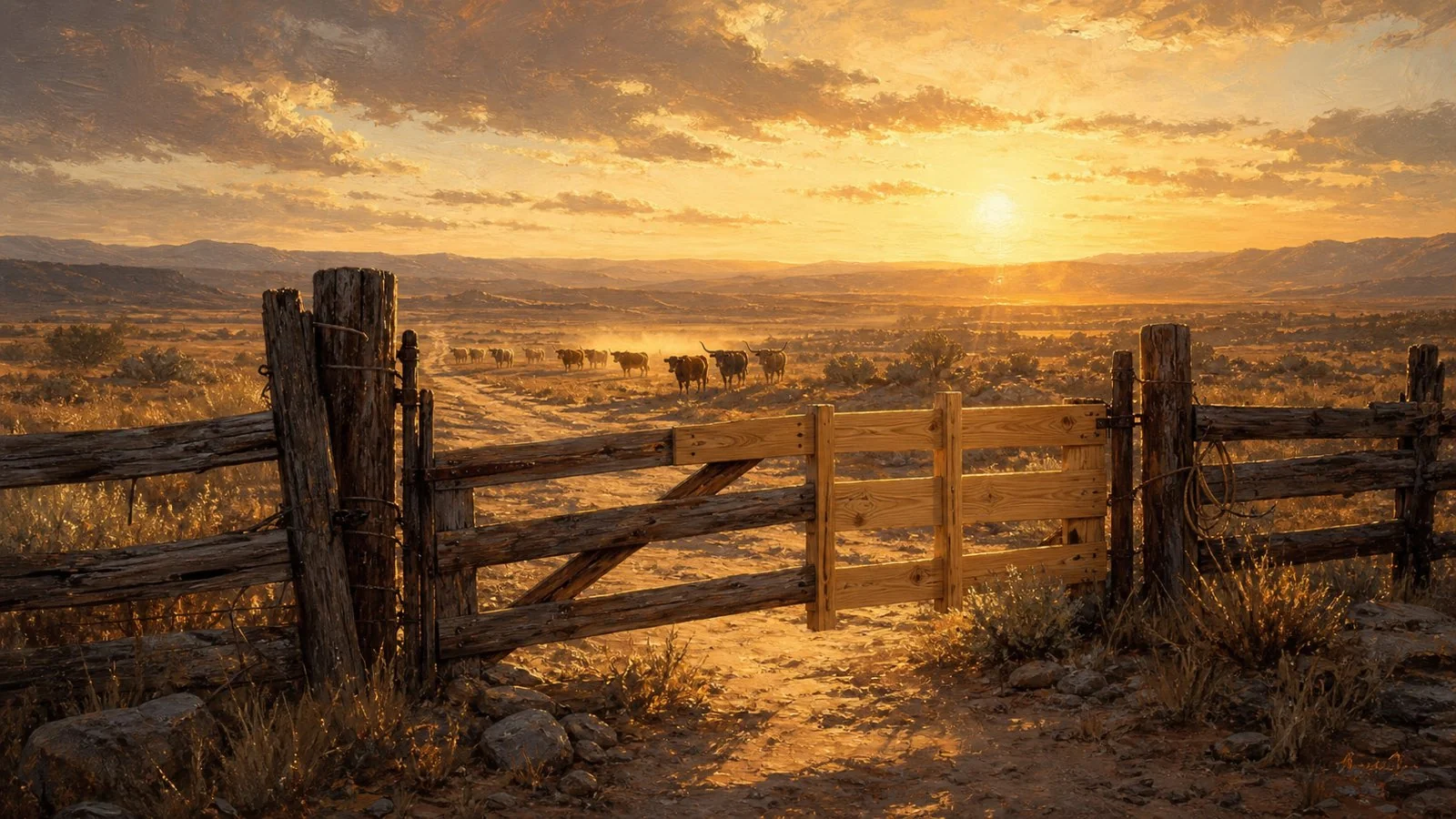
The Night Scene That Explains the Season
Late in the episode, Beth and Rip sit together on the back steps after a day that included a barn fire, a dead hand they don’t know about yet, a slaughterhouse standoff, and Carter’s jail run. The Texas heat refuses to cool at midnight. Beth says she misses waking up to the mountains. Then: “I miss him.”
Rip doesn’t ask who. He says: “We brought the best part of your father with us.” Beth pushes back — all those nights she’d find John staring into the fire, the weight of his promises, the way he never got to be happy. “He never got to be happy, not even try. And for what?” Rip: “For you. For the land.” Then Beth says what the whole series will have to earn: “I don’t want that for us. I want it simple. You, Carter, me.” Rip answers: “We’re too hard-raised for simple.” Beth corrects herself: “Peaceful, then.” And Rip closes it: “Sweetheart, you can’t chase peace. You got to live it.”
That exchange is the season’s thesis problem. Beth has never lived a day that wasn’t organized around a threat. Rip built himself from violence because violence was all that was offered. Carter was born into a system designed to make him disappear. The question Dutton Ranch is asking is whether these three can learn a different mode — not softer, but less organized around loss. The premiere’s answer is a structural maybe: the day ends with a horse in surgery, a labor market controlled by a ranch already eliminating witnesses, and a son who picked up a new name at a rodeo that probably belongs to a problem. But they are still standing in the same place together, and for this family that is not nothing.
Pros
- Kelly Reilly carries the weight of the Yellowstone grief without making every scene a funeral — Beth is forward-oriented even in mourning.
- The Rip/Azul dynamic is sketched efficiently and with genuine wit; the gas station exchange earns its place.
- The fire sequence trusts the actors; it doesn’t over-explain the emotional stakes.
- The final porch scene earns its length because both leads let silence do work between the lines.
- Carter’s jail beat is the right size — not overstated, not dropped.
Cons
- The Rob-Will/10-Petal cold open is a murder without context; it functions as plot machinery before it functions as drama.
- The slaughterhouse scene resolves too cleanly — Beth gets the Monday slot, which deflates the friction it spent three minutes building.
- A few expository exchanges in the middle act feel more like audience orientation than scene-writing.
Rating: 7.9/10
Universe Context: What “The Untold Want” Inherits from Yellowstone and 1883
This section covers significant Yellowstone universe spoilers through S5E14. If you haven’t finished Yellowstone, stop here.
“The Untold Want” does not begin with the end of Yellowstone. It begins somewhere after it — far enough after that Beth and Rip have already made the move, renamed the ranch, and had weeks in Texas to discover what they kept and what they lost when the Yellowstone was sold. But the premiere is threaded through with the weight of S5E14’s decisions, and watching it without that context is watching a building without knowing what burned down to make the lot available.
What happened in S5E14. John Dutton III was killed. [[beth-dutton]] stood at his coffin and told the priest she would say something other than goodbye — and whispered I will avenge you. After she and Kayce sold the Yellowstone to the Broken Rock reservation at $1.25 an acre — the exact price the federal government originally paid — Beth kept East Camp. The condition per Thomas Rainwater was that the land could never be developed, never sold. She accepted. She had spent years trying to make the ranch commercially useless to the developers circling it. She succeeded by removing it from the market entirely. Then she left Montana.
Texas as a second founding. The founding generation of the Dutton line, [[james-dutton]] and [[margaret-dutton]], drove cattle north from Texas into Montana in 1883. The entire Yellowstone dynasty was built from a route that started in Texas Hill Country. Beth is not retreating south. She is closing a loop. The ranch the family left when the frontier was still open is now the ranch the family returns to when the frontier is closed. James and Margaret would have recognized the landscape — flatter, hotter, less dramatic than Montana, less obviously worth dying for. They left it anyway because Montana promised more. Beth comes back to Texas because Montana is done, because the terms of the founding have run out, and because the thing the Duttons have always done — hold land at personal cost — still needs a place to happen. The Edwards Ranch was available. The name on the gate is already changed. Whether the project is the same one is the question the season inherits.
The title. “The Untold Want” is a Walt Whitman phrase — from a short late poem about the thing beneath all human striving that neither achievement nor failure can name or satisfy. It is the desire that survives every outcome, the want that was always there before any specific want took its place. Whitman’s poem offers it without resolution. The show has named its premiere after that condition rather than an event, which is a structural statement: this story is not about whether Beth and Rip build a successful ranch. It is about whether they can want something that doesn’t require an enemy to define it. The Yellowstone was always partly organized around what it was protecting itself against. Texas, the premiere proposes, might not need to be.
Beth’s grief as operating condition. The porch scene confirms what the character notes made explicit: [[beth-dutton]] has converted her grief for John Dutton into motion. She doesn’t cry. She doesn’t sit with the loss through conventional mourning. What she does is make decisions at dawn, fight a slaughterhouse owner before 9 AM, acquire a horse in surgery by noon, and come home to Rip with a list of operational problems and one admission — I miss him — that she delivers and then puts down. Her grief looks like business. That is what John Dutton’s daughter was made to do with everything. The premiere doesn’t try to fix this or soften it. It just shows the cost of it in a night scene where the only language available between two hard-raised people is honesty about what they can’t afford to carry and what they’re carrying anyway.
[[rip-wheeler]] without the brand as currency. Rip spent two decades as the Yellowstone’s enforcer because John Dutton gave him the brand and the job when Rip had nothing else. In Montana, the brand meant something legible to everyone who saw it — it was a known quantity inside a known hierarchy. In Texas, Rip is a stranger from Montana with a dead man’s authority and a new operation that the local ranching families have already divided up without him. The 10-Petal antagonist isn’t just a plot complication. It is the premiere establishing that Rip’s competence — which was always real, always severe — has to be re-earned in a context where nobody knows his history. He steps in front of the gas station confrontation not because it is tactically smart but because it is who he is, and the premiere’s job is to show us who he is when there is no brand and no Yellowstone to frame it. The answer the episode gives is: the same man. Which is both a strength and, in a new county with new power structures, a liability he doesn’t fully see yet.
[[carter]] carrying the inheritance forward. Carter was always the character the Dutton mythology needed to be honest about itself. Every generation passes the same lessons through the same methods: silence, labor, refusal to explain. Carter absorbed all of that in Montana and walks into Texas as the first Dutton by choice rather than by blood, obligation, or debt. He is also nineteen. The premiere gives him a night that includes a girl, a fight he didn’t start, and a jail cell — all the ingredients of a [[rip-wheeler]] origin story running about twenty-five years late, in a different state, under different terms. The rhyme is intentional. Rip killed his abusive father at roughly Carter’s age and arrived at John Dutton’s door with nothing. Carter arrived at Beth and Rip’s door with nothing. Now he arrives in Texas. The series is betting that the third time this pattern runs, it runs differently. The premiere leaves that ambiguous, which is the honest version.
[[john-dutton]] and [[james-dutton]] as structural presences. Neither man appears in the premiere. Both are in every scene. John is in the porch conversation and in the apology after the fire — Beth asking forgiveness from the people she asked to follow her, the way John never quite managed. James is in the landscape itself, in the idea that a Dutton starting over in Texas is not a retreat but a return to source. The Yellowstone franchise has always been about the gap between the founding promise and what the founding actually costs. Dutton Ranch S1E1 is the first episode in the universe that gets to run that argument with the founding generation’s Texas explicitly in frame — not as 1883 period drama but as geological fact. The land was there before the Duttons. The Duttons built on it, lost it north, and came back south. What they build now has to answer for all of that. The premiere earns its title by naming the want before it names the plan.
More episodes from Dutton Ranch — Beth and Rip build a Texas future, episode by episode. Jump to any episode in the season:
Where to go next
Reviewed by Mira Vance · QuizFandom Editor & Lead Reviewer. Every rating is an honest per-watch assessment from the desk that also writes the quizzes — not a press release rehash.