Jack Ryan: Ghost War Review: Jack Ryan Walks Back Into the Dark
What happens — the short version (spoilers)
- James Greer corners Jack at his civilian Wall Street life and sends him to Dubai to meet MI6 officer Nigel Cooke for a small pickup, with Mike November tagging along as backup.
- The meet goes wrong on a boat; Nigel is killed, and Emma Marlow rescues Jack, then reveals the Starling backstory and that Liam Crown turned the old post-9/11 unit private.
- Jack and Greer clash hard in the MI6 conference room over Starling's history, with Greer defending it as necessity and Jack naming himself as its personal cost.
- A clue points to an Aldgate Tower Bridge plot; the exposed bomb maker turns out to be a decoy, and the real attack kills Director Wright while Greer is wounded in the blast.
- With Wright dead, Greer becomes acting CIA director, which is exactly what Crown wanted, the team regroups at Abingdon, and Jack realizes Nigel was monitoring a live transmission, not uploading intel.
- Jack and Emma raid Crown's Dubai Marina building; Emma is hit in the server-room firefight, Crown corners them, but Greer's helicopter opens fire, and Jack is later urged to become deputy director.
Prime Video's continuation movie gives Jack Ryan one more test of whether clean hands can survive dirty history.
Ghost War arrives with a harder job than another season premiere. It has to justify pulling Jack Ryan out of the civilian life the series let him choose, while proving that the franchise can still find pressure in the gap between intelligence work and moral certainty. The movie knows that Jack is no longer an eager analyst with a theory and a backpack; he is a man who has seen enough to know what every favor costs. That makes the central question simple and useful: can Jack Ryan still be Jack Ryan when the institution asking for his help has started to look like the thing he fears?
Jack Ryan’s civilian life is already a cover story
The best early choice in Ghost War is that Jack’s private-sector life does not feel fake exactly, but it does feel provisional. When James Greer corners him around a bookstore and restaurant in New York, Jack is already braced for the pitch. The banter is light, with Greer joking about kidnapping him and Jack pointing out that a deputy director of the CIA could have called, but the scene has a bruise under it. Jack has left the agency, taken a Wall Street risk-management job, and stopped seeing Cathy since Christmas. He keeps saying civilian like a status, while Greer hears it as a temporary condition.
That opening reunion gives the movie its emotional contract. Greer does not ask Jack to come back. He asks him to meet Nigel Cooke in Dubai, accept a small pickup, and keep moving. Mike November makes the whole errand more honest by showing up as backup and immediately treating “just meeting a guy” as a phrase no competent spy should believe. The first-class flight to Dubai, with Mike giddy over champagne and Jack insisting that his hedge-fund life is real, plays like old-series comfort food until the movie starts tightening the screws.
The Dubai business meeting matters because it shows Jack trying to perform normalcy in public. He is supposed to speak about markets and the new Jakartan regime, but he cannot stop reading politics through risk. He warns that minds trying to bring back the past tend to bring volatility with them. It is a neat bit of foreshadowing, but it also exposes why civilian Jack is unstable as an idea. He can change employers, suits, and vocabulary; he cannot turn off the instinct that sees a market rally and asks who is being paid to ignore the bodies.
Nigel’s death is the favor that becomes an indictment
The boat sequence is the movie’s first real stress test, and it works because nobody in it has the information he needs. Nigel expected Greer, not Jack. Jack expected a package, not a frightened MI6 officer. Mike sees a tail too late. The resulting chase across the boat and into Dubai gives Ghost War its strongest old-school action stretch: close quarters, bad sightlines, a dead contact, and Jack still trying to search the body while Mike is screaming that they have to leave.
Emma Marlow’s entrance sharpens the movie. She saves Jack, then immediately makes clear that rescue and leverage can be the same act. Her interrogation of Jack in Dubai reframes Greer not as the mentor who always knows best, but as a survivor of Starling, a post-9/11 black-ops unit built with MI6 and driven by rage. Nigel, Crown, and Greer were part of that original machinery. Liam Crown did not abandon it. He carried it forward, turned it private, and began using old terror networks as proof that the world still needs men like him.
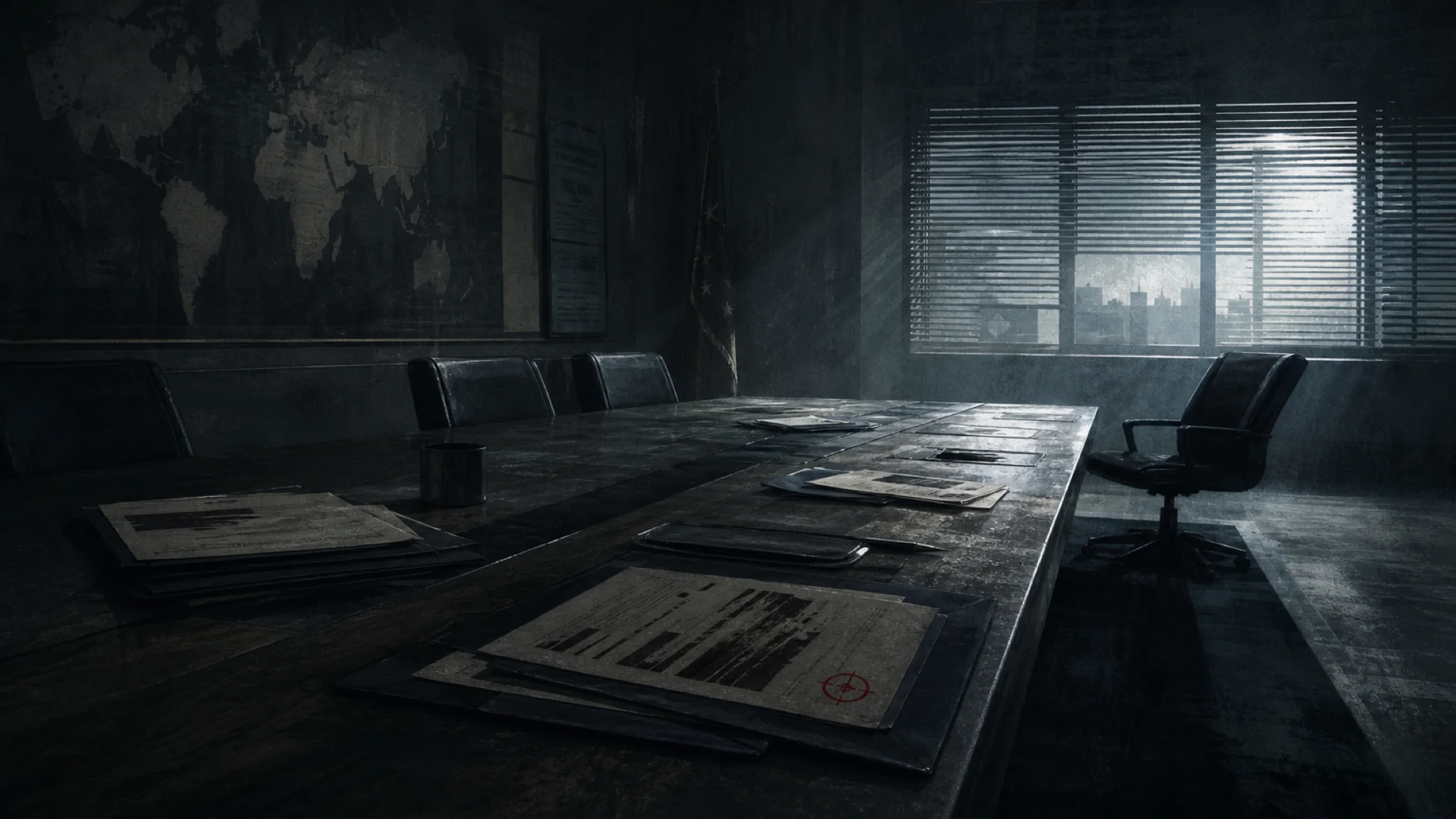
The film is most interesting when Jack’s anger at Greer is allowed to be personal and political at once. In the MI6 conference room, Jack hears that Mark Whitaker and Tobias Wilks were killed, that Wilks had reached out after seeing the scope of Crown’s revived operation, and that Greer sent him into Dubai without explaining the old war underneath the favor. Their argument is not subtle, but Greer gives it the weight of a man who has spent decades converting shame into necessity. Greer says Starling came from common sense in a moment when rules felt like delay. Jack answers from the other side of the bill, naming himself as the cost: the man who comes home to no one and wonders whether the dream he fought for exists.
That scene gives Ghost War a useful moral split without pretending the split is clean. Greer is not exposed as a fraud. Jack is not treated as naive. The movie lets both men sound right enough to make each other dangerous. Greer’s old line about the people who hold the gates shut becomes Crown’s ideology with better manners removed.
London gives Crown a thesis and the movie a wound
Once the damaged hard drive points toward Aldgate and the old Tower Bridge plot, Ghost War briefly turns into a procedural about reading a ghost map. The details are dense but legible: Karakoram surveillance images, London schematics, bank activity near Middlesex Street and Harrow Place, and Greer’s recognition of a bombing plan Starling stopped 20 years earlier. Crown wants MI6 and the CIA to move exactly as trained. He plants enough truth to make the institutions obey the trap.
The London section works best in its misdirection. Jack realizes that the exposed bomb maker is too exposed. There is too much hardware and too little protection, which means the real target is elsewhere. The movie cuts that deduction against Director Wright being moved through London, then turns the “look the other way” problem into a direct attack. Greer goes down in the blast radius, Jack runs through the chaos, and the chase spills toward St. Paul’s with Crown close enough to name but not close enough to stop.
Wright’s death gives the middle of the film its heaviest consequence. It also gives Greer the job Crown needs him to have. Jack understands the pivot quickly: Crown did not plan for Wright to enter the car, but once she did, he adapted. With Wright gone, Greer becomes acting director of the CIA, and Crown sees a chance to force an old Starling man into protecting Starling’s future. That is a stronger engine than a generic revenge plot. Crown does not only want to survive. He wants the institution to confess that he was always useful.
The Abingdon regrouping scene pulls the movie’s pieces together with welcome efficiency. Emma hides the team at a former RAF training station with Colonel Jones, while Jack, Greer, and Mike reassess what Crown is doing. The revelation that the attackers are tied to an obscure Russian paramilitary group matters less as lore than as pattern. Crown is not activating random enemies. He is bringing back groups Starling once shut down, staging the world as an exhibit for his own argument.
The Dubai raid pulls old spy craft into a server-room gunfight
Ghost War’s most satisfying detective beat is not a gadget. It is Jack and Emma in Nigel’s hidden apartment, poking through an old computer while the movie briefly lets them breathe. The Belinda Carlisle blast is a small comic jolt, but it leads Jack to the right idea: Nigel did not upload the intel; he was monitoring a live transmission through an old off-site connection. That is the kind of analog-to-digital spy problem this franchise handles well. The clue is not magic. It comes from thinking about what a cautious, lonely officer would trust.
The scene also catches Emma as more than a plot function. She bugs Jack’s jacket because trust is impossible until loyalties align, then lets him see the private cost of Nigel’s life through faded photos and a room no one was meant to find. Her chemistry with Jack is not written as sweeping romance, and that restraint helps. It is two professionals recognizing the same damage pattern in each other while still checking every angle for betrayal.
The final Dubai operation gives the movie its big feature-film escalation without losing the plot thread. Jack and Emma head back with Emirati help, Mike and Greer run a decoy flight, and Crown’s team scrambles to decide which move is real. The raid through the Dubai Marina building has the expected glass, rifles, stairwells, and server racks, but the goal stays specific: reconnect to the source Nigel found and pull Crown’s network before Crown can erase or reclaim it.
The server-room climax is cleanly built. Patrick works the download remotely, Emma is hit during the firefight, Mike finds the aircraft “back door,” and Crown steps into the room with the smug patience of a man who thinks everyone else is still playing catch-up. Jack’s plan, though, depends on Greer arriving from above. When the helicopter opens fire, it answers Crown’s recurring “no hesitation” doctrine with the one thing Crown misread: Jack can use force without adopting Crown’s theology of force.
What Ghost War argues about the franchise
Ghost War is a victory lap with teeth. It brings back Jack, Greer, Mike, and the shadow of Cathy Mueller without pretending the series can simply reset everyone to the old team-board dynamic. Cathy functions more as absence and promise than active partner for most of the film, which is honest to Jack’s state but also a limitation. Domingo “Ding” Chavez is not a meaningful part of the story on screen, and the movie’s choice to narrow its ensemble makes the Greer-Jack bond carry almost all the franchise weight.
That narrowness mostly helps. The Jack Ryan series often worked best when Jack’s righteousness had to survive contact with people who had better operational instincts and worse emotional weather. Ghost War pushes that old tension into legacy territory. Greer is not merely the boss pulling Jack back in; he is the living archive of an American and British security culture that created Crown, used men like Crown, then acted shocked when they refused to disappear.
The movie’s weakness is that Crown’s argument sometimes arrives in speeches where scenes have already done the work. The “gates” language gives the story a strong recurring image, but it is repeated enough that the subtext becomes a lecture. Still, the film is sharper than a cash-in because it treats continuation as consequence. Jack is not back because Prime Video needs another mission. He is back because leaving did not answer the question Greer left inside him.
Verdict
Ghost War works best as a bruised reunion thriller. Jack is strongest in the scenes where his irritation masks fear that Greer may be right about him. Greer carries a late-career heaviness that makes the Starling material feel like lived guilt rather than franchise mythology. Mike remains the pressure valve, but his line about the three men being the only family they may ever have lands because the movie has spent an hour showing how true and sad that is.
The action is sturdy rather than surprising. The boat escape, London attack, St. Paul’s pursuit, and Dubai raid are all readable, professionally paced sequences, with the server-room finale giving the movie its best mix of brain and body. Emma is the standout new element, particularly when her suspicion of Jack becomes collaboration without ever turning soft. Crown is effective as an ideological villain, though the script sometimes lets him explain himself past the point of menace.
As a continuation of the 2018-2023 series, Ghost War does enough. It does not reinvent Jack Ryan, and it should not. It tests whether the character can step back into government service with a clearer view of what service has hidden from him. The final recommendation that Jack become deputy director lands as both promotion and trap. Jack gets pulled back into the room, his private life remains an open question, and the franchise leaves him exactly where he is most useful: still angry, still needed, and still trying to prove that a moral compass can survive inside the machine.
Rating: 7.4/10
More episodes from Jack Ryan: Ghost War — The Tom Clancy Prime Video movie sequel — Jack Ryan returns. Jump to any episode in the season:
Where to go next
Reviewed by Mira Vance · QuizFandom Editor & Lead Reviewer. Every rating is an honest per-watch assessment from the desk that also writes the quizzes — not a press release rehash.