Tom Clancy's Jack Ryan S4E1 Review: Jack Cuts the Wires and Finds Pluto Waiting
Triage opens the final season by moving Jack Ryan from field hero to institutional surgeon, then shows how deep the infection has already gone.
Tom Clancy’s Jack Ryan begins its final season with Jack Ryan in the least comfortable job the series could give him: Acting CIA Deputy Director. “Triage” is not built around Jack chasing a single loose weapon through a foreign city. It is built around Jack inheriting a damaged agency, trying to stop the bleeding, and discovering that the wound may have been deliberately kept open. The episode’s title is literal in spirit. Jack has to decide which operations can be saved, which ones are too contaminated to continue, and how much political damage he can absorb while making that call.
That makes Season 4’s premiere a quieter reset than Season 3’s Russia opener, but not a smaller one. The cold open begins with a covert team moving through a target site, killing guards, taking a confirmation sample, and escaping under fire. A call follows: DNA is pending, the target is eliminated, and the Lagos shipping lanes are cleared. The episode then cuts to Washington, where Jack and Acting Director Elizabeth Wright have to answer for a Nigerian assassination that may carry American fingerprints. In other words, the action has already happened before Jack can reach it. His real fight is with the paper trail.
Jack discovers honesty is the bigger political hazard
The best early decision in “Triage” is making Jack’s new authority feel like another trap. In the White House briefing, he and Wright do not know enough about President Udoh’s assassination to offer the president a clean answer. The photos coming from Lagos show American weaponry and equipment. Wright names Ekon Ameh as the obvious suspect because he opposed Udoh and is a known warlord, but she also frames Lagos as a board crowded with foreign interests. Jack’s problem is not that he suspects the CIA did it. It is that he cannot prove the CIA did not.
That distinction becomes public during the Senate Intelligence Committee hearing. Senator Henshaw asks whether Jack can assure the committee that the CIA had no involvement in Udoh’s death. Jack answers with a blunt “No,” then refuses to soften the danger into bureaucratic comfort. When pressed on whether the uncertainty concerns him, he corrects the word: it terrifies him. The moment works because Jack reads as controlled rather than righteous. He knows the answer is politically disastrous, but he also knows that pretending certainty would make him part of the same rot he is supposed to remove.
The hearing also puts Season 3 on trial. Senator Jennings turns Jack’s Russia mission into an indictment: the SOG team, the destroyer, DEFCON 2, and Jack’s willingness to trust a Russian officer against advice. The question is not whether Jack saved the world. The question is whether the man now promising institutional reform has spent years proving that he will go around institutions when they slow him down. Jack’s answer is sharp because it is not defensive in the expected way. He says he does not report to Jennings, but he also concedes that if rogue action is the example he sets, the committee should not expect change yet.
That “yet” matters. “Triage” understands that Jack cannot simply walk into the deputy director’s office and become clean government by force of reputation. His old strengths are now liabilities in a different room. In the field, acting before the system catches up can save lives. In the office, that same instinct can look like exactly the disease he claims to be treating.
Greer knows where Miller buried the language
James Greer gives the premiere its most useful human scale. His scenes with Jack restore the familiar rhythm of affection masked as insult, especially when he interrupts Jack’s evening with Cathy Mueller and immediately starts teasing him about the relationship. The domestic scene matters more than simple fan-service return. Cathy tells Jack that without what he did in Russia, there would be no home to protect, while Jack jokes that she does not know what he did in Russia. He gets a brief life outside the institution before Greer drags him back into the mess.
Greer’s news is the hour’s procedural engine. Former Director Miller taught people in his office to muddy files, turning operations into shorthand that would be deniable at best and unreadable at worst. Greer says there is one person who knows how to read that language: him. It is a good use of the character because it does not make Greer merely Jack’s loyal old friend. He is the man who understands the bureaucracy’s corruption as grammar. Miller did not just hide actions. He hid them inside a private dialect.
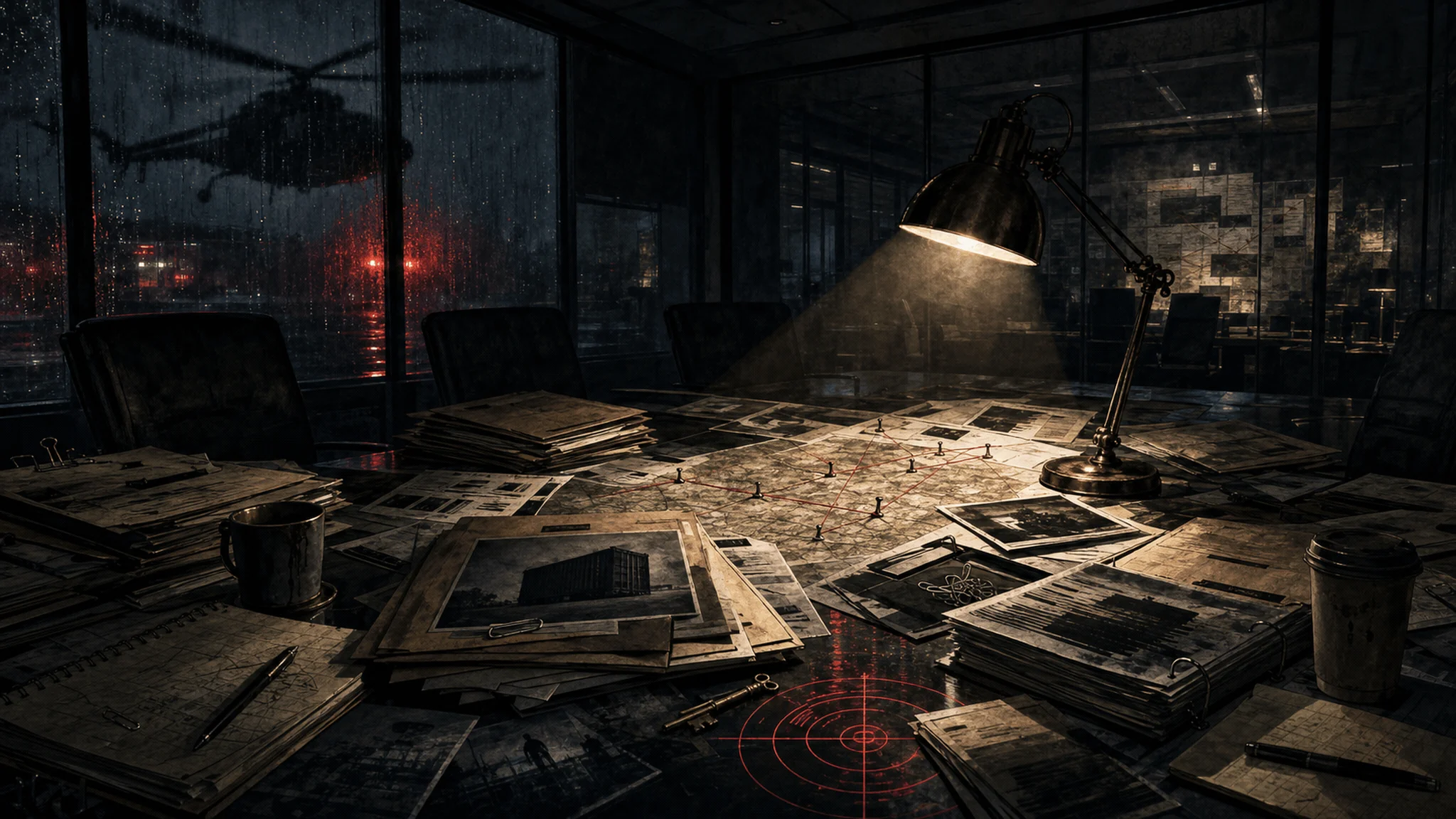
The later file-room scene gives that idea the premiere’s sharpest investigative beat. Jack and Greer boil the inherited mess down to nine operations with no clean evidence they even exist. Four of the files share the name “Mainland Renewables,” which sounds exactly like a shell company designed by people who know blandness is camouflage. Greer calls the material worse than muddy; it is a sewer. Jack then takes the president’s instruction to its logical extreme: any operation he cannot explain is no longer operational. If the way to expose the people behind Lagos is to cut off the money, he will shut all nine down.
That choice is the premiere’s strongest expression of Jack as an acting director rather than a field officer. He does not chase a suspect through a street. He kills the budget line. He makes a structural decision, and the final scene proves that the structure can feel pain.
Mexico shows the network Jack cannot see yet
While Jack and Greer are reading files, the Mexico storyline shows what those files may be protecting. The cartel material begins with a body, a photograph, and a speech about hands that hold the keys to Asia, pure product, and the Silver Lotus Triad. The men around Marquez believe they have eliminated the competition and become the last cartel standing. That confidence is immediately framed as dangerous because the Asian supply line is more than a drug upgrade. It is the beginning of a network.
“Triage” is blunt about that word. A separate conversation describes the plan as invisible and untraceable, interested only in making money no matter what form the enterprise takes. That is the point where “Triage” starts to widen beyond a cartel story. The villains are not only moving narcotics. They are building infrastructure that can carry whatever the highest bidder needs moved. Drugs are the proof of concept.
Chao Fah Sein enters that structure with an interesting double pressure. He speaks about adapting, family, and survival while preparing to travel to Mexico. He tells his circle that with their new partners, things much bigger than drugs are at play. That phrasing gives Chao Fah more weight than a visiting supplier. He understands the scale better than the Mexican side does, and his caution stays visible when the port meet is altered without his approval.
The Los Cedros sequence is the premiere’s main action payoff, but it works because the conversation before it is already unstable. Chavez warns that bringing Chao Fah to Marquez alone will not land the same way with the Triad as it would with a cartel. The response around him is racist bravado and territorial arrogance. Chao Fah arrives at a facility operating under Sun Oasis Organics, with vitamins and health products as cover. The details are almost absurdly clean: superfood powders, guilty customs searches, greased distribution lines. Then Marquez refuses to come to the port, Chao Fah is asked to travel alone, and the extraction waiting nearby collapses into gunfire.
The shoot-out does not yet explain who betrayed whom, which is the right choice for a premiere built around partial visibility. Chavez has a team staged to take someone out of the meeting, but the window closes fast once bullets start moving. Chao Fah gets out of the immediate trap, Kyi calls for Bennu, and Mexico reports foreign operatives at the port. By the time Wright shows Jack the news, the Mexico disaster is already on the same clock as Lagos. The Senate will not wait for the truth to become legible.
Wright learns that every public room is another battlefield
Wright’s arc in “Triage” is quieter than Jack’s, but it may be more politically revealing. She wants to step in front of Lagos at a Nigerian aid fundraiser because the agency is disavowing involvement and needs a unified front. The event gives the hour a different kind of pressure: not classified files, not covert teams, but lobbyists and benefactors turning crisis into influence.
Ade Osoji pushes Wright in public by arguing that Lagos is more dire than anyone wants to admit and that America has become too scared to do the right thing. Wright asks him what the right thing is, and his answer is short: do not look away. The scene is useful because he is neither obviously wrong nor safely right. The words sound morally clear, but the context is crowded with special interests. Later, Wright is told that Osoji is an aggravating but necessary Nigerian oil lobbyist. The premiere keeps returning to the same idea: a clean moral sentence can travel inside a compromised network.
The fundraiser also introduces Zeyara Lemos as more than a philanthropic name Cathy mentioned at home. She flatters Jack as a hero, speaks warmly to Cathy about the World Health Organization and a desired partnership, and positions herself front row center for Cathy’s upcoming relief conference. The scene is polite on the surface, but its placement after Lagos, Mexico, and the Miller files makes the politeness uneasy. “Triage” does not need to accuse her of anything yet. The point is how smoothly humanitarian access, political access, and intelligence pressure can occupy the same room.
Henshaw’s conversation with Jack at the bar sharpens that unease. Earlier, Henshaw treated Jack like an agency problem. Here he says they may be after the same thing: change. The line should sound reassuring, but “Triage” has trained us to distrust that kind of overlap. Everyone says they want change. Jack’s problem is figuring out who profits from the version of change they mean.
What this episode argues
“Triage” argues that corruption survives by becoming infrastructure. Miller’s files are unreadable by design. Lagos becomes a public crisis before the CIA can establish what happened. Mexico converts cartel consolidation into a distribution architecture for something larger. A relief fundraiser becomes a room where aid, oil, politics, and institutional reputation all press against each other. Even Jack’s personal life is not sealed off from the network, because Cathy’s WHO work brings her into Lemos’s orbit before Jack understands why that may matter.
That is why the final threat lands. Jack leaves the fundraiser with Cathy, steps away to get water, and is confronted by a man who tells him to turn Pluto back on. The line is powerful because Jack has just shut down nine dark operations in the name of accountability. Someone answers almost immediately, not with an argument, but with a countdown. Jack has pulled a wire and discovered it was attached to people close enough to find him on the street.
The title earns itself there. Triage is not cure. It is the first brutal sorting process after damage has already been done. Jack can stop the money, but he cannot yet see every patient, every infection, or every hand trying to keep the system sick.
Verdict
“Triage” is a strong, deliberate premiere for the final season because it makes Jack’s promotion feel dangerous rather than decorative. It plays less immediately propulsive than the best Season 3 stretches, and some of the cartel-network exposition arrives in heavy speeches about markets, territory, and respect. Still, the architecture is sturdy. Lagos gives Jack a moral crisis, Miller’s files give Greer a reason to stay in the game, Mexico gives the hidden operation a physical shape, and the fundraiser makes Washington civility feel like another kind of hostile ground.
Jack is effective when he has to swallow his field instincts and make an institutional decision with consequences he cannot fully map. Greer’s file-decoding material plays with warmth and bite, Wright’s caution feels tactical rather than timid, and Cathy’s return gives Jack something human enough to endanger. The final Pluto threat is exactly the kind of hook this season needs: not a mystery box for its own sake, but proof that Jack’s first attempt to clean house has already touched the live current.
Rating: 8.0/10
More episodes from Jack Ryan — Season 4 — The series finale season — Jack as Acting CIA Deputy Director chasing the convergence of cartels and terror. Jump to any episode in the season:
Where to go next
Reviewed by Mira Vance · QuizFandom Editor & Lead Reviewer. Every rating is an honest per-watch assessment from the desk that also writes the quizzes — not a press release rehash.