Money Heist Season 5 Episode 4 Recap: Tokyo Runs Toward the Locked Door
Money Heist (La Casa de Papel), Season 5, Episode 4 Netflix · Created by Álex Pina · 2021
Helsinki is trapped, Tamayo gets blackmailed, Manila speaks plainly, and Tokyo reaches the door that will not open.
At the start of Money Heist Season 5 Episode 4, the Bank of Spain heist has stopped pretending it is still a robbery with occasional gunfire.
Helsinki, Yashin Dasáyev (Darko Perić), is pinned under a marble statue. The army has blown through the roof. Palermo, Martín Berrote (Rodrigo de la Serna), Bogotá (Hovik Keuchkerian), and Rio (Miguel Herrán) are running toward a man losing too much blood. Tokyo, Silene Oliveira (Úrsula Corberó), Denver (Jaime Lorente), and Manila (Belén Cuesta) want to come at the soldiers from behind, but the Professor, Sergio Marquina (Álvaro Morte), sees the rooftop before they do.
A rescue from above becomes suicide if the snipers spot weapons.
So the answer is grotesque and practical: use the hostages.
That is late-era Money Heist in one move. The plan is clever. The image is obscene. The clock is bleeding. Tokyo’s narration says they thought they knew war because they had never met the real thing.
By the end, one door closes between Tokyo and the rest of the crew.
Nairobi’s name is already waiting on the other side.
Helsinki is pinned under the museum statue
Helsinki wakes up in the wreckage with his leg trapped and his voice barely holding.
Palermo starts talking him through survival before he has a plan. He promises Argentinian meat, then movies, then anything that keeps Helsinki awake long enough for him to reach the museum. It is ridiculous bargaining, but that is the point. Palermo has done too much damage to this crew by turning hurt into pride. Here, he has no pose left. He just keeps saying “Fatty” like the nickname can keep a man attached to life.
The rescue is ugly from the first second.
Helsinki knows the injury is not a simple extraction. His femur, shinbone, and knee are gone in every useful sense. He tells Palermo to cut the leg because the hospital will do it later anyway. Palermo refuses. Bogotá says the statue weighs at least two tons. Rio can see the same thing. The room has no mercy hidden in it.
Then Palermo reaches for a lever.
The choice matters because Palermo is still living after Nairobi. His apology to Helsinki in Season 4 did not erase what he caused. Gandía got loose because Palermo wanted revenge on the people who had humiliated him. Nairobi died after that chain began. Helsinki has still chosen him as family. Palermo is not saving a crew member in the abstract. He is trying to save the man who still calls him back from his worst self.
Outside, Lisbon, Raquel Murillo (Itziar Ituño), and Stockholm, Mónica Gaztambide (Esther Acebo), prepare covering fire. Tokyo takes hostages to the roof, tells half of them to pull off their masks, and makes Miguel Fernández Talanilla proof that civilians are in the smoke.
It is nasty. It also works.
The snipers cannot shoot cleanly. Matías fires from the door to split attention. Tokyo pulls the bag of weapons across the roof. Palermo waits until Helsinki is free before giving the stampede order, because bait only works if the man under the statue is not left behind.
The rescue is where the heist math and the emotional math agree.
Get Helsinki out.
Then turn the room into a trap.
Berlin teaches Rafael how thieves raise sons
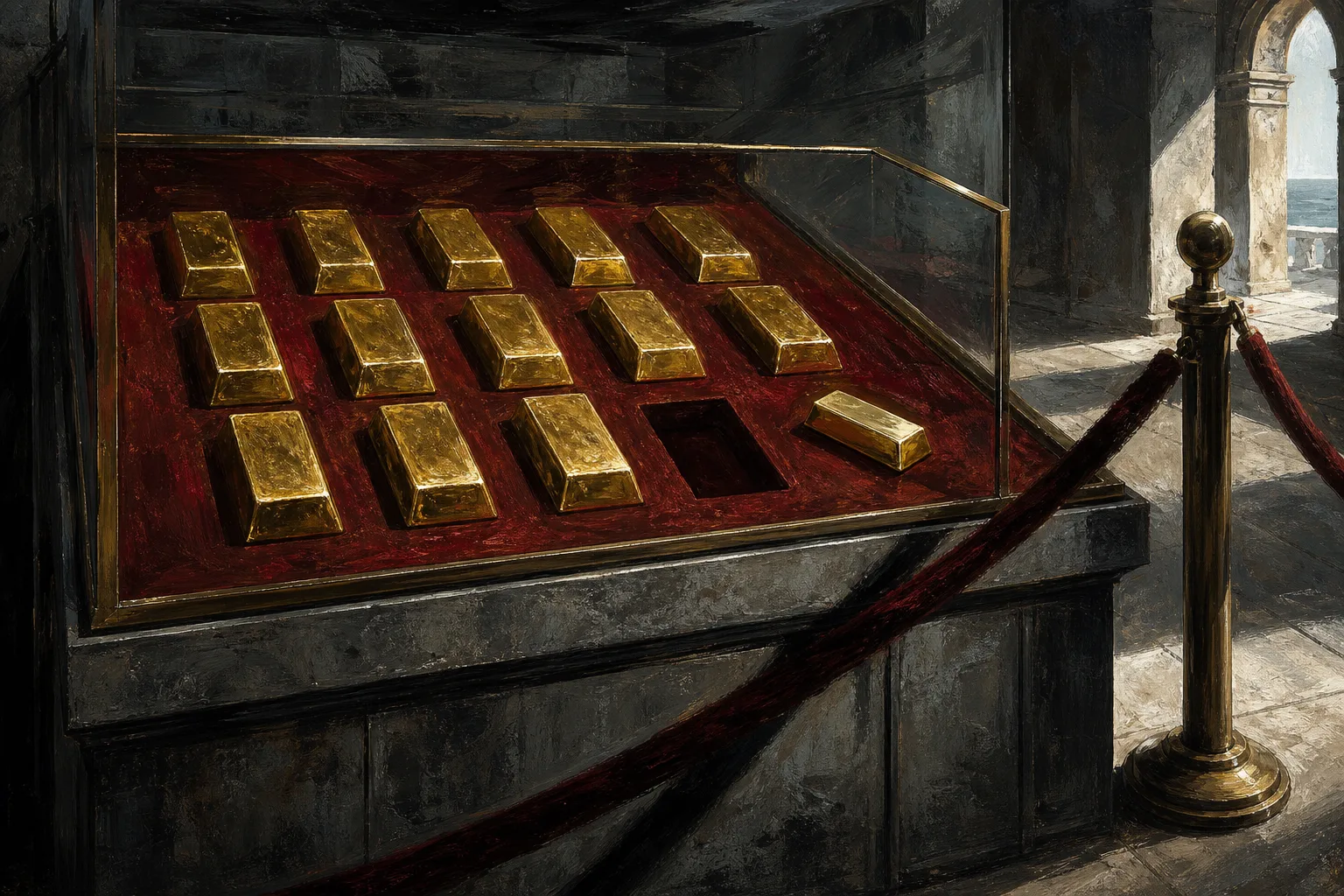
The flashback leaves the Bank of Spain for Frederiksborg Castle, where Berlin, Andrés de Fonollosa (Pedro Alonso), gives Rafael a father-son tutorial built around a gold theft.
The job has the pleasure of old Money Heist procedure. Tatiana (Diana Gómez) plays the concert. Rafael (Patrick Criado) poses as a piano tuner. A magnetic card reader clones a security credential. Barium sulfate hides replicas in a tool cart. Cristoff, Hans’s confused father, is guided through the party to pull Hans away from the guarded room.
It is absurd, mean, elegant, and very Berlin.
The sequence keeps giving the work to details. Thirty seconds near the card. Ten centimeters from the target. A security-feed loop. A guard called Bear 3. A father repeating “music” because that is the word he has been given. The theft runs on glamour, but the actual machine is awkward proximity and human pressure points.
Rafael is good at the part he did not want to inherit. He hacks the system, finds the gold, opens the right box, and starts to feel what Berlin wants him to feel: power without apology.
Then Berlin throws the gold away in front of Rafael.
Rafael is furious because twelve kilos of gold is not a lesson to him. It is fifteen million euros vanishing because his father wants a moment. Berlin treats the outrage as proof of belonging. Only a true thief feels ownership over someone else’s property, he says. Rafael can keep calling him cynical if he wants, but the feeling has already betrayed him.
That line is cruel enough to be honest.
Berlin’s flashbacks keep two versions of him alive at once. He is funny, stylish, brilliant, dying, and capable of tenderness toward people he chooses. He is also still the man who handed Tokyo to the police and made hostages live inside his fantasies. Here, he remains a romantic monster with a parenting philosophy that sounds like a toast and lands like a curse.
If you want something in life, steal it from somebody else.
That is not wisdom. That is Berlin handing Rafael the family disease.
The Professor turns Tamayo’s cover-up against him
Back in the stormwater tank, Alicia Sierra (Najwa Nimri) has a newborn, a gun history with everyone nearby, and enough practical sense to stay useful.
The Professor works out why letting the governor leave mattered. They hid a microphone in the handcuffs. If the handcuffs were removed before the radio-wave detector, the crew got a recording from the tent. Sierra understands the leverage at once.
They have Tamayo.
Colonel Luis Tamayo (Fernando Cayo) is preparing the second attack when the Professor calls him. The conversation starts with capoeira and insults because this series cannot resist turning blackmail into a comedy routine. Then Sergio plays the recording: Tamayo talking about killing wounded robbers, fabricating evidence, and needing the public to believe the crew are murderers first.
It is not a moral victory. Sergio knows Tamayo will not stop because he has discovered ethics. He will stop because Sergio can ruin him.
That is the right read.
The Professor threatens to tie Tamayo to Alicia Sierra’s frame-up, reserved funds, and a ten-million-euro transfer in the Dutch Antilles. Tamayo has sent elite soldiers into the bank, but Sergio can still make him look like a criminal partner rather than a national savior.
Tamayo holds the intervention.
The nasty joke is that Sagasta immediately knows something is wrong. He does not need the politics. The whole gang is in front of him, even “the mailman and his mother” could walk through the front door, and the tent still tells him to resist.
That pause saves the crew for a few minutes.
It also turns the soldiers meaner. Sagasta has been cut off from the second wave he expected, so he starts thinking like a trapped commander. Arteche sees the obvious problem: two flanks. They have to get rid of one.
The museum safety lock becomes the answer nobody in the Professor’s plan had drawn.
Manila tells Denver the truth before the doors drop
The rooftop maneuver gives Tokyo, Denver, and Manila a few seconds where fear turns personal.
Manila admits the scale has caught up with her. She used to rob gas stations. Now the entire army is after her. The line is funny for half a breath, then it becomes the thing she has been carrying. She came to the monastery and saw Denver with Stockholm and Cincinnati, a family already formed, and understood that the heist was not going to give her the life she once imagined.
Then she says it.
She has been in love with Denver all her life.
Denver tries to push it away because they are in the middle of a firefight. Manila is not confessing because she expects a romantic answer before the next grenade lands. She says telling him makes her calmer. Death is close enough that secrecy feels stupid.
Denver gives her the answer the moment needs: nobody is dying today.
He is wrong, and that is what makes it sting.
The later flashback with Tokyo and Nairobi sharpens the same fear. Tokyo asks what happens after they are shot in the head. Nairobi does not offer paradise. She says you leave your memory. Then Tokyo explains her trick: when chaos comes, she thinks about the happiest moment, so she can live there forever if the last second arrives.
That could be too sweet if the fight were not already moving her toward a locked corridor.
After Helsinki is free, the crew executes the trap. Tokyo, Manila, and Denver fire through the hole while Bogotá and Rio force the soldiers across the room. Sagasta pretends to surrender, then uses a grenade and Gandía’s fingerprint access to trigger the safety lock. Heavy doors drop where Palermo swears no doors exist in the plans.
Tokyo, Denver, and Manila run.
Denver gets through. Manila gets through.
Tokyo does not.
She screams as the door closes, separated from the crew, with soldiers nearby and Nairobi’s ghost already turned into a threat. Gandía taunts her from the other side of the danger: Nairobi is saving her a place in heaven.
Tokyo has always run toward trouble like it owed her money.
This time, trouble closes the door behind her.
What works
The Helsinki rescue works because every tactic has an emotional cost attached. Hostages on the roof, snipers forced to hesitate, smoke, Matías at the door, Tokyo pulling the weapons bag, Palermo refusing the amputation: it all stays readable.
Berlin’s flashback also works because it gives Rafael a real initiation instead of a lore dump. The castle theft is playful, but the lesson is rotten. Berlin can make theft look like romance and still leave poison in the glass.
Sergio and Sierra are fun together in the bunker because neither fully trusts the other and both understand leverage. Her newborn logistics, Marseille’s shopping list, the surrendered cartridges, and the Tamayo recording keep the outside plot sharp.
Manila’s confession lands because it is not framed as a demand. She names a feeling when hiding it no longer helps. Denver cannot answer the old history between them. He can only keep her moving.
What stumbles
The Denmark flashback takes a long detour while Helsinki is bleeding under stone. The contrast is intentional: luxury theft beside battlefield triage. Still, the museum panic has to restart its pressure afterward.
Tamayo’s tent side leans hard on shouting again. Fernando Cayo gives the colonel a sweaty desperation, but the command scenes are sharper when Sagasta and Arteche bring tactical detail back.
The hostage-roof maneuver is clever, but it asks the audience to sit with the crew using civilians as camouflage. The plan moves so fast that the moral aftertaste has to wait behind the bullets.
What this sets up for Episode 05
By the last scene, Tokyo is isolated with the army inside the bank and the crew split by a door Palermo did not know.
That is the immediate danger. The deeper danger is memory. Nairobi has become the crew’s wound, chant, and warning. Tokyo has spent this stretch talking about where a person lives after death, how fear changes when the last second comes, and which happy thought might hold her if the chaos catches her.
The Professor has bought time by blackmailing Tamayo, but he has not removed Sagasta’s team. Helsinki is alive, but badly damaged. Palermo has kept him from dying under the statue, and now he has to command through a mistake in the plans. Manila has said what she needed to say. Denver has no room to process it.
Tokyo is on the wrong side of the lock.
The war has stopped being a mood and become a hallway.
Rating: 8.6/10
More episodes from Money Heist (La Casa de Papel) — Tokyo's last stand, the brass swap, and the series finale — La Casa de Papel ends. Jump to any episode in the season:
Where to go next
Reviewed by Mira Vance · QuizFandom Editor & Lead Reviewer. Every rating is an honest per-watch assessment from the desk that also writes the quizzes — not a press release rehash.