My Mister Episode 10 Recap: Ji-an Learns What Protection Sounds Like
My Mister, Season 1, Episode 10 tvN · Written by Park Hae-young · 2018
A bruised man walks home, and a girl who has survived everything begins to hear what safety might sound like.
The argument here is simple and severe: shame only keeps its power when everyone agrees to treat it as fatal. Park Dong-hoon (Lee Sun-kyun) spends the hour bruised from a fight he refuses to explain honestly, while Lee Ji-an (Lee Ji-eun / IU) moves her grandmother into care and hears, perhaps for the first time, that her past does not have to be the whole of her. Around them, Hugye-dong lies for Dong-hoon, Yoon-hee learns what he has swallowed, and Do Joon-young starts to realize the woman he hired is no longer moving cleanly in his direction.
Rescue here is not grand. It is practical. An ice pack. A fake soccer story. Ten million won paid back. A nursing-home form. A neighborhood phone number that means thirty people will run.
Dong-hoon’s bruise becomes Hugye-dong’s secret
The fight with Kwang-il ends before the opening credits, but the bruise keeps moving through the hour. Dong-hoon has done the thing he almost never does. He has answered violence with violence because Ji-an was beaten by a man who claimed the right to keep punishing her.
Kwang-il’s reason is monstrous and human at once. Ji-an killed his father. He says it like a wound he has been picking at for years. Dong-hoon’s answer is not legal, moral, or polite. If anyone beat up his family, he would kill them too.
That is the line that matters. He does not call Ji-an family. He does not need to.
Then Hugye-dong takes over.
Sang-hoon and Gi-hoon find him with his face swollen and his temper gone. The soccer club men gather in the street with all the chaos of middle-aged loyalty: who did it, where is he, let me kill him, hide him from the police, stretch before you cramp. They are ridiculous with purpose. Dong-hoon is hurt, so the neighborhood becomes a wall of noise around him.
Nobody believes his first lie. A stranger bumped him outside a convenience store. A young thug cursed at him. He fought back. Gi-hoon hates the story because he knows his brother. Dong-hoon has built a whole life out of passing by. He pretends not to hear. He swallows. He keeps walking.
So the lie has to become communal. At Jeonghui’s, they test versions until morning soccer gives them the one everyone can use. He was heading the ball, collided with Gi-hoon, and came home looking like a man who lost a match to another man’s skull. By breakfast, Mother is scolding the men for playing drunk, and the table is trading stories of broken teeth, torn muscles, slide tackles, and groin shots. The bruise is no longer evidence of Ji-an’s danger. It is a family joke, rough and protective.
Yoon-hee (Lee Ji-ah) cries before she knows the details because Dong-hoon’s face tells her what his mouth will not. Then Joon-young calls, and the truth reaches her from the side: Dong-hoon already knows about the affair. He asked Joon-young to let her keep her ignorance because once she knew he knew, she might not be able to stay.
That request is Dong-hoon at his most painful. He is trying to spare the person who hurt him from the shame of being seen too clearly. Yoon-hee’s anger at Joon-young lands because he took Dong-hoon’s restraint and used it as shelter.
Ji-an lets Bong-ae leave without abandoning her
Ji-an pays the debt in full. The bank slip says 10,300,000 won, the kind of exact amount that makes suffering feel administratively real. She withdraws ten million won and sends it away, closing one door before she opens another.
The nursing-home sequence is almost wordless. Ji-an sits beside Lee Bong-ae, fills out forms, and faces the small cruelty of logistics: no one there knows sign language. Her grandmother can write, they ask. Ji-an answers like someone who has spent years turning impossible needs into daily tasks.
Then Bong-ae writes what she has not been able to say aloud. “Now I think I can breathe my last breath in peace.”
It is too large a sentence for the small white board that carries it. Bong-ae is not relieved because her life has become easy. She is relieved because Ji-an is no longer completely alone. The old woman has watched this girl drag both of them through poverty, debt, hunger, and humiliation with a child’s body and an adult’s exhaustion. Now there is a good person nearby.
Dong-hoon receives that gratitude with the discomfort of a man who has never wanted his decency to become an event. He keeps helping anyway. After Bong-ae is settled, he walks with Ji-an and gives her the practical theology of Hugye-dong. If Kwang-il bothers her again, call. More than thirty people will come. A hundred, if needed. His father, his brothers, his friends, their fathers: everyone knows everyone. The neighborhood is a response time.
Ji-an asks the question that has been waiting under her skin: who will stay close when they know she killed someone? People who once liked her hesitated after learning it. She can feel the recoil before it happens.
Dong-hoon’s answer is not sentimental. He does not tell her the past was good. He tells her how to carry it. If she treats it lightly, others will too. If she treats it heavily, others will too. “You always come first.”
That line is a door opening. Ji-an has lived as if every judgment against her were already correct. Dong-hoon asks her to stop assisting the verdict. He tells her to live up to her name because it is a good name. She asks what his means. Hoon is common in his family. Dong means power.
She walks fast afterward because the exchange embarrasses her. He notices. For once, embarrassment is not danger.
Joon-young hears the wiretap turn against him
The corporate plot is colder here, but it matters because power keeps trying to translate kindness into evidence. Joon-young (Kim Young-min) pulls Ji-an out and orders her to turn on the wiretap so he can listen to Dong-hoon’s dinner with Wang and the directors backing his promotion. Joon-young still thinks access is control.
What he hears is not a scandal. He hears Dong-hoon decide to compete.
Dong-hoon says he needs to become managing director because his mother is excited, because Sang-hoon is relieved about funeral costs, because Yoon-hee has worked hard alone, and because he cannot keep avoiding conflict forever. When Wang pushes for the missing reason, Dong-hoon names Joon-young and refuses to grant him too much importance. He does not want Joon-young in any part of his life. Bringing him down would be more attention than he deserves.
That dismissal wounds Joon-young more deeply than open hatred would. Wang’s men pile on with the kind of class contempt that Joon-young can never fully outrun: the ex-son-in-law who got a smell of money, got kicked out, and still tries to talk like a chaebol. Ji-an hears it too. The wiretap is supposed to expose Dong-hoon. Instead, it exposes the loneliness underneath Joon-young’s arrogance.
He responds by tightening his grip on Ji-an. How many times has she met Dong-hoon? One or two? Why can she not remember? His suspicion is correct for the wrong reason. Ji-an has been near Dong-hoon in ways that do not fit the job she accepted.
When the private investigator brings photos of Dong-hoon, Ji-an, and Bong-ae, Joon-young thinks he has found the shape of the attack. Ji-an cuts through it fast. A manager helped a subordinate from the same neighborhood whose grandmother could not move. People who know Dong-hoon will call that compassion, not misconduct. There are no calls, no texts, no hand-holding, no embraces. Nothing that fits the dirty story Joon-young needs.
Her defense is too fluent. He hears the shift in her before he names it. She has become fond of the man she was paid to destroy.
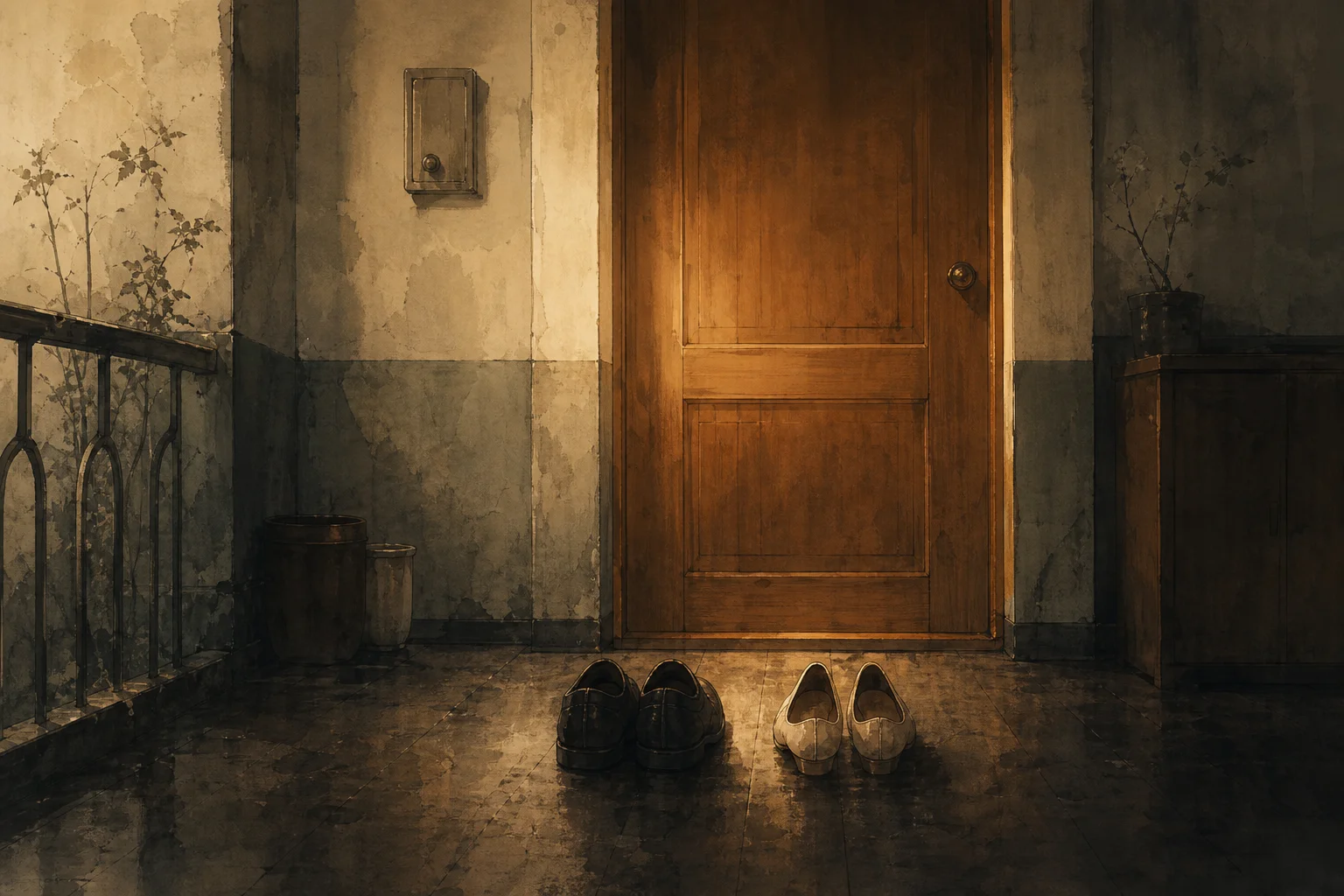
Everyone misses someone in a different room
Sang-hoon and Gi-hoon’s cleaning office gives Yoon-hee a brief, painful look at the family she has endangered. The brothers are not successful by any ordinary measure, but the room has ease in it. Sang-hoon says cleaning suits him because he wants to clean dirty things when he sees them. Mother feeds everyone braised kimchi and complains about the grocery burden of grown sons who returned home. The table is ordinary, loud, alive.
Yoon-hee sits there knowing Dong-hoon knows. She is being treated as family by people who do not know the fracture has already happened.
Yu-ra’s phone call with Gi-hoon is the gentler echo. She is working, liked by the cinematographer and lighting director, but her heart keeps jolting. Gi-hoon says he is coming. She stops him when the offer has done its work. She is ten percent brighter because he would come.
That is a very Park Hae-young measure of healing: ten percent. Brighter by a count a person can believe.
Ji-an, meanwhile, is pulled between performance and truth. At work, her colleagues keep inviting her to meals because Dong-hoon has asked them to keep trying. She refuses, accepts, then leaves. Ordinary company still feels like a trap.
At night, she confronts Dong-hoon with the feeling she most wants to kill. Missing him. Worrying about him. Wondering why he is not wearing the slippers she gave him. She asks him to hit her in the head so it will stop. The request is ugly because it comes from the only emotional grammar she knows. Pain ended things before. Maybe pain can end this too.
Dong-hoon will not give her that. He calls her crazy, which is a failure of tenderness and also the limit he has been trying to hold. Ji-an pushes harder. If he will not hit her, she will assume he likes her. She will tell the whole neighborhood.
The scene is dangerous because it names the misunderstanding the story has been refusing to indulge. Ji-an’s attachment is real. Dong-hoon’s care is real. Romance is the wrong container for both. They are left in that difficult space, where gratitude, loneliness, shame, and desire have started using the same words.
What works
The nursing-home passage is the standout because it trusts writing, silence, and waiting. Bong-ae’s gratitude does not need a speech. A few written lines carry a whole life of fear for Ji-an after she is gone.
The Hugye-dong material is nearly as strong. The soccer lie is comic, but it also explains why Dong-hoon can offer Ji-an a hundred people without boasting. These men may be foolish, loud, and bad at secrecy, but they know how to arrive.
Yoon-hee’s scenes sharpen the marriage without turning her into a single-note traitor. Her anger at Joon-young comes partly from guilt, partly from disgust, and partly from the late recognition that Dong-hoon’s silence was not stupidity. It was pain with manners.
What stumbles
The private-investigator material is functional, and the chase gives Ji-an a quick tactical win, but it is less textured than the scenes around it. Joon-young needs a way to threaten Dong-hoon publicly, and the photos provide it. Still, the mechanics are cleaner than the emotions.
The final confrontation also walks a hard line. Ji-an asking to be hit is faithful to her damage, but it risks being reduced into romance if viewers ignore how frightened and self-punishing she sounds. The warning signs are there.
What this sets up for Episode 11
Dong-hoon’s promotion fight is now active, and Joon-young has a new angle: not proof of an affair, but enough material to smear compassion as impropriety. Ji-an knows the attack is coming, which means her next choice will matter more than the scheme that hired her.
Yoon-hee can no longer live inside the mercy Dong-hoon offered her without seeing its cost. Sang-hoon’s divorce papers are signed. Gi-hoon has become someone’s late-night comfort. Everyone is being asked whether shame will make them hide, confess, or protect someone else.
For Ji-an, the question is sharper. She has paid the debt, placed Bong-ae somewhere safe, and heard Dong-hoon tell her that her past can be nothing if she refuses to bow before it. Now she has to decide whether she believes him enough to stop helping his enemies.
Rating: 9.6/10
More episodes from My Mister — Park Hae-young's quiet masterpiece, episode by episode. Jump to any episode in the season:
Where to go next
Reviewed by Mira Vance · QuizFandom Editor & Lead Reviewer. Every rating is an honest per-watch assessment from the desk that also writes the quizzes — not a press release rehash.