ONE PIECE S2 Episode 7 Review: Chopper's flag, Hiriluk's impossible cure, and the monster who finally gets named
What happens — the short version (spoilers)
- Luffy and Sanji tease the talking Chopper until Luffy touches Hiriluk's flag and exposes the wound beneath the joke.
- Kureha recalls Wapol's Great Doctor Hunt and Hiriluk finding a wounded, frightened Chopper in the snow.
- Hiriluk names Tony Tony Chopper, explains devil fruits, and teaches him that a pirate flag can stand for conviction.
- Dying, Hiriluk drives Chopper away, but Chopper returns with the poisonous mushroom he believes will cure him.
- Wapol tricks Hiriluk to Drum Castle, where Hiriluk gives the forgotten-man speech and dies by his own explosives.
- Dalton defies Wapol, Chopper asks Kureha to teach him medicine, and Luffy later hangs Hiriluk's flag proudly.
ONE PIECE* Season 2 finally gives Drum Kingdom its heart, and it turns out the heart is bruised, blue-nosed, and carrying a pirate flag like a medical oath. Episode 7 slows the outward voyage so Kureha can tell the story of Tony Tony Chopper and Dr. Hiriluk, but the hour does not feel like a pause. It reframes the whole island through one lonely child, one terrible doctor with a beautiful dream, one tyrant who mistakes fear for rule, and one captain who knows exactly why a flag should never stay folded in a box.
Luffy and Sanji find the talking reindeer, and Hiriluk’s flag turns the joke serious
The episode opens with the village hunting the “beast,” then cuts back to the castle where Luffy, Sanji, and Nami are trying to decide what they just saw. The first version of Chopper that the crew meets is pure confusion: maybe hallucination, maybe a talking animal, maybe dinner if Sanji wants to push the joke too far. The scene is funny because everyone is asking the wrong question with total confidence.
Then Luffy touches the flag.
That touch changes the scene. Chopper can ignore being called a bear, a dog, a raccoon, a monster, or dinner. He cannot ignore someone handling that pirate flag like a toy. His first real spoken boundary is not about his body. It is about memory. The flag arrives as a sacred object first, and the flashback spends the rest of the hour proving why.
Kureha’s answer to Luffy’s question gives the flashback a clean entry point. Chopper has a wound in his heart. He has been alone his whole life, except for the worst doctor on the island, who still mattered to him more than anyone else. That sentence is the episode’s whole balance: Hiriluk is ridiculous, dangerous, moving, and indispensable all at once.
Kureha remembers the Great Doctor Hunt, and Hiriluk finds Chopper bleeding in the snow
The Great Doctor Hunt makes Wapol’s rule uglier than the usual pirate-king cruelty. He does not only hoard money or command soldiers. He rounds up Drum Kingdom’s doctors and keeps medicine hostage in the castle. Anyone who resists can die. A country famous for healing becomes a place where illness depends on royal permission.
That leaves Kureha and Hiriluk as the two free doctors, which is a terrific pairing because they cannot stand each other and still understand the same rot. Kureha calls him an incompetent quack. Hiriluk calls her a greed-driven witch. Under the insults, the difference is brutal: Kureha knows the country is sick and doubts it can be saved; Hiriluk knows the country is sick and keeps chasing a cure anyway.
Chopper enters that argument as proof of how deep the damage runs. The villagers have shot him because he can talk, because he looks different, because fear has had years to become reflex. Hiriluk finds him wounded, panicked, and ready to attack anyone who comes close. The doctor survives that first contact by doing something almost embarrassingly simple. He shows empty sleeves. He says his name. He says he will not hurt him.
For a season built around Luffy collecting people who have been mishandled by the world, this is the right origin for the next possible crewmate. Chopper is not won by strength first. He is reached by proof that someone can look at him and choose care.
Hiriluk names Tony Tony Chopper, and the pirate flag becomes a medical promise
The middle of the flashback is the episode at its most disarming. Chopper wakes, curses, admits that humans shot at him when he spoke, and explains that even the other reindeer shunned him because of his blue nose. Hiriluk does not try to make that pain smaller. He gives it a name it can survive: Chopper is one of a kind.
The actual naming scene is lovely because it is so specific and so silly. Hiriluk sees antlers that could chop down trees and lands on Tony Tony Chopper. It is not grand. It is not fated. It is a strange old doctor giving a lonely child a name he can say with warmth. Chopper likes it, and that is enough.
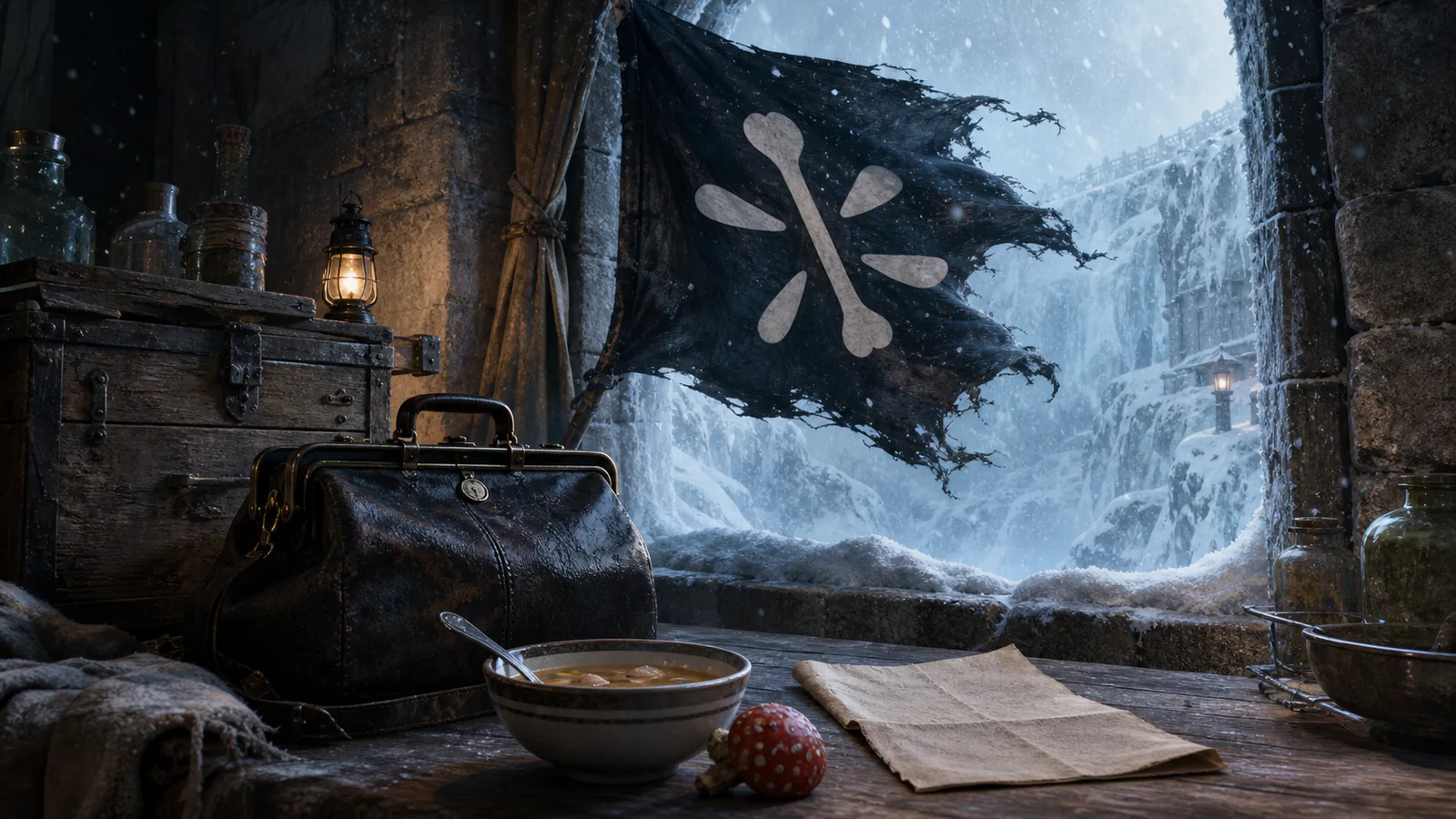
The flag lesson gives the name a future. Hiriluk tells Chopper about the robber healed by the sight of cherry blossoms, then explains his skull-and-crossbones as a symbol of conviction. In his mind, a pirate flag is not poison or threat. It is faith against impossibility. It means there is no such thing as an incurable disease. It means a person hoists the sign and fights.
That could tip into pure nonsense, but the episode grounds it in Hiriluk’s failures. His remedies explode. His science is suspect. His heart is not enough to make him a good doctor. Still, the dream he gives Chopper is real: the sea is bigger than Drum, and a life does not have to stay trapped inside the story other people wrote for it.
Hiriluk sends Chopper away, and the cure-all mushroom turns kindness into a wound
The harshest scene is not Hiriluk’s death. It is the door.
Once Hiriluk knows he is dying, he throws Chopper out with the worst words he can choose. He calls him a blue-nosed fool and tells him never to come back. The episode lets that land from Chopper’s side first, where it feels like abandonment and punishment. Only later does Kureha hear the truth: Hiriluk is trying to spare the only friend Chopper has ever had from watching him die.
It is a terrible kindness, and the show does not excuse how much it hurts. Chopper does what Hiriluk taught him to do. He refuses impossibility. He goes into the Valley of Death, comes back battered, and brings the mushroom he believes will save the doctor. The skull-and-crossbones in the book means danger, not miracle, but Chopper has learned a different language for that symbol. He sees hope where medicine sees poison.
Hiriluk understands exactly what happened. He drinks the soup anyway.
Hiriluk is not fooled. He knows the mushroom is lethal. He also knows what Chopper paid to bring it back. So he accepts the gift, lies with gratitude, and lets Chopper believe for one more minute that the soup has worked. Kureha has to be the crueler doctor afterward. Kindness is not medicine. Wanting to save people is not enough. If Chopper wants to keep anyone alive, he has to study.
Wapol traps Hiriluk at Drum Castle, and Dalton refuses to walk the king’s road any longer
Wapol’s fake emergency at Drum Castle is one of those villain moves that clarifies everything without needing much screen time. He spreads word that the captured doctors are sick, knowing Hiriluk will come. Hiriluk does come, loaded with explosives and still calling himself a doctor first. The trap works because his compassion is predictable.
The castle scene is cruel in two directions. Wapol laughs because no one is ill, then orders Hiriluk executed for being foolish enough to answer the call. Dalton watches the shape of his king with nowhere left to hide from it. Hiriluk’s speech gives him the last push. A man does not die from a bullet, a disease, or poisonous soup. A man dies when he is forgotten.
The speech reaches past Hiriluk into Drum itself. If a country can be remembered by someone who carries its better dream forward, then Wapol has not killed it yet. Hiriluk names Chopper as his son, asks them not to hurt him, thanks him, and makes Drum Castle his grave before the rifles can claim the moment.
Dalton’s turn is quieter but just as important. He refuses to hunt Chopper down. He tells the king he served Wapol’s father but will not keep walking the country toward collapse. That defiance gets him branded a traitor, and the final present-day cut makes clear Wapol has not forgotten it. Drum’s old wound is about to arrive at the village in person.
Chopper asks Kureha to train him, while Dalton trusts Vivi’s crew below the mountain
Chopper’s grief does not become action immediately. It becomes a vow. He will become a doctor. He will become a cure-all for every disease. The phrasing is childish and impossible, which is exactly why it belongs to him. Hiriluk gave him the dream. Kureha gives him the discipline required to chase it without killing the next person he loves.
Kureha’s “Call me Doctorine” is the best kind of acceptance. She does not soften into instant warmth. She does not pretend she was never hard on him. She lets the door open on her own terms, and that feels right for a woman who has survived Drum by keeping sentiment under lock and key.
Down the mountain, the present-day story keeps the tension alive without stealing the origin episode away from Chopper. Zoro, Vivi, Usopp, and Dalton wait for word from Luffy, and Dalton spots smoke from a campfire. His decision to investigate alone is a practical one, but his explanation matters more. He knows who Vivi is, remembers meeting her long ago, and decides that if she trusts these pirates, he can trust them too.
That makes Zoro’s little “acting Captain of the Guard” joke land as more than banter. Dalton is becoming, again, the kind of shield Hiriluk hoped Drum would still have.
Luffy hangs Hiriluk’s flag, and Chopper hears the words he needed years ago
The ending works because Luffy does not need the whole lecture to understand the core rule. He respects pirate flags. Hiriluk’s flag should not sit in a box. It should hang proudly, especially this one.
For Chopper, that is a direct hit. People have chased him, shot him, misnamed him, feared him, and turned his story into a local monster tale. Luffy looks at the flag that holds his grief and treats it with instinctive honor. Then Chopper sees Luffy’s stretched body and realizes the obvious thing the episode has been saving: Luffy is impossible too.
The line is simple: “I’m a monster too. Isn’t it great?” That is Luffy’s recruitment philosophy in one sentence. He does not ask Chopper to become normal. He does not ask him to explain his devil fruit, shrink his grief, or apologize for being strange. He reframes the insult as freedom. To Luffy, being monstrous means the world is wider than people said it was.
That is why Episode 7 earns its big flashback structure. It does not only tell us why Chopper hurts. It shows why Luffy is the first present-day person who can meet that hurt without trying to fix the wrong thing.
Tiny details worth clocking
- Sanji’s chicken soup impressing Kureha gives the castle scenes a small domestic warmth before the flashback drops the temperature.
- Hiriluk and Kureha insulting each other like old rivals keeps the tragedy from flattening either doctor into saint or skeptic.
- Chopper’s first fight being with Hiriluk is a beautiful little reversal: he needed a partner badly enough that even a quarrel felt like belonging.
- The poisonous mushroom misunderstanding works because Hiriluk taught Chopper the skull-and-crossbones as faith, then medicine forces the symbol back into danger.
- Dalton knowing Vivi from the Reverie quietly ties Drum’s political past to the Straw Hats’ present trust network.
Final verdict
Episode 7 is the season’s most emotionally direct hour so far, and it earns that directness by refusing to make Hiriluk clean. He is a terrible doctor in many practical ways. He is reckless, stubborn, often wrong, and far too willing to call a dream a cure. But he is also the first person to give Chopper safety, a name, a flag, and a horizon. A flawed rescuer can still change a life.
The structure is heavy on flashback, so the present-day plot advances in smaller steps: Dalton sees smoke, Wapol closes in, Luffy hangs the flag, and Chopper begins to see the Straw Hats differently. That is the tradeoff. Anyone waiting for a full Drum Kingdom battle will feel the hour holding the match just above the fuse.
But as Chopper’s origin, it lands. Hiriluk’s death speech, Kureha’s hard lesson about medicine, Dalton’s refusal, and Luffy’s final “monster” line all point in the same direction. Drum Kingdom is sick because fear has ruled it for too long. Chopper survives because three people, in very different ways, refuse to let fear be the final diagnosis.
Rating: 9.0/10 — A tender, funny, painful Chopper origin that gives Drum Kingdom its emotional center, with Hiriluk’s flag and Luffy’s final line turning a monster story into an invitation.
More episodes from ONE PIECE S2 — The Grand Line adventure, episode by episode. Jump to any episode in the season:
Where to go next
Reviewed by Mira Vance · QuizFandom Editor & Lead Reviewer. Every rating is an honest per-watch assessment from the desk that also writes the quizzes — not a press release rehash.