Star City S1E1 Review: The Soviet Moon Victory Comes With Locked Doors
What happens — the short version (spoilers)
- The Soviet Union secretly wins the moon: Alexei Leonov lands while his wife is taken from home and told under guard, and the Chief Designer is warned the KGB fears an American mole has the lunar base plans.
- New analyst Irina Morozova is stuck transcribing cosmonauts' private conversations, hoping to impress the legendary Colonel Raskova with better work.
- Cosmonaut Yana Akhmatova, expected to be the first woman on the moon, is arrested after Vika confuses her dead child brother with a same-named dissident writer; she's beaten until she confesses.
- Underprepared Anastasia Belikova is rushed in as Yana's replacement in three days, chosen for her loyalty and ability to recite Kremlin lines, while Valya rages that Yana should have the seat.
- Irina digs further, finds the real Ivan died as a child in 1949, and proves Yana's innocence to Raskova.
- During the mission, Belikova punctures her own malfunctioning suit to vent CO2 and barely crawls to the lander, surviving the descent everyone doubted she could make.
- Raskova orders Irina to shoot the innocent Yana, saying state power depends on never admitting it arrests the innocent; Yana is killed mid-plea.
- On the moon, Belikova names Yana and other women before the broadcast is cut, the announcer faking a lost connection while viewers see her speak silently.
The Soviet Union wins the moon, then spends the rest of the hour proving that victory can still feel like a prison sentence.
The story starts with a knock at the door, not a rocket. Alexei Leonov’s wife is taken from her home before dawn and brought to a room where the Chief Designer waits. She thinks something terrible has happened to her husband. Instead, she learns that he is already on the moon.
Glory arrives as a secret. Leonov steps onto the lunar surface for his country, his people, and the Marxist-Leninist way of life, while the woman who loves him finds out under guard. The parade comes later. Brezhnev honors the invisible Chief Designer. State announcers call Leonov a hero. Crowds celebrate a Soviet victory over the Americans. But inside Star City, celebration never quite separates from threat. The Chief Designer wants to talk about the next phase, Venus and Mars, because he believes the moon is only a stepping stone. Deputy Chairman Tarasov shuts him down and reminds him that the KGB is worried about what the Americans might do if his identity becomes public.
Then Tarasov adds the sharper warning: someone in Star City may already be working for the other side. American intelligence has acquired plans for the lunar base. The Americans are no longer just a rival on television. They are the explanation for every locked door and tapped room.
Star City is tied to the same alternate history that sent Alexei Leonov to the moon in For All Mankind, but the point of view changes the pressure. From here, the Soviet landing is a victory so sensitive that even wives, pilots, and engineers are treated like possible leaks.
Irina Morozova listens to cosmonauts from a desk
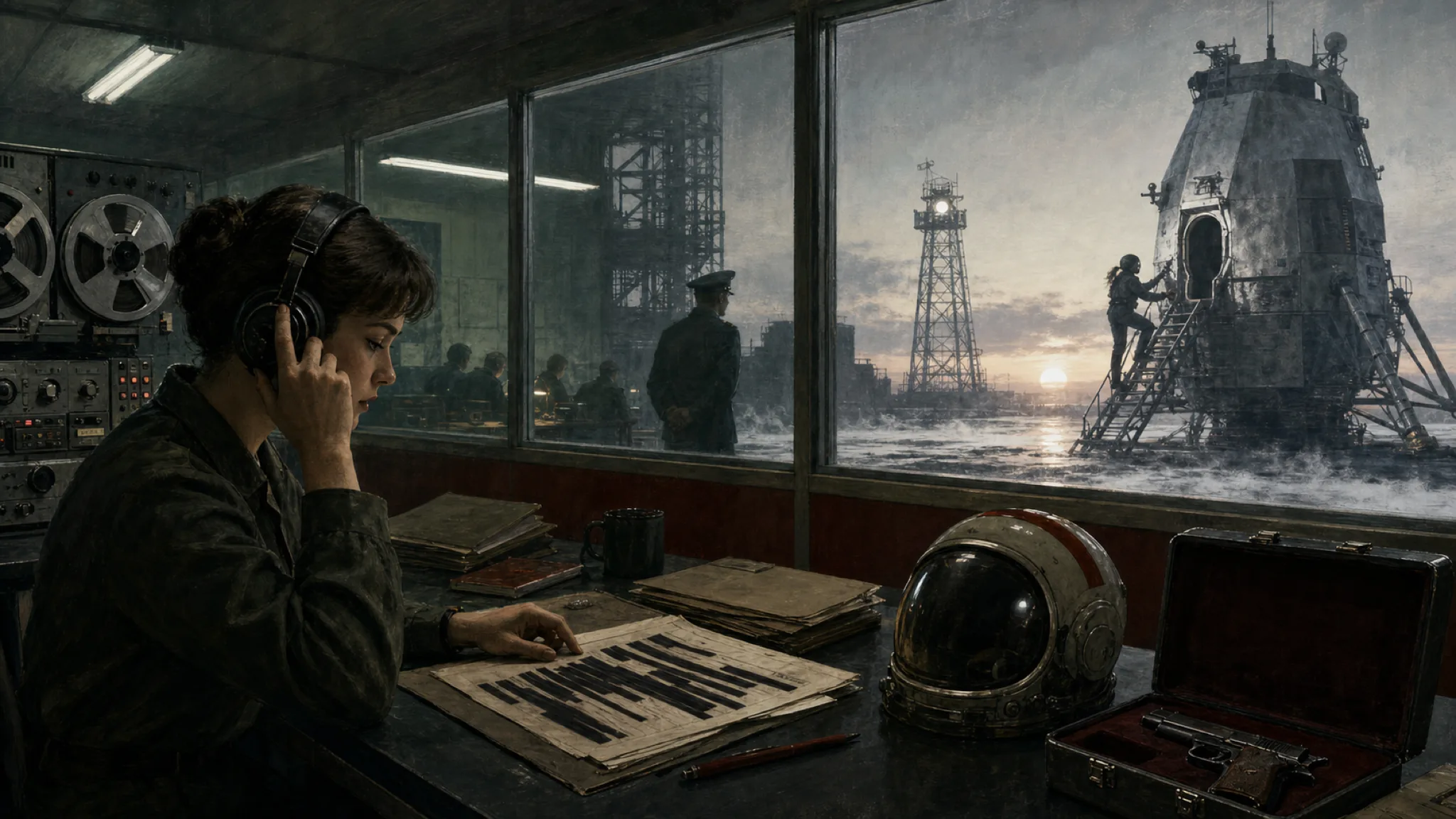
Irina Morozova arrives in Star City late and jokes that the building is a maze. Her first job is not to fly, design, or command. She listens. She sits with headphones and writes down domestic fragments from cosmonauts’ lives: toilet time, paprika in stew, bedroom arguments, anything the state might decide to call useful later.
She hates the dullness. After four years at Lomonosov, she did not imagine herself becoming a secretary for other people’s private moments. Vika counsels patience and says new workers always get the mundane assignments. Vika has a better one already: Yana Akhmatova, the cosmonaut expected to become the first woman on the moon. Irina has Valya Mironov and Tanya, his wife. Their apartment chatter feels almost harmless at first. Tanya worries about Valya’s assignments. She does not want to find out about her husband’s lunar mission the way Leonov’s wife did.
Nothing sounds dangerous. Irina writes down enough. Vika notices enough. A brother’s name becomes a charge. A conversation becomes evidence.
Colonel Raskova is introduced as the Night Witch, a legend rumored to have killed more than a hundred Germans. Irina wants her attention. She wants better work, and she is willing to earn it by burying someone. Better work means someone’s life may become a file.
Yana Akhmatova is arrested over the wrong Ivan
The first Luna 16 crew looks like a secret with momentum. Valya, Sasha Polivanov, and Yana train for the mission, while Anastasia Belikova is still treated as the alternate orbiting the real story. In the aircraft before a parachute jump, Sasha needles everyone and Belikova refuses to be treated like a cub. Her landing is rough enough for a jab, while Sasha fakes a chute failure badly enough to make his friends think he is dead, then laughs when they run toward him. It is childish and cruel, but it also gives the cosmonauts a few minutes of ordinary mess before Star City takes that away.
Vika’s discovery changes everything. Yana has said she will see her brother Ivan before launch. Vika checks the name and finds an Ivan Akhmatov connected to Sintaksis, an underground magazine. The assumption is immediate: Yana hid a dissident family connection to qualify for the program. Raskova questions her. Yana says Ivan is dead. Raskova says he is not.
The interrogation audio later makes the truth hard to miss. Yana insists she has done nothing wrong. She says she loves her country. She says she has a brother, but he is dead. The more she repeats it, the worse the beating gets. Eventually she gives the confession they want because she wants the pain to stop.
She is sacrificed because a bureaucracy cannot admit that one Ivan Akhmatov is not another Ivan Akhmatov. The mistake could be corrected. The evidence exists. But once the confession has been extracted, correction becomes more dangerous to the state than the falsehood.
The Chief Designer knows she did not do it. He calls Yana one of his eagles and breaks down because he can save rockets, missions, and propaganda victories, but he cannot protect a pilot from the people on his own side. His health scare earlier in the hour makes the weakness literal. His doctor warns him that stress could kill him after last year’s operation. He watches von Braun speaking on American television and spits out disgust that a Nazi can be paraded as a savior while he hides and another life is destroyed.
Anastasia Belikova is rushed into Yana’s seat
Moscow chooses Anastasia Belikova as Yana’s replacement. Raskova praises her party credentials, her father’s local position, and her reliability. Colonel Lyudmilla objects because Belikova cannot be ready in three days. The answer comes back with Soviet myth attached: Gagarin had three days.
Belikova gives the correct answer when the Chief Designer asks why she joined the cosmonaut corps. She says she did it for the glory of the Soviet Union. He calls it excellent. That is the problem. She has been chosen because she can repeat the line, not because she is ready to survive the mission.
Valya knows it. In the simulator, Belikova terminates a burn too early during reentry failure test 370 and overloads the capsule heat shield. Valya loses patience fast. Yana should be in that seat, he says, and Yana is likely on her way to a labor camp. He orders Belikova to stay quiet, press the buttons when told, and hope she does not kill them both when the launch becomes real.
Belikova is not arrogant. She is frightened, underprepared, and trying to obey. She has to memorize a speech written by the Kremlin about Soviet women, sacrifice, and the Revolution. She asks how she will know what to say, and the answer is that other people have already decided. All she has to do is remember the words.
The launch-day ritual gives her one small act of self-possession. Before boarding, Valya urinates on the bus tire because Gagarin did it before Vostok. Belikova asks what he is doing, hears the explanation, then hikes up her suit and answers the ritual in her own way while the men stare and laugh. It is crude, funny, and defiant. For one second, she is more than the acceptable woman selected by Moscow. She is someone figuring out how to belong in a tradition built around men.
Sasha’s affair gives Irina the missing answer
Irina’s breakthrough comes from an ugly private moment. Sasha is sleeping with Tanya while Valya trains. He treats the affair like another joke, calling himself a mouse and Tanya his cheese. The sex itself turns sour when he ignores her request to pull out, and Tanya has to tell him again that it is not funny.
Then Sasha gives Irina the key to Yana’s innocence. Tanya mentions the rumors about Yana’s dissident brother. Sasha says Yana told him she had not talked to her family in years. If that is true, then the case against her does not hold together. Irina brings the discrepancy to Vika, but Vika has just received a commendation for the report that condemned Yana. Retraction would humiliate her in front of Raskova. She calls Irina jealous and refuses to look again.
Irina keeps going anyway. She checks the grave and finds the real Ivan Andreevich Akhmatov, born in 1948 and dead in 1949. Yana’s brother was a child. The dissident writer is a different man with the same name.
When Irina brings the correction to Raskova, she does it with courage and an omission. She reports what Sasha said while speaking with Tanya, but leaves out that they were having sex. Raskova catches it at once. Irina claims it was not essential to the case. Raskova reminds her that her job is to write down everything she hears.
Raskova sees Irina’s privilege clearly — the Rublyovka softness, the assumption that some things will be handed to her. She also sees promise. So she takes Irina to fix the mistake.
Belikova survives the transfer as Yana is condemned again
The Luna 16 crisis and Yana’s fate unfold side by side. In orbit, Belikova makes her way from the orbiter to the lander when her suit CO2 begins rising. The scrubber is malfunctioning. Ground Control tells her to return to the command capsule, but she refuses because aborting would mean missing the landing window. The only proposed solution comes from Sergei Nikulov: puncture the suit near the release valve, let the carbon dioxide escape, and keep moving before pressure drops too far.
It is a terrifying fix. Belikova has to injure the thing keeping her alive. She does it anyway. The venting knocks her loose, the tether saves her, and then she is told to drop the tether because there is no time left. She crawls the last stretch with her vision warping and only minutes before unconsciousness. When she later appears on the lunar surface, the relief is real because almost everyone has underestimated her. Valya, Moscow, even the role she was given. She may not have belonged in Yana’s seat, but she earns the broadcast she is about to break.
Back on Earth, Irina and Raskova face Yana in custody. Yana confirms the truth. She tried to explain. She was beaten until confession felt like the only ending. Asked what she would do if released, she says she would return to training and do what is best for the space program.
For a moment, mercy seems possible. Raskova praises Irina’s promise. Then she orders Irina to shoot Yana.
Raskova does not flinch: “We do not arrest the innocent, comrade. Our power depends on it.” Yana’s innocence cannot be acknowledged because the arrest itself has already become state truth. Irina cannot save her by finding the facts. She can only prove whether she is willing to protect the lie.
Yana begs to go back to work. She says all she ever wanted was to fly. Then her plea cuts off.
Belikova names Yana on the moon
Belikova lands at Fra Mauro and prepares for the broadcast. Ground Control gives her exact instructions: camera placement, flag position, ninety seconds to air. She starts with the Kremlin words. “I am one woman,” she says, and takes the step for every woman of the Soviet Union, for those who dedicated their lives to the Marxist-Leninist way of life.
Then the speech breaks.
She stands on the lunar surface and names the women who came before her: Filosofova, Tereshkova, Yana Akhmatova. She calls them brilliant, fierce patriots and says the moment is for them. Not enough. Not even close. But it is a refusal to let Yana disappear into a false confession and a closed file.
Ground Control cuts the sound. The announcer pretends the connection has been lost while viewers around the world still see Belikova speaking silently on the moon. Irina goes home to her sleeping daughter. The public hears an inspirational quote about dedication to the Marxist-Leninist way of life. The people inside Star City know what was removed.
Verdict
“The Eyes” is a brutal first hour because its victories keep arriving with witnesses missing. Leonov wins the moon, but his wife learns under guard. Belikova becomes the first woman on the moon, but only because Yana was beaten into a lie and condemned again to preserve it. Irina finds the truth, but truth becomes her initiation into cruelty.
The For All Mankind connection gives the hour instant scale, yet the stronger material is smaller: Tanya asking not to be the last to know, Irina deciding what to leave out of a report, Valya raging at the wrong person, Belikova answering a men’s ritual in her own way, Yana begging to go back to work. The lunar setpieces land because the rooms beneath them are so frightening.
There are many people for one opener to introduce. Irina, Vika, Raskova, Valya, Tanya, Sasha, Belikova, Yana, Tarasov, Lyudmilla, Sergei, and the Chief Designer all arrive with jobs, secrets, and overlapping loyalties. A few early office exchanges carry more exposition than feeling. But the final twenty minutes tighten hard: the suit puncture, Yana’s last plea, and Belikova’s broken broadcast land as one continuous argument about what a nation will erase to keep calling itself victorious.
Star City begins with the Soviet Union ahead in space and ends with the cost written on three women: one ordered shot after begging to return to work, one blooded into complicity, one speaking into a microphone someone else can mute.
Rating: 8.7/10
More episodes from Star City — The Soviet space program's hidden cost, told from inside the cosmonaut city — episode by episode. Jump to any episode in the season:
Where to go next
Reviewed by Mira Vance · QuizFandom Editor & Lead Reviewer. Every rating is an honest per-watch assessment from the desk that also writes the quizzes — not a press release rehash.