Ted Lasso S1E2 Review: Be a Goldfish, Boss, and the Slow Work of Winning a Room
A losing match, a sabotaged manager, and a coach who keeps showing up with biscuits — Lasso's optimism meets its first real headwinds.
The pilot sold us Ted Lasso (Jason Sudeikis) as a man who treats hostility like weather: notice it, dress for it, move on. The second episode tests whether that posture is actually a strategy or just a personality tic. Rebecca Welton (Hannah Waddingham) wants to sabotage AFC Richmond. Jamie Tartt (Phil Dunster) wants the spotlight. Sam Obisanya (Toheeb Jimoh) wants to feel less alone. The fans want a different manager. Ted wants to bring his boss a cookie. By the end of the half hour, Richmond has been thumped 4-1 in front of its own supporters, and the show has quietly drawn the map of what it is actually going to be about.
Biscuits with the boss is the whole pitch in miniature
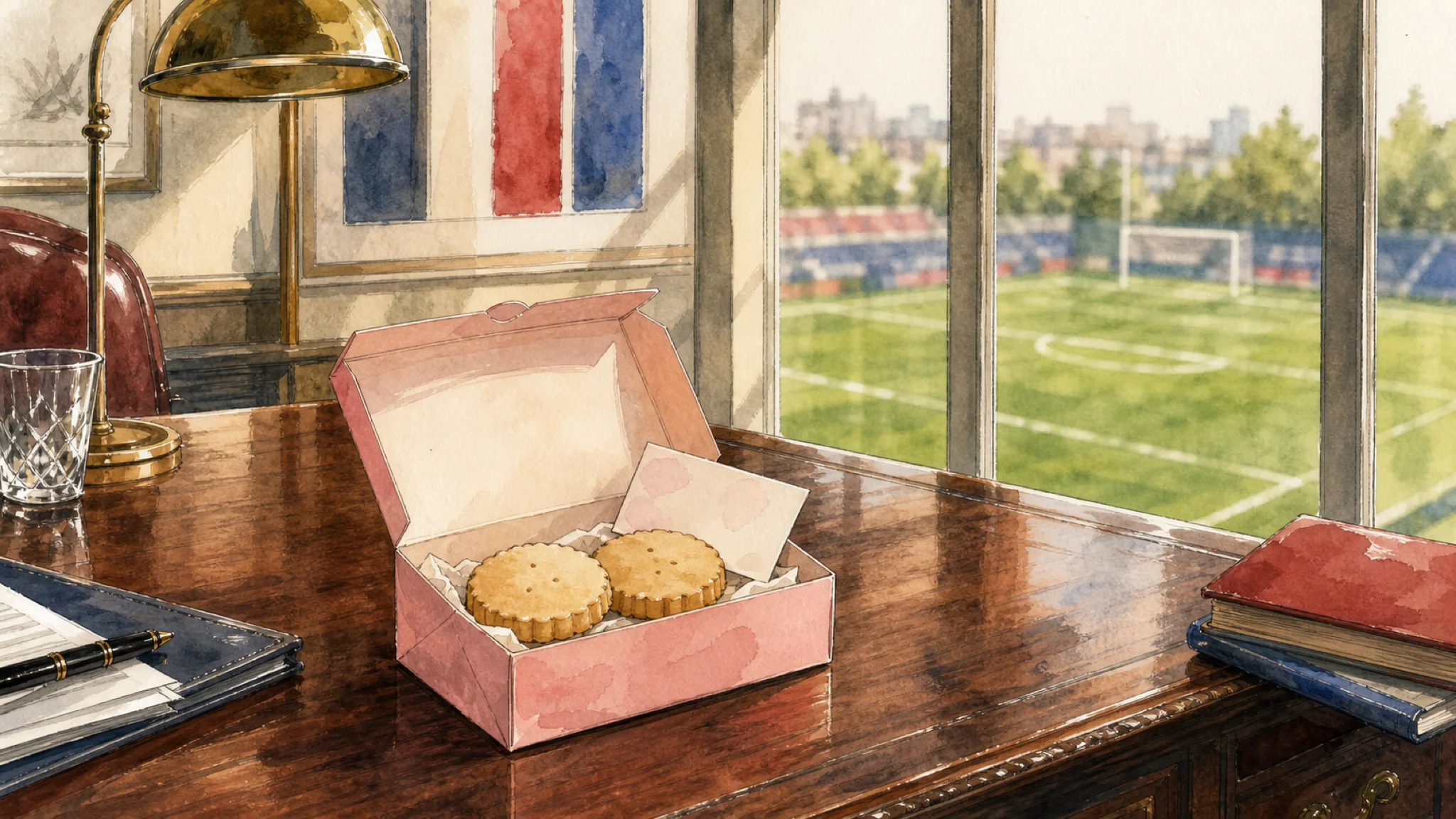
The episode opens with a ritual that will run through the season’s bloodstream. Ted, on coffee instead of breakfast because he had “one piece of cereal” and is pretty stuffed, walks into Rebecca’s office with a pink box. Inside are homemade shortbreads he calls cookies and then corrects to biscuits, with a warning not to smother them in gravy. Rebecca takes a bite, swears once under her breath, and asks where he got them. He does not say. He never says.
What looks like a sitcom bit is the show’s working thesis. Ted has decided that being a good partner means knowing the person across the desk, so he proposes a daily meeting called “Biscuits with the Boss” and tries to get her on the record about first concerts. She gives him the Spice Girls twice. He gives her Kenny Rogers. She tells him to stop, kindly and then less kindly, and asks if he is going to show up tomorrow with biscuits anyway. He tells her not to bet on that unless she wants to win a buttload of money. The joke is that he will obviously be back. The deeper joke is that she wants him to be.
Rebecca’s plan does not survive a second meeting intact. She tells Higgins (Jeremy Swift) that the most dangerous thing about Ted Lasso is not that he is bad at his job. It is that he is relentless and nice, and his players love him everywhere he goes. That, she says, is the one thing that could muck this up. She then assigns Higgins to find the source of the biscuits, which is its own little admission. She wants to know where the kindness is coming from so she can decide whether to be afraid of it.
Be a goldfish, and other ways to coach grief
If “Biscuits with the Boss” is how Ted handles power, “be a goldfish” is how he handles failure. After Jamie nutmegs Sam in a seven-on-seven drill called “The Exorcist” and crows over the corpse — “this spot here is where Sam died” — Ted pulls Sam aside. He does not give him a pep talk about effort or pride. He tells him the happiest animal on earth is a goldfish, because it has a ten-second memory. Be a goldfish, Sam.
The line is the kind of thing that lives or dies on tone. Sudeikis plays it as if he genuinely believes the fish has the right idea, and Jimoh receives it the way a tired kid receives a useful sentence from a grown-up he was not expecting to like. The choice to plant this in Episode 2, before the show has earned a tear, gives the audience a handhold for everything that comes later. Sam will be the show’s emotional engine. The episode introduces his loneliness through Nate (Nick Mohammed), who tells Ted that Sam has been underachieving since he arrived from Nigeria, and through Coach Beard (Brendan Hunt), who notes that Sam’s stats have cratered and that maybe the Premiership is too much for him. Ted’s answer is to find out when his birthday is.
The party in the dressing room before kickoff is one of the episode’s quiet wins. The team has gathered Nigerian Chin Chin in a box for Sam, who is briefly undone by it: “Wow, this is all I used to eat growing up.” Ted gives him a green plastic army man from a care package his own son sent. Sam, gracious and clear, asks if he can return it because he does not share Ted’s fondness for the American military. Ted says sure, calls it imperialism with a small embarrassed nod, and moves on. It is a tiny scene with enormous calibration: it lets a player tell his coach no without softening either of them, and it refuses the easy reading that warmth means agreement.
The suggestion box, the press conference, and the cost of being relentless
Ted’s other big experiment is a suggestion box, hand-decorated by Nate’s niece, that he and Beard plant in the locker room with the speech that the Internet has taught us it is easier to speak our minds anonymously. The first read is a slapstick massacre. “Wanker.” “Piss off, wanker.” “I hope you choke on a Big Mac.” Roy Kent (Brett Goldstein) signed his. Beard has to draw Ted a picture of what a wanker is, because Ted, a visual learner, would like to know. Buried in the pile is one note about the shower pressure being rubbish, which Ted dutifully notes — and which pays off later, when an unnamed player tells a teammate in the shower that the gaffer has fixed the water pressure. The box that exists to be insulted has produced exactly one useful piece of information, and Ted treated that piece as if it were the whole point.
The press conference is the episode’s hinge. Trent Crimm of The Independent asks Ted to explain the offside rule, and Ted invokes the U.S. Supreme Court’s definition of pornography from 1964 — hard to define, you know it when you see it. The joke lands and also reveals Ted’s actual hand: he does not understand the sport at the level the room expects, and he is going to keep performing his ignorance until it stops working. Then Ernie Lounds of The Sun turns the gun on Rebecca and asks about the newest girl who has come forward about her ex-husband Rupert, who, it turns out, has been cheating throughout their marriage. Rebecca lands a perfectly dry button — “all this time I thought men couldn’t multitask” — and the show takes its first real look at what is feeding her plan to bury Richmond.
That look is what powers the closing turn. Keeley Jones (Juno Temple) gets a full scene of her own here, dressed as a lion for a caffeinated-vodka shoot, sharing chips with Ted while he asks what motivates her boyfriend. She gives him an honest first answer, then a usable second one: positive reinforcement. The exchange does two pieces of work at once. It lets the show start drawing Keeley as a competent reader of the men around her rather than an accessory, and it sets up the photographer crouched at the edge of the moment. Rebecca gets the photos a beat later — Keeley sharing food with Ted, Ted leaning in, the star player’s girlfriend and the new manager looking too friendly. “Are you sure you want to do this?” Higgins asks. The press will eat them alive. Rebecca, after one long second, says do it.
What this episode argues
The thesis of the pilot was that warmth is a strategy. The thesis of the second episode is that warmth is going to cost something. Ted’s optimism is not a magic trick — Richmond plays “disjointed, uninspired, and joyless” against Crystal Palace, the crowd chants “wanker” through ninety minutes, and the table position drops to thirteenth. Jamie’s only goal is a meaningless consolation in injury time, which he celebrates like a World Cup winner. The press notice. Rebecca notices. The episode treats the loss as real and the warmth as real at the same time, and it refuses to let either cancel the other.
It also begins to hand the show its long-running internal vocabulary. Goldfish memory. Biscuits as a relationship. An older player muttering to a teammate in the showers that the gaffer has at least fixed the water pressure, which is the closest thing to a compliment any of these men will offer the new American for a while. The Jamie speech in the office, where Ted tells him he might be one in a million but he is still one of eleven, becomes a line Jamie repeats back to Trent Crimm in the corridor and then privately abandons the second Trent walks away. The kid still thinks his teammates were rubbish. The show is telling us, gently, that change is going to take longer than a clever sentence.
Verdict
This is a confident second outing that knows it has time. The biscuits, the goldfish, the suggestion box, the army man, the press conference, and the lion photo shoot are all small scenes pulling in the same direction: Ted’s method is going to be tested in public, his boss is actively working against him, and his best players are not yet on his side. The Crystal Palace loss is dramatized as humiliation rather than slapstick, which gives the closing locker-room cake speech its grace. Ted does not pretend it was fine. He brings sugar, plays Phife Dawg and Q-Tip on the speakers, and asks the press to come downstairs anyway.
A few seams show. The shoot-with-Keeley sequence has to do a lot of work in a short window — introducing her interiority, advancing Ted’s Jamie problem, and setting up Rebecca’s photo trap — and it leans on cuteness to get there. The suggestion-box runner is a touch long for the joke it lands, and Jamie’s heel turn at the press scrum is the most on-the-nose moment in a half hour that mostly trusts subtext. None of it sinks the episode. It is a half hour that earns the right to be liked and is honest about how slowly liking it is going to translate to results.
Rating: 8.5/10
More episodes from Ted Lasso — AFC Richmond's kindest revolution, episode by episode. Jump to any episode in the season:
Where to go next
Reviewed by Mira Vance · QuizFandom Editor & Lead Reviewer. Every rating is an honest per-watch assessment from the desk that also writes the quizzes — not a press release rehash.