The Boroughs Episode 1 Review: An Engineer, a Knife, and a Town That Won't Let You Leave
What happens — the short version (spoilers)
- Edward, a dying man, frantically calls his late wife on the phone before orderlies pull it away, setting the eerie tone.
- Sam Cooper, a retired engineer mourning his wife Lilly, arrives at The Boroughs furious and rips the AI 'Seraphim' assistant out of the wall.
- Edward breaks into Sam's kitchen with a knife, demands his dead wife back, insists 'it's in the walls,' and is dragged to The Manor by security.
- CEO Blaine Shaw offers to release Sam from his contract while warning that 'nobody's ever alone in The Boroughs.'
- At neighbor Jack's barbecue, Sam meets the misfit crew (Renee, Wally, Judy, Art) and Judy collapses into a seizure that Art handles a little too expertly.
- Sam admits to Jack that he hates everyone for still living, then walks toward Jack's house in the dark; what he finds there is left hanging.
Episode 1 is a slow-burn pilot about grief that ends with a hint of the show’s bigger argument — that loneliness, in the Duffer Brothers’ hands, is a horror story by another name.
Spoiler warning: This review discusses major events from The Boroughs Season 1, Episode 1.
The opening shot of The Boroughs is not the spaceship, the monster, or the science experiment. It is a man on a phone with his wife Grace, frantic, slipping in and out of memory and calling for their long-dead son Joey, until the orderlies pry the phone away. Edward (a heartbreaking pre-titles cameo) is sundowning, dying, or seeing something the show is not yet willing to name. By the time Sam Cooper’s family pulls into The Boroughs that same morning, the audience already knows what Sam does not: this place is not what its brochure promises.
Episode 1 is a grief portrait disguised as a sci-fi pilot, and the disguise is on purpose. The Duffer Brothers and showrunners Jeffrey Addiss and Will Matthews are taking the same toolkit they used on Hawkins, Indiana — the Spielbergian suburb, the synth cue, the kid bicycling past mailboxes that are slightly too uniform — and pointing it at a 75-year-old New Mexico retirement community. The result is a pilot that feels familiar in its rhythms and brand-new in what it is asking those rhythms to do.
The widower who refuses to be transitioned
Alfred Molina as Sam Cooper is the foundation the whole hour is built on. Sam is a retired aeronautical engineer whose wife Lilly died five months ago of a stroke. He arrives at The Boroughs because she picked it before she got sick, and he is too furious to admit that the alternative — moving in with his daughter Claire’s family in Albuquerque — would be unbearable for a different reason.
Sam carries himself with the precision of a man who has built his entire personality around being right. He notes that the wallpaper has been preserved per Lilly’s request. He labels boxes. He refuses the welcome-wagon beer. When the Seraphim — a hardwired AI assistant baked into every house — chirps a perky greeting, Sam rips it out of the wall hard enough to draw blood. “I do not need an electronic babysitter,” he tells Kayleigh, his “transition manager,” and the word transition lands like an insult, which is what he hears.
The grief, when it comes, comes sideways. Sam goes to the office to break his contract and gets ambushed by a flashback of Lilly in their old kitchen, dancing to Springsteen, asking him to dance with her one more time. He sees her. He calls her name. He runs out. The receptionist asks if he wants the appointment with the CEO. He says he has to go.
It is the sharpest grief beat in the pilot because it plays like a horror cut. The dance is normal. The cut to her absence is what registers as supernatural.
Edward in the kitchen with the knife
The midpoint of the hour brings the threat into Sam’s house, in the form of Edward, the man from the cold open who has wandered out of The Manor — the long-term care wing where The Boroughs warehouses residents with “Maxwell’s disease.” Edward is looking for his wife Grace, the previous owner of Sam’s house, who passed two months ago. He brandishes a knife. He demands Sam return her. He insists “it’s in the walls” and “you’re one of them.”
What makes the scene work is that Edward is not played as a monster. He is played as a man whose interior reality has not been updated since his last good week. He cuts Sam, screams, and is dragged back to The Manor by security. The next time we see him, in a fluorescent-lit common area decorated to look like a 1950s living room, he is calm, medicated, and — at CEO Blaine Shaw’s gentle prompting — apologizing as if reciting a poem he half-remembers.
Bill Pullman’s neighbor Jack will later joke that Edward “was a dick.” Sam’s first encounter with him is one of the season’s most efficient pieces of misdirection: the audience reads it as horror, the in-world residents read it as Tuesday.
Blaine Shaw and the contract
The pilot’s villain register is set in the meeting between Sam and Blaine Shaw. Shaw is the grandson of The Boroughs’ founder Marcus, who pitched a town just for retirees from a coal mine in 1949. Three generations of Shaws have owned this place. Shaw the Third has the bedside manner of a venture capitalist who has read three books about empathy.
He offers Sam release from the contract immediately. He explains that the company prefers not to drag the sheriff into “small stuff.” He notes, mildly, that Sam looks like a man with nowhere to go. “Loneliness is a disease just as savage as Maxwell’s,” he says. “And far more common these days. But nobody’s ever alone in The Boroughs.”
The show telegraphs Shaw as antagonist by what it does not show. He never raises his voice. He never threatens. He offers Sam coffee. He waits, with the patience of someone whose grandfather sold the same pitch in 1950 and whose grandfather knew, even then, what the buyer would not realize until much later.
The misfit crew assembles at Jack’s barbecue
The third act of the pilot is the Duffer Brothers writing a Stranger Things ensemble-introduction scene, except all the kids are in their seventies and the basement is a backyard with a Weber grill.
Jack Willard (Bill Pullman) is the welcome wagon — a former Santa Fe weatherman with sleep apnea, gout, and a relentless cheerful refusal to be left alone with his diagnoses. Renee (Geena Davis) is the woman whose stolen rose quartz the security chief refuses to take seriously; she has already saved Sam’s golf-cart battery and told him to stop being “a snippy little bitch.” Wally (Denis O’Hare) is a retired doctor with stage-four prostate cancer and a “back catalogue” he will not let anyone call a body count. Judy Daniels (Alfre Woodard) is a former journalist already digging into Sam from his wife’s obituary — “I’m not stalking, I’m investigating” — and her husband Art (Clarke Peters) is preserving his joy by playing golf with Maximo and refusing to call his terror by its name.
The scar-comparing scene is the show’s writers room flexing. Each character names the surgery that almost ended them and laughs about it. Jack offers a mole. Wally counters with prostate cancer. Renee shows them her chest scar — “they cracked your chest” — “they went in twice” — and wins. Sam, when asked, offers only the genetic retinal detachment that took his driver’s license. “We all become our fathers,” Wally tells him, and the line is heavier than the laugh that follows.
When Wally raises a toast — “To the Grey Rebellion!” — the show is naming both the season’s eventual title and the spiritual project of the pilot. These are people who refuse to be archived, and they have just noticed each other.
Judy’s seizure and what it might mean
The barbecue is interrupted by Judy collapsing into a seizure in the kitchen. Art catches her from behind, the standard hold. “It’s all right. I got her,” he says, and the moment is staged for the audience to wonder, for the first time, whether Maxwell’s is doing what Edward says it is doing or whether Maxwell’s is something the show has not yet shown.
Pay attention to who Art is in that moment. He has spent the episode shrugging off doctor visits, refusing exercise, calling weed Tiger Balm “unnecessary.” When his wife seizes in his arms, he handles it with the muscle memory of a man who has done this before. The pilot does not press it. The pilot does not have to.
Lilly in the dark, the wife who isn’t there
The episode’s emotional bottom comes when Sam, alone in his garage at night, kicks a door until his hand bleeds, then admits to Jack what the entire hour has been holding in reserve.
“My wife is dead. And the world just keeps on turning, and people just keep on living their lives. They shop, and they laugh, and they eat. And I hate ‘em for it.”
Jack’s reply is the closest the pilot comes to naming what it is about. “Grief makes your past feel too close and your future too far away.” Jack offers him a club and tells him golf is cheaper than breaking doors. Sam says he’ll think about it. He calls Shaw’s voicemail. He says he’s not leaving. He says he’ll see him around.
The episode could have ended there. It does not.
The closing shot
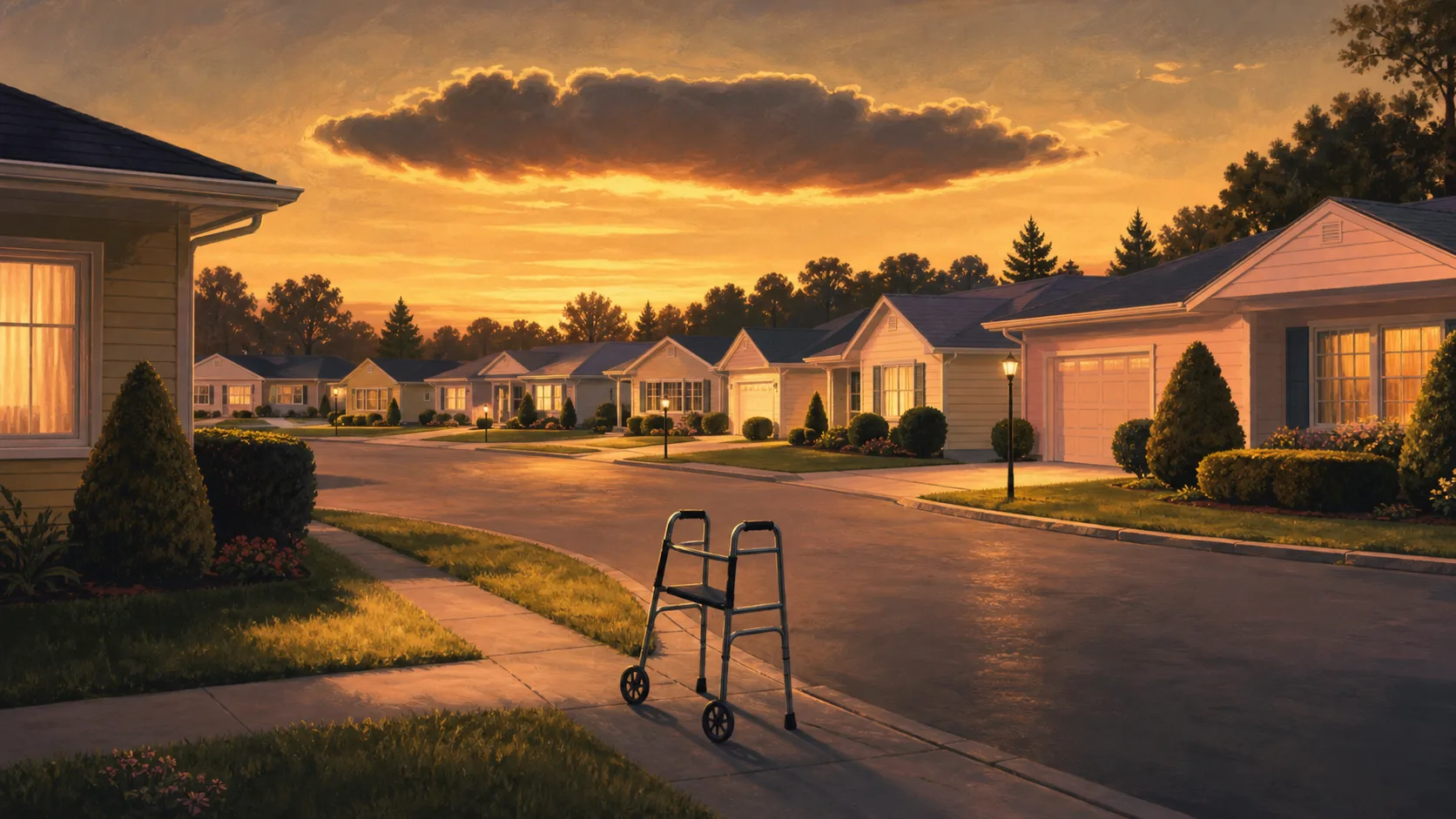
The final two minutes of the pilot are the show declaring genre. Sam walks toward Jack’s house with the Bob Seger song “Night Moves” playing diegetically from inside. He calls Jack’s name. He gets no answer. He walks farther into the dark — past the lit lawn, past the streetlamp, into a section of the cul-de-sac the camera has not shown us before.
The show does not give us what he sees. The hour cuts. The song plays on.
It is the right last shot. It tells the audience exactly what kind of season this is going to be without telling them what kind of season this is going to be. The owl is in the walls. The neighbor is missing. The man who was looking for his wife in another man’s kitchen is locked in a building Sam has been invited to admire. And the Duffers have, against the odds, made a Hawkins out of a 75-year-old retirement community.
Tiny details worth clocking
- Marcus Shaw, the founder, conceived The Boroughs in 1949 while working in a coal mine. The pilot establishes the timeline carefully — three generations, 75 years, money that has been compounding since Truman.
- Edward’s first phone call has him sliding between his wife Grace in the present and their son Joey in the past — Joey, who Shaw will later mention died young. The pilot drops this fact one line at a time.
- The Boroughs is, legally, “unincorporated land.” That detail will matter. Security chief Hank explains there are no police, no schools, only a county sheriff who is not encouraged to visit.
- Wally’s “back catalogue” line lands twice — once on Jack, once when Wally repeats it to himself.
- Renee tells Sam “snippy little bitch” and saves his battery. She is the only person in the show so far who treats him exactly the way Lilly did, and the pilot lets the audience notice that without saying it.
- The Seraphim is hardwired. Sam will need to remember this.
Verdict
The pilot does what the best Duffer Brothers pilots do: it sets a recognizable suburb on a slightly wrong frequency and trusts the audience to hear the difference. Sam anchors the hour with a grief performance that earns every minute of its 60-minute runtime. Bill Pullman, Alfre Woodard, Clarke Peters, Geena Davis, and Denis O’Hare each get one good scene and several great lines. Edward and the Shaws supply the menace. The argument the season is making — that loneliness in old age is its own horror genre — lands without overplaying.
The first hour is patient in a way modern streaming pilots usually are not, and it asks the audience to spend most of its runtime watching a widower be sad in a perfect house. It earns that patience by ending with the only kind of cliffhanger that works in a show about old people: a door, a neighbor’s lit window, and the question of what is happening inside it.
Rating: 8.6/10
More episodes from The Boroughs — Duffer Brothers' Stranger Things-adjacent retirement-community sci-fi, episode by episode. Jump to any episode in the season:
Where to go next
Reviewed by Mira Vance · QuizFandom Editor & Lead Reviewer. Every rating is an honest per-watch assessment from the desk that also writes the quizzes — not a press release rehash.