Viral Hit Episode 1 Review: "Do You Want to Become Stronger" — Kota Shimura Owes 1,000 Yen, Hamaken Gets Exposed, and a Chicken Mask Enters the Feed
What happens — the short version (spoilers)
- TOU-KEI opens the episode by asking whether oppressed viewers want to become stronger, then Hamaken uses Kota as makeover content for a stream with Rumi.
- Hamaken refuses to pay Kota the promised 1,000 yen, insults Mrs. Shimura's illness, and leaves Kota hiding bruises at Urabe General Hospital while she tells him to enjoy his youth.
- At American House Diner, Kota meets Kaho Asamiya, then Hamaken barges in with a burger challenge that turns the workplace into another content trap.
- Kanegon streams from Kota's room using Mrs. Shimura's ID and bank details, loses a 30,000-yen game mission, and provokes Kota into throwing his first punch.
- Kota's save-electricity habit causes the fight to auto-upload, making him a viral school spectacle and giving Kanegon the idea to expose Hamaken on their own channel.
- Kanegon explains the revenue math, TOU-KEI's zero-view fight video finds Kota, and the final setup turns Hamaken's next beating into the first true Viral Hit stream.
Episode 1 builds Kota Shimura's origin story out of three humiliations that all cost money: a fake makeover, a stolen bank account, and a beating that accidentally becomes content. The premiere is loud, ugly, and very online, but it keeps the center simple. Kota does not want fame first. He wants his mother treated, his lights kept low, and the 1,000 yen Hamaken promised him for being humiliated on camera.
TOU-KEI opens with a promise, and Hamaken turns Kota into makeover content before homeroom is over
The first voice in Viral Hit does not belong to Kota, Hamaken, or anyone at school. It belongs to a masked chicken on a dead channel asking a question with no chill at all: are you being oppressed right now? The pitch is ridiculous until it is not. “Become stronger, and you can change your world” sounds like algorithm bait, gym-bro mysticism, and a rescue line at the same time, which is exactly the weird lane this premiere wants.
Then Kota wakes up into the opposite of strength. His room already tells on him: the warning about fraudulent charges, the save-electricity sign, the text from Mom telling him to have fun at school. By the time he types back that he will, the lie is routine. Kota is not hiding one bad day from Mrs. Shimura. He is hiding a whole life.
Hamaken’s live stream makes that life public for laughs. He is celebrating more than 700,000 subscribers, Rumi is there to grow her new influencer profile, and Kota is dragged on as the model for a makeover he clearly did not volunteer for freely. Off-camera, Hamaken’s crew tells him to look like he is having fun because it is worth 1,000 yen. On-camera, Kota says hello with panda makeup on his face while his own narration does the cleaner damage: he laughs at things he does not find funny, nods at things he does not agree with, and just takes it.
Hamaken keeps Kota’s 1,000 yen, Mrs. Shimura hands him a rice cake, and Kaho Asamiya notices him at the diner
The 1,000 yen is a small number until Hamaken refuses to pay it. That is one of the premiere’s better instincts: it understands that poverty does not always arrive as a grand speech. Sometimes it is a kid asking for the money he was promised and getting kicked for being desperate. Hamaken makes it worse by dragging Mrs. Shimura into the insult, turning her illness into one more punchline, and Kota’s first thought afterward is not revenge. It is regret. He should have taken a swing.
At Urabe General Hospital, he does the exact opposite. Mrs. Shimura sees his marked-up face and asks if he was fighting; Kota says he tripped. She gives him a rice cake, worries about his school life, and tells him to enjoy being young. The hospital bill sitting between them is 3,140,000 yen, but Mrs. Shimura still talks like Kota’s youth is the thing she wants to protect. That makes his silence heavier than the bruise.
The diner gives him one clean second of teenage normalcy. Kota is frying potatoes at American House Diner, thinking this is his youth, when Kaho Asamiya arrives as the new employee. She is kind, direct, and immediately too bright for the room Kota thinks he belongs in. His crush is played broad, and Kaho thanking him by name after Hamaken’s burger challenge crashes into the shift hits him like a gift. Kota thinks she knows him; she is reading his name tag. For him, that still counts as being seen.
Hamaken invades the diner, Kanegon uses Mrs. Shimura’s bank account, and Kota throws his first punch at home
Hamaken’s diner stunt is pure nuisance content: make a cheeseburger in under 30 seconds, or the cute waitress gives up her number. Kaho tells him he is bothering customers. Kota tries to stop the stream without becoming the target and almost gets away with it. Then Hamaken sees him outside, punishes him for ruining “content,” and leaves him to explain the damage to Kaho as friendship.
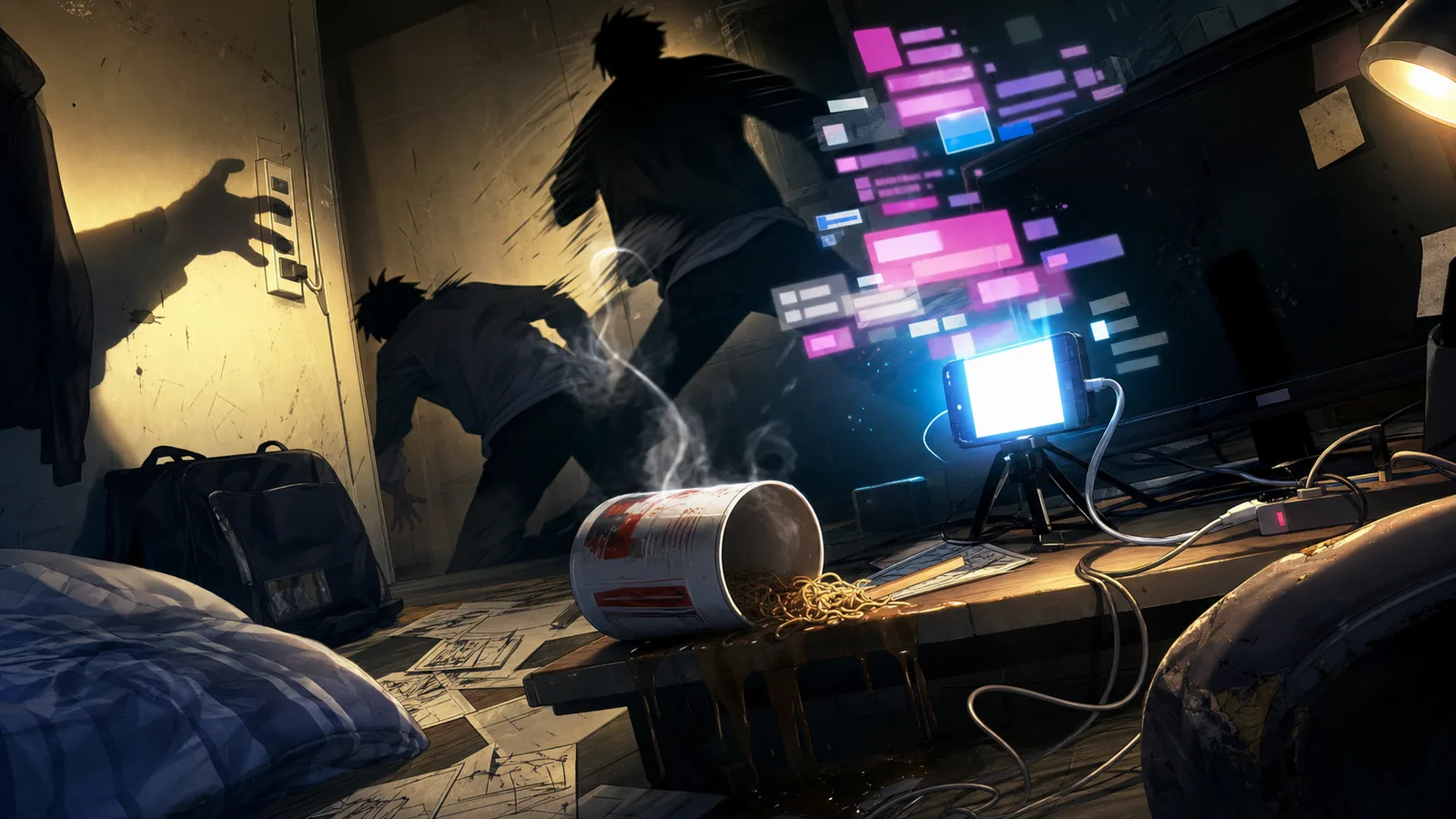
Kanegon takes the intrusion one step lower. He is in Kota’s room playing a game on stream, chasing donations, and using Mrs. Shimura’s ID and bank details because minors need a parent’s bank account to open a channel. It is such a grim little scam that the comedy has to run fast to keep up: Kota spills hot noodles, Kanegon loses a 30,000-yen mission one hit from victory, and the beating that follows happens in Kota’s own home.
The turn comes when Kanegon says Mrs. Shimura is going to die because Kota is useless. Kota grabs him. He lands the first fist he has ever raised, takes the first fist to his own face, and realizes something dangerous: fighting is not as impossible as he imagined. It still hurts. He still has to clean the room afterward. He still remembers to save power. That last detail is brutal in the plainest way. Kota can cross a line and still be the kid trained to turn off the lights.
The webcam uploads the whole fight, Hamaken drops Kanegon, and Barber Yashio quietly introduces Aki
The accidental upload is the premiere’s cleanest joke and its nastiest trap. Kota thinks he pulled the plug, but he only turned off the monitor. Then he shuts down the computer to save electricity, and the platform does the rest: the stream auto-uploads the whole fight from the webcam. The humiliation he wanted buried is now a “Live fight lol” clip with views climbing past 100,000.
School flips fast. Kota arrives hoping nobody saw it and immediately gets greeted as a viral streamer. Hamaken tries to laugh with the room, but Kanegon has lost usefulness to him. The bully who built his brand on camera-ready dominance cannot stay attached to someone who got beaten by Kota, so he drops Kanegon in public and insists they were never friends. It is ugly image management, and everyone knows what they are watching.
Kanegon, to his credit and his discredit, learns the right lesson for the wrong reason. He is not sorry for stealing Kota’s mother’s information or helping Hamaken grind Kota down. He is furious because he worked his way into Hamaken’s good books and got tossed out of the feed. Across town, Barber Yashio gives Aki a tiny dinner beat before the plot fully hands her the channel. She does not enter Kota’s life yet, but the premiere has already put another watcher near the feed.
Kanegon pitches an exposé, Hamaken stops the stream, and Kota keeps standing up for the money he is owed
The first revenge plan fails because Kanegon tries to expose Hamaken on Hamaken’s channel. The bully stages a fake reconciliation, promises a giveaway computer to anyone who likes and subscribes, and lets Kota and Kanegon apologize like props. Kanegon blurts the truth anyway: the giveaways are fake, Hamaken never paid Kota, and the nice-guy streamer beats people behind the scenes. Then Hamaken reveals the stream stopped a while ago.
That should be the end of it. Instead, Kanegon reframes the beating in real time. Do it on their channel, he says. They are minor celebrities now; an exposé video will go viral. Kota says no because Hamaken will beat him again. Kanegon says the word that cuts through every moral objection in the room: “Money. Don’t you want money?”
So Kota gets up. Not because he suddenly wants status, and not because he has discovered courage as a clean anime upgrade. He gets up because Kanegon offers 10,000 yen, because Mrs. Shimura refused Keytruda, because the hospital bill is not going to pay itself, and because Hamaken still owes him. Kota’s repeated “You owe me… 1,000 yen” is funny until it turns into a fighting stance. Hamaken beats him down, Ogi Tatsuya shuts the room up long enough to reveal how far above this school ladder he stands, and the video goes viral anyway.
Kanegon explains the revenue math, TOU-KEI appears with zero views, and Kota chooses fight streams over staying at the bottom
The exposé succeeds, but Kanegon still refuses to pay the promised 10,000 yen. His reason is pure platform brain: short videos do not make enough ad revenue, donations matter, fees leave only about 60 percent, and this beating was worth 3,900 yen after all that. The scene is blunt, almost too blunt, but it gives Viral Hit its engine. Kota has found a way to make money from being hit; Kanegon has found a way to make the hit last longer.
That is where the partnership forms. Kanegon wants fight streams: Kota picking fights with delinquents in real time, stretching each beating long enough for donations to rise. He calls himself Kota’s producer and promises him cash. Kota hears the number 200 million and stops hearing almost everything else. The premiere does not pretend this is healthy. It just shows why the pitch works on him.
Kota tries to learn how to last in a fight and finds the usual search results first: strength training, martial arts, boxing. Then a zero-view video called “Fighting Mindset” introduces TOU-KEI, the chicken-masked instructor from the opening. Kota’s response is perfect: why is he a chicken, is he not Japanese, this guy is nuts. But the line keeps following him. Hamaken is spiraling from backlash, Rumi walks past him, the club stops letting him in, and Kota keeps hearing the same question from the cold open: do you want to become stronger?
By the final chase, Kota and Kanegon have figured out the trick. Hamaken thinks he can take the phone away and stop the clip. Kanegon expects that, switches the setup, and sends Kota back into the beating with a new kind of purpose. Kota narrates it plainly: being on top never mattered to him. “All I need… is money.” The first view appears. Kota tells Hamaken to come at him. The channel is born at the exact moment the trap closes around everyone, including Kota.
Tiny details worth clocking
- Kota’s save-electricity habit causes the accidental upload, then reappears after his first fight when he turns the lights off in the wrecked room.
- Mrs. Shimura’s “only young once” returns through Kanegon’s schoolyard question about whether Kota is fine staying everyone’s laughingstock.
- Hamaken’s fake computer giveaway rhymes with his fake 1,000-yen promise to Kota: both are bait, just aimed at different audiences.
- Ogi Tatsuya barely does anything and still changes the temperature of the room; Hamaken quiets down the second someone outside the ladder speaks.
- TOU-KEI has zero views when Kota finds him, which makes the chicken mask funnier and stranger than a polished mentor entrance would be.
Final verdict
“Do You Want to Become Stronger” is a strong premiere because it never lets the viral hook float away from Kota’s body. The views matter, the comments matter, the subscriber counts matter, but every number comes attached to a bruise, a hospital bill, or a kid calculating how much pain he can afford to waste. Kota’s first power-up is the realization that the world already treats him like content, so he might as well invoice the beating.
The rough edge is the monetization exposition. Kanegon’s ad-revenue lecture is useful, and it fits his producer brain, but the scene pauses long enough to underline every term: short videos, donations, fees, 60 percent. The premiere is sharper when it lets the platform logic reveal itself through behavior, like Hamaken ending the stream before the exposé or Kanegon planning for the phone to be seized.
Still, that is a small drag on a nasty, confident opener. The final image works because Kota is not pretending the internet has made him noble. He is scared, broke, angry, and suddenly strategic enough to stand inside the frame on purpose. That is the hook: humiliation did not stop being humiliation. It just found a revenue model.
Rating: 8.4/10 — a grimy, funny, sharply targeted premiere with one slightly over-explained revenue scene, but a killer final turn from bullied kid to paid underdog.
More episodes from Viral Hit — Fight-stream anime, episode by episode. Jump to any episode in the season:
Where to go next
Reviewed by Mira Vance · QuizFandom Editor & Lead Reviewer. Every rating is an honest per-watch assessment from the desk that also writes the quizzes — not a press release rehash.