 NairobiThe one he couldn't save
 TokyoCrew he guarded to the end
 DenverHis closest crewmate
 RioThe kid he looked out for
 The ProfessorThe planner he served without question
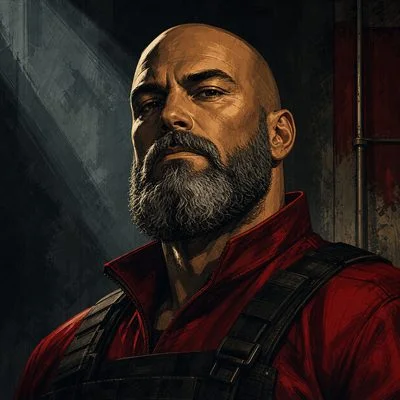
Darko Perić plays Helsinki — real name Mirko Dragic, revealed in Season 4, Episode 8 — as a man who decided at some point that the loudest thing he could offer the world was his presence. Not his words. Not his feelings. Just his enormous, reliable, grieving body standing between the people he cares about and whatever is coming for them.
That turns out to be enough.
Oslo dies and Helsinki carries him forward
Before the Royal Mint, before the jumpsuits, Helsinki and Oslo were already inseparable.
Their history stretches back through military service, through the Balkan wars, through the particular kind of bond that forms between two men who have watched each other survive things they were not supposed to survive. The show never dramatizes all of it. It does not need to. The way Helsinki and Oslo move through the Mint — always in proximity, always aware of each other’s position — tells you everything. They have been doing this for a long time.
In Season 1 and Season 2, they operate as a unit. Where Oslo is, Helsinki is close. When Oslo guards hostages, Helsinki watches the exits. They communicate in looks and gestures more than in sentences. If you were casting a thriller and needed two men who read like a single organism split into two bodies, you would cast exactly them.
Then Arturo Román, in a moment of cowardly desperation, attacks Oslo with a fire extinguisher in Season 2.
Oslo does not die from the blow. He lingers in a vegetative state, brain-damaged, breathing but gone in every way that matters. Helsinki sits with him. He holds his hand. He talks to him, though we never fully hear what he says. And then, when it becomes clear that Oslo will never come back, Helsinki makes the decision himself.
He pulls the oxygen mask away.
“Rest in peace, Oslo,” he says.
He says it quietly. No dramatic swelling. No trembling lip held for the camera. Just a man doing a terrible, necessary thing for someone he loves, and saying the only words that feel true in that moment.
That is the scene that defines Helsinki’s entire relationship with grief. He does not fall apart. He does the thing. And then he keeps moving, with all of it still inside him.
One night with Palermo, and the complications that follow
In Season 3, during the preparations for the Bank of Spain heist, Helsinki and Palermo sleep together.
Neither of them makes a production of it. Helsinki’s attitude toward the whole thing can be roughly summarized as: I am not gay, I am Helsinki. Bisexuality as a concept does not seem to interest him nearly as much as specific people do. He is not working through an identity. He is not announcing anything. He had feelings for someone and he acted on them, the same way he does everything else — directly and without ceremony.
The show treats this with the same matter-of-factness Helsinki does. There is no subplot about him “discovering” himself. There is no crisis. His sexuality is presented as one more thing that is simply true about him, alongside his Serbian military background and his taste for loyalty.
What becomes complicated is not the sex — it is what comes after.
Palermo is volatile. He loved Berlin with a devotion that warped him, and in Season 3 he channels some of that devotion toward Helsinki, but in a way that is more possession than partnership. He is jealous, then cold, then reckless. He gets himself captured by the police midway through the Bank of Spain job because his ego overtakes his judgment.
Helsinki watches all of this without much visible judgment. He is not blind to Palermo’s flaws. He is not naive about what he walked into. But he also does not stop caring. That quiet tenderness persists even after Palermo stops deserving it, because that is how Helsinki loves — not contingent on the other person being worth it.
It is not a healthy dynamic. It is an honest one.
What Helsinki actually does
It would be easy to file Helsinki under “muscle” and move on.
That would be wrong.
In Season 1, Helsinki is one of the people enforcing the perimeter on the Mint’s hostages, but he is also the person who holds Mónica Gaztambide’s hand through the aftermath of being shot. He does not talk to her like a hostage. He sits with her like a person in pain who deserves someone nearby. He gets her through the worst of it.
When Berlin orders the tunnel blown, Helsinki is the one who does it. He does not debate. He does not perform reluctance. He understands that the plan requires it and he executes. The efficiency is not cruelty — it is the military-trained part of him that knows hesitation costs more than certainty.
He puts the explosive vest on Arturo later, in a very different register. There is something almost patient in how he does it. Arturo has been causing problems since the first hour. The vest is not violence — it is the threat of consequence, delivered by the one person in the room who will absolutely follow through if necessary. Arturo knows this. Everyone in the room knows this. Helsinki does not need to say anything additional.
In Season 4, during the Bank of Spain operation, he is positioned at critical choke points, doing the physical work that keeps the rest of the gang alive to argue about their feelings. Gandia — the bank’s head of security, a brutal and highly trained opponent — moves through the team and does serious damage before he is contained. Helsinki does not come through that unscathed.
A marble statue falls on his leg during the confrontation with Gandia.
The injury is devastating. His leg is crushed beneath it.
The leg, and what Helsinki does with suffering
The injury becomes central to Season 5 in ways that are both literal and otherwise.
Helsinki’s leg has to come off. The amputation happens under impossible conditions — field surgery, limited supplies, the bank still under siege. He goes through it the way he goes through everything: not quietly exactly, but without performing his pain for an audience. He endures because enduring is what he does.
What makes the arc work is Manila.
Manila — Jonás, Denver’s childhood friend, later revealed to have been one of Berlin’s original crew — is the person who shows up for Helsinki when he needs someone to show up. Not with speeches or declarations. With presence. She checks on him. She sits with him during recovery. She does not ask him to be fine faster than he is.
That is a recurring pattern in Helsinki’s life. The people who love him well are the people who understand that he does not need to be fixed. He needs to be accompanied.
His recovery is slow and unglamorous. There are no montages of him pushing through rehabilitation, no triumphant return to full strength mid-heist. He loses something real. He carries it forward with the same posture he brings to everything else — shoulders up, face steady, one foot in front of the other even when one of those feet is now prosthetic.
The quiet refusal to perform suffering is its own kind of strength.
The pattern of loving men who die
Look at the whole arc and a quiet pattern emerges.
Oslo dies in Season 2. Helsinki kills him gently, out of love, and carries the loss through everything that follows.
Berlin — to whom Helsinki was loyal without being close in the intimate way Palermo was — dies at the end of Season 2, walking back into the Mint to buy the rest of the gang an exit. Helsinki does not get a proper goodbye. Berlin simply does not come out.
Palermo survives. That is, in some ways, the harder ending of the three. Helsinki has complicated, unresolved feelings toward a man who is alive and difficult and permanently tangled in the aftermath of Berlin’s death. There is no clean grief there. Just an ongoing complicated thing that has no resolution except coexistence.
The show does not comment on this pattern directly. It does not need to. Helsinki does not comment on it either. He is not the kind of person who identifies patterns in his own life and talks about them. He just lives with what he has lost, and keeps making room for whoever is still there.
Helsinki on the beach, at the end
The finale puts Helsinki on a beach in the sun.
He is alive. He has his friends. He has his amputation and his grief and his one-night stand turned complicated and his dead brother and his dead almost-brother and the memory of every decision he made in every impossible room over five seasons.
The survival feels earned. Not because Helsinki did anything to deserve it in a moral accounting sense — none of them do, really — but because the show has invested in him as someone whose continued existence matters. He is not just a soldier. He is a person who made people feel less alone in very bad circumstances, and that person is still here.
Manila is beside him.
He does not make a speech about what it means to be alive.
Of course he does not.
Helsinki has never needed words for the things that matter most. His grief lives in the set of his jaw, in the way he still pauses in the middle of something and you can see Oslo there, or Berlin, or the ghost of a night with Palermo that turned into something neither of them had a name for. He carries all of them. He always will.
The beach is warm. He looks out at the water.
That is enough.
Which Yellowstone Universe character are you?
24 questions. Beth, Rip, Spencer, Cara, John, Kayce — pick your spirit Dutton.