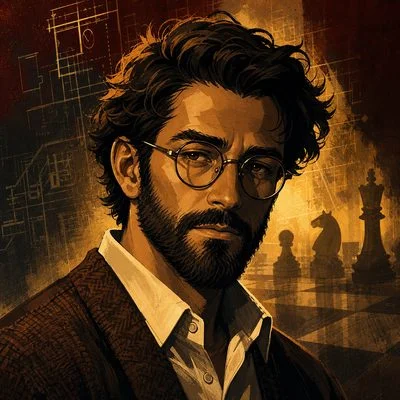
 BerlinBrother — the plan he inherited
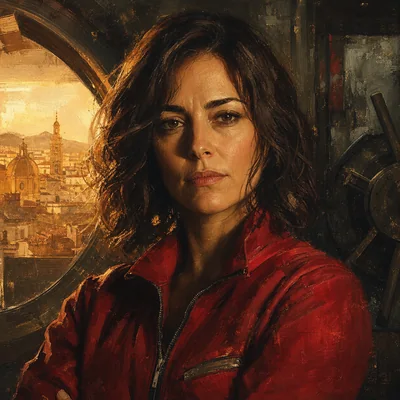 LisbonLove — the variable he never solved
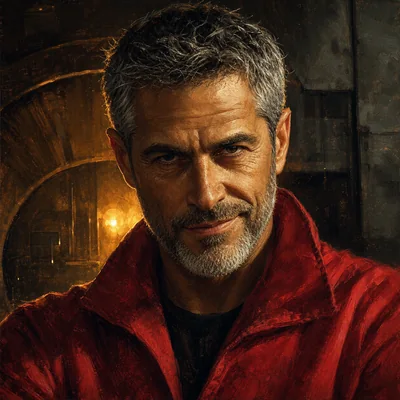 PalermoBerlin's replacement and co-architect
 TokyoThe narrator he recruited at her lowest
 RioThe kid the whole second heist was to save
 NairobiThe heart of the crew he sent inside
 DenverMoscow's son, loyal to the end
 Alicia SierraThe pursuer who became an ally
Most heist stories are built around someone who punches through walls. Sergio Marquina — The Professor, played by Álvaro Morte — does the opposite. He sits outside. He draws the blueprint. He accounts for every contingency except the ones that involve his own heart, and those nearly kill everyone.
That tension — between total control and the one variable he can never fully solve — is what makes him worth watching for five seasons.
Origin: the sick child and his father’s failed dream
Sergio’s father was not a criminal by nature. He was a desperate man with a dying son and no legal options left.
The original plan — rob the Royal Mint of Spain, print your own money, walk out untouched — was designed as a way to buy Sergio’s survival. His father died before he could execute it. A botched robbery, a body on the floor, and a boy still in a hospital bed who would eventually learn that his father’s death was the price of a dream that never got off the ground.
What Sergio did with that grief was not normal.
Most people bury a parent’s failed plan. Sergio spent decades improving it. He pulled in his brother Andrés. He studied economics, psychology, negotiation, pressure tactics. He mapped every centimeter of the Mint. He did not just inherit his father’s idea — he made it airtight and then ran it successfully, in his father’s memory, with his father’s name on every coded transmission.
Calling himself “The Professor” is partly ego, partly armor. But the name his crew uses on the radio — “Dalí” — is a mask over a mask. The person underneath both is a boy who never stopped trying to finish what his father started.
The brother — Berlin and Andrés de Fonollosa
Berlin is everything Sergio is not allowed to be.
Where Sergio stays outside, Andrés walks in through the front door. Where Sergio calculates, Andrés improvises and enjoys it. Where Sergio falls apart when Raquel appears to be dead, Andrés faces his own death — Mossman’s disease, a body shutting down piece by piece — with something close to elegance.
Their relationship is not warm in any conventional way. Andrés is cruel, aristocratic, and frequently monstrous. But he is also the only person who knew Sergio before the plan existed. He knew the sick boy. He knew the father. He chose to be there for the Mint job not just because the plan was good, but because Sergio was his brother.
The Bank of Spain flashbacks make this clearer. Andrés volunteered for the Mint knowing he would not survive long enough to do it a second time. His terminal illness was not an obstacle — it was a reason. He wanted one last thing that mattered. Sergio gave him that.
In return, Andrés gave Sergio something harder to quantify: permission to be ruthless. Berlin made all the decisions inside the Mint that Sergio could not make from a distance. When hostages needed controlling, Andrés controlled them. When lines needed to be crossed, Andrés crossed them. Sergio got to stay clean, at least in his own accounting.
He was not clean. But he had a brother who let him pretend.
Tokyo: the recruitment style
The way Sergio recruits tells you everything about how he reads people.
Tokyo opens the whole series with a voiceover about the worst day of her life — police closing in, her boyfriend bleeding out, no exit. And then a stranger appears and offers her something no one else has: a way out that still has dignity attached.
He does not recruit people who are doing fine. He finds people at the exact moment when ordinary life has collapsed around them. Río trapped under his family’s debt. Nairobi watching custody vanish. Denver unable to see a future that isn’t crime. He walks in when hope is lowest, offers a plan so complete it feels like safety, and names them after cities so that the crew has no real past to carry into the job.
The city names are not whimsy. They are a deliberate erasure. No surnames, no histories, no way for one member to compromise another by accident. Sergio understood that the biggest security risk in any heist is not the police — it is the humans you bring with you.
He was right about that. He was also somewhat ruthless about it. The people he recruited were genuinely vulnerable, and he knew it before he knocked on any door.
Raquel: love or manipulation
This one does not resolve cleanly, and it should not.
When Sergio approaches Raquel Murillo, he already knows she is the lead inspector on the Mint case. He also knows, from research, that she came out of a marriage to an abusive man, that she is psychologically trained to read people but still tends to give them more good faith than they deserve, and that she passed a polygraph under pressure.
He targets all of that. The cider workshop is not accidental. The patient listening, the lack of performance, the way he seems genuinely interested in her life rather than impressed by her rank — none of it is purely spontaneous.
And yet.
He falls in love with her. Genuinely. Inconveniently. In a way that breaks his own plan multiple times and nearly destroys the entire operation.
When he believes she has been killed, he stops functioning. He cannot run the Bank of Spain job from a distance because his distance is gone. He makes irrational decisions. He exposes himself. He risks everything for one person in a way the original spreadsheet never allowed for.
So was it manipulation? Yes, at the start — he chose her deliberately and studied her vulnerabilities first.
Was it love? Also yes.
The uncomfortable truth is that both things are true simultaneously. He began with calculation and ended up somewhere he did not plan for. That might be the most human thing about him.
The Professor’s monasticism
Sergio does not drink. He does not indulge. He lives in houses stripped of unnecessary objects. He plans with an almost religious discipline. Between jobs, the flashbacks show him testing scenarios alone, running simulations, treating every variable as a confession that might destroy him later.
This is not just personality. It is a defense system.
He cannot enter the bank. He cannot be inside the thing he built because he is the only person who holds all the information. If he gets caught inside, everything ends. So the rules of the job require him to stay outside — and over time, he has built a life that looks a lot like that constraint. He stays outside of most situations. He observes. He plans for what might go wrong before he allows himself to feel anything about what might go right.
There is loneliness in that. The crew are inside together — they eat, fight, grieve, form bonds under pressure. Sergio watches on a monitor. He hears gunshots through a radio earpiece. He knows what is happening, but he is never in the room where it happens.
It protects him. It also costs him more than he admits.
Not a leader — an architect
This is where a lot of analyses get it wrong.
Berlin runs the floor inside the Mint. Berlin makes real-time decisions about hostages, about tone, about violence. When something goes sideways, Berlin improvises. Sergio cannot improvise from a safe house — by the time a situation reaches him, it has already become something his plans didn’t anticipate.
His actual authority over the crew comes through the plans themselves. Hamelin. Cameroon. Alcatraz. Paris. He names his contingencies like cities because a plan has to feel like a destination to work. The crew trusts him not because of charisma or command presence, but because the plans keep working.
But leadership requires presence, and Sergio is almost never present in any meaningful way until the plan forces him out of his safe house. When he finally enters a building — truly enters it — it is usually because everything else has failed and his body is the last variable left.
He is not comfortable in that mode. You can tell.
The true architect of the heists is also, in some ways, the person least equipped to survive when the blueprint runs out.
The series-ending shape: the man who made it out
When Money Heist ends, Sergio is alive.
He is on a beach with Raquel. They made it. By every measure of the plan, the Bank of Spain job succeeded — the gold was extracted, the crew walked, the police were left with nothing they could use.
But the crew that trained in Toledo for five months is gone. Moscow died inside the Mint. Berlin died at the end of Part 2. Nairobi was shot through a window while holding a photograph of her son. Tokyo detonated herself in a hallway to take out thirty Special Forces soldiers.
Sergio carries all of that.
He built the plan that put them in those buildings. He chose them at their lowest and gave them something worth dying for, and some of them died for it. He can tell himself that they consented, that they knew the risks, that the plan was sound. All of that is true.
It does not make the beach uncomplicated.
He is alive, and Raquel is beside him, and the money exists somewhere the government cannot touch. He survived the thing that killed his father, finished the plan that outlived his father’s hope, and made it to the other side.
But the boy who got sick in a hospital while his father planned a robbery — that boy had a father who died for him. Sergio had people who died for his father’s dream, and his, and maybe for something bigger than either.
The beach is beautiful. The sand is warm. Sergio Marquina sits there and does not quite look like a man who has put it all down.
Which Yellowstone Universe character are you?
24 questions. Beth, Rip, Spencer, Cara, John, Kayce — pick your spirit Dutton.