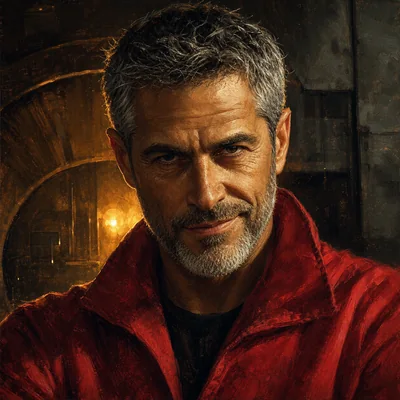
 BerlinHis love and the architect he replaced
 The ProfessorBerlin's brother, his uneasy commander
 NairobiThe crew he turned against, then regretted
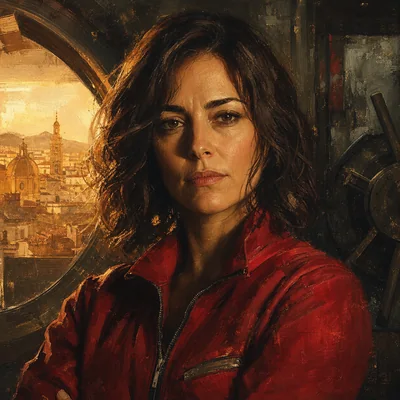 LisbonCo-lead inside the Bank job
 HelsinkiMuscle he relied on
Berlin is dead by the time Palermo walks through the door. Technically he never walked through it at all — he was the one standing outside, drawing the blueprints, feeding the math to Berlin in the years before the show started. When he finally gets his own heist, the ghost of the man who recruited him runs the whole operation from memory.
That tension makes Palermo the most divisive new character the back half of Money Heist produces. Viewers who loved Berlin wanted his replacement to match the energy. Palermo was never meant to match it. He was built to fail in different ways for different reasons, and Rodrigo de la Serna plays him with a specific, uncomfortable intensity that made half the audience furious and the other half fascinated.
The planning years and Berlin’s romantic partner
The relationship between Palermo and Berlin precedes every heist the audience has ever seen. They met before the Royal Mint, during the long theoretical period when Sergio Marquina was building the plan. Andrés de Fonollosa — Berlin — was never just Sergio’s older brother. He was also the man who recruited Palermo, who recognized a kind of structured obsessive intelligence in him and pointed it at a problem worth solving.
What the flashbacks reveal in Season 3 is that their relationship was romantic. Not symbolic, not subtext — a real partnership that Palermo never moved past. He loved Berlin. He still loves him, past tense made permanent.
That context transforms everything that follows. Berlin chose Tatiana for the Royal Mint and left Palermo out of it. This is presented as the wound that sits under all of Palermo’s volatility. He was not excluded from the first heist because Berlin doubted his ability. The architecture of the Royal Mint was simpler — it needed a charming negotiator on the inside, a man who could perform theater for weeks without cracking. That was Berlin. The Bank of Spain required something else entirely. It required the kind of technical obsession that could map a flooded subterranean vault, calculate gold smelting rates, and design a tunnel extraction that nobody in Spanish law enforcement would anticipate. That was Palermo.
Berlin gave him the more complex heist because he trusted him more, not less. Palermo knows this. He also knows it does not stop him from being angry about Tatiana.
The Bank of Spain blueprint
The heist Palermo designed is a different animal from the Royal Mint.
Where Season 1 and 2 were about holding a building and its people while printing money, the Bank of Spain plan is a demolition problem. The gold is in a vault below sea level. Getting it out requires flooding the vault, melting the gold into portable blocks, and running an underwater tunnel exit that bypasses the army and police surrounding the building. Nobody goes home rich by printing — they go home by removing what was already there.
All of that engineering belongs to Palermo. The flooded vault plan is his. The gold smelting timeline is his calculation. The tunnel runs on his specs. He spent years mapping the bank’s infrastructure before Sergio agreed to move forward, and his obsession with the technical details is what makes the heist survivable in theory.
The problem is that engineering a heist and running one through a crisis are completely different skills. Berlin had both. Palermo has the first and catastrophically lacks the second.
The S4 command takeover and its collapse
When Sergio gets captured in Season 4 and goes into Europol custody, somebody has to run the operation from inside the bank. Palermo steps into that role with the confidence of a man who spent years believing he was waiting for exactly this moment.
He is wrong almost immediately.
The mistakes stack fast. His first instinct under pressure is control — not the charismatic, manipulative control Berlin used to bend people’s behavior, but a raw top-down authority that assumes the crew will follow orders because the orders come from him. When they do not, he escalates. The Arturo vest incident — using the odious Arturo Román as a human shield by strapping explosives to him — is Palermo’s work. It keeps the police from breaching the building but it costs him almost everything else. The crew watches him weaponize a person they despise and understand, correctly, that Palermo will do the same to any of them.
The Gandía interrogation goes worse. Gandía is the bank’s head of security, the most dangerous person trapped in the building, and Palermo’s handling of him shows every flaw in his command style. He underestimates physical threat because his understanding of the operation lives in blueprints and timelines, not bodies and violence. Gandía escapes and kills Nairobi.
That death ends Palermo’s command.
Nairobi is not just a casualty. She is the emotional center of the crew — the one person everyone trusted and no one wanted to lose. Her death on Palermo’s watch turns what was already crew frustration into something closer to grief-rage. Helsinki strips his authority. The rest of the crew follows. Palermo goes from tactical commander back to the person standing in the corner with the best floor plans and no leverage.
Palermo does not completely fall apart after losing command. He is furious, he argues, and he keeps insisting he was right about the strategic calls even as he acknowledges the human cost. That refusal to entirely break — to keep making the case for his decisions when the case has already lost — is either arrogance or uncomfortable integrity, depending on how you watch him.
Palermo and Helsinki
The relationship between Palermo and Helsinki across Seasons 4 and 5 is one of the stranger things the back half of the show manages.
Helsinki is built for loyalty and endurance. His leg injury keeps him close to Palermo in ways that proximity gradually makes complicated. They are not equals and never pretend to be. But there is something in the tenderness Palermo extends toward him that does not read like manipulation.
Part of it is grief. Palermo is carrying Berlin constantly, and Helsinki was there for all of it — the planning years, the first heist, the aftermath. He is one of the few people in the room who knew Berlin as something other than a legend. When Palermo is at his lowest, Helsinki does not offer comfort in any conventional sense. He just stays nearby. That counts.
Part of it is that Palermo, without Berlin, does not know how to want things for himself. He can want outcomes — the heist succeeding, the gold out, the exit secured. He has no practice wanting connection that does not route through someone else’s vision of him. Helsinki offers something that does not require him to perform.
It is not a romance. It does not need to be one to matter.
What Palermo represents in the crew
The easy read is Berlin’s understudy — a lesser version of the same archetype, brought in to fill the villain-adjacent slot once Berlin died.
That reading misses what he actually does.
Palermo is not there to replicate Berlin’s charisma. He is there to show what happens when the person who designed everything is put in charge of implementing it. Berlin had the social intelligence to manage people under pressure alongside the tactical intelligence to manage the plan. He could pivot. He could perform. He could be cruel in ways that made people obey rather than rebel.
Palermo cannot do most of that. His genius is real — the heist works in every technical dimension because of his planning — but the heist survives Season 4 because Sergio eventually gets back and because the people Palermo alienated keep doing their jobs anyway.
This is a different kind of competence failure. Not the kind that comes from not knowing enough. The kind that comes from knowing everything about the plan and almost nothing about the people executing it.
The grief over Berlin and the eventual loyalty to Sergio
What keeps Palermo from becoming purely a liability is that his loyalty, once it settles, is real.
He and Sergio share Berlin — the understanding that Berlin was a flawed and sometimes monstrous person whom both of them loved anyway. That shared grief does not get spoken out loud much, but it runs under every conversation they have.
His eventual loyalty to Sergio is not redemption in any clean sense. He does not stop being volatile or wrong in his calls. What changes is that he stops fighting for control and starts fighting for the outcome. The two things look similar from outside the building but feel completely different to the people around him.
He wanted to lead. He accepts that he cannot, not in the way the situation needs. That acceptance costs him something.
The beach at the end
Palermo survives Season 5 and ends up on the beach with the others.
He spent years building toward a heist that required Berlin to give it meaning — a heist that was partly a love letter and partly a proof of capability. Berlin is not there to see it work. The gold gets out. The crew escapes. Palermo stands on the sand with people who mostly spent two seasons doubting him.
He is alive and the plan worked, and those two facts sit next to each other without adding up to resolution.
Palermo is not a character who earns a clean ending. He earns a complicated one: the heist succeeds in his image, the man he loved is still dead, and what comes next is genuinely unclear.
The plan outlives the grief. Whether that is enough is a question the show leaves open, which is the right call.
Why the performance works
What makes Palermo land despite the divided audience reaction is that Rodrigo de la Serna never plays him as sympathetic and never plays him as purely antagonistic. The character sits in an uncomfortable middle space — someone capable of genuine tactical brilliance and genuine cruelty, someone whose grief explains his behavior without excusing it.
He is at his worst when he most needs to be right, and at his most human when he has run out of arguments.
That balance — brilliant, volatile, grieving, unlovable in specific ways — is harder to play than either full villain or clean redemption. De la Serna holds it across three seasons without softening the rough edges or playing them for sympathy.
Palermo’s mixed reception is a feature, not a flaw. A character everyone loved or everyone hated would have been simpler. He ended up as someone viewers argue about, which is closer to the truth of what he is: a man built around a dead man’s vision, trying to outlive it.
Which Yellowstone Universe character are you?
24 questions. Beth, Rip, Spencer, Cara, John, Kayce — pick your spirit Dutton.