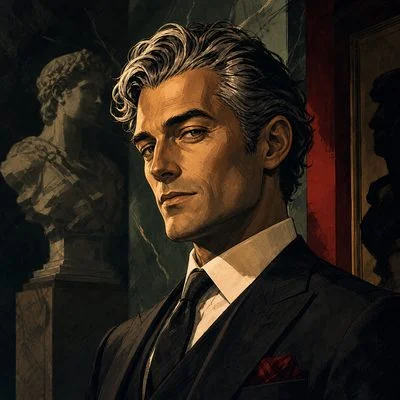
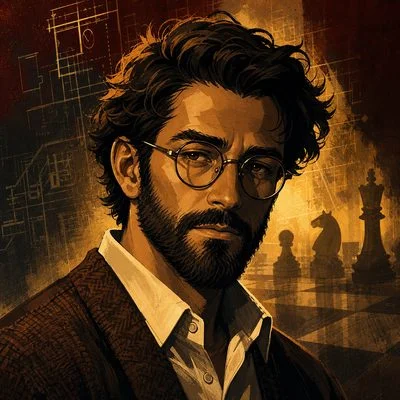
 The ProfessorYounger brother — the architect to his showman
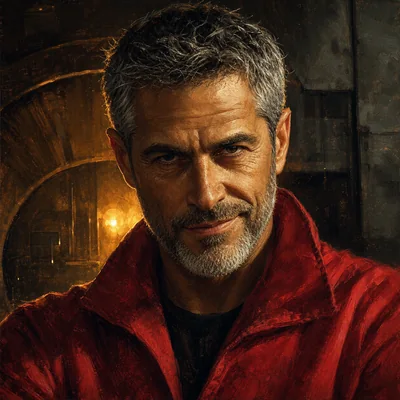 PalermoHis co-designer and his love
 RioThe kid he tormented and trained
 TokyoHis antagonist on the Mint floor
 NairobiCrew he never fully respected
 DenverMoscow's boy, under his command
Berlin enters the Royal Mint in Season 1 with the composure of a man attending his own investiture. He breathes with the hostages. He apologizes in a voice that sounds sincere. He threatens a man’s life in the same measured tone he might use to order espresso.
Pedro Alonso’s performance locks in immediately: this is not menace that announces itself. It is menace wearing excellent manners.
What followed across five seasons — and one spinoff — became one of the more unusual character arcs in recent prestige television. Berlin died in Season 2, definitively, on his own terms. Then came back in Season 3. Then Season 4. Then Season 5. The flashbacks kept accumulating until he had more screen time dead than most characters get alive.
Audiences did not object.
A dying man with nothing left to lose
Helmer’s myopathy is a degenerative neuromuscular disease. There is no cure. The progression is slow until it is not, and Berlin knows in Season 1 that his body is already beginning to betray him.
The illness does not make him sympathetic. It makes him theatrical.
A man who knows he will die slowly has a particular relationship with urgency. Berlin does not perform his cruelty despite his diagnosis — he performs it because of it. Every negotiation, every threat, every quiet confrontation is staged by someone who has already made his peace with the ending and only cares now about the quality of the act.
When he threatens Arturo with a fake explosive vest, he is not improvising panic management. He is directing a scene. He wants the humiliation comprehensive, public, and properly lit.
Berlin’s cruelty is never quiet. It does not do the work in the background. It dresses up, takes the center of the room, and demands an audience.
The illness gives that theatricality its bottom note. He has nothing to lose in the way people mean it when they say it as a warning.
He genuinely has nothing to lose.
What Berlin actually did at the Royal Mint
There is a version of the Berlin conversation that skips this section.
That version focuses on the opera references, the beautifully cut suits, the “love is to be lived” speeches, the final stand at the tunnel mouth, the way he says “I love you, little brother” into a dying phone call.
That version is incomplete.
Berlin handed Tokyo to the police. Not as a calculation about the heist — as punishment. Tokyo broke his rules, disobeyed a direct order, fired at officers when it was not her call to make. Berlin decided her sentence should be sexual humiliation at police hands, and he arranged it with the same composure he brings to everything else.
The crew knew what was happening. Some of them were horrified. He did not care.
He ordered Denver to execute Mónica Gaztambide, a civilian, because she had overheard information and he could not fold sentiment into his operational math. Denver could not do it. Berlin had no trouble issuing the order.
The Russian roulette negotiations — a loaded gun pressed to a hostage’s temple while he stared down the police inspector — were not leverage in any tactical sense. They were a performance about dominance, dressed up as pragmatism.
Arturo got a fake explosive vest strapped to his chest and was paraded before the cameras as a suicide bomber willing to die for the crew. The vest was inert. The humiliation was real.
These things happened. The man who did them is also the man audiences fell in love with. Money Heist understood that holding both of those facts at once was more interesting than resolving the tension.
The S2 last stand
The police breach the Royal Mint in the Season 2 finale.
There is a tunnel. Helsinki and Oslo rigged it with explosives. The crew has an exit.
Berlin does not take it.
He sends the crew through. He calls his brother. “I love you, little brother.” Then he picks up his rifle and walks toward the police alone, moving through a building full of hostages and flash grenades and armed officers, shooting and being shot, until the tunnel goes up behind him and the exit is closed.
This is not the show punishing him. This is Berlin choosing his death the same way he chose everything else: as an act, as a statement, on his terms, with nobody else making the decision for him.
His body degenerating slowly over years or his body ending in that hallway, standing up, doing what he wanted to do — there was no real question which he preferred.
The detail that carries the most weight is that he was already dying and already knew it. He was not sacrificing a long future. He was trading one ending for a better one.
That is what makes the last stand feel like a character completion rather than a dramatic convenience.
Berlin in flashback: Tatiana, Rafael, the planning years
The flashbacks in Seasons 3 through 5 are not nostalgia. They are a second character study.
The Italy years — Berlin and Palermo planning the Bank of Spain heist over years, in a villa, with red wine and blueprints and the kind of romantic obsession that gets dressed up as intellectual partnership. Tatiana, the pianist-thief, plays at parties for old money and passes intel to whoever is paying. She is drawn to Berlin because he sees her clearly. He is drawn to her because she understands that theft is an aesthetic practice, not just a financial one.
They marry. The marriage is wild and doomed in the way all of Berlin’s marriages are wild and doomed. He has four of them by the time the Royal Mint job begins. Each one ends. He treats this as the natural order.
Rafael is the surprise.
His secret son arrives in Season 5 as a revelation and a wound. Berlin had a child he mostly did not raise and never fully acknowledged. The flashbacks show the shape of it: a father who believes love is expressed through grand gestures and withholding, who cannot hold ordinary affection because he was not built for it, who passes criminal thinking to his son the way other fathers pass down a trade.
The Bank of Spain heist — the one that drives Seasons 3 through 5 — is Berlin’s plan in the same way the Royal Mint job was the Professor’s. He built it across years, in the flashbacks, with Palermo holding the blueprints and Berlin holding the vision. He never lived to see it executed. Palermo carries it forward as something between tribute and inheritance and grief.
Berlin and Palermo
The relationship between Berlin and Martín Berrote — Palermo — is the emotional center of the flashback seasons.
They are lovers. Berlin’s bisexuality is part of who he is, folded into his history alongside the four marriages and the criminal genius and the terminal illness and the countries where he has left legal or emotional wreckage.
Palermo is brilliant, volatile, and desperately in love with a man who refuses to treat love as something exclusive. Berlin believes desire belongs to the moment it occupies. He does not think fidelity is a virtue — he thinks it is a failure of appetite.
Palermo disagrees, in the way people disagree when they are already destroyed by someone and cannot stop.
When Palermo arrives at the Bank of Spain job in Season 3, Berlin has been dead for two years. Palermo built the plan with him. Palermo was supposed to lead it with him. He has to do it alone, carrying the memory of a man who never loved him the way he wanted to be loved.
That grief drives some of Palermo’s most self-destructive decisions in Seasons 3 and 4. He is not reckless. He is managing a loss that he cannot name cleanly because the thing he lost was never entirely his.
Why the flashbacks kept coming
After the Season 2 finale, the choice was to let Berlin stay dead or find a way to keep him in the show.
The flashback approach is the right call, and the reasons are visible in every scene.
A resurrected Berlin would require explaining why he survived, renegotiating his sacrifice, undoing the only moment where he fully controlled his own fate. He cannot come back without that death becoming something other than what it was.
A flashback Berlin can be anything the story needs him to be. Lover, father, architect, monster, best man at his own dissolution. The flashbacks show who he was before the Mint job cemented the worst of him, when the rot was seeping rather than flooding, when the charm was less obviously a weapon.
Pedro Alonso finds angles in Berlin that the Royal Mint version never had room for. A tenderness with Tatiana that is genuine before it curdles. A warmth with Palermo that exists before Berlin’s philosophy of love makes warmth insufficient. A father’s awkward attempt at Rafael that is not enough but is more than nothing.
The audience’s willingness to follow him through all of it is not cognitive dissonance. It is the actual argument: a person can be truly terrible and genuinely compelling, those qualities do not cancel each other out, and the most charismatic figures are often the ones who refuse to be legible by any simple moral measure.
What Berlin leaves behind
The Season 5 epilogue shows Rafael as a grown thief, carrying forward the methodology if not the soul.
The Berlin spinoff — now in its second season, the second series trailing the second heist — keeps revisiting who Andrés de Fonollosa was before the Mint job made his legend. The prequel format does what flashbacks do: it lets the audience stay with someone they already know is capable of terrible things, watching the road that led there, searching for the turn where it all went wrong.
They will not find a clean one.
Berlin did not have a defining betrayal or a single corrupting event. He had a worldview — performative, operatic, contemptuous of sentiment as weakness — that he applied consistently across marriages, crimes, loves, and wars. The cruelty at the Mint was not a departure. It was the same man in a different theater.
What the franchise gave audiences, and what keeps them coming back, is a character who never asks to be excused.
He did what he did. He meant it. He believed it. He died standing up.
That is what makes him impossible to leave alone.
Which Yellowstone Universe character are you?
24 questions. Beth, Rip, Spencer, Cara, John, Kayce — pick your spirit Dutton.