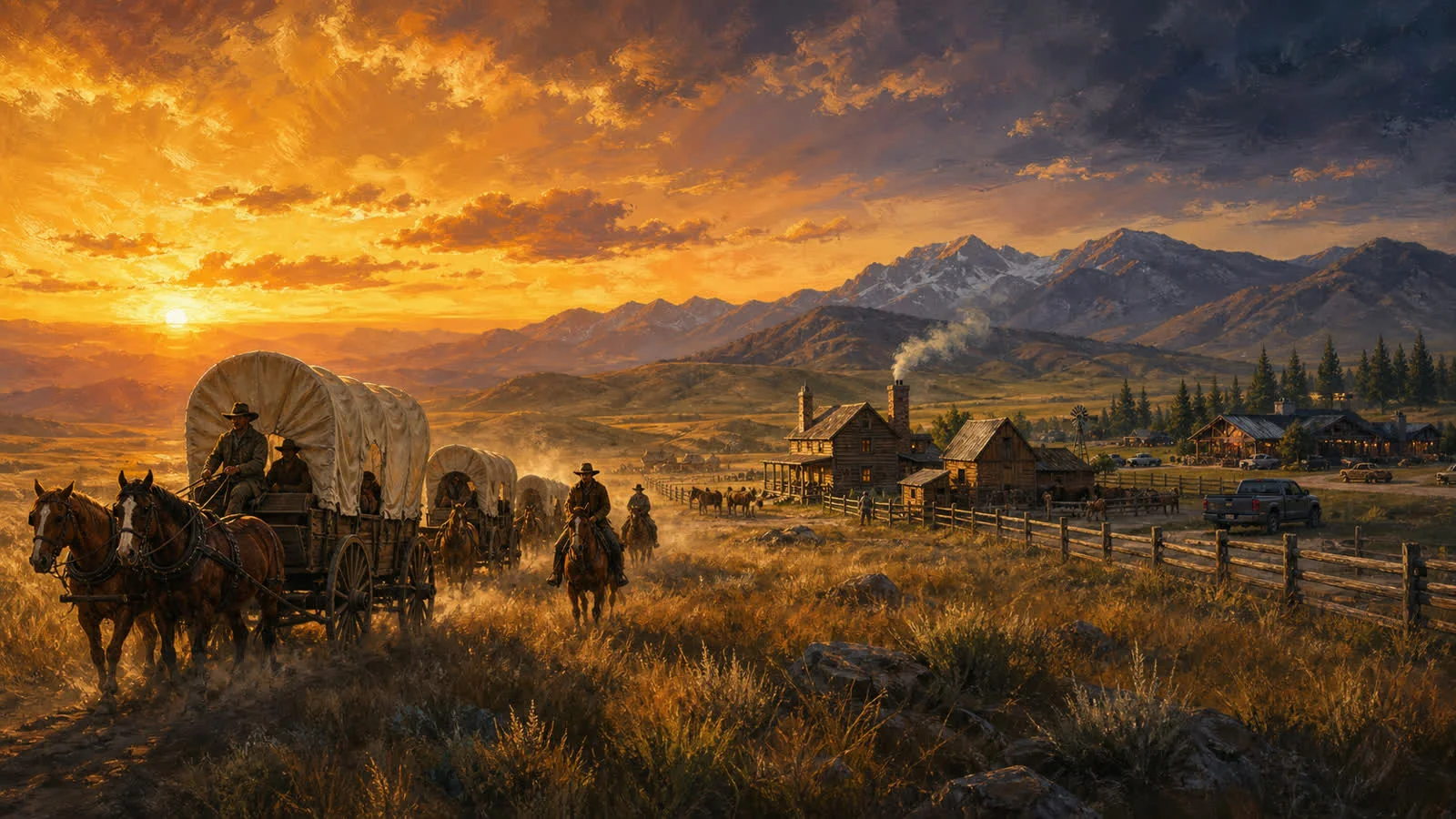
From 1883 to Dutton Ranch: How the Dutton Bloodline Survives
The ranch begins as a grave. Every generation that follows has been, in some form, standing guard over it.
The Yellowstone universe runs four shows across roughly 140 years of American history, and the question threading all of them is the same one: what does it cost a family to hold a piece of land? Not in dollars. In blood, in children, in the choices people make when they understand the land will outlast them.
The answer looks different in each era — a dying girl in a covered wagon, a woman loading a rifle while writing a letter, a widower selling his birthright to the people it was stolen from, a woman and a hired hand starting over with nothing but a boy and a name. But the arithmetic underneath never changes.
1883 — The Founders
Tim McGraw plays James Dutton as a man who has already run the numbers and accepted what they add up to. When the wagon train reaches the moment of no return — Elsa Dutton bleeding from an arrow wound, no doctor within five hundred miles, the Oregon dream collapsing one day at a time — James does not argue with the calculus. He speaks it plainly, in the dark, to a group of people who came to him for a decision.
“We ain’t gonna lay her to rest here. We keep heading north. Where she dies, that’s where we stay. She’ll be with us.”
The sentence is brutal and it is love. He turns his daughter’s death into a promise of permanence: wherever the ground takes her is where the family puts down roots. The ranch is chosen before it exists, in the same breath that accepts the cost of building it.
Faith Hill plays Margaret Dutton as the woman who carries that decision forward. Margaret does not get the mythologizing Elsa’s narration provides. She gets the work that follows: the winters, the children who survive, the silence that settles over a household when the loudest person in it is gone. By the time 1923 opens she is already dead — gone the way founding mothers often go, listed in the background of someone else’s account. But the ranch is hers as much as James’s.
The bluff where Elsa is buried is the fixed point the entire franchise orbits. Every subsequent generation is a response to that settlement — not a continuation of ambition but a fulfillment of a promise made to a girl in the ground.
1923 — The Stewards
Forty years later the ranch is real: cattle, water rights, hired hands, a house with a cook and a bunkhouse full of men who’ve sworn to defend it. What it faces in 1923 is the first wave of forces that can’t be answered with a gun — drought that doesn’t care who owns the land, a federal government with a longer memory than any rancher, sheepherders whose sheep don’t respect boundary fences, a war that took the family’s best young men and returned something quieter and harder in their place.
Harrison Ford plays Jacob Dutton, James’s brother, as a man who inherited the ranch and the obligation simultaneously. Jacob did not found the place. He was given custody of it when the founders died and the children they left behind needed someone to hold the line. He holds it in the only way available to him — through force when necessary, through political maneuvering when possible, through sheer refusal to acknowledge that any external pressure constitutes a final offer.
The range war with Banner Creighton’s sheepherders is the visible conflict of 1923. The real conflict is quieter: how do you transmit a mission across a generation when the generation is scattered, damaged, or dead? John Dutton Sr. (1923) — James’s son, grown up now, carrying the Dutton name into the new century — is killed in the fighting before he can become the patriarch the ranch needs. Jack Dutton survives, but survival at that price leaves its marks.
Helen Mirren plays Cara Dutton as the person who understands that the ranch will only survive if someone holds its institutional memory. She does this through letters. While Jacob manages the physical war — the cattle, the riders, the legal fights, the blood — Cara writes to Spencer Dutton in Africa, pulling him back across the Atlantic by the force of her account of what is at stake.
“Spencer, this ranch and your legacy are in peril. You must come home and fight this war.”
She writes this with a rifle on the table and Banner Creighton’s men visible through the window. The combination is not dramatic irony. It is her morning. Cara manages the people the ranch is killing; Jacob manages the threat that is doing the killing. They are not one operation. They are two, running in parallel, and the ranch survives because both are true at once.
Spencer returns — dirty, late, carrying a wife nobody has met — and the 1923 story closes on a family that has held the line but paid for it. Who exactly passes the Dutton name forward remains one of the franchise’s genuinely open questions. What the show does close cleanly is the principle: the ranch exists because people who did not found it treated stewardship as absolute.
Modern — The Last John
Kevin Costner plays John Dutton III as a man who has been the ranch’s last line of defense for so long that the distinction between himself and the land has dissolved. He took over from his father at thirty-four. For the next three decades he never spent a night away from it. By the time Yellowstone’s pilot opens — Lee dead in a cattle conflict, Kayce estranged, the developers circling — John is less a rancher than a fact of the landscape, as much a feature of the terrain as the mountains at his back.
The pilot’s first image of him is at a horse’s ear, speaking quietly before pulling the trigger: “It’s not fair, this life.” He is euthanizing an animal. The register is the same one he uses for everything that follows — practical, tender in private, harder in public than any external threat.
What John understands about the ranch that his predecessors did not have to articulate is its political dimension. James held ground against the elements and against a continent. Jacob held ground against men who wanted to take the water and the grass. John holds ground against men who want to take it legally — through zoning, development rights, eminent domain, the machinery of capital that has no face to negotiate with and no land of its own to defend. He fights this with the same tools his ancestors used: proximity, fury, and a willingness to accept costs his enemies won’t.
He loses. Not to the developers. To the people inside his own family — the ones he trusted with the decisions he couldn’t make himself. By S5E14, with Jamie dead and the political protection the ranch depended on collapsed, Beth Dutton and Kayce Dutton stand in the wreckage of a hundred-year project and do what their father could never bring himself to do.
The $1.25-an-acre offer Beth makes to Thomas Rainwater is the closing of an account that opened in 1883:
“When my ancestors came here, land sold for $1.25 an acre, back when it was your land. Even though you didn’t sell it, that’s what it sold for when they took it. And that’s the price I offer you. Under two conditions: East Camp I keep for my family. And you can never develop the Yellowstone and you can never sell it.”
The price is restitution. The conditions are continuity. Beth does not give the land to the market. She gives it to the people who never consented to lose it, under terms that make development permanently impossible. She has been trying to render the ranch worthless to capital for years. This is how she finally does it — not by winning on the market’s terrain, but by removing the ranch from the market’s terrain entirely.
At John’s coffin, the priest tells her to say goodbye. She declines. “I think I’ll say something else.” What she whispers — I will avenge you — is not grief. It is the conversion of grief into something with a direction. Beth does not cry. The grief has already become an instrument.
Texas — The Continuation
What Beth Dutton and Rip Wheeler take to Texas is not the ranch. It is the instinct the ranch produced: the conviction that land is worth building toward, that a place can be made worth dying for, that a boy without a name deserves one.
Kelly Reilly and Cole Hauser carry the Dutton project into Dutton Ranch S1 not as heirs restoring a dynasty but as two people who know exactly what it costs to build something and are choosing to pay it again. Carter, the orphan Beth and Rip took in during the final Yellowstone seasons, comes with them. He is the one thing Beth took for herself that had no political utility, no strategic value — just a kid who needed a door to walk through.
The Texas land is not the Montana bluff. It has no grave at the center. No cross, no girl buried in the soil, no promise extracted from a dying parent. What it has is Beth and Rip, who carry the weight of the original promise inside them whether they name it or not. The Dutton instinct — that land is a living obligation, that you don’t sell it and you don’t walk away from it and you don’t let the wrong people sit at the table — is not stored in Montana soil. It travels.
What they left behind is already sustained. Montana is in Rainwater’s hands, at a price that closes the ledger James opened when he drove stakes into a bluff and made a promise to the dead. Texas is what comes after the ledger closes — not a sequel but a new entry, written by people who learned the language from the original account.
The only bloodline that matters in the Yellowstone universe is not genetics or legal title. It is the willingness to stand on a piece of ground and say: this is where we stay.