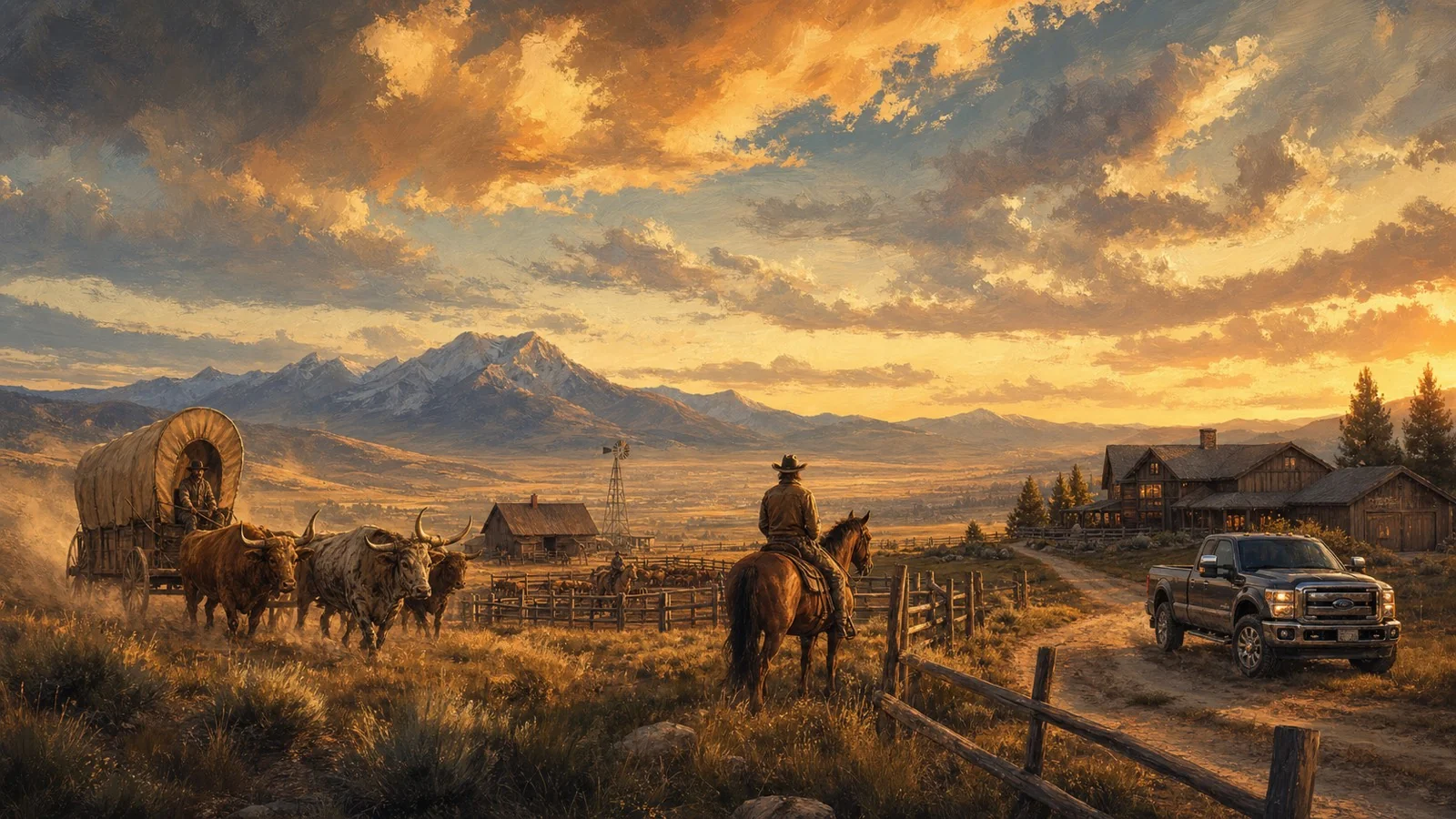
Yellowstone Universe Timeline
Every acre the Duttons defend in 2018 was bought in 1883 with the currency the frontier accepted: family members. The timeline below runs in order from Fort Worth to Texas — the founding muster to the new gate, a span of roughly 143 years across five shows and six generations of people who kept the name alive by spending everyone who carried it.
1883 — The wagon-train year
James Dutton musters in Fort Worth in the spring of 1883, joining Shea Brennan’s immigrant column for the crossing into Montana Territory. The party is already short. Claire Dutton dies early on the trail, refusing to travel further at her own daughter Mary Abel Dutton’s grave. The column does not stop long for either of them.
What finishes the journey is not arrival but wound. Elsa Dutton, James’s eldest, takes a poisoned Lakota arrow at the end of the crossing and does not recover. She rides the last miles dying. The land she finds in her final days is the land James keeps.
- 1883 S1E01 — Fort Worth muster. James Dutton and Margaret Dutton join Shea Brennan’s column at the livestock pens in Fort Worth and begin the crossing north and west.
- 1883 S1E02 — Claire Dutton stays behind. James’s sister sits down at a roadside grave and refuses to continue; she and Mary Abel Dutton are the trail’s first family cost.
- 1883 S1E05 — Ennis dies. Elsa Dutton’s first love, Ennis, is killed by Comancheros within days of their union; Elsa buries him and keeps riding.
- 1883 S1E07 — The arrow. Elsa rides into a Lakota skirmish against orders and takes a poisoned arrow in the abdomen; the wound is mortal within days.
- 1883 S1E08 — “I’m not going to Oregon.” Delirious and febrile, Elsa tells James she is staying. She is half out of her mind with sepsis. She is also correct.
- 1883 S1E10 — Arrival at the bluff. James buries Elsa in the valley Spotted Eagle calls Paradise — present-day Paradise Valley, Montana. The ranch is fixed to that grave. John Dutton Sr. (1883), still a boy, watches his father make the promise.
1923–1924 — The drought and the range war
Forty years after James’s burial, the land passes to Jacob Dutton, his brother. Jacob and Cara Dutton have run the Yellowstone through the lean decades that followed the founding — blizzards, market crashes, Spanish flu, the end of the open range. By 1923, the pressure has a face: drought contracting every lease, cattle prices collapsing, and Banner Creighton’s sheepherders grazing Jacob’s grass on purpose.
While Jacob holds the ranch by force and Jack Dutton learns to inherit it beside Elizabeth Strafford Dutton, Spencer Dutton is ten thousand miles away in East Africa, hunting dangerous game as a form of self-exile after the Western Front. Cara’s letters find him in Nairobi hotel bars. He reads them and orders another drink before moving. Teonna Rainwater runs a parallel story at a Catholic boarding school in the same period — a young Native woman subjected to forced assimilation, whose resistance and eventual flight track the same violence the Duttons deploy on their end of the same land.
- 1923 S1E01 — The lease confrontation. Jacob Dutton faces Creighton’s sheepherders on an open road, outnumbered, and delivers his terms to the sheriff’s face: graze my lease again and I take the flock.
- 1923 S1E03 — The ambush. Banner Creighton’s men ambush Jacob on the Yellowstone road; Jacob takes several bullets and spends the next weeks incapacitated; John Dutton Sr. (1923) is killed in the same attack.
- 1923 S1E03 — Cara’s letter. Spencer Dutton reads Cara’s account of the attack in a Nairobi bar and does not move immediately; the pause defines the character — he knows returning to Montana ends Africa.
- 1923 S1E06 — Alexandra. Spencer Dutton rescues Alexandra Dutton from a lion attack near her safari party in East Africa; she is already shooting when he arrives; they marry before the episode ends.
- 1923 S1E06 — Teonna escapes. Teonna Rainwater kills a priest at the boarding school and flees into the Montana wilderness; her arc runs parallel to the ranch war without intersecting it.
- 1923 S2E03 — Turned away at the dock. Donald Whitfield’s legal interference strands Spencer Dutton and Alexandra Dutton on the wrong side of the Atlantic while the ranch moves toward foreclosure.
- 1923 S2E07 — Spencer returns. Spencer Dutton arrives at the Yellowstone dirty, late, and carrying a marriage nobody has met; the scene plays without score — he reads the state of the ranch the way he read the African plain.
- 1923 S2E08 — Jacob reclaims. Recovered, Jacob Dutton positions Spencer Dutton and Jack Dutton for the final push against Banner Creighton; badges, leverage, and the war’s last accounting.
The gap years (1924–2017)
The middle century is largely offscreen. What the shows establish: Jacob Dutton outlives the range war. Jack Dutton and Elizabeth Strafford Dutton inherit young. The lineage between Jack Dutton or Spencer Dutton and the modern John Dutton III remains the franchise’s deliberately open seam — the shows name ancestors without closing the chain. By the mid-twentieth century the ranch has grown to 700,000 deeded acres. By the 1990s it is the largest ranch in the continental United States and the single largest landholding the state of Montana has not yet absorbed.
The generational math costs are named but not dramatized: families who worked the land and died there, foremen who stayed when there was no reason to stay, the slow accumulation of obligation that Rip Wheeler will eventually call home.
- c. 1893 — James’s death. James Dutton dies sometime after the 1883 finale; Margaret Dutton’s later plea brings Jacob Dutton and Cara Dutton to the ranch to hold what survives.
- 1997 — Evelyn’s accident. Evelyn Dutton dies in a riding accident; Beth Dutton is present, blamed by herself for the outcome; the wound does not close across the next twenty-seven years.
- c. 2000 — Rip’s arrival. Rip Wheeler arrives at the Yellowstone as an adolescent after killing his abusive stepfather; John takes him in and marks him; he never leaves.
2018–2024 — Modern Yellowstone, Seasons 1–5
John Dutton III is the fifth generation on the Yellowstone and the last to hold it as patriarch. By 2018 the threats are legal and financial rather than armed — development groups, eminent domain proposals, political leverage — and John has reoriented the family accordingly. Beth Dutton runs a Billings finance firm as his market weapon. Jamie Dutton holds the state attorney general’s office. Kayce Dutton has been living off-ranch with Monica Long Dutton and Tate Dutton, trying to clear the body count he accumulated as a Navy SEAL. Lee Dutton is the heir apparent, until S1E01.
The modern era runs at compressed speed: a cattle dispute in Season 1 opens into a political war, a near-assassination, a governor’s race, and ends in a funeral.
- S1E01 — Lee dies. Lee Dutton is killed in a cattle-recovery dispute with the Broken Rock reservation; Kayce Dutton kills the man who shot Lee and comes back to the ranch carrying both the death and the act.
- S1E03 — Beth goes in. John asks Beth Dutton to step into the public fight as his statehouse operative; she answers without pausing — “I will never tell you no, Daddy.”
- S2E07 — Beth’s office. Masked men enter Beth Dutton’s Billings office and kill her assistant; when told they are there to frighten her, she answers: “Best of fucking luck.”
- S3E06 — The clinic. Beth Dutton names the wound in full: Jamie Dutton drove her to a clinic for an abortion at seventeen and did not disclose that the clinic sterilized patients as a condition of care. “I didn’t ask you for a fucking hysterectomy.” Everything Beth has done to Jamie since is a sentence handed down and carried out.
- S3E07 — “Will you do that?” Beth Dutton proposes to Rip Wheeler — directly, a little defiant, stripped of ceremony, with John’s prior acknowledgment that Rip would never ask without asking him first.
- S3E10 — The bombs. Beth Dutton, John Dutton III, and Kayce Dutton are targeted simultaneously in coordinated attacks — a car bomb, an office explosion, armed men at the ranch; the season ends on all three as the picture goes dark.
- S4E09 — The photograph. Beth Dutton presents Jamie Dutton with the photograph of Garrett Randall dead and Jamie standing over him: “You’re mine now.” The instrument of Jamie’s ending is now in her hands.
- S4E10 — The wedding. No dress, no flowers, a priest John had at the ranch; Beth Dutton and Rip Wheeler marry in the field with Lloyd as best man and Rip’s mother’s ring; “I don’t give a shit about the wedding, Dad. I just care about the marriage.”
- S5E01 — Governor. John Dutton III is inaugurated Governor of Montana; he pulls Jamie Dutton aside and makes the exercise plain: “We measure every decision against what is good for the ranch. The ranch comes first.”
- S5E14 — John’s death. John Dutton III is killed; Beth Dutton, at the coffin, declines to say goodbye: “I think I’ll say something else.” What she whispers is: I will avenge you.
- S5E14 — Jamie’s death. Beth Dutton and Rip Wheeler find Jamie Dutton on the Yellowstone and execute the debt; the ranch keeps its accounting internal.
- S5E14 — The land sale. Beth Dutton and Kayce Dutton sell the Yellowstone to the Broken Rock reservation at $1.25 an acre — the price the government originally paid when it took the land — at Thomas Rainwater’s condition that it can never be developed or sold again; Beth keeps East Camp; the Dutton name leaves Montana.
2026 — Dutton Ranch
Beth Dutton and Rip Wheeler arrive in Texas with Carter. The gate reads Dutton Ranch. The house is a different shape. The work is the same. Beth runs the books. Rip runs the cattle. A new foreman, a new crew, the same logic: protect the land from the people who want to price it. The Texas chapter is the franchise’s argument that the Dutton method was never about Montana specifically — it was about holding something the market wants to dissolve, by any instrument necessary.
- Dutton Ranch S1E01 — “The Untold Want.” Beth Dutton and Rip Wheeler establish the Texas operation; the first episode names the underlying claim before a fence post is driven.
- Dutton Ranch S1E02 — “Earn Another Day.” Carter absorbs the new crew and the new landscape; Beth and Rip build what John spent five decades refusing to rebuild — something that might outlast the people who built it.