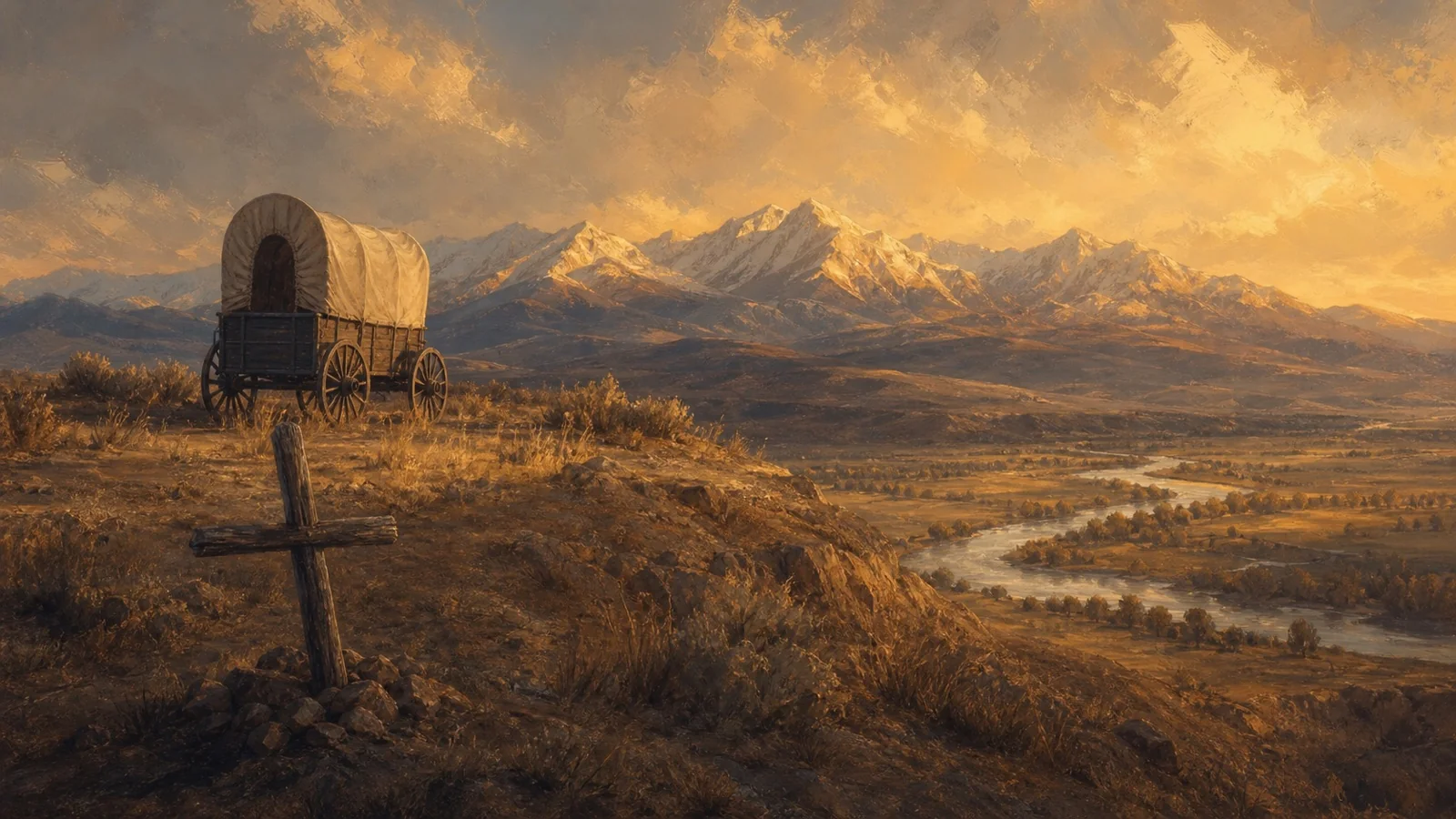
How the Yellowstone Ranch Was Founded
The ranch starts not as a land claim but as a burial promise. What the 1883 crossing cost the Duttons, and why James Dutton stopped in Paradise Valley.
The wagon train and what it took
Fort Worth, Texas, 1883. The train assembles at the livestock pens — a hundred-odd German and Eastern European immigrants who have paid to be led west by a former Pinkerton named Shea Brennan. Tim McGraw’s James Dutton joins the column not as hired help but as something harder to name: a Tennessee farmer who needs the crossing more than he can explain, riding with his wife Margaret Dutton, his teenage daughter Elsa Dutton, his son John, his recently widowed sister Claire Dutton, and Mary Abel Dutton, Claire’s daughter. The family is intact. That is the last time it will be.
The immigrants don’t know how to drive wagons, swim horses across rivers, or read the land for water. Shea tells Thomas, his scout, plainly: “Half these folks ain’t gonna make it, and we both know it.” James isn’t immune to the math. He is simply the kind of man who, when told the odds, says “I don’t know what I’m gonna do, but I’m gonna do it right here” and stays. His operating principle is presence, not optimism.
What they move through is not empty. The terrain itself kills — rattlesnakes, river crossings, heat, and contaminated water thin the column before a single raid. The Brazos River crossing takes lives in E03. Bandits follow the train out of Texas. Comancheros kill Ennis, a young cowhand Elsa had fallen for, within a week of their leaving Fort Worth. Claire breaks before the train crosses into Indian Territory; she sits down beside a grave somewhere in the sagebrush and refuses to move, telling James, “God damn you, James. God damn you and your dreams.” He rides on. He has no other move. Claire and Mary Abel Dutton are buried on the trail. The train doesn’t stop for grief. It can’t.
By the time the column reaches Wyoming, James Dutton has watched two of the people he brought west go into the ground. Margaret knows the arithmetic. She has been watching it build since Fort Worth. When Elsa kills a man who attacked her and comes back changed — quieter, unreachable, with a look in her eyes Margaret says she doesn’t recognize — Margaret confronts James at the wagon: “Wherever we’re going it better be paradise… ‘Cause it’s costing us a daughter… If you ask me, it’s a shitty trade.” James doesn’t argue. He says only: “I don’t forgive me.” The wagon keeps moving.
Elsa’s arrow and the failure of the planned destination
The destination was Oregon. James had studied the land: too little rain in the east, too much snow in the west, Oregon and Washington the answer — mild winters, enough rain, room for cattle. The Willamette Valley. It was a plan, not a dream, and the distinction mattered to him.
S1E07 kills the plan. Elsa rides into a Lakota raid after James shouts for her to stay back. She takes a poisoned arrow in the abdomen at close range. The wound closes on itself. By S1E09 — “Racing Clouds” — the column has reached a fort and a doctor who tells James what the infection has done: “She’s gonna die.” Margaret refuses it: “How fucking dare you? I will not lose a child.” The doctor holds the verdict. “She’s gonna die, and it’s gonna cut us in two, and if we don’t accept it now she’ll die in some fort with some doctor doping her up so badly she can’t see straight, then we will have robbed her.”
The poisoned arrow has settled a question James didn’t ask. The route to Oregon was always measured in time — weeks of travel, a season of pushing north and west. An arrow clipped in manure, a doctor told him flatly, is always fatal. The infection moves faster than any wagon. Oregon is no longer the point. Finding the place where Elsa dies becomes the only point there is.
James says it plainly, still in Wyoming with the train around him and his daughter alive but beyond saving: “Our wagon drive is over. Where we bury her is where we stay. That is our home… Not here. Not in this place. I will find the place. By God, I will find a place.”
The burial and the bluff
He finds it through a Lakota man named Spotted Eagle. The exchange is brief and specific. Spotted Eagle tells James to go through the pass and follow the river south — a valley he hunted as a boy, where winters are cruel but summers rich and a man who plans can thrive. James asks what the valley is called. Spotted Eagle doesn’t know the English word: “When you die, you go there.” James offers: “Heaven.” Spotted Eagle shakes his head. James tries again: “Paradise.” — “Yes, Paradise. Good name.”
Spotted Eagle adds a warning James accepts without argument: “In seven generations my people will rise up, and take it back from you.” James’s answer: “In seven generations you can have it.” It is the closest he comes to philosophy. He is not thinking in generations. He is thinking in days.
The wagons are too slow. Elsa has a week at most, the doctor said; the wagons need that long to reach the valley. James made Elsa Dutton a promise: let her choose the spot. He cannot break it. He needs to take her on horseback, alone, and leave Margaret behind.
He can’t ask Margaret Dutton himself. He sends Shea. The exchange at the wagon, in S1E10, is the most compressed and punishing scene the series produces. Shea tells Margaret what James has promised and what it requires: “He promised your daughter she could choose where she dies. And that’s where you build the ranch. But it’s a week’s drive on a wagon. She ain’t got a week. Horse can make it in two days.” Margaret answers before Shea finds the question: “Still haven’t heard a question.” When Shea finally frames it — are you willing to say goodbye here? — she says: “Men are such fucking cowards.” Then, after a moment: “When do they leave?”
She lets Elsa go. She stands at the wagon and watches the horses move north until she cannot see them. The founding begins in that watching.
Isabel May’s Elsa Dutton chooses the spot herself. Riding the last miles with James, weak, she names her fear: “Wanna know my greatest fear about dying? It’s being forgotten.” He promises her nobody will forget her. When they reach the valley she is the one who says stop. Against a tree, she tells James: “This is the spot.” She asks him what his first memory is. He tells her. She tells him hers — birds after a rain, pulling worms from soft earth, she thought it was so smart. Then she goes quiet. The birds are still singing when she dies.
What the founding actually cost
The Yellowstone is built over two kinds of dead. The first is Elsa Dutton, buried under a tree in Paradise Valley, Montana, the valley Spotted Eagle called by the only word he had for it. James keeps his promise — he stays. The ranch’s location, its specific bluff, its specific river, traces back to a seventeen-year-old girl pointing at a tree and saying “this is the spot.”
The second kind is less visible. Claire Dutton and Mary Abel Dutton are buried somewhere on the trail in Texas and Indian Territory, in graves the column passed without lingering. James rode on from Claire’s grave with her cursing him. He never stops blaming himself. The strangers buried along the Oregon Trail — the immigrants who drowned at the Brazos, who died of snakebite, who fell to raids — are the other entries in the ledger. The column that reaches Montana is a fraction of what assembled in Fort Worth. James Dutton is the man who assembled it.
Faith Hill’s Margaret Dutton survives. She consented, out loud, to everything the crossing asked — the loss of Elsa, the loss of Claire, the loss of the Willamette Valley, the loss of the person Elsa was before the prairie got to her. In E06 she told James it was a shitty trade. In E10 she said goodbye to her daughter at a wagon. She is still standing when the horses disappear. That is the founding act, as much as anything James does with stakes and rope.
The ranch in 1883 has no title, no deed, no legal standing. James has arrived at a valley a Lakota man named for his afterlife, because his daughter pointed at a tree. He begins to build. John Dutton Sr. (1883) will inherit what James builds here. A century forward John Dutton III will fight, scheme, and ultimately die defending these same acres. He won’t know the name of the tree.
What “founded” means
The word sits uneasily on what actually happened. Founding implies intention, plan, arrival at a chosen destination. The Duttons were going to Oregon. They ended up in Paradise Valley because Elsa got shot, because the wound was infected, because a horse is faster than a wagon, because James Dutton made a dying girl a promise and kept it.
The grave and the ranch are the same thing. James drives stakes where Elsa is buried not because the land is strategically ideal — though Spotted Eagle’s description suggests it is — but because he said “where we bury her is where we stay” and he is the kind of man who means what he says when there’s nothing left to argue. Every generation after pays a version of this debt. The 1923 range war that Jacob Dutton and Cara fight is a defense of the same ground. John Dutton III’s last stand against the developers and the state is a defense of the same ground. None of them chose it. A girl on horseback chose it, going north toward a valley called Paradise to die against a tree, and the dynasty accumulated around her like sediment around a stone.
Elsa narrates 1883 start to finish, and into 1923. The conceit signals the premise from the first frame: she does not survive. What she leaves behind is not a will or a deed but a location and a story. The Yellowstone is a grave marker that became a cattle empire. Every fence line in it was first drawn in grief.