Alice in Borderland Season 1 Episode 4 Recap: Two Strangers Find a Reason to Keep Running
Alice in Borderland (今際の国のアリス), Season 1, Episode 4 Netflix · Created by Shinsuke Sato · 2020
A highway Four of Clubs teaches Arisu what it costs to make a decision — and gives him someone worth making it for.
After three episodes of relentless group tension, Episode 4 strips everything back. Karube and Chota are gone. Shibuki walked away without a second glance. Arisu (Kento Yamazaki) is alone, crouched over a camping stove, cooking rice for a person he just watched try to die. The episode takes the space that grief creates and fills it with something quieter than survival: two people learning, slowly, why the other one is still here.
Arisu cooks rice for someone who says she does not want to live
The opening minutes do not linger on the botanical garden. There is no slow processional of memory. Arisu just sits in a clearing and eats. Across from him is Usagi (Tao Tsuchiya), who registered for the last game without intending to clear it, and who told him plainly that there is no point in her being alive.
He does not argue with her. He cooks extra rice and says he made the effort, so she should eat before she dies.
It is not comfort exactly. It is more like a side-step — acknowledging that she has decided something while refusing to perform urgency about it. What breaks through is not his words but her own body. She is hungry. He says he has been in that same place, lying down so long that his stomach started asking for things even when the rest of him did not want to answer. That small parallel does more than a speech would.
Before they move into the next game, the episode pauses to show us who Usagi was. Her father, Shigenori Usagi, was a world-famous mountaineer. In a memory, the two of them stand on a peak together, and he asks what she would wish for if God were listening. She says she wants things to stay exactly like this, forever. He calls her strange. He smiles. The mountains, she tells him, are the only place she is accepted as she is. He is the only person.
Then the fraud headlines. A solo no-oxygen summit suspected of being staged. Reporters at the door. Her father disappearing. The single word: suicide.
The reason she has stopped wanting to survive is not abstract despair. It is a specific absence — the one person who made her feel like herself, gone under circumstances that mixed dishonor into the grief. Usagi did not lose her reason to live. She watched it be taken apart in public and handed back to her in pieces.
A Four of Clubs sends twelve players down a dead highway
The game venue for this episode is a long stretch of empty highway. Twelve players register, including Arisu and Usagi and a compact three-person group who have cleared four games together: the calm, methodical Seizan, the injured Takuma, and Yamane, who has a pregnant wife at home and a reason to finish every countdown.
The suit is Clubs. Clubs games test physical endurance rather than betrayal. The difficulty is Four — low enough to feel manageable, high enough that nobody relaxes. The rule is one word: Distance. Reach the goal within one hundred twenty minutes.
No one knows where the goal is. The display just counts up — 1,000 meters, then 5,000, then 8,000 — and everyone runs.
Takuma’s leg gives out early. He sends Yamane and Seizan ahead and tells them to clear the game. Yamane refuses to go. Seizan makes the harder calculation: Takuma is telling them to leave because he wants Yamane, who has a family coming, to survive. Yamane eventually goes. Seizan eventually goes. Takuma stays behind with a distance counter and a bus that will not start.
This is the shape the episode keeps returning to — the person left behind asking the people who stay to leave, and the weight of that ask landing differently on each receiver.
Arisu figures out the fuel, goes back, and the goal was the bus all along
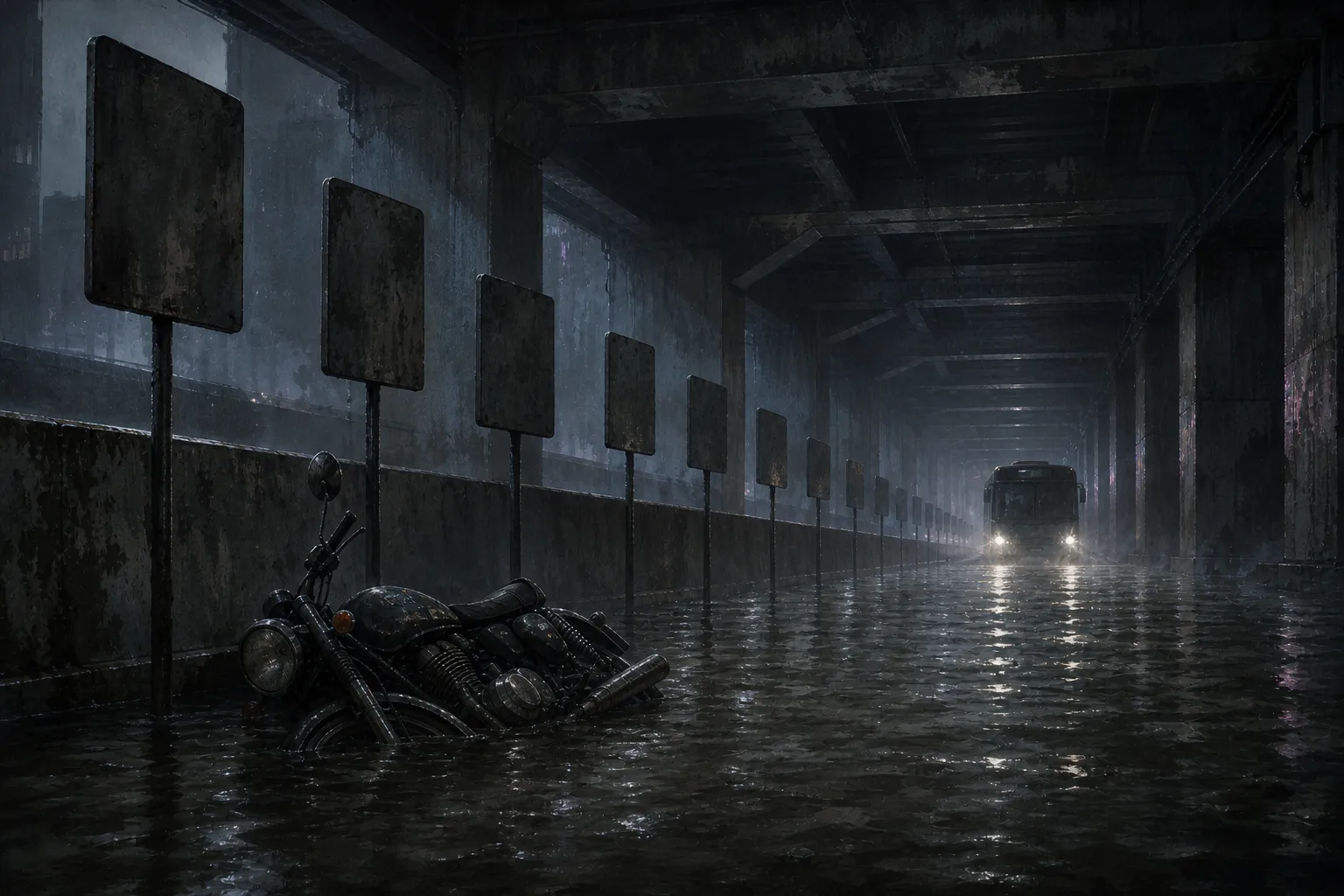
Around 8,000 meters, Arisu stops at a Royal Enfield motorcycle lying on its side. Something about it is wrong and right at once. He knows the model: diesel engine, no IC chip, analog mechanics. Every modern vehicle on the highway is dead because the electrical circuits in the area have been destroyed. But analog equipment still works.
The bus at the starting point runs on diesel too.
Arisu does the math aloud. The fuel from the motorcycle, carried back to the start, could get the bus running. If the bus moves, everyone can reach the goal. There is still half the time remaining. He tells Usagi to keep running with Yamane. He turns back.
“Letting someone die so I can survive. I’ll never do that again.”
He says it quietly, not like a declaration. More like a rule he is writing for himself in real time, one he knows will cost him every time it applies.
The distance counter is still climbing when Arisu reaches Takuma. The bus starts. The numbers on the counter begin dropping — 4,000, 1,000 — and then a flood barrier activates, water surging down the highway, and everyone is running again, the bus grinding forward, Usagi shouting for Arisu from the goal line.
The goal was the starting bus. It was written there from the beginning. The distance counter was measuring proximity — not how far they had to go, but how far they already were from the answer. Arisu, who ran 8,000 meters in the wrong direction before understanding the game, was always closest to clearing it when he turned back.
The episode does not underline this. Takuma says it simply: “I was always right inside the goal?” And Arisu confirms: the distance was always zero. He just needed to return.
What works
- Usagi’s backstory earns its runtime. The father-daughter memory does not traffic in sentiment — it is specific and quiet, mountain air and a shared joke, a girl who found acceptance in altitude. When the fraud headlines follow, the loss has texture that the rest of the episode can build on.
- The rule Arisu sets for himself — no one dies so he can survive — lands precisely because the episode does not give him a clean test. Going back for Takuma means abandoning the direct path to the goal. It might cost everyone. He makes the choice anyway, and the game rewards it in a way that feels earned rather than convenient.
- Yamane works as a minor character because he is given one specific thing: a pregnant wife, a baby due in autumn, and the conviction that the people who disappeared are safe somewhere and waiting. He says it to a photograph, not to Arisu. Nobody needs to affirm it.
- The goal twist — the bus was always the destination — reframes the whole game in retrospect. The players ran because “Distance” implied a far endpoint. The answer was to stop, think, and go back. It is the kind of design that would feel cheap if the episode had not already earned the emotional parallel.
- Usagi’s bicycle moment at the end is the first time anything has been light. She never learned to ride one. He seems surprised. She says it feels nice anyway, her legs dangling. It is thirty seconds of normalcy dropped into forty-five minutes of grief, and it works because the episode did not try to build toward it.
What stumbles
- Seizan and Takuma do the same thing as Karube and Chota structurally — the capable one tells the emotional one to keep going while he handles what is left behind — and the parallel is close enough to feel recycled. Yamane and Seizan are given enough detail to matter, but the emotional register of their farewell lands softer because the template is already familiar from the episode before.
- The flood sequence at the end is the one place the episode leans on spectacle. The water surge is effective but brief, and the editing scrambles the geography in a way that makes it hard to track who is where. The tension resolves quickly enough that the disorientation does not quite pay off.
- Arisu’s delivery of his new personal rule — “I’ll never do that again” — is clear and necessary, but it arrives before he has demonstrated it rather than after, which removes some of the weight. Hearing him say it and then watching him act on it feels slightly out of sequence.
What this sets up for Episode 5
The Beach is now the only direction. Arisu has a reason he can name: Karube told him to live on, and living on means finding the people who disappeared. Usagi has a different reason — hers is less about return and more about motion, the absence of a reason to stop. They are not the same thing, but they are compatible.
Whatever the Beach is, Shibuki knew about it before any of them. That is worth noting.
Rating: 8.3/10
More episodes from Alice in Borderland — Three friends wake in an empty Tokyo and must win deadly games to live — episode by episode. Jump to any episode in the season:
Where to go next
Reviewed by Mira Vance · QuizFandom Editor & Lead Reviewer. Every rating is an honest per-watch assessment from the desk that also writes the quizzes — not a press release rehash.