Alice in Borderland Season 1 Episode 7 Recap: The Beach Burns and Nobody Knows Who Lit the Match
Alice in Borderland (今際の国のアリス), Season 1, Episode 7 Netflix · Created by Shinsuke Sato · 2020
Hatter is dead, the Beach is on fire, and the Ten of Hearts wants every survivor to turn on every other survivor before the timer runs out.
Episode 7 is the one where the Beach stops being a community and becomes a crime scene. For two episodes, the tension between Hatter’s idealism and Aguni’s firepower held in an uneasy stalemate. This episode dissolves that balance in under ten minutes and then forces everyone still alive to spend the rest of the hour proving they deserve to stay that way.
The game is called Witch Hunt. The rules are simple and vile: find the person who murdered Momoka, burn them in the Fire of Judgment, and survive. Momoka’s body is already on the floor when the episode opens. The fire is already burning. The game began without anyone’s consent.
The militants take control and the hunt turns inward
The trouble is that the Witch Hunt starts at the same moment the crowd learns Hatter was murdered.
When a woman appears at the gathering with blood on her clothes, the crowd moves on her immediately. Her explanation — she found Hatter’s body, the blood got on her while she was checking — arrives too late. The crowd is already building toward violence. Then she says it plainly: Hatter is dead. Someone at the Beach shot him with one of their own guns.
That second reveal detonates the trust that was keeping everything in order.
Aguni reads the room and sees an opportunity. Everyone who is not a militant, he announces, is a potential witch. If no one comes forward, he will throw everyone into the fire. His people open gasoline cans and start spreading fuel through the hotel. The logic is Aguni’s logic — the logic of someone who never trusted Hatter’s organizational dream and has been waiting for the moment when brute force would be the only language left.
Niragi (Dori Sakurada) is the enthusiastic version of this. He corrals Beach members into a corridor, forces them to kneel, and amuses himself with the power. He is not trying to find the witch. He is trying to enjoy the authority the chaos has handed him.
The Beach that Hatter built — collective mission, shared rules, the idea that cooperation could outlast the games — dies in this sequence. It does not fall to an outside force. It falls because the people holding the guns decided cooperation was no longer convenient.
Chishiya and An pursue the witch the slow way
Not everyone joins the burning.
Chishiya (Nijiro Murakami) moves through the chaos with the same detached expression he has worn since Episode 5, which by now reads less like composure and more like someone who has already finished calculating. He finds An (Ayaka Miyoshi), who introduces herself the way competent people sometimes do in emergencies — by telling you exactly what she can do before you’ve asked.
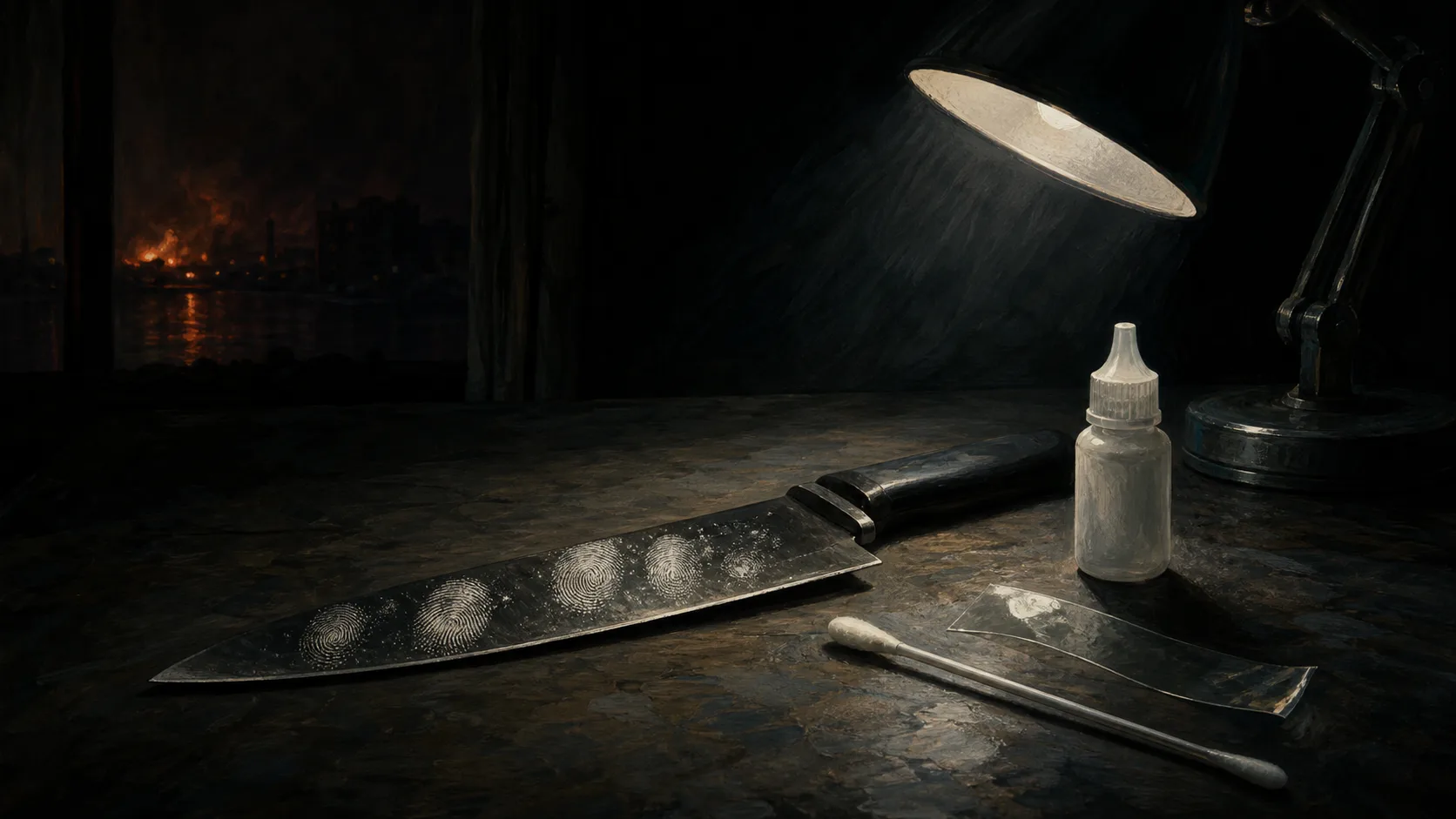
An worked in Forensics for the Tokyo Metropolitan Police. She has cyanoacrylate glue and a working knowledge of fingerprint chemistry.
Their method is slow and precise. Heat the glue over the murder weapon and the vapors fuse with moisture to reveal prints. Dust with cocoa powder. Lift with tape. Cross-reference against cups used by the most likely suspects. It is the kind of approach that requires patience the Beach’s militants have stopped pretending to have, which is why it falls to Chishiya — who has no gun and no allegiance to Aguni — to pursue it while everyone else is hunting on suspicion alone.
The pairing works because neither of them is performing urgency. An explains her method once and gets to work. Chishiya confirms that the witch is not the one frantically hunting: if you were the witch, you would either hide or participate in the killings to avoid suspicion. Someone actively trying to identify the culprit through evidence is, by elimination, not the person the game is looking for.
Arisu reframes the game from witch-logic to game-master logic
Arisu (Kento Yamazaki) spends the middle of the episode trapped, separated from Usagi (Tao Tsuchiya), working through the game’s design the way he worked through the Light Bulb puzzle in Episode 5 — by refusing to take the rules at face value.
He notices something Aguni’s approach ignores entirely: the main power supply at the Beach has changed since the game started. The generators are offline. The hotel is now drawing from its own power infrastructure, which means someone with access to the basement — access only executives and militants have — managed the switch. The game master did not drop the Witch Hunt from outside. Someone inside the Beach made it possible.
The deeper reframe arrives when Arisu stops asking “if I were the witch, what would I do?” and starts asking “if I were the game master, what was I waiting for?”
Hatter was already dead. The game started immediately after Momoka was murdered. The timing is not coincidence. Whoever designed this game was watching the Beach and waiting for the moment when Hatter’s death would already have destabilized the authority structure. The Witch Hunt was never about finding a murderer. It was designed to introduce maximum distrust at maximum chaos.
“Hearts games are utterly wicked,” Arisu says. “You toy with people’s feelings, betray, and kill each other. They’re designed so that you can’t win without feeling disgusted.”
He knows this because he has cleared a Hearts game before. He knows the suit’s logic is not physical survival — it is what it does to the people who survive.
Aguni’s past surfaces and the witch reveals herself
The episode’s deepest material sits in a flashback that lands quietly in the middle of the violence.
Hatter and Aguni were old friends. Before the Borderlands, before the Beach, before the feathered hat and the SDF uniform, they shared a city and a loyalty that ran longer than either of their careers. Aguni, who presents now as a man entirely stripped of sentiment, had something the Beach slowly buried. He carries a friend’s dying wish in the form of Hatter’s leadership — a role he neither wanted nor believed in, maintained because Hatter asked him to maintain it.
“You’re the only old friend I have left,” Hatter tells him in the memory.
“Live long,” Aguni says.
This does not redeem what Aguni does in Episode 7. It does not make the burning acceptable. What it does is make the coup comprehensible as something other than pure power-hunger. Aguni is not the villain who waited for his chance. He is a man who watched the community Hatter built become something Hatter would not recognize, and whose response to grief is indistinguishable from destruction.
The witch, when Arisu identifies her, is Asahi — a quiet Beach member who has been part of the background in every scene. She is not a monster. She is a person who was assigned a role in the game and played it because the alternative was death, and who breaks down completely once Arisu reaches her. The game forced her to trigger the chaos. The guilt of what followed is all she has left.
She activates her collar — the device that signals she has been caught — and the game ends.
What works
- Chishiya and An’s forensic track gives the episode a grounded counterweight to the mayhem. An’s method is specific and useful, and the scene where she and Chishiya quietly establish that neither of them is the witch — through logic rather than performance — is the quietest beat in a very loud episode.
- Aguni’s flashback does the right thing at the right moment. Coming after an extended sequence of brutality, the memory recontextualizes the coup without softening it. He is not a simple tyrant. He is someone for whom grief and violence have become the same gesture.
- Arisu’s reasoning pivot — from witch-thinking to game-master thinking — lands because the series has established that the Hearts suit is not about bodies, it is about trust. Once he reframes the question, the answer follows quickly. It is the same lateral step that has defined him since the Ferris wheel sequence in Episode 5.
- Kuina’s (Aya Asahina) composure throughout the chaos is consistent with who she has been, and the brief Aguni confrontation — she tells Niragi to stop bullying the weak, Niragi turns his weapon on her, she does not flinch — is one of the episode’s better character beats.
- Mira (Riisa Naka) watches everything from a position of perfect stillness. She does not intervene. She does not panic. In an episode full of people revealing themselves through how they respond to crisis, Mira’s non-response is its own signal.
What stumbles
- The physical geography of the hotel during the chase sequences is difficult to follow. Who is on which floor, which group is approaching which corridor — the editing compresses the space in a way that makes it hard to stay oriented. The chaos is intentional; the confusion about where everyone is standing is less so.
- Asahi’s reveal lands quickly after Arisu names her and does not give her much to do beyond confirm the logic and die. She has been present long enough to be recognizable but not long enough to have established anything that would make the reveal hurt the way it should.
- The militants’ behavior during the hunt, particularly Niragi’s, tips into excess so quickly that some of the horror feels abstracted. The episode wants the Beach’s collapse to feel tragic, but the speed of Niragi’s cruelty makes it hard to register as loss rather than inevitability.
What this sets up for Episode 08
The Beach is gone. Not evacuated — dismantled from within, the trust that held it together used as kindling.
Aguni is still standing. Arisu and Usagi are still standing. The cards the Beach collected are somewhere in the hotel. Chishiya has been circling the stash for two episodes without tipping his hand about what he intends to do with the information.
Mira watched all of it and did not move.
Whatever comes next, it will not be a recovery. The Borderlands does not offer those. It offers the next game, and the next visa deadline, and the choice of who you are still willing to be when both of those arrive at once.
Rating: 8.6/10
More episodes from Alice in Borderland — Three friends wake in an empty Tokyo and must win deadly games to live — episode by episode. Jump to any episode in the season:
Where to go next
Reviewed by Mira Vance · QuizFandom Editor & Lead Reviewer. Every rating is an honest per-watch assessment from the desk that also writes the quizzes — not a press release rehash.