Ashes to Crown Episode 19 Review: Jiu Refuses the Xie Ancestral Hall, Chu Zhao Turns Fire Oil into Law, and Xiaoman Starts Watching the Frontier
What happens — the short version (spoilers)
- Xie Yanfang offers to place Jiu and Cuiyu in the Xie pedigree before Jiu leaves, but Jiu says he no longer needs the Xie family's rightful identity.
- Jiu asks whether Yanfang knew the Bloodburn Pill would kill anyone who took it, and the flashback keeps Yanfang's answer poisonous without fully confessing.
- At Cuiyu's tomb, Jiu remembers being abandoned on the Xie Residence stairs and admits that both family love and rightful identity once felt unreachable.
- Chu Zhao gives Jiu the comfort Fu Jiu wants, then puts Chu Ling's armor on him and makes him swear to return alive.
- Liang Qiang returns as Roving General and discovers how quickly clan warmth appears once rank can bring glory.
- Chu Tang chooses to carry literary gatherings beyond the Capital so more women can shine outside inherited expectations.
- The old Xiaonan caravan file shows six thin cargo trips before the Wei Village fire, pointing Chu Zhao and Xiaoman toward fire oil, Cangmu, and Mu Mianhong as the real target.
- Chu Zhao turns Wangcheng trade into policy by requiring her approval for fire-oil transport, making Xiao Xun panic and watch Deng Yi's mansion.
- Xiaoman becomes commander of the Imperial Guard Office, commands 700 guards, and uses Cangmu scouting habits to monitor frontier troop movements for Jiu's mission.
Episode 19 is a farewell hour built out of ledgers, tablets, armor, and old hunger. Jiu has the frontier seal now, but the show does not send him north until it has stripped the Xie family fantasy down to the bone and given him one cleaner oath to carry. Chu Zhao spends the same hour doing the less romantic half of devotion: turning Wei Village evidence into public procedure, forcing Xiao Xun toward Deng Yi, and building an office that can watch every move around the man she has sent to war. The result is a chapter about chosen belonging, but it keeps that belonging practical. Love here does not escape the court. It gives Chu Zhao a reason to make the court harder to breach.
The episode opens exactly where Episode 18 left its blade: Xie Yanlai has stood in court, sworn to kill the Northern Desert King within half a year, and made himself too visible for either brother to pretend the old arrangement can continue.
Xie Yanfang tries one last form of family seduction. Before Yanlai leaves, he offers the thing the child once wanted most. His mother’s tablet can enter the Xie ancestral hall. Yanlai and his mother can enter the pedigree as rightful members of the family that spent years making him feel like a ghost at its door.
That offer might have broken him ten episodes ago. Now it only shows how late Yanfang is.
Xie Yanfang offers the ancestral hall, and Jiu asks whether the Bloodburn Pill was a death sentence
The conversation is quiet because the damage under it is old. Yanfang names rightful identity, clan recognition, and maternal honor as if he is setting three treasures on a table. Yanlai refuses all three. His mother does not need Xie offerings. He does not need Xie pedigree. He knows who he is and what he wants, and that is enough.
The old hunger is not denied. It is outgrown.
Then Yanlai asks the question that turns the scene from family drama back into the season’s central crime: when Yanfang gave him the Bloodburn Pill five years ago, did he know that anyone who took it would die? The flashback does not clear the brother. It shows Yanfang giving the pill as a direct-line secret elixir, then later trying to pull Yanlai back from Yunzhong with a colder argument: Chu Ling has 200,000 frontier troops, and if he learns Yanlai is a Xie, he can kill him at will.
Yanlai’s answer in the memory is the answer he has been growing toward all season. Chu Ling cares whether he can slay enemies and guard the place. He does not care who Yanlai really is.
So when Yanfang finally says, “If I say I didn’t know, will you believe me?” the line lands in a room already full of proof that belief has become impossible. Even if Yanfang did not understand the full poison, he understood how to use fear, shame, and family as a leash. That may be less tidy than a confession, but it is more poisonous.
Jiu mourns Cuiyu at her tomb, and Chu Zhao gives Fu Jiu the comfort Xie Yanlai never dared to want
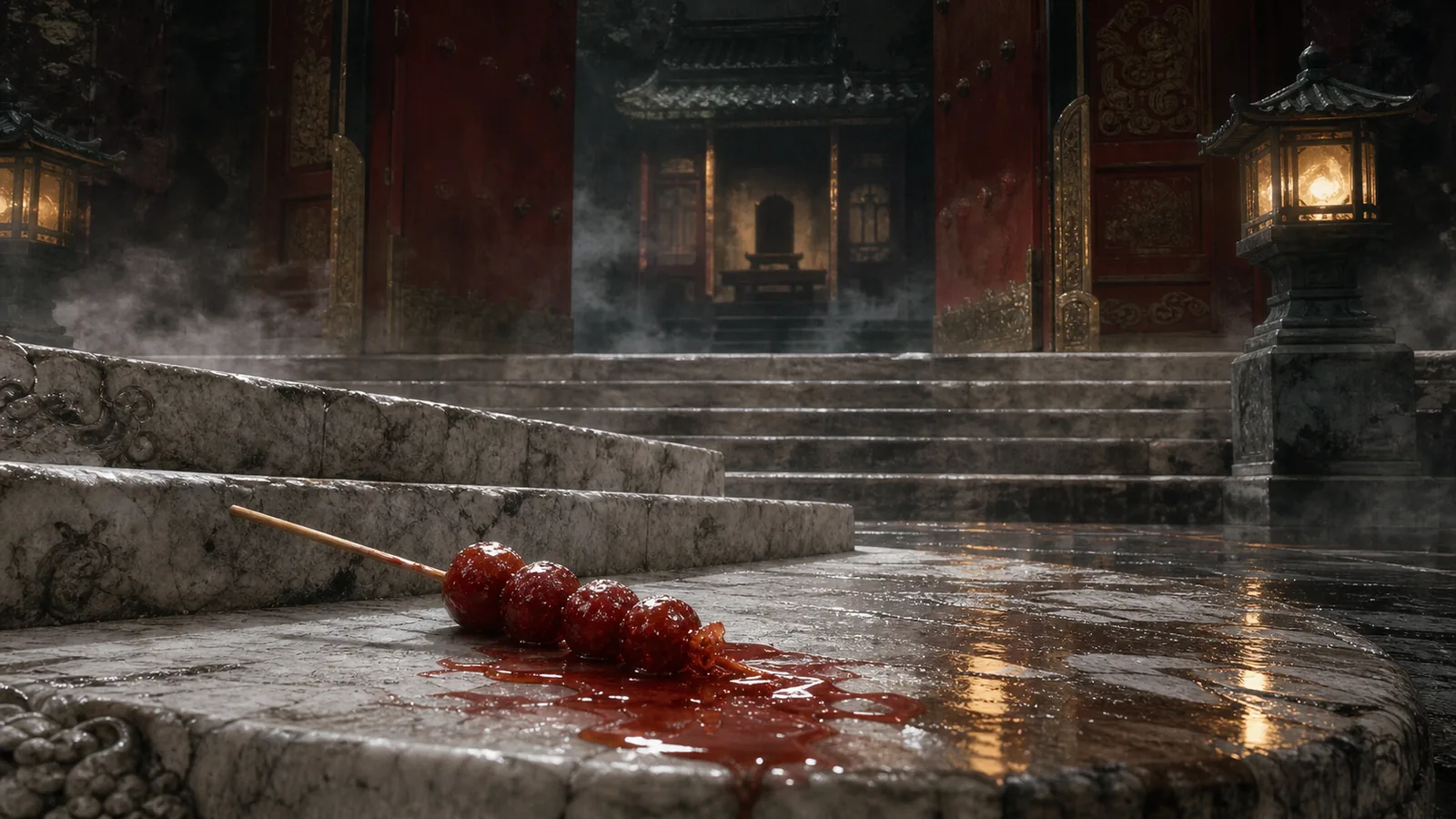
The episode then gives Jiu the mother scene without making it clean. The tomb names her Cuiyu, “a life marked by misfortune,” and the flashback is brutally ordinary: a woman bargaining over gold, a boy clinging to her, a promise of new clothes, and a child left waiting on the Xie Residence stairs until night falls and his candied hawthorn melts.
That melted candy is the kind of detail this show uses when it wants grief to stay small enough to hurt. Jiu does not accuse his mother with the grand language of betrayal. He remembers the exact texture of waiting. He remembers studying, training, enduring insults, and wanting the Xie family to look at him differently so her tablet could one day stand among theirs.
Then he lets himself say the thing he has not been able to say in front of the living: she abandoned him long ago. Even there, he does not turn the wound into hatred. He imagines that perhaps the day she left, she cried hard too. It is not forgiveness as performance. It is a son refusing to make his own pain the only truth in the graveyard.
What changes the scene is Zhao.
Jiu tells his mother he met the most important person in his life, and her name is Zhao. She made him understand that rightful identity does not matter. When Chu Zhao appears behind him and simply says, “Don’t be sad,” the hour understands how much that sentence costs him to receive. As Xie Yanlai, he says, he would have disdained such useless comfort. As Fu Jiu, he wants it.
That distinction is the whole wound and the whole cure. Xie Yanlai was the name that survived by pretending he wanted nothing. Fu Jiu is the man who can admit that identity and family love were out of reach, so he called them useless to make the shame bearable. Chu Zhao does not ask him to choose one name over the other. She tells him he is hers, good as he is, with the freedom to choose.
The line is possessive in the courtly-romance sense, but the scene around it keeps it from shrinking into sentiment. Her claim gives him back to himself. Whether Xie Yanlai or Fu Jiu, he no longer belongs to the Xie family’s leash, the abandoned child on the stairs, or the old belief that a blade’s life does not need preserving.
Chu Zhao puts Chu Ling’s armor on Jiu, and Jiu vows to return both the armor and himself
That is why the armor scene works. Chu Zhao is still furious that Jiu made the Northern Desert vow without telling her, and he admits the reason plainly: if he had told her, she would not have let him go. He knows she worries. He also wants, this once, to do something for her.
Chu Zhao answers with her father’s armor. Chu Ling taught her that armor is a soldier’s second life. Jiu never wore it before because he did not believe his life was worth the protection. Now she wants him inside it. She is waiting for him to come back alive, just as her father once brought him out of the desert alive.
The vow she demands is not made to romance first. It is made to Chu Ling’s armor. Jiu promises he will stay alive and return it to her father, and the oath ties three versions of protection together: Chu Ling saving the abandoned soldier, Chu Zhao protecting the man she loves by valuing his life, and Jiu choosing survival as duty instead of glory.
The later farewell at Ferryman’s Lodge lets that seriousness breathe. Chu Zhao comes not as the princess whose power cannot speak too softly, but as “your girl” with honey filling and maltose, teasing him about armor, Yunzhong women, and whether his sweet talk has improved. Jiu answers by promising to return both the armor and himself, then seals the promise with a kiss because words alone are no proof.
It is a romantic scene, but it is built out of logistics: food for the road, armor for survival, a pledge for return. The show has spent too long treating vows as political instruments to let this one float free of consequence.
Liang Qiang returns as Roving General, and Chu Tang carries the literary gathering beyond the Capital
Episode 19’s secondary threads are less graceful, but they are doing useful work. Liang Qiang returns to his clan as the newly titled Roving General and is greeted by relatives who suddenly remember warmth, pride, and tears. He barely remembers them. They remember what his title can do.
His stop at the ancestral hall rhymes pointedly with Jiu’s refusal. Liang Qiang tells his dead parents that visitors have flooded in after half a day of rank, that relatives and friends have popped up from every corner, and that soon the Capital will know he can bring glory to the Liang family. Jiu has just walked away from clan recognition after wanting it all his life. Liang Qiang has just received enough recognition to become dangerous.
The episode does not yet over-explain him, and that restraint helps. By the time Chu Zhao later names his old grievance, the shape is already visible. A fallen clan, a young man pushed from rich son into frontier soldier, and a sudden path back toward prestige make exactly the kind of ambition Deng Yi would notice.
Chu Tang’s scene is gentler and more direct. After the literary gathering’s success, she comes to Chu Zhao with a choice of her own. Once, she thought manipulating court affairs looked great. Then she thought being a hero might be the true thrill. Now she admits neither path quite fits her. What she wants is to take literary gatherings elsewhere, to give other women the same chance to shine outside inherited expectations.
That decision matters because Episode 18’s public victory could have stayed a single spectacle in the Capital. Chu Tang turns it into a road. She cannot become an official, but the world is wide enough to travel through, and the work that makes her happiest is not her own glory. It is opening rooms for other women to find theirs.
Chu Zhao’s blessing is simple: then the world will shine because of her. In a season full of armies, seals, and hostage bargains, that may be the softest form of expansion on the board.
The Cangmu file shows six Xiaonan caravan trips, and Chu Zhao makes fire oil a court rule
The Wei Village investigation moves with the same practical rhythm as the last two episodes. A letter from the stronghold brings the old Xiaonan caravan file. Three months before the fire, the caravan passed Wei Village six times. Each trip carried too little cargo for normal trade.
Chu Zhao and Xiaoman follow the arithmetic where Jiu sent it. The fire came from fire oil. The oil may have been transported for the Northern Desert. The village itself had only a few dozen people and empty wilderness, so the target was never merely the village. It was Cangmu Stronghold, and more exactly Mu Mianhong. Exposing Chu Zhao’s mother as a Northern Desert general would have been the cleanest weapon against Chu Ling, and a weakened Chu Ling would have given Xiaonan and the Northern Desert a new opening at the frontier.
The old crime is still not fully solved, but Episode 19 knows exactly what kind of proof matters at this stage. Chu Zhao does not need every name in court. She needs a pressure point that forces the guilty to move.
So she uses Wangcheng’s revival to make fire oil public. The court discusses reopening trade and appointing supervisors for the Maritime Trade Office. Xie Yanfang’s side recommends Zhao Su, Deng Yi’s side recommends Zhou Ming, and Chu Zhao lets both pupils share the office so each faction balances the other. Then she adds the clause that matters: special goods touching frontier defense cannot be transported without her approval.
The special good is fire oil.
It is a beautiful court move because it sounds procedural. No accusation is spoken. No old massacre is named. One commodity is placed under the Grand Princess’s hand, and Xiao Xun panics within six hours.
At Ferryman’s Lodge, he learns Chu Zhao has somehow obtained the old ledgers and proposed approval over fire oil transport. He sees the shape of her attack correctly enough: one move after another, all designed to make him lose composure. His answer is to watch Deng Yi’s mansion. Deng is his last card, and that makes Deng’s next banquet the door Chu Zhao needs.
Xiao Xun counts on Deng Yi, and Xiaoman turns Cangmu scouting into an Imperial Guard Office
The final stretch is crowded with machinery, but the pieces are clean. Chu Zhao knows Deng Yi is being crushed between Xie Yanfang’s military power and her own command of the frontier troops. Deng is a civil officer looking for “biting fighters,” so he invites twenty-five military guests, with seventy-two attendants moving around them, to a banquet that looks social and smells defensive.
Liang Qiang is among them. Xiaoman wonders why Deng would choose a man who had been only a soldier at Wangcheng, and Chu Zhao gives the missing history: Liang’s clan was tied to the Third Prince, exiled after choosing the wrong side, and left him carrying resentment from rich young man to frontier ranks. Resentment and hatred lead to ambition. Give such a man a glimmer of hope, and he may work with the devil to seize it.
That explanation is pointed enough to make the Liang scenes click. His sudden generalship is not color. It is recruitment.
The better surprise is Xiaoman. Chu Zhao has titled her commander of the Imperial Guard Office, and the choice first sounds almost playful. Then the report arrives. Xiaoman has counted horses, carriages, attendants, family relationships, trees, doors, windows, warehouses, and carriage routes. She apologizes that the intelligence is not detailed enough.
Chu Zhao’s delight is earned. Xiaoman’s Cangmu habits were always intelligence work by another name. Before a raid, she had to know the size of a household, the location of doors and windows, and where every carriage might stand. Chu Zhao does not civilize that skill out of her. She gives it office, guards, and imperial cover.
The instruction underneath is larger than Deng’s banquet. Xiaoman now commands 700 guards, including open access to part of the Longwei Army, and Chu Zhao wants every move of the frontier troops reported immediately. Xiaoman sees through the reason at once: this is for Xie Yanlai, clearing obstacles from his mission to kill the Northern Desert King. Chu Zhao tells her not to blab, which is as close as this hour gets to an admission.
The last line sends the setup back toward the man on the road. Chu Zhao hopes it will help Jiu. Not save him instead of his vow. Help him keep it.
Tiny details worth clocking
- Jiu’s candied hawthorn melting on the Xie Residence stairs gives his abandonment a child’s clock: he measured betrayal by waiting for sweetness to hold its shape.
- The episode places Lady Xie’s tablet offer before Cuiyu’s tomb, so the ancestral hall never gets to feel noble. It is already too late.
- Liang Qiang’s clan greeting him as “General Liang” mirrors every family system Jiu rejects: affection arrives fastest when rank can bring glory home.
- Chu Zhao making sweeter honey filling overnight turns the farewell food into a private answer to the public armor vow.
- Xiaoman calling her surveillance report incomplete after recording horses, carriages, trees, attendants, and household ties is the funniest proof that Cangmu scouting belongs in government.
Verdict
Episode 19 is strongest when it lets objects carry feeling. The mother’s tablet, the melted hawthorn, Chu Ling’s armor, the honey filling, the Xiaonan ledger, and the fire-oil clause all do more than decorate the hour. They let the show braid private repair with public control. Jiu can leave because Chu Zhao has given his life weight; Chu Zhao can let him leave because she is already turning the court into a shield around his road.
The weaker stretch is the late handoff into Deng Yi and Liang Qiang’s next moves. Liang’s return is intriguing, and the banquet math is useful, but a lot of new positioning arrives through dialogue after the emotional peak with Jiu. It never breaks the chapter, yet the late political setup feels more like a necessary bridge than a finished turn.
Even with that bridgework, the chapter refuses to make love small. Chu Zhao does not choose between the state and her heart by pretending one cancels the other. She says the difference between herself and a puppet is choice, then chooses to guard the court, protect the state, and make it impregnable so the person she loves can be safe. Every earlier scene has made that argument in material form. Jiu is not protected by being kept from battle. He is protected by armor, intelligence, law, and the knowledge that someone wants him alive enough to build around his return.
Rating: 8.7/10
More episodes from Ashes to Crown — A betrayed empress, reborn to undo her own ruin. Jump to any episode in the season:
Where to go next
Reviewed by Mira Vance · QuizFandom Editor & Lead Reviewer. Every rating is an honest per-watch assessment from the desk that also writes the quizzes — not a press release rehash.