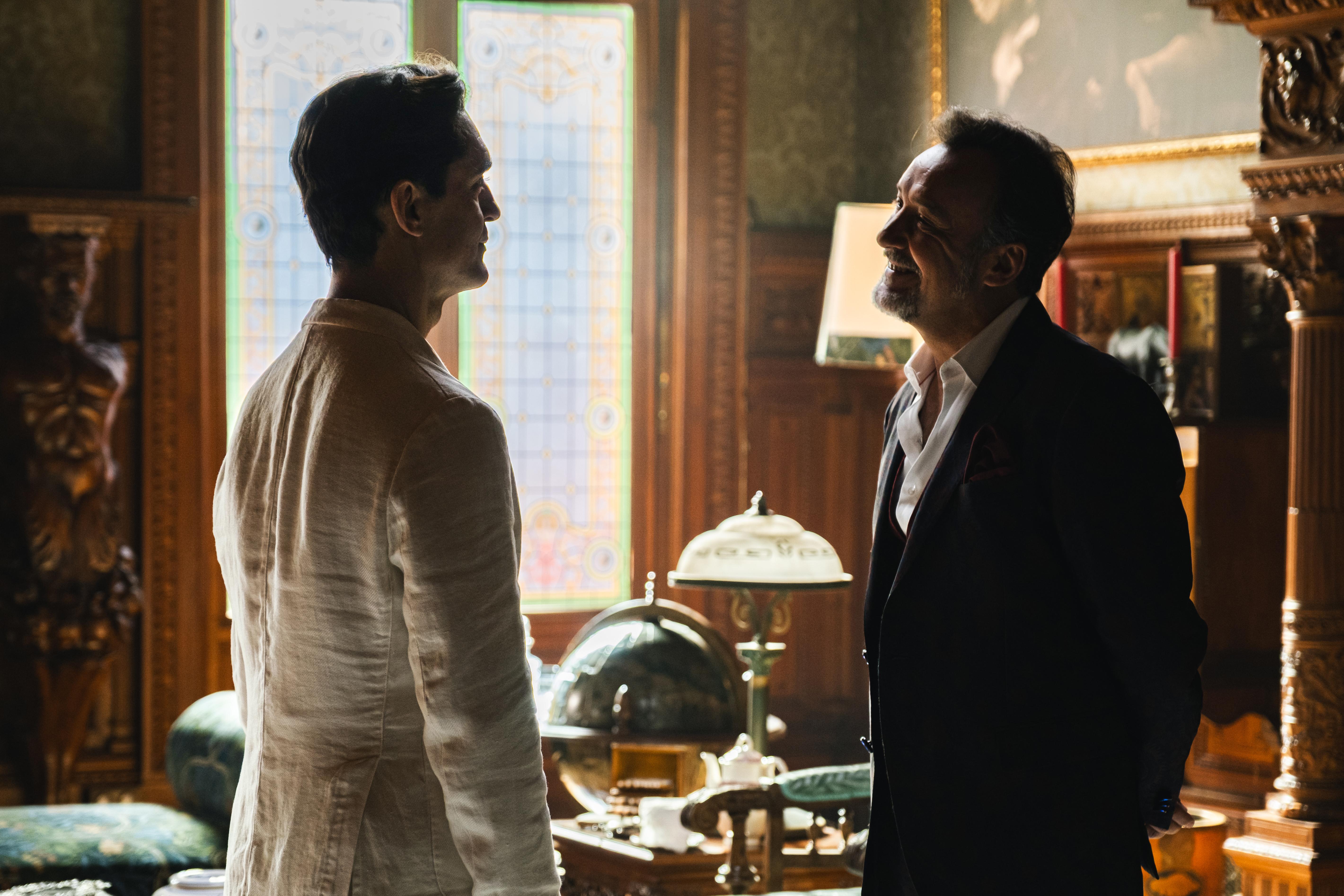
Berlin and the Lady with an Ermine Episode 3 Review: A Basement Full of Stolen Masterpieces, and Berlin Has a Religious Experience
Episode 3 finally lets the art heist breathe — then Berlin looks at the world’s most stolen masterpieces and decides robbery is not enough. He wants poetry, revenge, and divine-level chaos.
The Heist Stops Being Cute
“Stendhal Syndrome” is the episode where Berlin and the Lady with an Ermine stops flirting with an art-heist premise and fully commits to the sickness of it.
Not sickness as in sloppy. Sickness as in Berlin standing in front of stolen Rembrandt, Van Gogh, Cézanne, Modigliani, and Caravaggio paintings like he has walked into church and found God chained in a wine cellar.
That is the episode’s best move: it makes the robbery feel ridiculous, elegant, and weirdly moral all at once. This is not Paris and the royal jewels again. This is stolen history hoarded by a rich sadist who treats masterpieces like trophies. Berlin — future Royal Mint monster, current golden-age romantic disaster — is narcissistic enough to believe he is the only criminal in the room with a soul.
[Image suggestion: Berlin staring at the hidden gallery / first reveal of the stolen paintings. Caption angle: “When the heist becomes a religious experience.”]
Berlin Walks Through the Front Door, Obviously
The crew begins the episode rattled. Bruce has been shot in the face with pellets. Keila is shaken. The estate has barbed wire, jammers, bulls, sensors, and a trigger-happy aristocrat who has already proved he will shoot first and decorate the murder later.
Berlin’s answer? Walk in through the front door.
Peak Andrés de Fonollosa: suicidal confidence wrapped in silk. Everyone else sees a death trap; Berlin sees timing, keys, and theatrical opportunity. In Money Heist, that quality turns authoritarian and terrifying. Here, in prequel glow, it still looks seductive — but Episode 3 keeps letting the rot leak through.
He leaves Cameron and Roi to guard the captured estate thug and frames it as couple’s therapy: adrenaline, fear, one hand on the trigger. Berlin genuinely believes danger is intimacy. Love, crime, ego, performance — he mixes them like ingredients in the same poisoned cocktail.
The Couples Are Imploding Mid-Mission
The heist mechanics are clean, but the emotional damage is louder.
Keila confesses to Bruce that she cheated. Not over coffee. Not during a calm “we need to talk” window. She tells him after thinking he might die, after realizing she would have killed for him. Bruce’s reaction is painful and brutally inconvenient: in the middle of the operation, he needs details. Was it sex? Where? Did the other guy sleep over? Was he better?
It is ugly, but it is not fake. Season 1 gave Keila and Bruce the awkward-sweet romance. Episode 3 asks if it survives actual betrayal.
Meanwhile, Cameron and Roi collapse on the yacht. Their Season 1 slow burn was built around trauma, tenderness, and two guarded people trying to open up. Here, a hostage turns those wounds into weapons. He clocks Cameron as the alpha, Roi as Berlin’s loyal little soldier, and suddenly their private pain becomes public ammunition.
Roi’s fantasy of Seville is devastating: Triana bars, flamenco, whispers in her ear, tourist clichés, luxury stores, a horse-drawn carriage, a hotel room where they never sleep. It is romantic in the franchise’s most shameless way. Berlin would probably applaud.
Cameron cuts through it: “It was you who pushed me off the cliff.”
That line hurts because it rejects the franchise’s favorite illusion — that a beautiful speech can fix what people broke.
[Image suggestion: Cameron and Roi separated on the yacht / Cameron deciding to leave. Caption angle: “The romance fantasy finally hits a wall.”]
The Laser Scene Is Delicious Heist Nonsense
Then the episode remembers it is also a heist show and gives us exactly the kind of over-engineered absurdity this universe does best.
Smoke to reveal lasers. A two-degree oscillation loophole. Matching power, frequency, and caliber. A spectrometer. A neurosurgical robotic arm. Measurements down to 432 millimeters and 91.36 degrees.
Is it ridiculous? Completely. Is it fun? Also completely.
The Money Heist universe has always treated planning like seduction. The more specific the explanation, the more we want to believe the impossible thing can work. Keila gets a proper shine here too. Berlin may be the peacock, but she is the reason the peacock does not get carved into rich-man carpaccio by a fortress of lasers.
Even Damián has to admit the duke knows what he is doing. The oak barrels, sand-covered floor, cellar depth, and dome-like security setup make the gallery feel less like a private collection and more like a dragon’s lair.
Then the door opens.
Stendhal Syndrome: Berlin Finds His True Religion
The reveal is the episode’s crown jewel.
The Storm on the Sea of Galilee by Rembrandt. Poppy Flowers by Van Gogh. Cézanne. Modigliani. Caravaggio’s The Nativity. A basement of legendary missing art, hidden like contraband wine.
This is where the title snaps into place. Berlin has Stendhal Syndrome: euphoria, palpitations, almost hallucination-level overwhelm caused by exposure to beauty. For anyone else, this might be a gag. For Berlin, it feels like diagnosis and confession.
Berlin has always aestheticized crime. Jewels, opera, aristocrats, disguises, grand gestures — he does not just want money. He wants the story of himself committing the crime to be beautiful.
That is why this episode is such a juicy Money Heist callback. Fans know where he ends. We know the Royal Mint is waiting. We know the charming aesthete becomes the man who can be funny, cruel, heroic, misogynistic, magnetic, and monstrous in the same breath. Watching him genuinely shaken by stolen art does not redeem him. It complicates him.
He is horrified that the duke has sequestered beauty from the world. He talks about visiting Botticelli’s Birth of Venus at the Uffizi whenever he feels depressed or afraid for humanity. He calls art “the highest spiritual expression of humanity.”
And then you remember: this man is still robbing the place.
That is the Berlin paradox in pure form. He can identify desecration because he is an aesthete. He can hate the duke’s narcissistic hoarding because he recognizes a rival narcissist. But he is not a selfless guardian of civilization. He is a thief having an epiphany and immediately converting it into a bigger, grander, more poetic robbery.
His morality is real for five seconds at a time. His ego makes sure it never stays clean.
[Image suggestion: Close-up of Berlin overwhelmed by the masterpiece reveal. Caption angle: “Stendhal Syndrome, but make it criminal.”]
Damián Snaps — And He Has a Point
Damián’s blowup is one of the episode’s sharpest turns.
Berlin hesitates. He needs five minutes to think. Damián hears: after everything, after rejecting his Marbella idea, after dragging everyone through this insane laser ballet, Berlin may not actually rob the duke.
So Damián grabs a Monet and tells Andrés to go to hell.
The “Fuck you, Andrés” lands because Damián is one of the few people who can make Berlin feel the weight of his real name. Not Berlin the myth. Andrés the friend, partner, and man who humiliates people, changes the rules, then asks them to trust his latest revelation.
In Money Heist, Berlin’s strongest relationships are always tangled in devotion and damage: Sergio, Palermo, Tatiana, Rafael, and every crew member who follows him because he makes catastrophe feel meaningful. Damián belongs in that lineage. He loves the performance, but he is exhausted by the cost.
When Berlin declares the paintings will become part of “the biggest, grandest, and most poetic robbery in history,” it is thrilling. It is also manipulative. He saves the partnership by giving Damián what he wants, but he does it in Berlin language: not apology, not compromise — myth.
The Duke Is Rotten All the Way Down
The final stretch reminds us the duke is not just a collector-villain with good security. He is a creep in a matador-jacket fantasy, making his wife break birthday piñatas, abandoning her the second Berlin calls from the gallery — and leaving the dirty work to his scarred estate enforcer, who operates the kennel routine in his absence.
The dog humiliation scene is nasty: the estate enforcer forcing the captured young man to bark, then tossing Cameron into the kennel setup like people are animals the duke owns. The estate’s whole energy becomes clear. The stolen art, the bulls, the wife-as-doll birthday ritual, the dogs — everything is possession.
That makes Berlin’s disgust sharper. He may be a monster, but the duke is a smaller, uglier kind: a man without romance, only appetite.
Episode 3 ends with Cameron screaming for help, and that cliffhanger does exactly what it should. It punctures Berlin’s grand art-revolution high with the reality that while he is busy making poetry in the cellar, his people are still bleeding in the duke’s playground.
Verdict: Gorgeous, Toxic, and Slightly Insane
“Stendhal Syndrome” works because it fuses the season’s strongest ingredients: romantic collapse, absurdly precise heist craft, and Berlin’s dangerous worship of beauty.
It is spicy because everyone says the worst possible thing at the worst possible time. It is emotional because Keila, Bruce, Cameron, Roi, and Damián stop functioning as accessories to Berlin’s legend and start bleeding under it. And it is fan-native Money Heist material because Berlin’s contradictions are the whole engine.
He sees stolen masterpieces and experiences transcendence. He sees a tyrant hoarding beauty and calls it disgusting. Then he decides the answer is to commit an even more spectacular theft.
That is Berlin: less redeemed villain than beautifully lit contradiction. A man who can recognize art as humanity’s spiritual expression and still make himself the main character of its rescue.
If Episode 3 is any sign, Lady with an Ermine may have found the lane Season 1 sometimes missed: let the romance burn, but make the heist feel like a sin worth confessing.
Rating: 8.6/10 — the season’s first transcendent hour, where the masterpiece reveal lets Berlin’s Stendhal-meltdown and Damián’s “Fuck you, Andrés” share the same lit gallery without either losing voltage.
More episodes from Berlin and the Lady with an Ermine — The Money Heist spinoff, episode by episode. Jump to any episode in the season:
Where to go next
Reviewed by Mira Vance · QuizFandom Editor & Lead Reviewer. Every rating is an honest per-watch assessment from the desk that also writes the quizzes — not a press release rehash.