Bridgerton S01E3 Recap: "Art of the Swoon" — Daphne Learns the Rules
What happens — the short version (spoilers)
- Daphne and Simon perform jealousy at balls, helping her reject weak suitors while enjoying their own banter.
- Prince Friedrich arrives, compliments Daphne, and gives Queen Charlotte a royal alternative to Simon.
- Lady Featherington dresses Marina in Featherington yellow and pushes her back into society to find a husband.
- Lady Featherington and Varley forge George's rejection letter, leaving Marina shattered and Penelope devastated.
- Daphne understands Simon's mother's painting, and the intimacy rattles him more than flirtation does.
- Simon explains desire to Daphne after she asks what mothers refuse to teach, then cuts off their arrangement.
Daphne Bridgerton tries to play the marriage market like a game, then discovers that longing has terrible manners.
Bridgerton, Season 1, Episode 3 — “Art of the Swoon” Netflix
Every young lady in “Art of the Swoon” is being taught a lesson she did not ask to learn.
Daphne is learning that a fake courtship can still bruise. Marina is learning that love letters are poor protection against a determined mama. Eloise is learning that a woman may have a mind and still be expected to aim it toward a husband.
Daphne and Simon begin by congratulating themselves on their clever little ruse. By the end, the ruse has done its job too well. The ton believes them. Whistledown believes them. Worse, Daphne has started to believe there is something real under all that practiced banter.
Daphne and Simon keep their fake courtship in public
Lady Whistledown opens the social ledger with Daphne having rejected three proposals in a single week. That is a triumph only if one ignores the ticking clock behind it. Daphne and Simon’s arrangement has restored her value, but it has not yet found her a husband.
In the carriage, Daphne names herself the trusted general in “the grand battle of the season” and Simon the soldier brave enough to serve. Simon adds that he is also handsome, a correction only a duke with too much confidence would consider necessary.
At the ball, Lord Weaver asks Daphne for a dance, and Simon loudly complains about sharing her attention with “every moon-eyed dandy.” Daphne answers with perfect composure: only the charming ones. It is jealous enough to be useful and unserious enough for them both to enjoy.
Lord Hardy can talk about his landaus and ancestral home. Lord Tompkins offers the cheerful prospect of his mother moving in after the wedding. Daphne asks practical questions, and the answers come back empty or faintly horrifying.
The prince’s arrival should change the room. Queen Charlotte introduces Prince Friedrich as the sort of match every mama can understand. Miss Cowper lowers her eyes, lifts them again, deploys her fan, and waits for royal attention exactly as Daphne predicts.
Then Friedrich tells Daphne her gown is exquisite, the exact compliment Simon has just guessed he would offer every young lady in the room.
Daphne snorts.
It is not graceful. It is better than graceful. For one second, she is not the diamond, the prize, or the girl with a practiced answer. She is simply laughing with the person who makes the room bearable.
Marina returns to society in Featherington yellow
Across the square, Penelope is still waiting for a letter that does not come.
Marina has written to Sir George in Spain and believes his love will answer her. Penelope tries to keep hope alive, imagining that the delay is only the difficulty of sending letters from the front. Lady Featherington has no patience for hope. Marina is pregnant, hidden away, and rapidly becoming a problem that cannot be hidden much longer.
So Lady Featherington gives her an order: reenter society and find a husband at once.
Marina’s new wardrobe tells the truth before anyone says it aloud. She is to dress in the family colors, which means bright Featherington yellow and no privacy at all. At the modiste, Genevieve struggles with the measurements while Lady Featherington blames cake and promises a reducing diet.
At Somerset House, Lady Featherington tries to place her before Lord Middlethorpe. Penelope wants a private word. Marina, frayed and humiliated, snaps that she was not addressing him. Lady Featherington turns on Penelope — who has tried to pull Marina aside — calling her “a lovely girl with such an ugly countenance” and “a meddlesome little wench.”
The visit to the poorer neighborhood is meant to scare her into obedience. Marina refuses the easy cruelty of it. She will not pretend honest working people are a horror story arranged for her improvement. She still believes Sir George loves her. Lady Featherington asks the practical question she has been avoiding: if he knows of her condition, why has he not written back?
Then the letter arrives.
Marina reads a rejection that says George wants nothing to do with her or her situation. She breaks. Penelope breaks with her. Downstairs, Lady Featherington and Varley reveal the knife twist: the letter was copied by their own hand.
Lady Featherington calls it protection.
It is cruelty with a bonnet on.
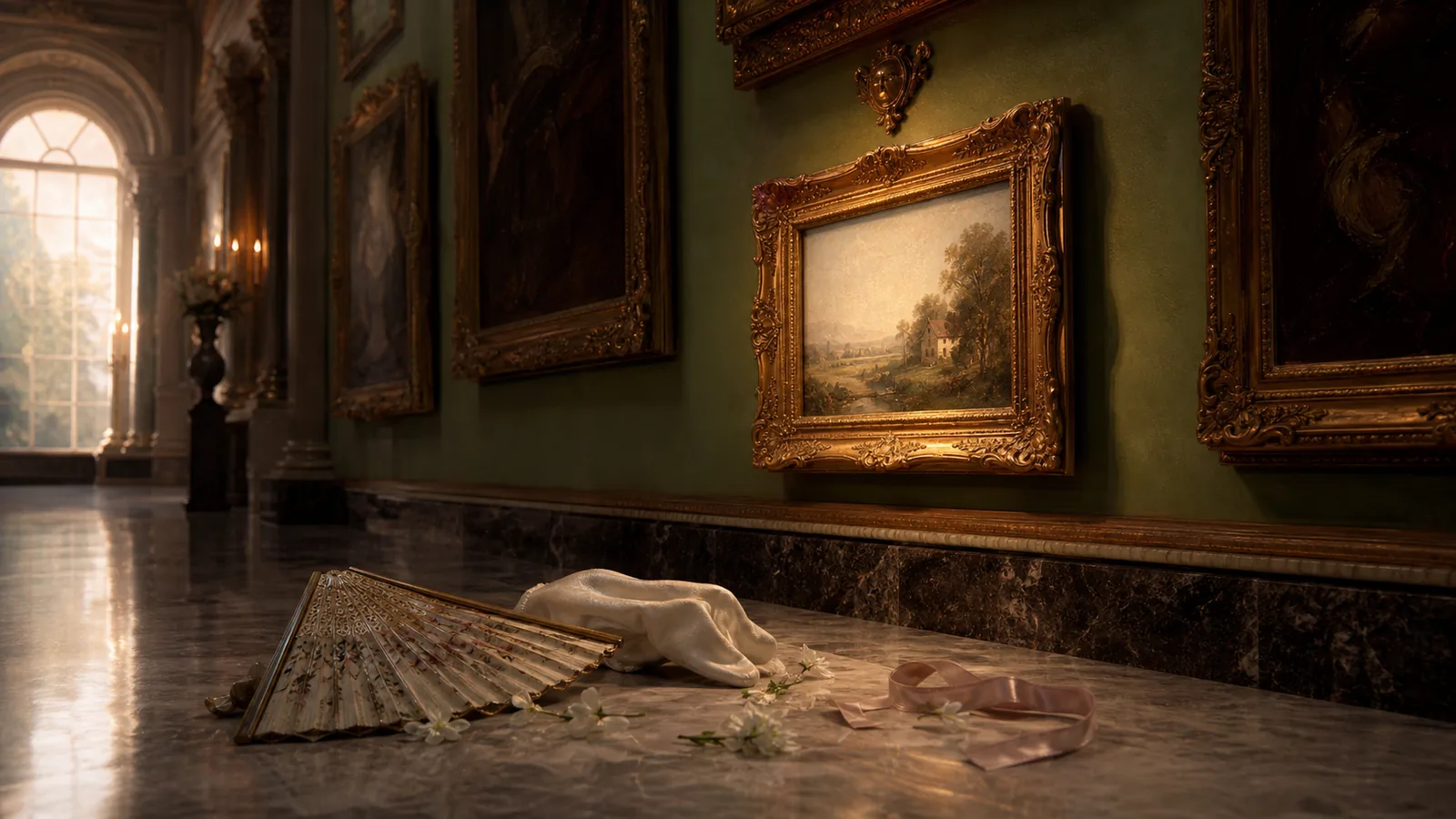
Simon and Daphne linger over his mother’s painting
Somerset House gives nearly everyone a chance to expose themselves.
Benedict critiques a painting to Lady Danbury, only to discover Mr. Granville, the artist, has been standing right there. Eloise and Colin call out the dull parade of women painted like “human vases.” The prince tries polite charm on Daphne, but she sees Simon and loses the thread.
She admits she enjoys fooling Lady Whistledown. The woman knows everyone’s business, even the queen’s, and yet Daphne and Simon have convinced her they are mad for each other. Simon says excessive pride suits her. Daphne reminds him pride is a sin. Simon calls it one of the lesser ones.
Simon donated several pieces from his family collection. This one belonged to his mother’s favorites. He has never understood why. Daphne does.
She sees the country in it. Morning before anyone speaks. A window, quiet, and the strange comfort of being alone without being lonely. The grander pieces may impress a room, but this one feels intimate.
That is the dangerous part. Daphne has understood something connected to his mother without trying to impress him. For a man who has spent his life insisting he needs no family, no marriage, no tenderness, it lands too close.
Cressida saves them by collapsing into Prince Friedrich’s arms.
Her feigned swoon is shameless, effective, and immediately printed into the day’s new game. Simon and Daphne laugh that they need to raise their own standard. But Simon has already changed.
Simon tells Daphne what mothers will not
Daphne’s real education begins at the edge of embarrassment.
Violet has told her to marry her dearest friend. Anthony, over cold milk in the kitchen because neither sibling knows how to light the stove, tells Daphne a little about Simon’s loneliness: he barely knew his father, never knew his mother, had no siblings, and spent his life alone.
He is speaking about Simon. He is also speaking about Siena.
Daphne keeps searching for an answer no one in her house will give plainly. During a walk with Simon, she asks whether marriage is friendship. Then she pushes further, toward the physical and intangible things that bring a couple together.
Simon laughs, then regrets it. Daphne does not let him retreat. Mothers tell their daughters nothing, she says, and he is not a real suitor. If she is meant to find a proper husband, how is she supposed to know what she is looking for?
Carefully at first, then with a frankness that changes the air between them, he explains that what happens between husband and wife is connected to what she can discover alone. He tells her she can touch herself anywhere that gives pleasure until the feeling grows into release.
Daphne listens with the focus of someone being handed a key to a room everyone else pretended did not exist.
Later, alone, she names the song Eloise had pressed her to finish. She also lets Simon’s lesson settle into her own body. Daphne’s innocence is not stupidity. She is intelligent, observant, and capable of running social strategy. What she lacks is information, because polite society has decided that ignorance is a virtue until the wedding night.
Simon gives her knowledge.
Then he decides he has corrupted her.
Lady Danbury warns Simon before he leaves Daphne
Lady Danbury sees the danger before Simon names it.
She asks whether all this time with Daphne is leading anywhere. If Simon intends to marry her, Prince Friedrich can become a dinner-party anecdote. If he is only dallying while Daphne loses the chance of an extraordinary match, then he is being careless.
Simon says Daphne is far from a fool.
Lady Danbury’s answer is colder: then he is being cruel, and she taught him better than that.
The next time Daphne approaches him, she is excited. She wants them to do something different together instead of the usual ices. Simon does not let her finish. He tells her their arrangement has succeeded and must end.
He hides behind the prince. Then he hides behind himself.
He calls himself a rake. He says he will corrupt her. When Daphne insists she can decide the bounds of her own propriety and reminds him they are friends, he cuts deeper. They were never friends, he says. She was a convenience, a diversion, pretty but nothing more.
It is a vicious lie because it has to be vicious to work.
Daphne leaves in tears. Simon immediately orders his affairs settled so he can leave England sooner than planned. For all his talk of corruption, his real fear is that Daphne may want the one thing he has sworn never to give.
Anthony fares no better with Siena. He visits her after the opera, jealous over a duke who never called, and finally admits he misses her. Siena does not let the confession erase the old terms. Anthony is still a viscount. He will marry, sire an heir, and guard his family. She will remain the woman he loves in darkness, never in the light of day.
She refuses to be his fool again.
Two Bridgerton men, two exits, two women left to pay the cost of male panic. The ton may be dressed beautifully, but no one should mistake it for gentle.
Daphne answers the ton with Prince Friedrich
Lady Cowper gives Violet the insult that clarifies the board. It is good Daphne is so taken by the duke, she says, because Cressida would never have a hope with the prince if Daphne went after him. Cressida has fortune. Daphne has the face.
She tells Rose to put away the dress she planned to wear and chooses white and silver instead. She asks for the hair Rose likes, with the circlet of jewels and flowers. Rose says she will look perfect. Daphne’s answer is calm enough to draw blood: “Good. That is what they want.”
At home, Violet turns the same pressure on Anthony by handing him fourteen eligible names. She catches him checking his father’s old watch and reminds him that time is of the essence.
At the ball, Simon announces that he is leaving England early. Lady Danbury calls him foolish, which is both concise and correct. Marina, hollowed out by the forged rejection, accepts a dance. Cressida imagines herself as a princess. Society keeps moving, no matter who has been wounded in private.
Then Daphne enters.
She has made herself exactly what the room wants to see: gleaming, composed, available. Violet asks whether she is all right. Daphne says she feels exceptional.
Prince Friedrich asks for her first dance.
Daphne gives it to him.
Simon can only watch as Whistledown’s next version of the story forms around them. The diamond has tired of waiting for the duke. Perhaps she has traded up. Why settle for a duke when one can have a prince?
It is a perfect society-page ending and a miserable romantic one.
Which, for Bridgerton, is often the same thing.
Verdict
“Art of the Swoon” has the surface pleasures Bridgerton needs: glittering rooms, vicious mamas, comic suitors, sibling teasing, and a royal complication dropped into the middle of a fake courtship. The sharper pleasure is how every public performance leaves a private mark. Daphne and Simon begin by manipulating the room, then discover the room is quite capable of manipulating them back.
The Marina material is harsher, and it should be. Lady Featherington’s forged letter is not a side scandal; it is a reminder that reputation is never abstract for these women. Daphne can answer rejection with a prince. Marina is being cornered into survival. Both stories belong in the same ballroom.
The result is a confident, romantic, quietly bruising chapter that lets Daphne grow more curious, more wounded, and more strategic at once. The swoon may be Cressida’s trick, but Daphne gets the better transformation: she learns what the rules are, then chooses how to weaponize them.
Rating: 8.5/10
More episodes from Bridgerton — Season 1 — Daphne and the Duke's fake courtship, episode by episode. Jump to any episode in the season:
Where to go next
Reviewed by Mira Vance · QuizFandom Editor & Lead Reviewer. Every rating is an honest per-watch assessment from the desk that also writes the quizzes — not a press release rehash.