Citadel Season 2 Episode 3 Review: Bernard assembles a disaster team, Nadia protects Asha, and the Edison hunt points to Rome
What happens — the short version (spoilers)
- Bernard buys Nadia 72 hours and turns Mason into a necessary weapon
- Braga's plan gives the mission a clean and ugly clock
- Braga turns a school meeting into a lesson in punishment
- Nadia leaves Asha with Honey and refuses to soften Mason's perimeter
- Frank Sharpe turns one North Korea memory into a Rome target
- Celine and Hutch turn CIA history into a Library con
Citadel* Season 2 Episode 3 is a mission-planning hour with a loaded custody handoff inside it. Bernard Orlick pulls an unstable team around one urgent problem: Paulo Braga is days away from making his assassin usable. The spy mechanics are clean: find Edison before Manticore does, break into the CIA's Rome archive if necessary, and keep Braga away from Russian President Dmitry Aronov. The emotional mechanics are colder. Nadia has to leave Asha with Honey, Mason risks another boundary, and every operative treats trust as something to spend before it spends them.
Bernard buys Nadia 72 hours and turns Mason into a necessary weapon
Bernard being alive should be a relief. Nadia treats it like another operational problem. He has summoned her to Baha Mar with Jim, Celine, Hutch, and Mason in the room, and the first real business is not the reunion. It is the mole.
Bernard says he knows Mason betrayed Citadel. His proof is not a recovered file. It is eight years in a bunker, time to decide the mole had to be Nadia or Mason, and then the way Nadia looked at Mason when he came back into the room. That is a very Citadel kind of deduction: emotional residue processed as intelligence.
Nadia asks the only useful question. If Bernard knew, why bring Mason back? Bernard’s answer is necessity. Manticore will come for both families. If they want out for good, they have to kill all eight families, starting with Paulo Braga. Mason is not cleared. He is simply useful. Bernard asks for 72 hours and promises to kill him himself if he makes one wrong move.
The bargain gives the episode its pressure. No one trusts Mason. Everyone still needs the thing he is good at.
Braga’s plan gives the mission a clean and ugly clock
Bernard’s briefing cuts through the team’s bickering. Paulo Braga is close to perfecting technology that can co-opt a person’s mind and turn that person into an assassin. The target is Russian President Dmitry Aronov at the G8, seven days away.
The payoff, as Bernard understands it, is Russia’s spy satellite network. Aronov is a nationalist. If Braga kills him and gets a corrupt prime minister into power, Manticore gets surveillance sharp enough to track someone down to DNA. One assassination turns into global visibility.
That puts Mason’s priority in check. He says saving the world is not his problem because Braga’s people have Abby. Bernard answers with the link Mason cannot ignore: he cannot save Abby without getting to Paulo, and he gets to Paulo by stopping the assassin.
The weapon has one exposed seam because Bernard built it that way. A receiver chip goes in the host’s cerebellum, then the programming hijacks the brain. Bernard sabotaged the code with a firewall that blocks transmissions longer than a minute. Only Bernard and a Korean hacker named Edison can disable it. Joana is chasing the same lead through Aparna, who is in Stockholm and still too focused on Sinh. Both sides know Edison is the hinge, and both sides have one week.
Braga turns a school meeting into a lesson in punishment
Braga’s school scene is the hour’s clearest read on the man behind the larger threat. His son Edgar punched another boy and made him bleed, so Ms. Turrant explains the school’s zero-tolerance policy and says Edgar will be suspended for a week. Braga accepts the punishment too easily, then asks who else will be punished.
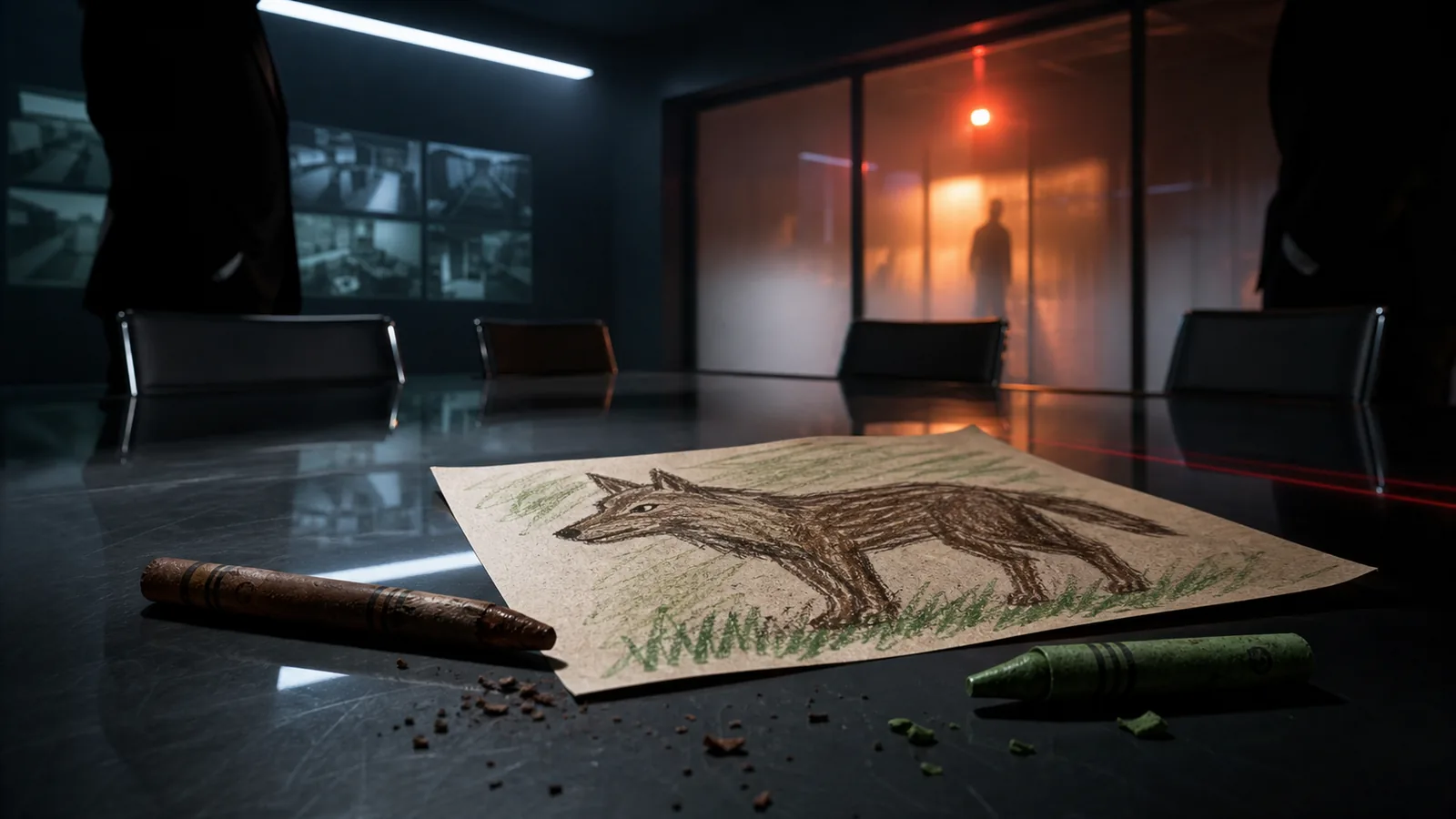
The control comes through details. He asks for crayons, first brown and then green. When Ms. Turrant hesitates, he slams the table. He already knows the other boy is Pierre, knows Pierre’s parents, and knows where they live. He lists Pierre’s behavior: screaming, pulling girls’ hair, teasing children who raise their hands, and targeting Edgar worst of all.
Braga does not blame Pierre. He blames the adult in the room for making Edgar restore order. By the time he asks what Ms. Turrant’s punishment will be, the meeting has become an interrogation. His final warning is direct: do not ever put his boy in that position again.
The wolf drawing turns the threat into doctrine. Some children draw pigs and rabbits, others draw wolves. Without wolves, Braga says, people would still have houses of sticks and stones, not bricks. For him, violence is not a failure of order. It is how order gets built.
Nadia leaves Asha with Honey and refuses to soften Mason’s perimeter
Nadia’s handoff at Olympia Station is staged with the precision of an extraction. She has 95 seconds until the stop, and she spends them reopening the old wound with Honey. Honey says she stayed away to protect Nadia. Nadia calls it abandonment.
Neither woman can fully dismiss the other’s position. Honey’s logic is operationally sound and emotionally ruinous, and Nadia is now using the same logic for Asha.
The handoff sharpens around a name. Nadia says her daughter’s name is Asha. Honey says her own mother’s name was Asha. The child recognizes Honey as “the lady from the movie,” and Honey tells her to call her Honey.
Honey gives Nadia one sealed instruction: if Nadia falls into trouble, and only then, call him. The transcript does not name the man. Then Honey tells Nadia in Hindi to come back for Asha.
Mason violates Nadia’s perimeter almost immediately. He says he needed to see Asha one last time. Nadia tells him she does not want him anywhere near her. His apology gets nowhere. When he says she needs to let him move forward, Nadia says there is a way forward and deep down he knows what it is. She calls him too much of a coward to do it.
Frank Sharpe turns one North Korea memory into a Rome target
Frank Sharpe is useful in the way old spies often are: he knows the right names, has terrible habits, and is broke enough to hire. Nadia recognizes him as the man in the Edison surveillance photo, though the photo itself is almost worthless because Edison had a black bag over his head.
Sharpe remembers one job 15 years earlier, identifying a weapons shipment in North Korea. Edison was a hacker. Edison did his work and left. Sharpe never saw his face, but he remembers who handled him: the CIA.
That turns the search toward Rome. If Edison was handled by the CIA, Bernard says, his true identity and whereabouts would be stored at CIA European headquarters. Hutch knows what that means: the Library, an air-gapped server in an ultra-secure room on a floor that requires top-level clearance. One person in the Agency operates the database.
Sharpe also brings the dirt they need. Bernard hires him for compromising information: fetishes, addictions, predilections, anything that can make human error open a secure room. The bank foreclosed on Sharpe’s place three weeks earlier, so the money matters as much as the mission. Bernard can talk about former spies being hunted for institutional knowledge, but debt is the cleaner recruitment pitch.
Celine and Hutch turn CIA history into a Library con
Celine’s flashback explains why everyone treats Hutch like an asset with a blast radius. Cash and Bantam introduce him as both an A-plus agent and an A-plus problem, with incidents tied to Morocco, Lithuania, and Oslo. Their message to Celine is simple: focus him, keep him in line, and if he goes too far, “extinguish” him.
That past sits under the present-day plan. Sharpe identifies a mark. A call in Italian pulls Katherine Delaney away with news that Felix had an accident on the monkey bars and may have broken his arm. Celine separately works Erik, who owes $400,000 to dangerous people, and offers him money for one thing: a cup of coffee.
The coffee gives Hutch time to stall Cash and Bantam. He tells a long false story about crying through The Best Exotic Marigold Hotel, disappearing after Dallas, retreating to Belize, and finding himself through yoga, veganism, and ayahuasca. Cash and Bantam know he was spotted in France and call the story false. By then, the timing has shifted.
The con is not elegant. It is pressure, embarrassment, and personnel weakness, all aimed at one locked database.
The fake surrender breaks open and turns violent
The CIA entry depends on people believing the wrong betrayal. Hutch and Celine bring in Nadia Sinh and Frank Sharpe as a peace offering and claim they want back in. Nadia improvises when no one buys it. She tells the officers Hutch is really there to steal intel, then offers Mason Kane and Bernard Orlick in exchange for disappearing her and Asha.
For a few seconds, it sounds like a real maternal sellout, which is why Stahl listens. Hutch hates it because it was not the plan. Nadia later gives the practical answer: no one believed him, so she had to improvise.
The extraction hits fast after that. The high-pitched tone incapacitates Cash and Bantam. Hutch gets the numbers he needs, sings them to hold them in memory, and takes an ID. Nadia tells Stahl she should have taken the deal. Tony opens the door.
Then the operation loses its clean edge. After the argument over Nadia’s improvisation, a gunshot drops someone and Hutch calls it a one-strike rule. The building shifts to emergency language: suspect shot, medical needed, Hutch in the east wing, headed toward the Library. The mission still points toward Edison, but Bernard’s recruited tools are now proving exactly how hard they will be to control.
Tiny details worth clocking
- Bernard identifies Mason through Nadia’s reaction, keeping the mole reveal tied to intimacy rather than paperwork.
- Braga knows Pierre’s parents and address before Ms. Turrant confirms the boy’s identity, which makes his family life feel surveilled too.
- Honey’s reaction to Asha’s name gives the handoff a family echo without turning it into reconciliation.
- Sharpe’s foreclosure makes the recruitment cleaner: ideology may help, but debt closes the deal.
- Nadia’s fake offer works because it sounds like something a cornered mother might actually do.
Final verdict
Episode 3 is mostly setup, but the setup is disciplined. Braga gets a mechanism, a deadline, and a target. Edison is not just another name on a board; he is the only person besides Bernard who can finish the weapon Manticore needs. The CIA Library becomes the next locked door in a chain that starts with Abby and points toward the G8.
The personal side gives the mission weight. Nadia leaving Asha with Honey mirrors the protective secrecy she despises in her mother. Mason’s brief reach toward Asha keeps him at the edge of a family he damaged. The CIA break-in leans hard on chaos, but the direction is clear: mind control as weapon, family as leverage, and trust as a temporary operating condition.
Rating: 7.8/10 - A controlled mission-setup episode with strong Nadia and Braga material, even when the CIA break-in leans harder on chaos than consequence.
More episodes from Citadel S2 — Spy fallout and family secrets, episode by episode. Jump to any episode in the season:
Where to go next
Reviewed by Mira Vance · QuizFandom Editor & Lead Reviewer. Every rating is an honest per-watch assessment from the desk that also writes the quizzes — not a press release rehash.