Dutton Ranch S1E4 Recap: "Start With a Bullet" Puts Mercy Behind the Rifle
Dutton Ranch, Season 1, Episode 4 — “Start With a Bullet” Paramount Network
A sick bull is one kind of disaster. A lie that arrives inside the animal is another.
The first gunshot in “Start With a Bullet” is quick and awful, the kind of sound a ranch makes when mercy has run out of softer tools. Rip knows what foot-and-mouth means before anyone has time to make peace with it. Everett confirms it, and the math is immediate: act fast or lose the whole herd. The new bull is the likely source. The papers are supposed to explain why that could not be true. By the end of the day, those papers have become part of the wound.
That is the cruel shape of the day. Beth and Rip came to Texas with a ranch, a herd, and one fragile hope that work could become peace if they kept at it long enough. Instead they have to save the future by killing what was supposed to carry it.
Rip Finds Foot-and-Mouth in the Herd
Rip, Beth, Azul, and Zachariah stand over sick cattle before breakfast, and there is no room for denial. Everett says the words plainly: foot-and-mouth. It will burn through the herd if Rip waits. Rip hears him, cuts him off, and starts moving.
Beth asks how it happened. Rip’s answer is practical before it is angry. It has to be the new bull, and it probably did not come clean through Reveille Farms. Somebody sold them an animal under false papers, and the entire Edwards dream is now breathing through infected mouths.
Beth’s first instinct is Carter. “I don’t want Carter to see this,” she says. That is not softness. It is memory. She and Rip both know what a young man becomes when every lesson arrives as blood and duty. They want Carter to learn the ranch, but not this version of it. Not a pit. Not rifles. Not the sound of cattle dying because the living ones need a chance.
Rip sends her to get him up and out. Then he calls Azul and Zachariah to work.
There is just the fact of it.
Beth Finds Carter and Oreana in Bed
Carter is not where Beth needs him to be. He is in bed with Oreana Jackson, and the room changes as soon as Beth sees them together.
Carter tries to make it small. Beth makes it practical. She does not mind what he does in his free time, but he should be getting to school. Oreana pushes back, asking whether Carter is old enough to decide for himself. Beth answers without turning the fight into a performance: “I wasn’t talking to you.”
The ride back to 10-Petal matters more than the discovery. Beth asks Oreana why Carter, and Oreana gives the only answer that could soften Beth without making her trust her: he does not try to be something he is not. Beth warns her anyway. Carter has a pure heart. If Oreana plays with it, Beth will make her life hell.
Oreana does not flinch. Beulah already did that, she says. She tells Beth that Beulah uses people, threw her father away, and will not let her leave. For the first time, Beth sees the girl without the Jackson name doing all the talking. Oreana is reckless, but the cage around her is real.
Beth leaves her with a sentence that sounds almost like permission: Oreana does not strike her as the kind of woman who asks for it.
Then Beth meets Beulah at the door.
Beulah calls Oreana Texas weather, the kind that changes if you wait a day. Beth does not accept the joke. Carter is not a plaything. Beulah offers a drink and a fresh start. Beth passes. Rio Paloma is a small town, Beulah says, which is less a neighborly reminder than a claim of reach.
Beulah’s reach touches Carter through Oreana, Everett through an old wound, and Rip through Rob-Will’s absence. Beth knows the shape of a powerful woman when she sees one. She just does not know yet how many rooms Beulah already owns.
Beulah Pulls Everett Back to 10-Petal
Everett is called to 10-Petal for a pregnant mare that does not exist. He arrives ready to work and finds Chet running the place, or trying to. Rob-Will is gone. The hands say he does not work there anymore. Nobody has a mare in trouble.
Beulah has pulled Everett there because asking would have let him say no.
Their whiskey conversation is the quiet counterweight to the herd crisis. Beulah is dangerous in public, but Everett knew her before that danger hardened into a way of life. She asks him to drink. He knows nothing from her is simple. He drinks anyway.
She tells him Rob-Will has been sent to rehab, and Everett does not quite take the story at face value. “Third time’s the charm,” he says. That line carries a lot of history and almost no trust. Rob-Will murdered Wes. Everett does not know that. Beulah knows enough to keep the answer covered.
Then the conversation turns old. Beulah talks about the tire swing still hanging from her oak, the one that makes her think Levi is out there when the wind moves it. She wants the ropes to rot because cutting it down would feel like a second betrayal. Beulah looks human there, and it does not redeem her. It only explains why the cruelty has somewhere to come from.
Everett says, “If we could go back…” Beulah lets the sentence die with him. They have too many demons to be good for each other. Neither argues. She cries after he leaves, and the grief sits there by itself, stripped of power and still not innocent.
That is what makes Beulah more dangerous than a simple ranch villain. She has loss behind her. She has money around her. She has people under her. Pain did not make her kind. It made her efficient.
Carter Skips School and Follows an Old Hand
Beth sends Carter to school so he will not see the cull. Carter does not go.
He walks into a bar looking for ranch work and finds an older cowboy who knows the local outfits, talks too much, and offers a day’s pay with food included. Carter says he does not have a horse. The old man tells him he is about to be one.
It is funny until it is not. Carter spends the day doing real labor for a stranger who feeds him beer and calls it the school of life. The man talks about wrecks, broken bones, and the cowboy life requiring tough sons of bitches. Carter listens because listening is one of the things he does when he wants to belong.
Beth calls while Carter is with him. She apologizes for the morning, tells him to take Oreana to dinner, and gives him no curfew. Carter thinks Beth has accepted the girl. The truth is uglier. Beth is buying time. She wants him away from the ranch until the pit is filled and the rifles are put down.
The day gets stranger. The old hand takes Carter out on a Gator, jokes about Texas and Oklahoma, then shows him Xena, a full-blooded African leopard he says he bought through the internet. Carter knows enough to understand that this is not normal. He takes his pay, takes the Gator back, and leaves the man behind with the animal.
The leopard detour is wild, almost too wild, but it does put Carter in the right emotional place for the ending. He spends the day chasing adult work and finds foolishness, danger, and cash. Meanwhile the real ranch work is happening without him. When he learns that, he does not hear protection. He hears exile.
For Carter, those have always sounded close together.
Rip and Beth Kill the Herd
Rip gathers Azul and Zachariah before the cull and gives them a way out. This will follow them to the grave, he says. If either man wants to walk, he will not hold it against them.
Neither walks.
Zachariah says yes, sir. Azul stays with him. Rip assigns the work: Azul keeps him loaded, Zachariah helps dig the pit, Beth and Rip drive the cattle in. Beth refuses the safer place. Rip tells her that beside him is not where she wants to be. Beth answers, “That’s why I won’t be anywhere else.”
That is marriage in this world. Not comfort. Not rescue. Standing close enough to share the stain.
Before the guns start, Zachariah and Azul sit with the question neither can settle. Zachariah says God’s plan is not always a blessing. Rip tells him to shut up. Later, Azul repeats something his father Hector used to say: the surer a man is, the less he knows. Zachariah cannot live with the thought that it might all be for nothing.
Then the killing begins.
Beth tries once to save a cow. Maybe she is okay, she says. Rip says they cannot. The answer is not cold. It is worse than cold because it is true.
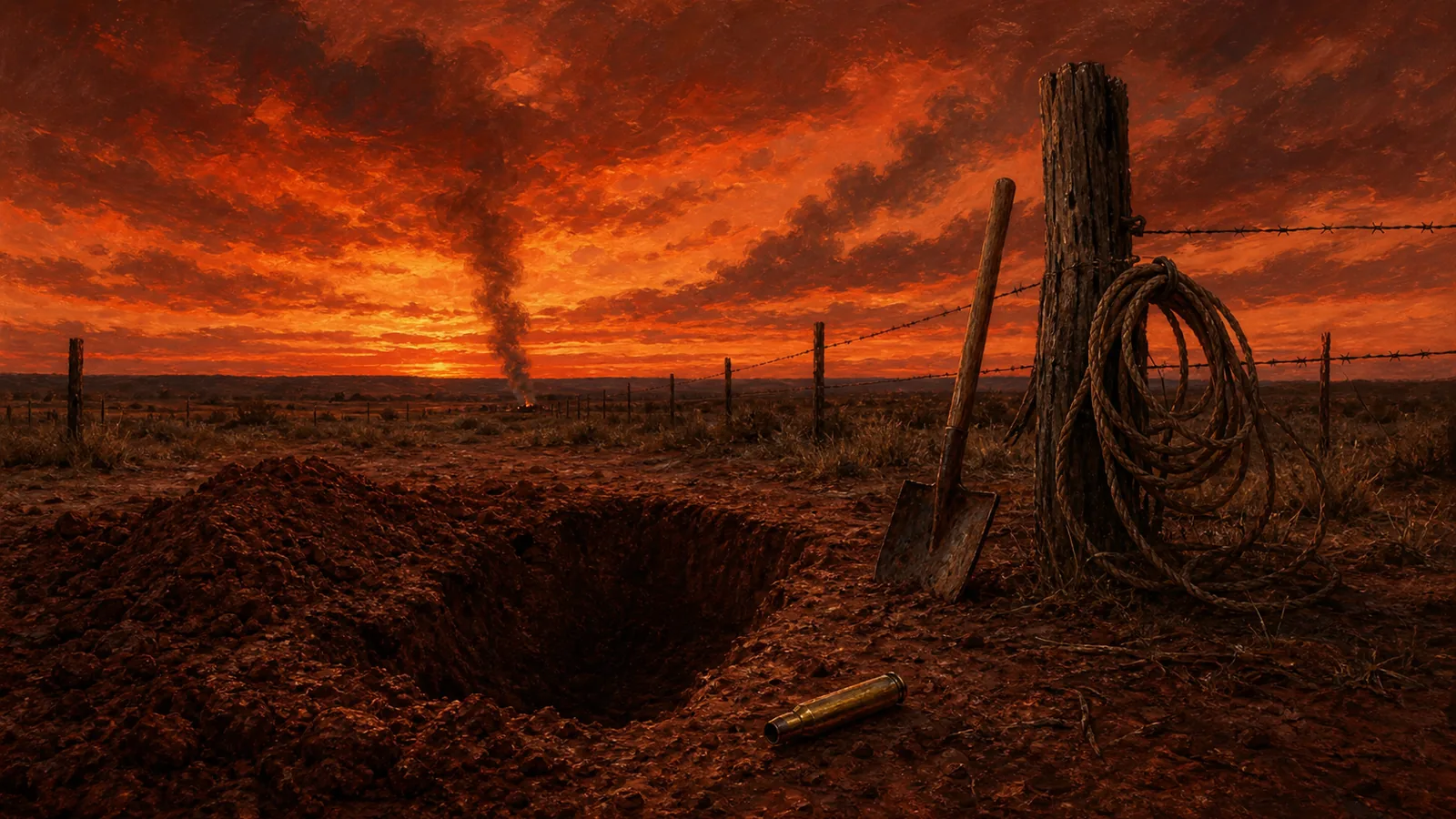
The calf is the wound that stays open. Beth looks at it and says, “You don’t deserve this.” Then the gunshot answers because there is no other answer left.
Zachariah sings afterward, voice low over the dead. It is not a funeral in the human sense, but Rip already named it at the store when the clerk asked where the party was. Not a party, he said. Funeral. He was right. The herd is property on a ledger, meat on a future invoice, and Billy Edwards’s dream in living form. It is also a field of animals that did nothing wrong.
“Start With a Bullet” earns its rating in this stretch. The ranching detail is harsh without becoming spectacle. Beth does not break down because the day is too large for that. Rip does not harden because he is already as hard as the work requires. Azul and Zachariah become men who stayed.
That is enough.
Beth and Rip Run J.R. Simon Out of Rio Paloma
Beth starts tracing the lie before the killing is done. She calls Winter Garden Vet Clinic about the bull she bought from J.R. Simon, asking for Dr. Poole and the presale examination. Dr. Poole has never heard of Simon. He has never heard of Beth.
The blood work was forged. The vet paperwork was forged. All of it.
When Beth tells Rip, the loss changes shape. A disease is bad luck if it arrives through honest channels. This did not. A broker put a sick bull in their herd under fake papers, and the cost landed in rifles, pits, and a child they tried to shield.
Beth and Rip find Simon in his trailer and wake him hard. Beth says he sold her a sick bull. Rip does the rest of the persuading. Simon says people come to him and their business is not his. He promises money. He gets thirty seconds to leave Rio Paloma instead.
The scene is blunt, and maybe too quick for the size of the damage. Simon is a middleman with a trailer and a bad set of documents, not the final answer to who wanted the Dutton herd broken. But the confrontation gives Beth and Rip what they need in the moment: a body to push out of town.
Beth says later that this was supposed to work. That line lands harder than any threat to Simon because it is the private wound beneath the public violence. Texas was supposed to be the place where work could become enough. Beth says she will fix it. Rip tells her no. This is not on her to fix.
He is right. He is also asking Beth Dutton to put down the one tool that has kept her alive.
She does not know how to do that yet.
Carter Calls Beth a Liar
Carter comes home after the cull and sees the absence before anyone can explain it. Beth needs a minute. He does not give her one.
“You sent me away,” he says.
Beth says she was protecting him. Carter asks from what. She wants him to be a rancher. He says he should have been there. Beth says today was not ranching. Carter calls that what it is to him: bullshit.
The fight hurts because both are telling the truth from opposite sides of the same fence. Beth and Rip would break themselves in half to give Carter a better life. Carter answers with the line she cannot solve: his life is not hers, and it is not Rip’s.
He is right. Carter cannot become whole by being kept from every wound that made them. He also cannot become whole by inheriting all of them.
Beth’s no-curfew lie is the point that gets him. He thought she liked Oreana. Instead he sees the trick. Beth used the girl as cover to keep him gone.
“You’re just a liar,” he says.
Beth apologizes after he walks away, but the door has already closed. That apology is small and late and still real. She protected him like a mother. She deceived him like a Dutton. The two things are not separable in her yet.
Rip calls Everett afterward with only two words: “It’s done.” Everett says he is sorry for him and Beth. He does not need the details. In ranch country, there are days when the result is the whole story.
This one started with a bullet and ended with a son who no longer trusts the mercy behind it.
Pros
- The herd cull is handled with the gravity it needs; every character in the pit sequence carries a different kind of cost.
- Beth’s choice to protect Carter creates a real consequence instead of easy sympathy.
- Beulah and Everett’s whiskey scene gives Beulah a wound without letting her off the hook for what she covers.
- Azul and Zachariah bring moral texture to the ranch work without turning the cull into a sermon.
Cons
- Carter’s leopard detour is memorable, but it pulls hard against the grounded ranch crisis around it.
- J.R. Simon takes the full force of Beth and Rip’s anger before the larger question of who profited from the forged papers can breathe.
- Beulah’s scenes are strong on atmosphere, but Rob-Will’s disappearance still leans on withholding rather than discovery.
Rating: 8.1/10
Universe Context: The Dutton Inheritance When the Herd Has to Die
The Dutton saga began with people driving animals across land that did not care whether they lived. [[james-dutton]] and [[margaret-dutton]] crossed into the West with cattle, children, grief, and a belief that land could become home if enough loss was buried under it. In “Start With a Bullet,” that old bargain returns to Texas from the other end. Beth and Rip are not moving a herd toward a promised valley. They are killing one to keep a promise from dying altogether. The 1883 founding treated survival as a claim. Here, survival requires destroying the thing Beth and Rip were trying to build.
[[john-dutton]] spent his life teaching his children that the ranch came before comfort, before innocence, and often before truth. [[beth-dutton]] inherited that lesson in its harshest form. Her choice to send Carter away is not weakness; it is the John Dutton lesson turned toward motherhood. Keep the heir alive. Keep the heir clean if you can. Lie if you have to. The trouble is that Carter is not a blood heir receiving a finished kingdom. He is a young man trying to earn a place on land that still does not know him, and Beth’s protection denies him the proof of belonging the Dutton world has always demanded.
For [[rip-wheeler]], the cull cuts even closer to his Yellowstone inheritance. John gave Rip work when Rip had nothing, then turned work into identity. In Montana, Rip learned that love often looked like obedience under terrible conditions. In Texas, he stands as the man giving orders, offering Azul and Zachariah a way out before asking them to carry a day they will remember forever. That is the lineage Beth and Rip brought south: the Dutton name, and the habit of turning pain into duty before anyone has time to grieve. The Montana ranch burned. The Edwards herd is gone. What remains is the question every Dutton generation has faced since 1883: whether the land is worth what it keeps asking them to become.
More episodes from Dutton Ranch — Beth and Rip build a Texas future, episode by episode. Jump to any episode in the season:
Where to go next
Reviewed by Mira Vance · QuizFandom Editor & Lead Reviewer. Every rating is an honest per-watch assessment from the desk that also writes the quizzes — not a press release rehash.