For All Mankind S4E4 Review: A Suit Valve Becomes a Cold War Detonator
One fist fight at Depo One drags Happy Valley, Moscow, and the Gore White House into the first proper Cold War of the alt-history's twenty-first century.
“House Divided” is where the Korzhenko coup stops being a news ticker and starts redrawing every desk in the show. A two-cosmonaut argument about Lenin and Stalin ends with a valve hissing on the Martian surface, and within twenty hours the leak has traveled from a hyperbaric chamber on Mars to a treadmill in Houston to a small office in Star City where Margo Madison decides what she is willing to do for a piece of bread that is not stale. “House Divided” runs as a slow burn that ends in three quiet betrayals stacked on top of each other. None of them feel inevitable. All of them feel like the only move available.
A bar fight on Mars rewrites the M-7
The cold open is built like a stage two-hander. Svetlana Zakharova and Vasily Galkin are alone at Depo One testing anchor clamps and arguing about whether Korzhenko represents a return to Lenin and Stalin or the same old shooting-dissidents-in-the-forest. The argument is so specific it sounds rehearsed, which is the point. Svetlana lost her patron the day Gorbachev fell. Vasily’s uncle just gained one. The fight that breaks out is short and ugly. Svetlana cracks the seal on Vasily’s suit. He survives because she shouts at him to exhale, but the bends do the rest. We then sit with the bill: Vasily in a chamber, possibly brain-dead; Krys Marshall’s Danielle Poole pulling Svetlana’s wings; Joel Kinnaman’s Ed Baldwin arguing she is too valuable to the asteroid program to sideline. The argument from the cold open has not ended. It has just relocated to Dani’s office.
The escalation is what makes the episode tick. Within hours the new head of Roscosmos has phoned Houston and demanded extradition under the M-7 Charter’s recall clause. Daniel Stern’s Eli Hobson sits across a videolink from Irina Morozova and tries the moves that worked on the UAW. He calls them partners. He calls it a dustup. He suggests the Happy Valley commander handle it in situ. Morozova, ex-KGB, returns each move with a cleaner one. Charter is charter. Soviet citizen assaults Soviet citizen. The right to recall belongs to the sending nation. When Eli reaches for the Gorbachev-was-the-other-guy gambit, she counters with whether Gore’s election invalidated all of Ellen Wilson’s treaties too. Eli does not have an answer. He hangs up and tells the room it did not go well.
Moscow runs Happy Valley by retreating from it
The Soviet response is staged with the muffled gravity that Russian-language scenes in this show have always been good at. Morozova opens her room with a sentence about resisting an egregious act and immediately suspends the asteroid program. She frames it as needing to investigate Kuznetsov’s death first. Everyone in the room knows the suspension is leverage. Then she orders Roscosmos to flip the Happy Valley ops computers back to Cyrillic and Soviet-original parameters. When Dani’s bridge tries to reboot the primary root server twice and cycle the CPUs, a Soviet engineer named Yevgeniy tells her plainly that the Soviet Union no longer recognizes her role as commander. The Cold War has not been reignited. It has been routed through the user interface.
That is the rhythm of the hour. Mars is not the site of confrontation. It is the surface that registers a confrontation happening in Moscow. The base does the same work it has always done, then logs in one morning to find the words on the screens have changed. Wrenn Schmidt’s Margo, watching the same Soviet meeting from her chair in Star City, gets handed the asteroid accident report on a courtesy made unsubtle by Tatyana Volkova handing her a copy meant for someone else. The Volkova-Margo scene at the coffee machine is the episode’s quietest love letter to its own past. A woman without coffee is a dangerous woman, Tatyana says, and slides a kopek-weighted slug into the machine. Margo helps her invert a matrix. The two women are deciding whether to know each other, and the show lets the decision take three pages.
Ed and Dani break the only friendship the show has
The hopper that lands inside Happy Valley is Toby Kebbell’s Miles Dale falling into a hole on Peckinpah Mesa with a smuggled Helios suit and a head full of obsidian. The Miles arc is the episode’s lightest plot and its most reliable thermometer. He talks Ilya into the obsidian-jewelry side hustle while Ilya warns him that more people means more risk and more ways to get fucked. Miles ignores the warning, books an unauthorized EVA on a borrowed suit with a misbehaving radio, and falls into a pit. Sam, the Helios worker who refused to drive him out there, suits up and finds him. The reunion is shouted. Sam patches his arm in silence. The two of them ride back together with the cargo netted up between them. The scene tells you the colony has begun to sort itself into people who help each other and people who manage them, and that the line is not where the M-7 thinks it is.
The Ed-Dani scene that closes their arc is the episode’s hardest swing. Eli has cooked up an Indian neutral-venue compromise. Korzhenko and Gore have signed off. Svetlana will be tried by an independent judge in the only M-7 country that is not in either camp. Dani has already said yes. Ed loses it. The fight that follows is the one the show has been postponing since season three. Dani accuses him of letting his feelings for Svetlana cloud his judgment the same way Gordo did on Jamestown and Danny did when they let him fly. Ed dares her to say it. She says it. Svetlana Zakharova will be on Unity when it leaves tonight. My decision is made. The hour does not let either of them off. Dani is right about Ed. Ed is right that the deal is wrong. The friendship absorbs both punches and walks out of the room together, but the show is honest enough to film the exit as a hairline fracture rather than a clean break.
A units conversion and a kidnapping
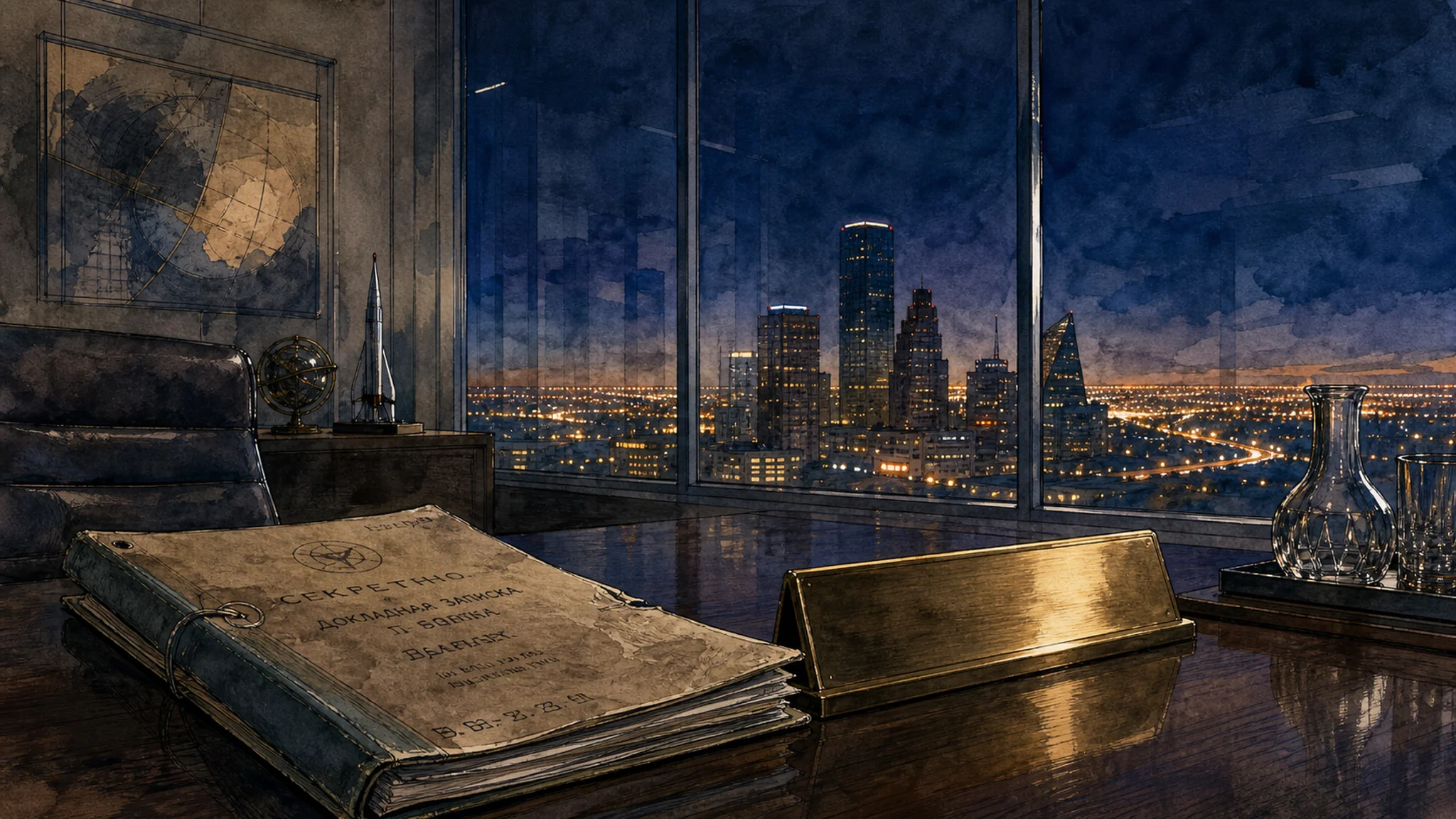
The Star City plot is where the hour pays off its slowest setup. Margo’s matrix help in the coffee corner buys her Tatyana’s goodwill. Tatyana’s goodwill buys her a Babanin-pilfered copy of the Kronos accident report. The report blames Ed Baldwin and the American command-and-control. Margo, alone at her desk with a calculator, sees what Roscosmos saw and chose to bury: the anchor bolts were specced in pound-feet, Roscosmos manufactures in Newton-meters, and someone screwed the conversion. The bolts would have failed even if Ed had not authorized the emergency EVA. Kuznetsov died because of a unit-conversion error inside a Roscosmos quality-control office.
Morozova listens to Margo lay this out in front of Kirill Semenov, the engineer who let the report ship. She lets Margo press him. She lets him confess. Then she walks him out of the room and has the KGB pick him up in front of his own department. The closing scene of that arc is Tatyana sobbing into Margo’s shoulder about cowards. By that point we have to ask what Margo has just done. She has helped a regime she fled extract a confession that ends in a man being disappeared. Morozova hands her a 1969 ground-control photograph that includes Sergei Nikulov. Margo accepts the gift. The take-us-far-into-the-cosmos pitch is not subtle, but Wrenn Schmidt’s face shows that the choice was already made before the photograph crossed the desk.
What this episode argues
“House Divided” is built around a single proposition. Distance no longer protects anyone. The M-7 architecture assumed that Mars could be a frontier where Earth politics softened on the way up; what the Korzhenko coup proves is that Mars is a downstream venue for Earth’s bad decisions and that the bad decisions reach the colony faster than the colony can respond to them. Happy Valley does not get a vote on whether the Cold War is back. It gets a Cyrillic boot screen. The asteroid program does not get a vote on whether to launch. It gets suspended by a director who has not flown a sim. Svetlana does not get a vote on her trial. She gets an Indian compromise drafted while she packs.
The other argument runs through the four central characters. Each of them in this hour decides what they will trade to keep working. Dani trades a friend for the base. Ed trades the base for a friend, and loses both. Margo trades a man’s freedom for a chair next to a desk. Miles trades Ilya’s careful system for an obsidian payday and almost trades his life. None of these are moral failures. They are the cost of staying in the room. The Pushkin poem Morozova recites is the whole argument wrapped in a gift box. Without grace. Without inspiration. Without tears. Without life. Without love. Then my spirit woke and you appeared again. The Soviet Union is recruiting Margo back into love of the work. The work is what gets people kidnapped.
Verdict
“House Divided” is a transitional hour that earns every minute of its runtime by refusing to let the diplomatic plot pretend it is procedural. The cold open is the strongest action beat the season has staged, the Star City stretch builds to a kidnapping with the patience of a chess problem, and the Ed-Dani fight is the kind of long-arc payoff that justifies six seasons of accumulated context. The Miles-and-Sam side trip is slighter, and the Eli-on-the-exercise-bike comic beat sits oddly next to the Kirill Semenov disappearance, but those rhythm wobbles do not break the hour. Daniel Stern is doing some of the warmest work in the cast, and the marriage-bike-Aruba scene with his wife Kath quietly justifies its placement when his neutral-venue idea drops.
The closing shot of Ed walking Svetlana to the shuttle is the episode in miniature. Two people the show has been building since Apollo-Soyuz say goodbye in a corridor neither of them designed. The Cold War has reorganized their day around a flight manifest. Neither of them got to vote. Both of them showed up anyway. That is the loyalty the show is interested in this season. Not loyalty to a flag. Loyalty to whoever is left in the room with you when the screen flips to Cyrillic.
Rating: 8.6/10
More episodes from For All Mankind — Season 4 — Helios, Happy Valley, and a colony with rules, episode by episode. Jump to any episode in the season:
Where to go next
Reviewed by Mira Vance · QuizFandom Editor & Lead Reviewer. Every rating is an honest per-watch assessment from the desk that also writes the quizzes — not a press release rehash.