Tom Clancy's Jack Ryan S1E3 Review: Black 22 Makes Jack Ryan Watch the Cost of Distance
A Paris manhunt and a drone crew's impossible view turn Jack Ryan's third hour into a study of judgment under pressure.
“Black 22” widens Tom Clancy’s Jack Ryan without letting the season lose its nerve. Jack Ryan and James Greer are still in France after the apartment attack, but the hour keeps cutting away from the analysts and cops to people who live inside the consequences of the chase: Ali’s old friend, Suleiman’s wife, and a drone pilot in Nevada. The episode’s title comes from a roulette streak, but the real gamble is procedural: when everyone can see part of the picture, who gets to decide when looking becomes action?
Paris Gives the Manhunt a Moral Argument
The episode starts with French television trying to name the violence before the authorities can. Police describe the men from the apartment as local jihadis, one recently back from Syria, others tied to a mosque known for radicalizing young men, and the TracEuro clue explains why the investigation has attracted extra manpower. It is a blunt opening, but the hour quickly complicates the shorthand. Jack and Greer are not chasing a faceless cell anymore. They are chasing a brother.
Captain Sandrine Arnaud brings over Mousa bin Suleiman’s prison records, and the file gives Jack the connection he needs: the man he chased after the apartment raid is Ali bin Suleiman, Mousa’s brother and only prison visitor. The address points them toward the 93 Department, which Sandrine identifies as a Muslim neighborhood. Jack’s instinct is tactical, but Sandrine’s anger is still raw. She asks why he drew his weapon and did not fire. Jack says civilians were behind Ali and he had no clean shot. Her answer is the hard local version of the job: if the gun comes out to shoot, the shot follows.
That exchange gives the Paris material its edge. Jack is not wrong to value the background civilians, but Sandrine is not only being reckless or vengeful. French citizens have just died on French soil, and the attack happened under her watch. The episode lets that grief live beside the larger intelligence logic Greer keeps pushing. Later, when the GPS on Omer’s car locates Ali and Sandrine wants an intercept, Greer argues for surveillance because Ali may lead them back to the cell or to Suleiman himself. Sandrine agrees, but draws the line at the border. The compromise is not a victory. It is two institutions disagreeing over whose dead count first.
The neighborhood search also gives Jack a small but important mirror. Sandrine asks how he can work inside the CIA while knowing what his government does. Jack gives the inside-the-system answer: maybe from there he can change something. She does not mock him, but she reads him more sharply than he reads himself. For a man who calls himself an analyst, he keeps finding his way into the field. Sandrine names him as a wolf pretending to be a sheep, and the line lands because the episode has already shown Jack chafing against distance. He wants the information chain, but he also wants proximity to the moment when a choice can be made.
Hanin Reads the House Better Than Suleiman Does
While Paris turns Ali into a lead, Suleiman’s home turns into a quieter prison. Hanin receives passports from Fathi, who says he did it for her and the children rather than for money. The scene plays like a favor until Suleiman enters the episode’s domestic space. The family plays Monopoly, children laugh over railroads and fake money, and Suleiman invites Hanin to sit because he wants everyone together. The warmth is real enough to be unsettling. This is not a villain speech. It is a father staging affection at the exact moment his wife knows she has to leave.
The proposal story makes the room colder. Suleiman tells the children about coming home from the war in Ramadi, being taken in by a man in the desert, and seeing Hanin bringing soup to the table. Then the memory turns. Her father had no work and no money, and he offered his daughter for the night. Suleiman frames his refusal as rescue: he wanted to marry her properly and take her away. Hanin’s face, and the scene’s placement after the passports, keeps the story from becoming romance. A man can remember himself as deliverance and still build a house his wife has to escape.
That is why the line about secrets is so sharp. Suleiman says they have no secrets from each other, and then repeats the point directly to Hanin. The children hear a family lesson; Hanin hears a warning. When she wakes Sara and tells her to pack three days of clothes, the danger is not abstract politics. It is a woman calculating how quickly she can move two children through the night before the men around her discover the plan. Samir refuses to go without his father, and Hanin makes the hardest choice the episode gives anyone outside a command center. She leaves her son because staying would trap them all.
The desert escape keeps returning to faith, but not as propaganda. When the car gives out and Sara panics that they have no food or water, Hanin tells her God will protect them. She says it again later, after a shot from above saves them from Yazid. The sentence means two different things in those scenes. The first is a mother’s way to keep a child moving. The second is a survivor trying to make sense of a rescue she cannot possibly understand. The episode’s critical eye is in that gap. To Hanin, protection arrives from God. To the viewer, it arrives through an American drone pilot who has broken orders after watching too long.
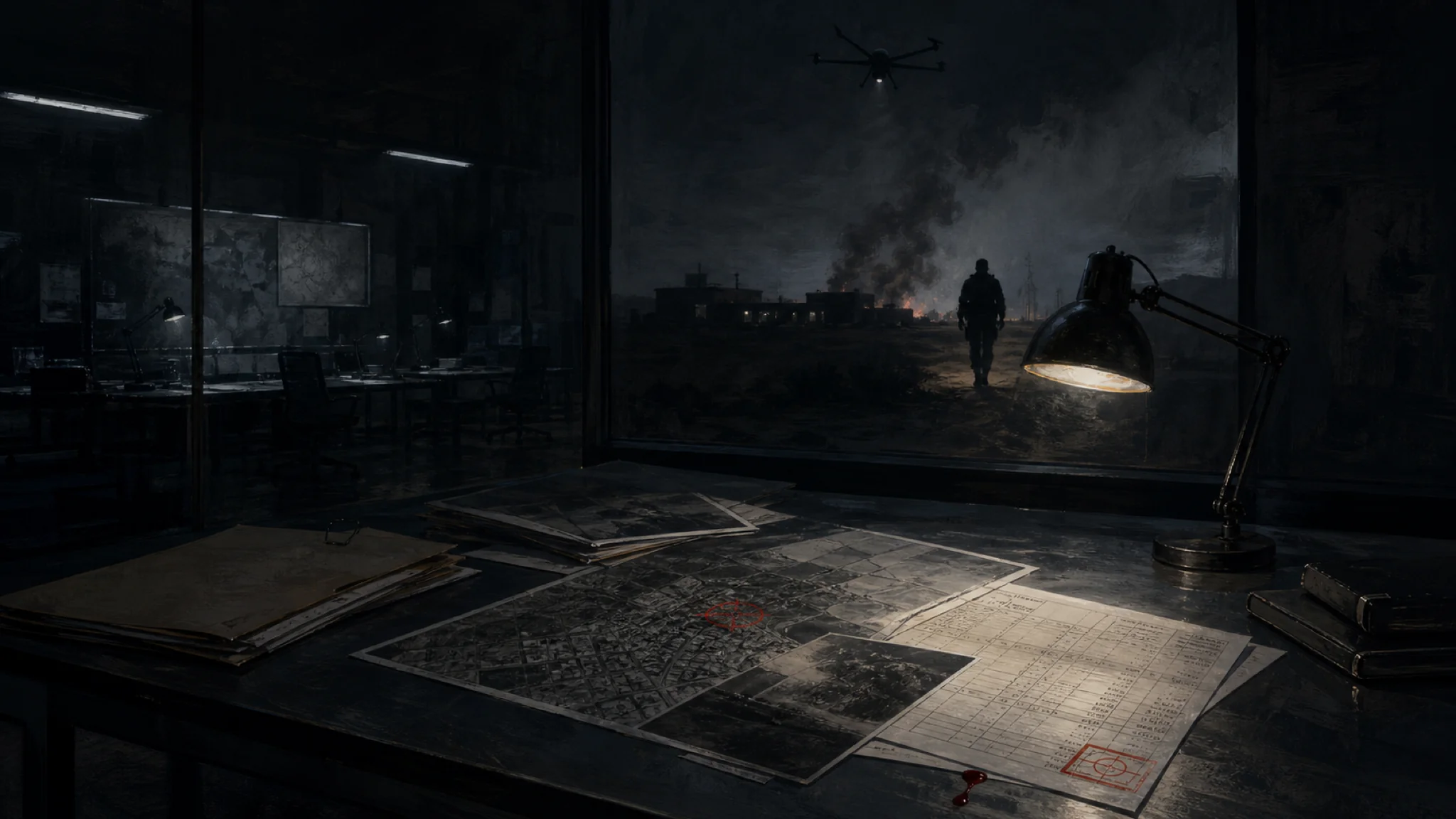
The Drone Story Makes Distance Feel Physical
Victor Polizzi begins the hour as a young Air Force lieutenant watching the world through military optics. The opening drone strike is clean in the language of the room: rifle, time of flight, battle damage assessment. Ava Garcia, call sign Riot Grrl, congratulates the shot with coarse camaraderie, and Victor is already shaken enough that the confidence around him feels defensive. The sequence gives the killing professional vocabulary before it gives Victor a private cost.
The Las Vegas interlude looks at first like a detour from the Suleiman plot, then becomes the episode’s title sequence in disguise. Victor brings defaced cash to a roulette table, meets a couple using the names Stanley Kowalski and Blanche DuBois, and rides an impossible run: red, red again, then Black 22 twice. The winning streak pulls him into their hotel room, where celebration turns predatory. Blanche pushes past his refusals, Stanley joins the humiliation, and Victor is left bruised, confused, and handed back the money because, as Stanley tells him, he earned it.
That scene is deliberately ugly, and not only because of the assault. It folds Victor’s drone work into a different kind of spectatorship. At the table, everyone cheers the streak. In the hotel room, Stanley turns Victor’s body into entertainment. Back at Creech, Ava watches village sex lives on the monitor and talks about them like a soap opera. The episode is not claiming these things are equivalent. It is putting them in the same hour so the viewer cannot miss how easily distance, screens, and bravado can make another person’s life feel available.
The payoff comes when Hanin and her daughters reach the village and Fathi and Yazid catch up with them. From the drone station, Victor and Ava can see what the people on the ground cannot: Fathi is listed only for surveillance, Yazid is not cleared as a target, and the situation is falling apart in real time. Captain Josh Whitmore tells them there is nothing to do, then calls up the chain when Ava pushes. The chain gives the expected answer. No authorization. No shot.
Victor takes it anyway. Yazid has shot Fathi, dragged Hanin away, and is about to assault her while the girls scream nearby. Victor reports that he has a shot, Whitmore orders him to stand down, and the command room becomes a contest between rules of engagement and the human fact on the screen. The strike kills Yazid, saves Hanin, and immediately puts Victor under discipline. Whitmore says Victor disobeyed a direct order and broke the rules. Then a phone call changes the temperature, and Victor learns he is lucky. The word is cruelly precise. The action is morally legible and procedurally forbidden; the institution can punish it or absorb it depending on how the result looks after impact.
What this episode argues
“Black 22” argues that modern spy work is less about clean heroism than partial sight. Jack sees Ali as a route to Suleiman, Sandrine sees Ali as a murderer who cannot cross the border, Hanin sees Suleiman’s tenderness and control in the same room, and Victor sees a crime through a camera he is not authorized to turn into protection. None of those views is complete. The episode’s strength is that it does not pretend the American answer automatically outranks the others.
That restraint matters in a post-9/11 action framework. Jack Ryan is still built around a CIA analyst becoming a field operator, and the show clearly enjoys the pressure of pursuit, drones, GPS, and command rooms. But this hour keeps scraping at the politics underneath the machinery. Sandrine’s line about France having no hyphenates gives Ali’s path a social context without excusing the apartment attack. Hanin’s escape keeps Suleiman from being only a target file. Victor’s strike saves lives, but it also exposes how remote war makes ethics depend on latency, hierarchy, and camera angle.
Verdict
“Black 22” is the season’s strongest episode so far because it broadens the map without flattening the people on it. The Paris investigation has urgency, the Suleiman household has real dread, and the Nevada material gives the hour a bitter counterpoint to Jack’s desire to be closer to the action. Jack is most useful here when he is not winning arguments, but being challenged by Sandrine and corrected by the limits of his own frame.
The episode does have strain marks. The casino assault thread risks feeling imported from another show until the final drone sequence locks it into place, and some of the French counterterror dialogue leans hard on exposition. Still, the hour’s best scenes carry unusual weight for a franchise pilot season: a wife packing in the dark, a cop arguing for the dead in her own city, and a pilot making an unlawful choice because the lawful one would mean watching. That is a sharper version of Jack Ryan than simple competence fantasy.
Rating: 8.1/10
More episodes from Jack Ryan — John Krasinski's CIA-analyst-to-field-asset arc, Season 1. Jump to any episode in the season:
Where to go next
Reviewed by Mira Vance · QuizFandom Editor & Lead Reviewer. Every rating is an honest per-watch assessment from the desk that also writes the quizzes — not a press release rehash.