Tom Clancy's Jack Ryan S1E4 Review: Jack Follows the Wolf Until the Trail Turns Bloody
A tense pursuit episode turns Jack's best hunch into a body, while Suleiman's war moves from money to mass terror.
“The Wolf” is the first episode of Tom Clancy’s Jack Ryan that fully tests whether Jack Ryan’s instincts can survive contact with field consequences. The season has already made Jack’s financial pattern-reading valuable, but this hour asks a harsher question: what happens when the correct analytic call still ends with blood in the snow? Jack Ryan and James Greer follow Ali bin Suleiman through the French Alps, while Suleiman consolidates power in Syria and Cathy Mueller notices an Ebola case that does not fit its official explanation. The episode’s final church attack ties those strands together with grim efficiency.
Jack bets on the trail instead of the arrest
The opening traffic stop gives the episode its operating principle before Jack says much of anything. A French officer pulls Ali over, asks for license and papers, and lets him go after a brief exchange. From the surveillance vehicle, Jack and the French team watch the decision land. Jack knows exactly how risky the choice is, because he is the one arguing for it. Taking Ali immediately might produce an interrogation, but letting him move might expose a cell, a meeting site, or an attack in motion.
That argument matters because the episode does not flatter it. Jack admits he cannot be sure of anything. He has a message, a pattern, and enough confidence to ask everyone else to accept uncertainty with him. Greer, more experienced and more bruised by the field, prefers “bird in hand.” The difference between them is not courage versus caution. It is method. Jack still believes a clean inference can outrun a messy situation; Greer has lived long enough to know that a good read can still leave you holding the wrong end of the bargain.
The car sequence sharpens that tension by placing Jack’s reasoning beside Cluzet’s open prejudice. Cluzet talks about Islam as “submission,” complains that France is being taken over from inside, and treats the pursuit as confirmation of a civilizational fantasy he already carries. Greer quietly answers with his Tasbih, explaining that he uses it when he cannot pray or needs Allah to grant him restraint. The exchange is short, but it gives the hour a necessary boundary. The show is chasing a terrorist network, not endorsing Cluzet’s worldview. Greer’s restraint becomes a moral counterweight to the officer’s rot.
Suleiman buys the room before he claims the war
While Jack and Greer follow Ali, the episode cuts to Suleiman’s return to a militant camp. The first details are domestic and tactical at once: children nearby, armed men waiting, hostages coughing in confinement, and a leader who has heard that Suleiman’s wife left him and his brother is missing. The man also knows Suleiman has been recruiting across sectarian lines, bringing Shia, Sahani, and Salafis into the same formation. He frames that as betrayal. Suleiman frames it as command.
The power play is not subtle, but it is effective because it begins with money rather than rhetoric. Suleiman says he is buying something with his money, then reveals that the cash is not for the commander. It is for the unpaid men. When the commander asks whether Suleiman thinks he can buy loyalty, Suleiman answers by proving the point. The fighters are told to take away the commander’s weapons. A few moments later, Suleiman brings out Ibrahim as his next offering, and the camp’s hierarchy visibly shifts.
Suleiman’s speech gives the title its first explicit meaning. He tells the men that their former leader enjoyed life’s luxuries, ignored their interests, and acted like a wolf instead of a shepherd. The word is doing propaganda work. Suleiman accuses another man of predation while using money, public humiliation, and religious language to seize the same men for himself. His promise of unity against the enemy and a restored Islamic empire sounds less like faith than recruitment architecture. He knows which wounds to name, which debts to pay, and which humiliations to stage in public.
The hostage room adds another layer of dread. A Western captive asks whether a sick man is going to die and what Suleiman wants with them. Hanin enters only briefly, ordering Samir back to his room, but that small interruption keeps the family story in the frame. Suleiman’s operation is not happening in some abstract villain space. It is unfolding around a wife who has fled him, a child still inside his orbit, prisoners who do not know why they are being kept alive, and followers being taught that obedience can be purchased as long as the purchase is dressed as destiny.
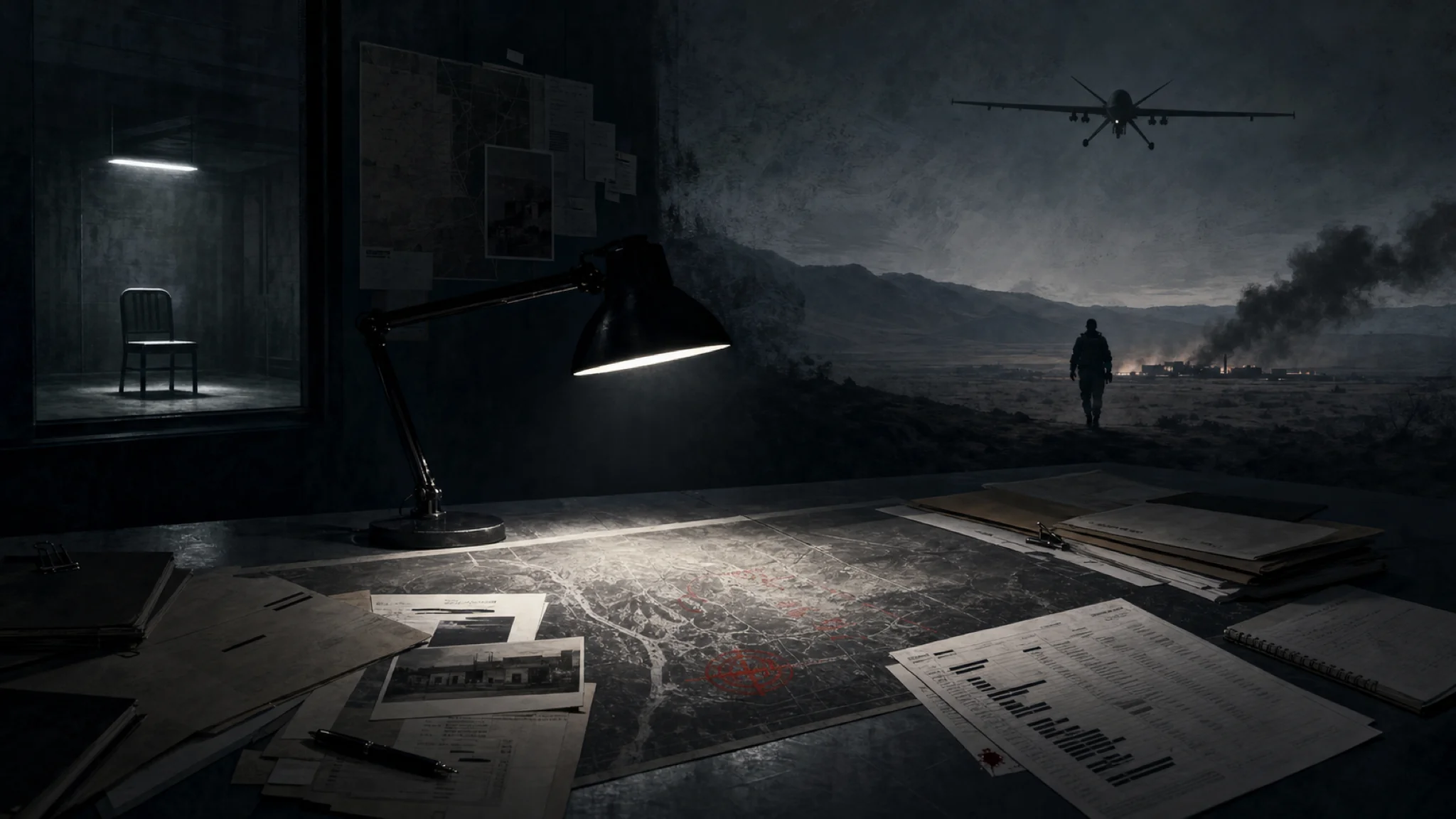
Jack kills the man he needed alive
The ski resort sequence is the hour’s sharpest piece of thriller construction. Jack and Greer lose visual contact, find Ali’s vehicle at the chalet, and realize from the fresh tracks that he has switched cars. Then Cluzet’s voice comes over the radio, the building turns hostile, and the pursuit becomes a rescue nobody can complete fast enough. Jack is knocked down, gunfire erupts, and Cluzet is hit. The officer who spent the drive reducing Muslims to an invading mass dies inside the very operation his certainty could not understand.
The episode then strips away the team’s machinery and leaves Jack alone in the snow. He follows Ali into the cold, fights him hand to hand, and wins. The scene is not staged as a heroic graduation ceremony. Jack is desperate, winded, and frightened by what the fight requires. After Ali goes down, Jack asks where the attack is. Ali cannot give him the answer Jack needs, and Jack breaks down beside the man he had argued not to arrest because he believed Ali could lead them to something larger.
That is the bitter turn. Jack’s gamble was not foolish; the episode gives him enough evidence to justify it. But the outcome still becomes Cluzet dead, Ali dead, and the attack still hidden. Greer understands the damage before Jack has language for it. His advice at the airfield is crude but perceptive: do not take it home, get drunk or get laid, do anything except sit alone and think. Then Greer softens the order with a phone number and an offer to talk Jack down, provided Jack really needs it. Greer is not warm, exactly, but he knows the shape of the wound.
Cathy’s thread makes that wound harder to compartmentalize. Earlier, while Jack is still on the operation, Cathy is in the lab discussing Ebola cultures from a new patient in Liberia. The official idea is relapse, but she is not convinced, because the patient never appeared on earlier lists and the explanation depends on him having been sick without telling anyone. At first, the scene plays like medical background and a way to keep Cathy in Jack’s orbit. By the time the church attack arrives, it reads like a warning Jack’s world and Cathy’s world are already touching.
Their date is charming because Jack is so visibly unprepared to be ordinary. Greer coaches him into sending a confident text, then Cathy tells a colleague that Jack supposedly has a government logistics job and is not her usual type. When they meet, Jack brings Cathy to a crab place tied to his father, tells the story of his first beer after seeing a girlfriend kiss his best friend, and repeats his father’s line: “Whenever you’re ready.” The date lets Jack perform normalcy with real tenderness, but it also forces him to lie badly. His fake supply-chain explanation collapses into manifests, receipts, and nervous detail.
The restaurant scene also shows why Cathy matters beyond romance. She notices evasions. She asks follow-up questions. She is curious enough to accept Jack’s strangeness without being blind to it. When she invites him upstairs, the episode gives Jack a reprieve that Greer practically prescribed. Yet the editing refuses to make that reprieve clean. Jack and Cathy move into intimacy while another French congregation gathers for Father Joseph’s funeral. Private escape and public consequence run side by side.
What this episode argues
“The Wolf” argues that intelligence work is not purified by good intentions. Jack is right about Ali being useful. Greer is right that a captured suspect has value. The French team is right to fear an attack, and Cluzet is wrong in the moral vocabulary he uses to explain that fear. The episode’s politics are strongest when it lets those truths coexist without pretending the pursuit itself is innocent. Suleiman is building a murderous network, but the Western response is also full of prejudice, improvisation, pressure, and men trying to survive guesses they will later call strategy.
The title also turns Jack’s self-image inside out. Greer jokes that Jack should be a wolf in his text to Cathy, and Suleiman uses the same animal to condemn a rival as selfish and predatory. By the time Jack kills Ali, the word has lost its flirtatious charge. Jack is not a desk analyst pretending to be bold. He is a man learning that the field can make him violent even when he is trying to prevent violence. The episode does not ask the audience to cheer that change. It asks us to watch what it costs.
Verdict
“The Wolf” is one of Season 1’s most consequential early hours because it links character formation to plot escalation. Jack’s first major field choice produces information, death, trauma, and no immediate victory. Suleiman’s camp scenes are blunt but functional, giving the villain’s network a material logic beyond vague menace. Cathy can still feel slightly underwritten as a romantic counterweight, but the Ebola material gives her professional life a direct line into the season’s threat.
The church attack is grimly effective because the episode has already seeded every piece: the missing aid workers, the unexplained Ebola case, Father Joseph’s funeral, Ali’s unresolved trail, and Suleiman’s need to turn logistics into spectacle. The hour is not flawless. Some of its villain-side dialogue leans broad, and the romance has to move quickly to serve Jack’s post-kill spiral. But as a hinge between analyst thriller and biological-terror nightmare, “The Wolf” gives the season a sharper shape.
Rating: 8.1/10
More episodes from Jack Ryan — John Krasinski's CIA-analyst-to-field-asset arc, Season 1. Jump to any episode in the season:
Where to go next
Reviewed by Mira Vance · QuizFandom Editor & Lead Reviewer. Every rating is an honest per-watch assessment from the desk that also writes the quizzes — not a press release rehash.