Made in Korea Episode 1 Recap: Baek Kitae Hijacks the Hijacking
What happens — the short version (spoilers)
- Baek Kitae boards a Tokyo-Fukuoka flight under the alias Matsuda Kenji, carrying a meth shipment, when armed radicals seize the plane and demand passage to North Korea.
- Baek convinces the leader, Yamada, to release women, children, and the elderly, then offers his briefcase of meth as the gift that will make Pyongyang accept the hijackers.
- At Gimpo's underground tower, Sergeant Chae Jiseok gets a KCIA order to seize the plane before it reaches the North, and secretly redirects it south using a fake control channel.
- South Korea stages a fake North Korean welcome at Gimpo, which collapses when a hijacker asks if this is Seoul, exposing the whole operation.
- Baek grabs the briefcase, fires a gun inside the cabin, takes command of Yamada's men, and forces a hostage exchange that frees the passengers; Chae is pressured into silence afterward.
- Back in Busan, Baek reports to Director General Hwang Gukpyeong and reveals he masterminded the double hijacking, while prosecutor Jang Geonyoung notices the unidentified suited man on the plane.
Made in Korea, Season 1, Episode 1 Disney+ · 2025-26
A 1970 airline crisis becomes a lesson in who gets remembered, who gets buried, and who profits anyway.
Made in Korea Episode 1 follows Japan Airways Flight 351 from Tokyo to Fukuoka, where a domestic flight becomes a political emergency after armed radicals seize the cabin and demand passage to North Korea. Inside the plane, a passenger traveling under the name Matsuda Kenji talks the hijackers into releasing women, children, and the elderly, then uses the crisis to protect his own meth shipment. By the end, the “businessman” has been revealed as Baek Kitae, a KCIA officer whose quiet plan redirects the aircraft to Gimpo and leaves an honest air traffic controller to take the institutional silence.
Baek Kitae boards Flight 351 as Matsuda Kenji
Baek Kitae arrives under a false name. He is told to take the first flight to Fukuoka, meet Ikeda Yuji, and hand over a briefcase. If he falls out of favor with Ikeda, the deal is over.
On the plane, he calls himself Matsuda Kenji, a businessman on a work trip. Baek Kitae (Hyun Bin) plays the role with a controlled dullness, sitting with a shipment worth nearly 90 million yen while ordinary passengers settle into a short domestic flight. A woman notices his nerves and offers gum for takeoff. A child asks if he is scared to fly. Baek says it is only his first time.
Baek is already acting before anyone knows there is a crisis. He accepts the gum. He watches the mother and child. He gives them a reason to remember him as harmless before the plane fills with guns.
The hijackers move fast. A man steps out of the lavatory. Weapons appear in the aisle. The cockpit sends a mayday before the radicals identify themselves as the Revolutionary Army of the Communist League and announce that they are going to North Korea. The cabin becomes panic and ideology at once: children crying, crew obeying, armed men shouting revolutionary slogans over a flight that was supposed to land in Fukuoka.
Japan’s response begins in confusion. At the Ministry of Transport, Minister Moriyama Yoshiro and Vice-Minister Natsume Junji struggle with the basic order of operations. The Cabinet? The police? Tokyo or Fukuoka? There is no hijacking manual because boarding a plane with knives and guns was still possible in 1970.
Captain Honda Kunihiko, a veteran pilot with more than 10,000 flight hours, understands the practical problem faster than the officials on the ground. The aircraft was fueled for a domestic trip, not a flight to Pyongyang. He warns the hijackers that they will crash before they reach North Korea unless they land and refuel.
The plane lands at Itazuke Airport, but relief lasts only a moment. The hijackers demand fuel, a clear runway, and flight charts. When the airport workers stall, one radical threatens to kill one passenger every hour. The group is already splitting between men who want discipline and men who want blood.
Baek steps into that gap. He stops the execution of a passenger and asks to speak with the leader, Yamada. The move is not heroic in any clean way. Baek does not challenge the hijacking because he wants to save everyone. He challenges it because dead hostages, panicked radicals, and a stalled plane are bad for his own exit.
His pitch to Yamada is cold and accurate. Release the women, children, and elderly first, he says, and the public will turn on the government instead of the hijackers. Yamada listens because Baek gives him something better than rage: leverage.
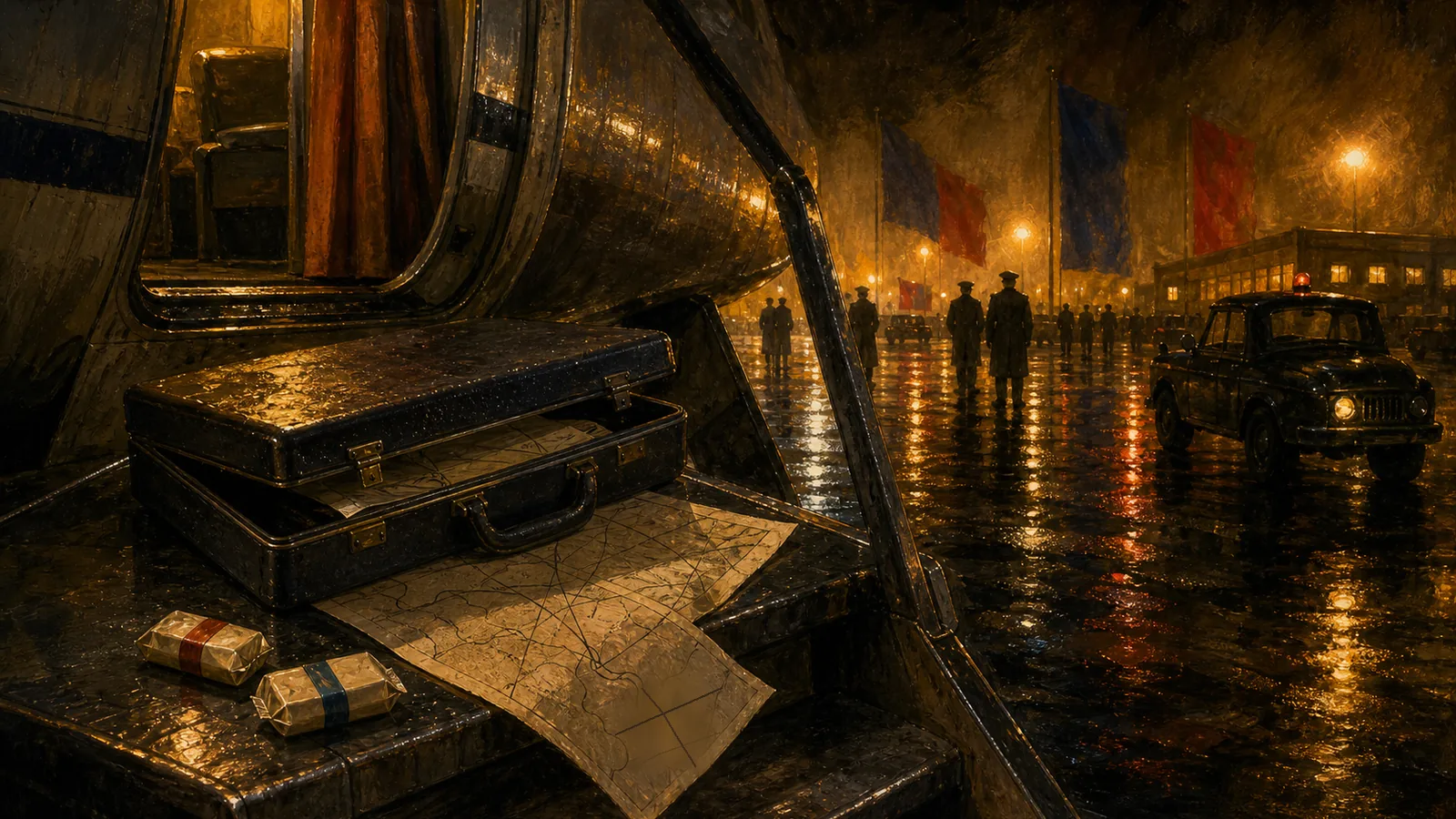
Then Baek opens the briefcase.
The meth changes the room. Baek knows Pyongyang’s powerful men want it. He offers the drugs as the gesture Yamada needs to make North Korea accept the hijackers. He tells Yamada, “I’m just a businessman,” and the lie lands because the truth is worse.
Chae Jiseok receives the KCIA order
Once Flight 351 leaves Itazuke, the crisis moves to Korea. At Gimpo Airport’s underground RAPCON tower, US Forces Korea pulls back and leaves Sergeant Chae Jiseok in charge of a situation he did not create. A phone is pushed into his hand. The KCIA director is on the other end.
The order is direct. The plane must be seized before Pyongyang gets it. Under no circumstances can it reach North Korea first. Chae is not presented as a strategist or a political animal. He is an air traffic controller with a rank, a frequency, and the wrong seat at the wrong moment.
The KCIA context makes the political world harsher. This is a state force built by a military regime, operating under anti-communist language while terrorizing civilians and guarding presidential power. When Chae takes the call, he is being folded into a system that will use him and then deny him.
The double hijacking is clever because it is almost absurd. Chae intercepts the communication meant for Pyongyang Control and redirects Flight 351 south. Korean fighters shadow the plane, then pull away once the false channel is working. The pilots think they are following North Korean instructions. No one in the cabin understands that the plane has crossed the West Sea and is now descending toward Gimpo.
On the ground, South Korea rushes to fake North Korea badly. Locals, students, and soldiers are arranged like a welcoming committee. North Korean flags are hung on the terminal. The order is ready: capture the hijackers alive if possible, open fire if they resist.
The fake welcome fails almost at once. A hijacker asks if this is Seoul. The answer exposes the whole operation, and Baek’s life is suddenly hanging off the same lie he helped build.
Baek takes control of Yamada’s men
The South Korean and Japanese delegations argue while the plane sits at Gimpo without power or ventilation. Japan wants negotiation room because its citizens are still inside. South Korea refuses to let the aircraft go to Pyongyang, partly because of the recent Korean Air hijacking that left citizens detained in the North. Both sides speak of passenger safety while protecting national pride.
Inside the cabin, Baek has a different problem. Yamada knows he has been manipulated and calls Baek Zainichi with open contempt. Baek does not flinch. He says he can still get them to Pyongyang and will bet his life on it.
The cabin’s air starts to run out. Seoul Approach Control tells them to open the door, and Baek uses the pressure in the room to make his next move. He tells Yamada that South Korea needs a justification. Let all the remaining passengers go, he says. Yamada refuses and threatens to cut Baek’s head off first.
Baek asks for the briefcase.
The briefcase no longer matters as contraband. It matters because it gives him a gun. He fires inside the plane, then turns the hijackers’ fear against them. From that point on, Baek is commanding them.
He has Yamada dictate the new demand: if the governments do not meet their terms by noon, the hijackers will blow up the plane; if the terms are met, all passengers will be released. The condition is a hostage exchange. Vice-Minister Natsume boards the plane, the passengers are freed, South Korea loses its passenger-safety argument, and North Korea grants asylum to the hijackers.
Public history rewards the visible men. Natsume and Captain Honda are celebrated in Japan. Chae Jiseok, who diverted the plane and saved the passengers, is pressured into silence and later leaves his uniform behind. Baek’s lesson is blunt: that is how the President and the KCIA keep the country running.
Baek returns to business in Fukuoka
After all that, Baek still goes to Fukuoka.
He meets Ikeda Yuji, who turns out to be a woman rather than the chairman he expected. She is calm and unimpressed by lateness. Baek tells her the goods were left on the plane because of the Revolutionary Army. Ikeda hears the excuse and ends the meeting almost immediately.
Baek recovers by selling the story as proof of value. He was on the plane that went to Pyongyang. The shipment is gone, but the nerve remains. Ikeda leaves him with a line that sounds less like forgiveness than assessment: she will see him again.
Only after that do we see the office where Baek belongs. In Busan, prosecutor Jang Geon-young (Jung Woo-sung) watches news of the hostage exchange and notices that someone on the plane knew how to use his head. He is already tracking the Manjae Gang’s meth dealings with the yakuza, and an unidentified man in a suit has caught his attention.
That man is Baek.
At the KCIA Busan Branch, Baek walks past a man being beaten in an interrogation room and reports to Director General Hwang Gukpyeong. The office scene confirms what the plane only suggested. The double hijacking was Baek’s idea. The emergency code reached the KCIA because he had given the boy’s mother the number. His code number is B73. His real name, he finally says, is Baek Kitae, head of the Intelligence Department at the KCIA Busan Branch.
Hwang praises the operation, then pivots to Jo Manjae and the yakuza meth trade. Baek says he is aware of it. Hwang asks why he did not report it. The question points toward the actual season: whether Baek is running state work, private business, or both at once.
What works
- The airplane structure gives the premiere a clean pressure chamber. Every choice inside Flight 351 changes the political options outside it.
- Baek’s reveal is patient. His gum, his briefcase, his advice to Yamada, and the KCIA emergency code all click together before he names himself.
- Chae Jiseok’s role gives the double hijacking a human cost. He saves lives and gets erased, while officials and senior men receive the public story.
- The period detail feels specific: no airport security checks, paper flight charts, flags hung for a fake Pyongyang, and ministries improvising under pressure.
- The brief Crash Landing on You contrast stays in its lane. Baek’s stillness is not romantic restraint. It is risk management.
What stumbles
- The opening leans heavily on explanatory narration. The historical framing is useful, but several passages state the political meaning early.
- The hijacker group is functional rather than textured in this premiere. Yamada has a clearer shape than the others, while several radicals blur into shouting and panic.
- Jang Geon-young arrives very late, so the prosecutor side of the series is still mostly a promise rather than a full counterweight to Baek.
What this sets up for Episode 02
Baek now sits at the center of three lines: KCIA power, Jo Manjae’s meth route, and Ikeda Yuji’s Japanese connection. Jang has already noticed the unidentified man in the suit, which puts the prosecutor on a collision path with a state officer who may be using state violence for private profit. Hwang’s final question also leaves Baek exposed inside his own agency.
Rating: 8.5/10
More episodes from Made in Korea — Hyun Bin's 1970s cold-war thriller, episode by episode. Jump to any episode in the season:
Where to go next
Reviewed by Mira Vance · QuizFandom Editor & Lead Reviewer. Every rating is an honest per-watch assessment from the desk that also writes the quizzes — not a press release rehash.