Made in Korea Episode 04 Recap: Baek Kitae Vanishes Before Jang Can Catch Him
What happens — the short version (spoilers)
- Jang visits his father, the meth addict who killed his mother, then prosecutes the two American defendants and demands the death penalty.
- Hwang confronts Baek over the private meth route, but Baek buys survival by offering 300 million won a month and a path to the Blue House.
- Baek and Jang share a tense dinner in Jang's wired office, trading veiled threats about each other's families before Baek leaves rather than concede.
- Hwang sends Pyo with Baek on the Osaka run, secretly ordering Pyo to kill Baek on the return voyage; in Osaka, Choi Yuji demands ten times the supply.
- On the ship home Baek buys Pyo off with cash, and when the Mangeum docks, Jang sees Pyo carry the money off while Baek is nowhere in sight.
- Jang follows the trail to a temple in Bansong, where ritual, fire, and violence erupt; Baek reappears, Hwang is left critically injured, and the arrest plan collapses.
Made in Korea, Season 1, Episode 04 Disney+ · 2025-26
A prosecutor’s family history and a KCIA drug route collide, leaving Baek alive, Hwang bleeding, and Jang exposed.
Made in Korea Episode 04 turns the meth case into a family disease, a state business, and a private war. Jang Geonyoung visits the father who killed his mother while high on meth, then walks into court and seeks death for two American defendants in a narcotics murder. Baek Kitae survives Hwang Gukpyeong’s discovery by offering him 300 million won a month, carries 20 kilos to Osaka, and disappears from the ship before Jang can make the arrest. By the final temple sequence, the question is no longer whether the KCIA is involved in the drug trade. It is how many men are willing to kill their own partners to control it.
Jang Geonyoung visits his father and asks for death in court
The first minutes place meth in history before it becomes evidence. Philopon is traced back to war, soldiers, forced labor, and the men who came home damaged enough to damage their own families. Then the narration narrows to one name: Jang Myeongho, the addict who killed his wife and left his son with a memory he cannot put down.
Jang Geonyoung (Jung Woo-sung) visits him in a mental hospital with red bean buns. His father still asks how Jang’s mother is doing, still wonders if she might be cheating, still tells Jang to bring her next time. The cruelty is quiet because the man who committed the violence no longer recognizes it. Jang has to sit there as a son, a witness, and the only person in the room carrying the truth.
That visit follows him into court. Prosecuting Robert Blunt and Jimmy Walters for the murders of Kim Taeyeong and Lee Suni, Jang lays out the killing as a meth crime and asks for the death sentence. The defendants shout from the dock because they expected a reduced sentence after cooperating. Jang does not soften the request. Lee Suni was pregnant, the victims had their throats slit, and his own life has already taught him what meth leaves behind when polite institutions call it a social problem.
His superior worries about the Americans and US-Korea relations. Jang answers by pointing to the newly formed Drug Enforcement Administration in the United States and suggesting Korea build something similar. He wants authority big enough to reach the drug line, and he knows that line is already brushing against the KCIA.
Hwang Gukpyeong takes Baek Kitae’s monthly price
Baek Kitae (Hyun Bin) spends the early middle section inside a different kind of sentencing hearing. Hwang Gukpyeong knows enough to confront him: the nonexistent notebook, Bae Geumji, Choi Yuji, Kang Daeil, and the private meth route Baek has been trying to run under KCIA cover. Hwang’s anger is not moral. He is furious because Baek has made the work dangerous for both of them.
Baek survives by changing the size of the problem. He offers 200 million won a month, then lets Hwang push the number to 300 million. He promises more money later and says he will do whatever it takes to put Hwang in the Blue House. That is the bargain in its purest form: Baek buys a future, Hwang buys distance from Cheon Seokjung, and narcotics become another route into presidential power.
The reversal does not make Baek safe. After Hwang throws him out, Baek finds out that Jang was the one who told Hwang about the Kang Daeil connection. He also exposes Pyo Haksu as Cheon’s planted man inside Hwang’s branch. Baek does not report the mole because the mole is useful. He asks Pyo to get him a meeting with Cheon, already looking past the boss who just raised his monthly fee.
Jang works the same case from the street. He finds Kang Daeil on a date with Baek Soyeong and presses him through family: Daeil’s sister’s wedding, the house he bought her, the money skimmed from Jo Manjae’s meth. Jang gives him a number and tells him to call when the first batch is out. Daeil warns him that the KCIA is number one in the country. Jang has already decided that fear cannot be the stopping point.
Baek and Jang share dinner in a wired office
The dinner between Baek and Jang works because both men arrive pretending to be polite. Baek calls first and suggests pork and rice soup. Jang redirects him to the prosecutor’s office, where the staff has gone home and the room is quiet enough for threats to sound like conversation.
Jang starts with Jo Manjae. Baek says Jo went missing and mentions a supposed sighting in the Philippines. Jang says Jo is dead, and then tells a story about a meth dealer in Seoul who called exporting drugs to Japan a form of patriotism. Baek’s answer is almost blank. He says it is funny and keeps eating.
Then both men reach for family. Baek warns Jang about Hyeeun’s guitar instructor, Kim Minsu, claiming KCIA intelligence ties him to North Korean funds. Jang answers by bringing up Baek Kihyun’s old school incident and then points out the wiretap lights in the office. His question is direct enough to cut through Baek’s manners: is wiretapping a prosecutor also serving the country?
Baek leaves rather than concede anything. Outside, he orders the wiretap team pulled and the Jang Hyeeun file prepared. He also asks about Jang’s father in the mental hospital. Baek is collecting soft places to press.
Jang’s side still gets the break it needs. Daeil calls with the shipment details: 20 kilos, Osaka, Ikeda Yuji, the 13th, 5:00 a.m., Yeongdo. The ship is the Mangeum, and word has it the vessel belongs to the KCIA. Jang books Osaka with Ms. Oh, sends Mr. Kim to gather everything on the Ikeda clan, and learns that Kim Minsu has no student-movement history. Baek’s threat against Hyeeun may be a manufactured file, but manufactured files can still ruin lives in this country.
The Osaka shipment becomes a trap on the way home
Hwang sends Pyo with Baek on the Osaka run and then gives the real instruction in private: get rid of Baek on the ship back to Korea. The same branch that just accepted his money is preparing to bury him with the shipment.
Osaka widens the drug business without making it glamorous. Choi Yuji presents the balance sheet to her father and argues that Japan’s factories are hard to keep running, which makes Korea their option. He warns her that clan trust has to be earned by ability, not by being his daughter, and tells her that sometimes one must spill a child’s blood for the clan. The line sits beside Hwang’s order to kill Baek. Fathers, bosses, and patrons all speak the same language when money is at stake.
Jang and Ms. Oh arrive with less control than they hoped. The Osaka Expo has filled the hotels, leaving them stuck with one room at Hotel Fuki and an awkward night before the surveillance begins. Mr. Kim calls from Korea to say Baek has left on the ship and that another man boarded with him.
The deal itself moves through a fish-market distribution network that can send meth across Japan under the cover of ordinary commerce. Choi Yuji takes Baek to Koreatown afterward. They talk over broth, childhood, Osaka, Busan, and the slurs that followed them on both sides of the water. Baek says he came to Japan at nine and returned to Korea after his father died. Choi says she was born there and spent her life wanting out while still missing the food.
Then she asks for ten times the current supply, enough to cover Japan at once. She offers Taiwanese precursors as an investment and tells Baek to secure a steady pipeline soon. It is not flirtation alone, though the scene lets that charge hang in the air. Choi needs volume. Baek needs protection. Both of them are trying to outrun older people who still think they can decide who gets to stand in front.
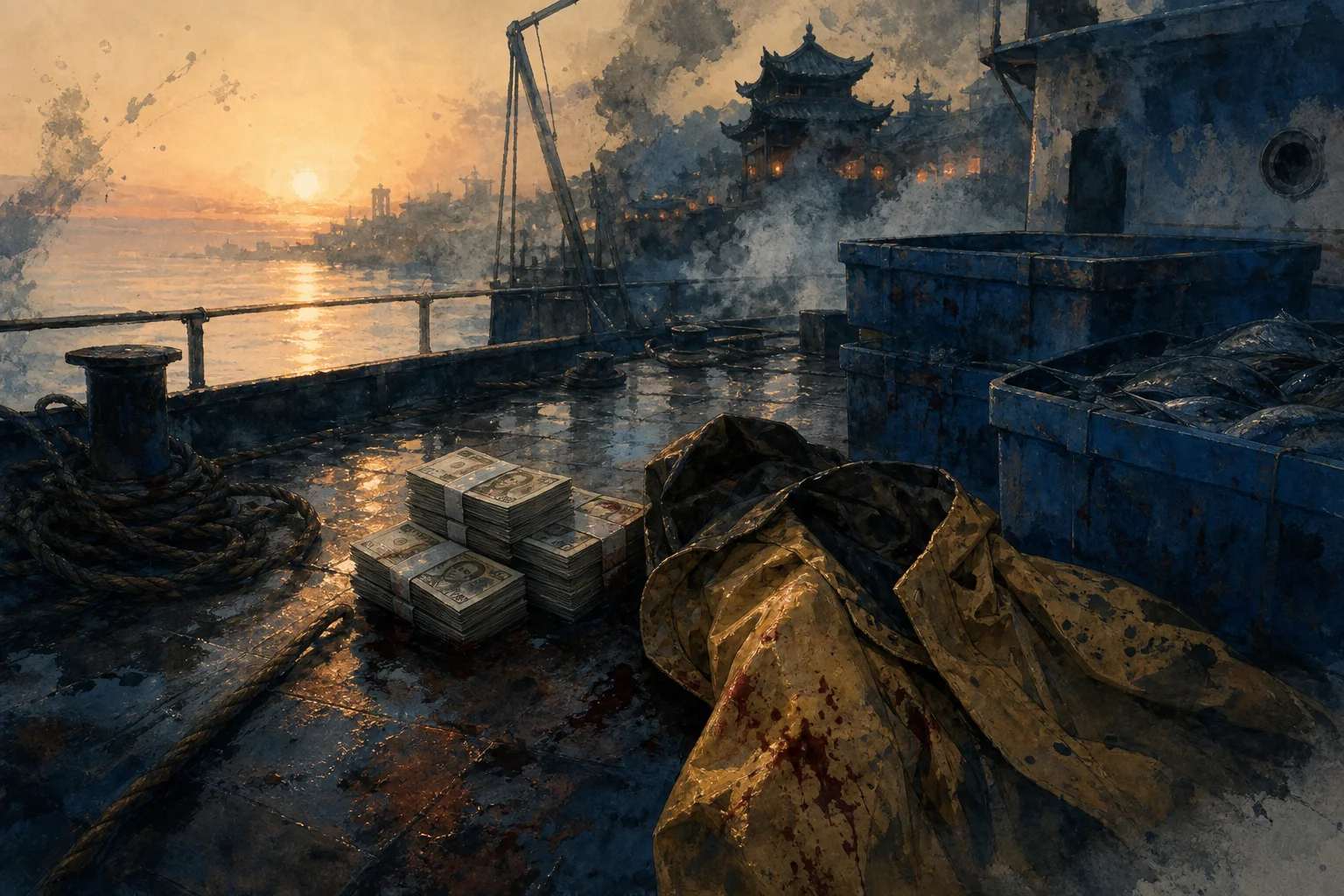
On the ship back, Pyo reports to Hwang that the deal went smoothly. Baek answers with cash. The amount comes out to about 300 million won, enough, Pyo says, to buy 100 apartments. Baek tells him to name his price. By the time the Mangeum reaches Busan, Jang sees Pyo leave the ship with the money, Hwang arrive in person, and Baek nowhere in sight.
Hwang believes Baek has been handled. He takes the cash, orders Kang Daeil taken down, and tells Pyo to seize the gang and run the factory himself. Then the case runs away from him. Jang follows the trail to a temple area in Bansong, where ritual noise, fire, fleeing bodies, and violence break the clean arrest plan into chaos. Baek appears where he should not be. Hwang is left in critical condition. Jang can only shout into a phone for ambulances to be sent to every temple in the area because he does not even know the name of the place where the trap has sprung.
What works
- Jang’s opening family material gives the drug case a private wound without softening him. His death-sentence recommendation lands differently after seeing his father ask for the wife he killed.
- The dinner scene is all manners and knives. Baek and Jang never need to raise their voices for the office to feel dangerous.
- Osaka gives the narcotics route a sharper geography: Yeongdo, the Mangeum, the Ikeda clan, Koreatown, Taiwanese precursors, and the ordinary fish-market flow hiding the product.
- Choi Yuji’s Koreatown scene adds texture without turning Baek into a romantic figure. Their shared displacement matters because both of them have learned to treat belonging as leverage.
- The port sequence keeps shifting who has the advantage. Jang thinks he has the shipment, Hwang thinks he has killed Baek, Pyo thinks he has been paid, and Baek is already somewhere else.
What stumbles
- The hotel-room awkwardness with Jang and Ms. Oh sits close to broad comedy beside family trauma and institutional killing.
- Some of the late temple geography is intentionally chaotic, yet the sequence with ritual, chase, fire, and Hwang’s injury can be hard to map on first watch.
- Cheon Seokjung’s role is still mostly relayed through other men, so the larger KCIA hierarchy remains a little abstract even as its pressure shapes every choice.
What this sets up for Episode 05
Baek has survived Hwang’s attempt to remove him, and that changes every alliance around the KCIA drug route. Jang now has proof of organized KCIA involvement, but his sister, his father, and his office have all become reachable pressure points. Choi Yuji wants a supply line large enough to cover Japan, Pyo has taken Baek’s money, and Hwang’s condition may decide who controls the factory next.
Rating: 8.8/10
More episodes from Made in Korea — Hyun Bin's 1970s cold-war thriller, episode by episode. Jump to any episode in the season:
Where to go next
Reviewed by Mira Vance · QuizFandom Editor & Lead Reviewer. Every rating is an honest per-watch assessment from the desk that also writes the quizzes — not a press release rehash.