Michael Jackson: The Verdict Episode 1 Review: "Episode 1" - The Neverland raid, the arrest warrant, and the convoy into court
What happens — the short version (spoilers)
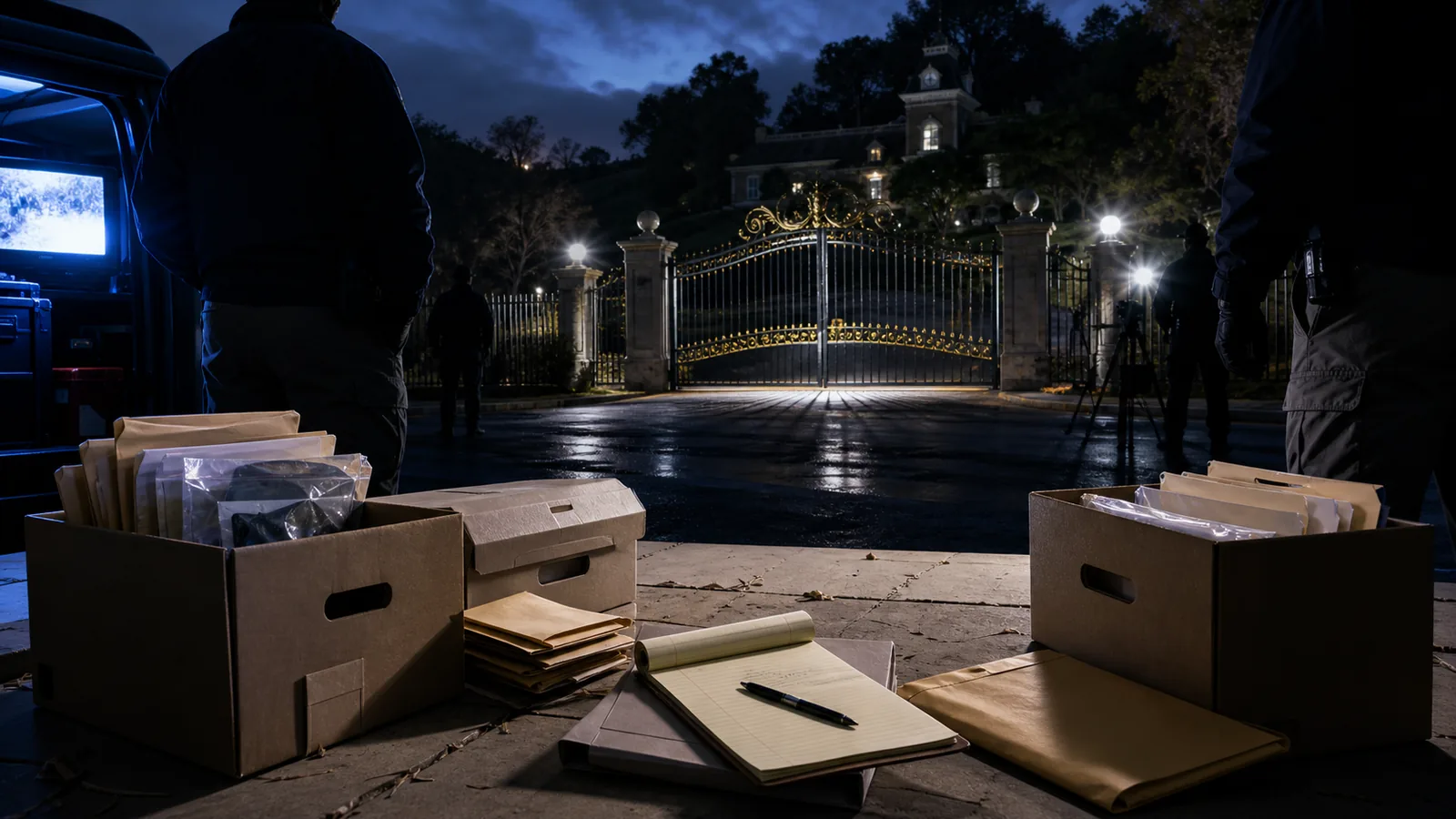
- Police serve the search warrant and treat Neverland like a scene where every detail might matter later.
- Brian Oxman gets the call while Michael can only say he does not know what is happening.
- Fox turns the raid into a live broadcast and the allegation is framed around a 12-year-old boy.
- The arrest warrant widens the case into fame, race, wealth, and jury dynamics.
- Fans, police escorts, and the convoy to court turn the trial into controlled chaos.
- Tom Sneddon and Tom Mesereau emerge as opposing theories of the same life.
Police procedure opens the hour and public spectacle closes it, with Michael Jackson's life treated like a crime scene before the trial has even really begun. The search, the television alert, and the machinery around fame all keep crowding the same frame. Celebrity never gets to stand apart from suspicion here, and suspicion never gets to stay away from the paper trail that follows it. By the time the convoy reaches court, the fight already looks like evidence, image, and who gets to define the story first.
The search warrant turns Neverland into a locked scene, and Brian Oxman gets the call
Sheriff’s deputies move through the gate, announce that they are serving a search warrant, and immediately start treating Neverland like a place where anything might matter later. The transcript keeps the focus on procedure: who’s in control, what doors exist, what might be hidden, and what investigators think they are looking for. The legal idea of the search matters as much as the search itself.
Then Brian Oxman remembers the phone call. Michael tells him the police are raiding Neverland Ranch, and when Brian asks what is happening, Michael says, “I don’t know. I don’t know.” That small exchange gives the whole opening its temperature. No speechmaking, no spin - just a star hearing his own home converted into evidence before he can understand why.
Fox turns the raid into a broadcast event, and the warrant is framed around a 12-year-old’s allegation
The episode does not let the raid stay private for long. Fox News is already on it, announcing that police are searching Michael Jackson’s Neverland Ranch in California while the reporting voice lays out the basic logic of the investigation: an ongoing inquiry, a claim by a 12-year-old boy, the possibility of DNA, hair, and blood samples. That is the hour’s first hard pivot from gossip to criminal process.
What lands is how little certainty exists in the room. The investigators say they do not know the child’s identity or the full specifics of the accusation, and the documentary leans into that uncertainty instead of pretending otherwise. It knows the public has already decided to watch, but the case itself is still being assembled.
The arrest warrant lands, and the episode frames the case as fame, race, wealth, and a mostly white jury
Once the arrest warrant is issued, the episode widens the lens. This is no longer only about one search or one allegation. It is about a man who is, in the documentary’s words, the most famous man in the world being accused of what it calls the most heinous crime in the world. The language is blunt because the situation is blunt.
The courtroom context is just as loaded. One voice says the trial touches race, wealth, and celebrity, and another juror remembers growing up with the Jackson 5 on Saturday cartoons before having to sit in judgment as a juror. The case cannot be separated from the racial and cultural weight around Michael Jackson himself.
Fans, police escorts, and the courthouse arrival turn the trial into controlled chaos
By the time the convoy moves toward Santa Maria, the story has shifted from investigation to spectacle. Fans line the route, shout that they love him, and press signs toward the car while police officers in uniform escort the vehicle through what one observer calls controlled chaos. Michael keeps lowering the window, and the people around him keep warning that exposure is dangerous.
The episode uses that ride to show the central contradiction around him. He wants protection, but he keeps reaching toward the crowd because the crowd is also his shelter. The line between support and risk is thin enough to disappear. When one voice says, “We don’t have anything but God protecting us at this particular point,” the episode makes the courthouse feel less like a building than a pressure chamber.
Tom Sneddon and Tom Mesereau arrive as opposing theories of the same life
Inside court, Tom Sneddon and Thomas Mesereau give the hour its duel. Sneddon is the prosecutor who believes the case has to be pursued, and his side sees a recognizable pattern of harm. Mesereau is presented as the defense’s shock-and-awe operator, the lawyer who will say the Arvizo family has a history of false claims and then go looking for proof.
That split is the engine of the series. The prosecution sees abuse wrapped in fame and access; the defense sees extortion wrapped in resentment and money. The hour does not pretend those are equal truths. It shows them as competing narratives that will be fought over in public, under oath, and on television.
London in 2002 shows a star already frayed, and the documentary camera starts the chain
The last stretch pulls back to the earlier meeting in London, June 2002, where Michael appears heavily made up, with messy hair and the look of someone who has not slept. The point is not nostalgia. It is that the documentary frame already catches him after the shine has thinned and the scandal cloud has thickened.
When the filmmaker says he wants to make a film with him, cameras, editing, and interpretation move from background to machinery. That matters because this series is not just about what happened in court. It is about who got to point a lens at Michael Jackson first and what that lens turned into.
Tiny details worth clocking
- The search team keeps asking about secret rooms, and the only answer they get is that there is just a bathroom and no hidden doors.
- The transcript uses the phrase controlled chaos for the courthouse arrival, which is exactly the right mood for the whole episode.
- One juror says the Michael Jackson case feels like a circus, but also insists the stakes are life-or-prison serious.
- The episode keeps returning to the gap between what fans see and what investigators are looking for.
Final verdict
Episode 1 works because it spends its first act on the chain from raid to warrant to broadcast alert to courthouse arrival. That sequence turns a private world into a public case file before the series has even settled into trial mode. Its best stretch stays procedural and lets the pressure build.
It also avoids easy drama. The fans are not irrelevant, and the police are not theatrical villains. What you get instead is a world where celebrity, race, money, and suspicion are already entangled before anyone takes the stand. That is a sturdy foundation for the rest of the series.
Rating: 8.4/10 - A disciplined setup hour that turns fame itself into part of the evidence trail.
More episodes from Michael Jackson: The Verdict — Neverland trial docuseries, episode by episode. Jump to any episode in the season:
Where to go next
Reviewed by Mira Vance · QuizFandom Editor & Lead Reviewer. Every rating is an honest per-watch assessment from the desk that also writes the quizzes — not a press release rehash.