Money Heist Season 1 Episode 6 Recap: Berlin Finds Mónica Alive
Money Heist (La Casa de Papel), Season 1, Episode 6 Antena 3 / Netflix · Created by Álex Pina · 2017
Raquel turns the Ibiza into a manhunt, while Berlin’s exposed identity sends the Mint toward another internal rupture.
Raquel Murillo ended the previous chapter smelling ammonia in a scrapyard and realizing the police had been beaten to the Ibiza by minutes.
That should have been a win. It proves the car mattered and that someone close to the heist was still outside, cleaning evidence in real time.
At the start of Episode 6, he barely slips away.
The Professor runs from the scrapyard as officers close in. Raquel does not see his face, but Tokyo’s narration knows how narrow the gap has become. The police already have Rio. They have Tokyo. They are about to have Berlin. If they get the Professor too, the robbery loses him.
Inside the Royal Mint, that pressure arrives as gossip, television, jealousy, and bad choices. Berlin is still performing control. Denver is still hiding Mónica. Tokyo is still trying to outrun grief by starting fires in other people.
Raquel pays for the leaked Alison recording
The leak does what the Professor wanted.
Television turns Raquel’s choice into a national trial. The commentators replay the question: Alison Parker or eight Spanish minors? They talk about Alison’s dual nationality, Raquel’s complaint against her ex-husband, her mental state, her medication, her stability. The heist has moved from the Mint to Raquel’s living room before she has even had time to breathe.
Itziar Ituño’s Raquel absorbs that damage at home first.
Paula has just spoken to her father. Alberto has used the chaos to ask whether she wants to live with him and his sister. Paula is angry because Raquel is never home. Raquel tries to explain that Alberto hurt her. Paula repeats what he has told her: it is not true.
That is colder than any insult on television.
Raquel’s mother tries to help by insulting Aunt Marta and dragging the conversation toward burgers, chocolate ice cream, and a girls’ trip to the Canary Islands. It is funny because it is ordinary. It is painful because Raquel has to become a mother again while the country is calling her unfit.
Back in the command tent, Prieto offers the usual institutional comfort: the government supports her, and if the crisis ends well, everyone will forget the ugliness. Raquel does not care what the president thinks. She cares what her daughter and mother believe.
Then she returns to the evidence.
The forensic report confirms ammonia and alcohol all over the Ibiza, applied minutes before the police arrived. A fingerprint survives on a button. The beggar from the scrapyard is gone. Raquel clears the tent, keeps Ángel Rubio beside her, and says the thing the police cannot afford to ignore: “There is a mole among us.”
The line matters because she is right and wrong at the same time. There is a leak. It is not a uniform in the tent. It is Salva, the gentle man who can sit across from her and still run toward a police crime scene with cleaning supplies in his hands.
The Professor explains the tunnel he wants the police to find
The flashback to Toledo answers the question Raquel has just asked Prieto: how are the robbers getting out?
The Professor (Álvaro Morte) tells the crew they will leave through a tunnel, and everyone sees the obvious problem. A tunnel from the boiler room to the sewer sits close enough to be found by georadar or picked up by vibration. It is the escape route the police would expect.
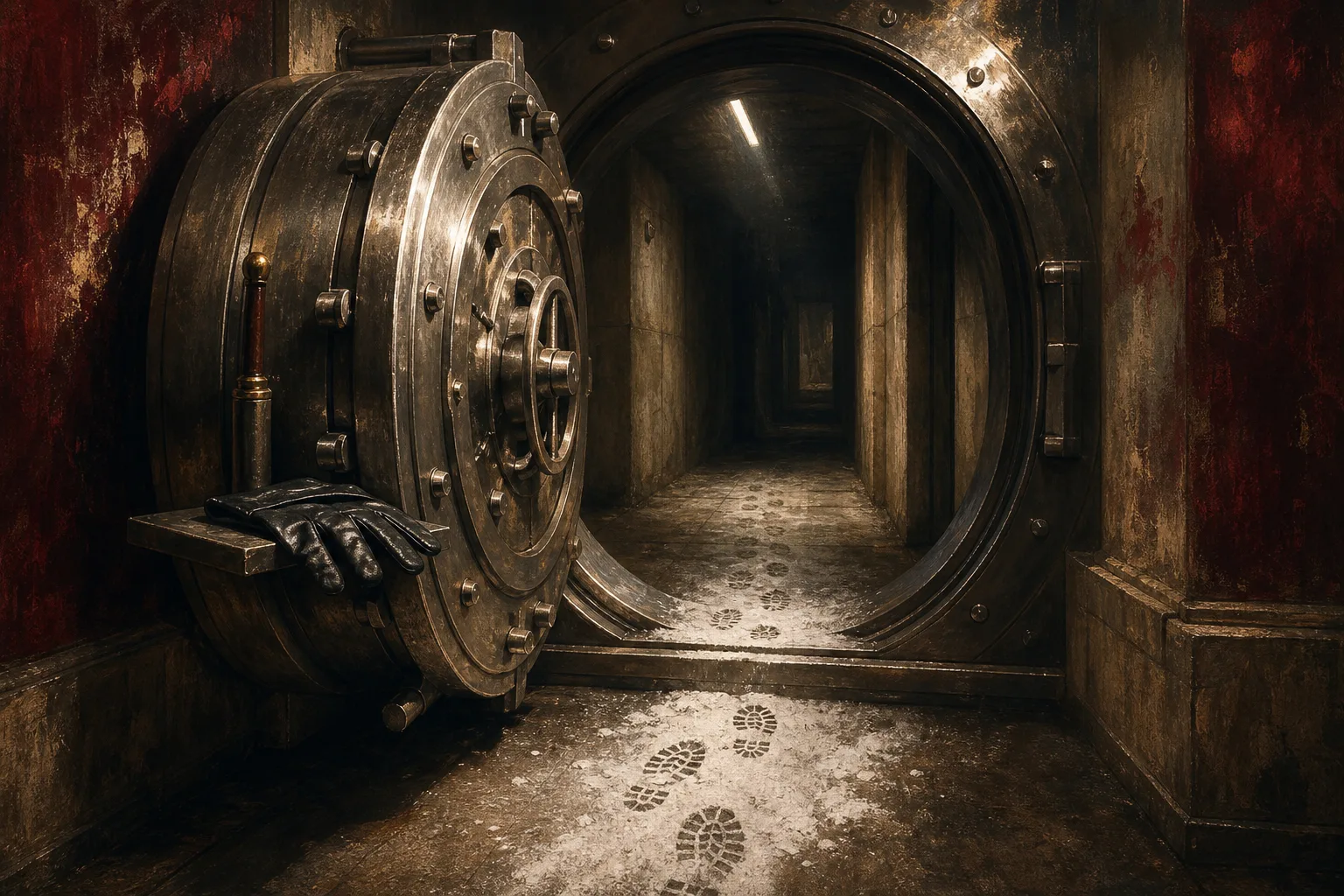
The first tunnel is bait. The real exit begins from vault number three, through armored flooring, steel, reinforced concrete, and earth. Six meters and seventy centimeters have to be cut by hand, with a thermal lance and a radial tool, because an air hammer would betray them.
Moscow (Paco Tous) understands the cost better than anyone. Ten to twelve days, he says. The exact length of the occupation.
The Professor has already built the rest. Five years earlier, he had 486 meters dug to a hangar. The crew only has to bridge the last distance while Nairobi keeps the presses alive. Two hundred million euros a day. Eleven or twelve days. The 2.4 billion suddenly has a practical shape.
That flashback also shows why the Professor’s public-opinion plan matters. He compares the occupation to the 15-M protests in Puerta del Sol, where thousands camped for weeks because the public mood made a police removal poisonous. The robbers are not protesters. Helsinki says the obvious part out loud: they have guns, not tents. Still, the Professor wants Spain watching the Mint and hesitating over every order to enter.
He believes resistance has glamour.
That mix is why Raquel’s Alison decision wounded her and helped him. He put a moral trap in front of the state, then made Tokyo leak the answer.
Berlin is named while Tokyo spirals inside the Mint
The fingerprint on the button gives Raquel a name: Andrés de Fonollosa.
The file fits Berlin (Pedro Alonso) with uncomfortable neatness and still misses him. Jewelry stores. Vans. Auction houses. White-glove robberies. No real address, no known family, no easy confidants. A psychiatric profile describes narcissism, grandiosity, lack of empathy, honor, and a need to impress strangers.
Inside the Mint, Berlin proves half of it while insulting the other half.
He gathers the hostages to kill one rumor and feed another. Yes, he says, Mónica Gaztambide has been executed. Then he pivots into applause for the printing operation. Torres has helped produce 311 million euros in 40 hours, and Berlin turns him into employee of the month inside a hostage crisis.
It is grotesque because the hostage hall briefly becomes an office party after a murder announcement.
Arturo Román (Enrique Arce) returns from medical care to applause too, pale and wounded and looking for a private word. His concern for Silvia is real, but it drags him back into Berlin’s orbit. Berlin asks what classes he teaches, hears philosophy, ethics, religion, sex education, and makes the conversation ugly. Silvia is tied up nearby. Arturo has to look at another failed escape fantasy.
Raquel tries to use Berlin’s file against him by leaking the ugliest allegation: trafficking women, including minors. Ángel objects. Raquel knows it is dirty. She also knows television has already turned her complaint against Alberto into a weapon, and Alberto is using the moment to pull Paula away.
Ángel’s loyalty gets a clear shape here. He says he believes her. He offers to testify against Alberto even though he did not witness the abuse. It is a bad legal idea and a sincere emotional one. For all his jealousy, Ángel knows when Raquel has been abandoned by the people who should be protecting her.
Inside, the leak lands like a match in Berlin’s pride.
Nairobi (Alba Flores) mocks the accusations. Berlin denies trafficking and pimping with offended dignity, then insists his ethics would never allow betrayal either, even of filth. He is monstrous, but not for the simple reasons the news crawl gives the hostages.
The button gives him the real answer. He has never been in the Ibiza. Someone wore his jacket.
Denver did.
The Professor threatens Nikolai as Berlin finds Mónica
Before Berlin can reach Denver, Tokyo (Úrsula Corberó) starts her own little disaster.
She takes Alison Parker (María Pedraza) to the restroom with the other girls, apologizes for tying her too tight, and hears the girl under the diplomatic label. Alison’s father has chosen her school, her future, her table manners, even her extracurriculars. Dance was a rebellion he could not supervise on Saturdays.
Tokyo could hear that and feel tenderness.
Instead, jealousy wins. Alison admits Rio’s smile has caught her attention, and Tokyo punishes her for saying it. She pulls Alison into a bathroom stall, pinches her hard, frightens her, then acts like the lesson is about games.
Moscow sees through it later. In a flashback from Toledo, he catches Tokyo and Rio sneaking back from a festival, then tells Tokyo exactly what he fears. She treats life like a video game: robberies, shootings, lovers, adventures. Every step leaves someone else paying. Her dead boyfriend. Her mother. Now Rio.
It is harsh because he is frightened for his son.
It is harsh because Tokyo already believes too much of it.
Rio (Miguel Herrán) finds her crying over the idea that she is toxic, scorched earth, a gas can and a match. He answers with teenage devotion. He knows she may leave him. He asks whether it has to be now.
No, she says. It does not have to be now.
While Tokyo and Rio cling to each other, the Professor is running out of space outside. The Russian scrapyard guard, Nikolai, starts building a police sketch with Almansa. A witness can make a face real.
So the Professor creates a fake robbery call, gets a patrol car emptied, climbs in, and broadcasts on channel 8 in Russian. He threatens Nikolai’s wife and daughter by name. If the sketch looks like him, they disappear.
It works. It also strips away any soft version of Sergio.
The man who flirts awkwardly with Raquel and lectures his crew about no blood uses a witness’s family as leverage without shaking apart. He is saving the plan and becoming exactly the kind of person Raquel is hunting.
Berlin’s private crisis reaches its own cliff at the same time.
He finds Denver with Mónica alive in the vault. The woman he ordered dead on Friday is breathing on Sunday. Berlin turns the discovery into church language, calling it Resurrection Sunday, but nobody in that room is saved yet. Denver has lied to command. Mónica has been imprisoned by the man who spared her. Berlin has proof that his authority is partly imaginary.
Then the next fuse lights.
Alison gets hold of scissors. Rio’s parents appear on a recording asking Aníbal to surrender. The Professor orders the Valencia plan. The assault units prepare.
Everyone is reaching for a door at once.
What works
The police work is strong because tiny objects become major threats. A button matters. A medicine name matters. A radio channel matters. A witness’s memory matters. The robbery is still grand, but the danger comes through scraps.
Raquel is bruised by the press, hurt by Paula, cornered by Alberto, and still able to isolate evidence, distrust the tent, pressure a prisoner, and follow the sketch lead. Her competence never needs to be clean to count.
Berlin’s exposure gives the inside story a nasty charge. He can survive being called a thief. He cannot survive being made vulgar. His vanity, ethics, cruelty, and theatrical need for control all crash into one borrowed jacket.
Mónica and Denver keep gaining texture too. She does not let his mercy erase what he did to her. He saved her life, yes. He also shot her, hid her, and made her use a bucket. Their bond is messy because it has to be.
What stumbles
Tokyo’s jealousy over Alison shows her roughest instincts, but the bathroom beat is jagged in a way the aftermath does not fully sit with. Moscow’s later read of Tokyo gives the choice emotional context. Alison still gets pulled into a lesson about Tokyo and Rio when her own fear deserves more room.
The public smear against Berlin moves fast too. Raquel’s desperation makes sense, and Ángel’s objection helps, but the false trafficking allegation needs more weight from the police side.
What this sets up for Episode 07
Raquel now has Berlin’s real name, Berlin’s illness, the Retroxil trail, and proof that the Professor is willing to attack witnesses outside the Mint. She still has a mole problem.
Inside, Berlin knows Denver spared Mónica. That revelation threatens Denver, Moscow, Mónica, and the command chain Berlin has protected with manners and bullets. Rio is being targeted through his parents, Alison has scissors, and the Professor has activated the Valencia plan.
Episode 7 has a simple problem waiting: the police are preparing to move, and the people inside are no longer hiding their fractures well enough.
Rating: 8.9/10
More episodes from Money Heist (La Casa de Papel) — Eight strangers, the Royal Mint of Spain, and a heist that became a movement — episode by episode. Jump to any episode in the season:
Where to go next
Reviewed by Mira Vance · QuizFandom Editor & Lead Reviewer. Every rating is an honest per-watch assessment from the desk that also writes the quizzes — not a press release rehash.