Money Heist Season 1 Episode 13 Recap: Tokyo Rides Back Into the Mint
Money Heist (La Casa de Papel), Season 1, Episode 13 Antena 3 / Netflix · Created by Álex Pina · 2017
Raquel catches the man beside her, Tokyo waits for rescue, and everyone inside the Mint runs out of mercy.
Money Heist Season 1 Episode 13 starts with three women crossing three different lines at once.
Raquel knows Salva is not Salva. Mónica knows Arturo has turned her into a criminal in front of everyone. Tokyo knows the Professor’s rescue plan is the only thing between her and prison, but she has no proof that he can still reach her.
The Professor built a robbery that depends on distance: him outside, the crew inside, the police kept at arm’s length, every emergency answered by a rule made months earlier in Toledo. Now distance becomes punishment. Tokyo cannot find him. Raquel cannot decide whether to arrest him or break him. Berlin wakes up and decides the hostages have mistaken exhaustion for weakness.
Nobody gets the clean version of the plan anymore.
Raquel arrests Salva in the bar bathroom
Raquel’s suspicion arrives through details that refuse to sit still.
Salva mentions Palawan with the soft eagerness of a man planning a future. He knows the population, the capital, the beaches, the shape of the island near Borneo. The fantasy should feel romantic. Instead, Raquel’s face changes because Ángel had already been close to a man with a beard and glasses. Alberto had already described a stranger who fought like a “ninja with glasses.” The clown wig’s color at the hospital had already sharpened her suspicion.
So Raquel tests him with desire.
She asks him to meet her in the ladies’ room, lets him believe the leap is emotional, then cuffs him against the wall. It is a nasty little reversal because Sergio has been using her tenderness as cover for days. Here, her tenderness becomes the trap.
Álvaro Morte’s Sergio does not explode when the cuffs close. He stays quiet. That restraint makes Raquel angrier, because guilt usually babbles and he gives her almost nothing. She has to drag the truth out of a man who has been lying to her with the same mouth that promised beaches.
Tokyo’s narration frames the discovery as Raquel realizing she had fallen in love with “Spain’s biggest robber.” Raquel is humiliated as a police inspector and wounded as a woman who made one brave private choice and found the entire robbery sitting inside it.
That is why the later interrogation hits hard. Raquel does not ask only police questions. She asks which version of him was real: Sergio, Salva, the Professor, the man on the phone, the man in her bed. Everything was planned except falling in love with her.
It does not save him.
Raquel straps him to a polygraph and makes him answer for Ángel, for the leak that ruined her in public, for choosing her because she was vulnerable, for using the story of the cider as the story of the robbery. Sergio admits too much and still tries to keep one piece of innocence for himself.
He says his father imagined the Mint job first, as a desperate man trying to pay for a sick child’s treatment in the United States. Raquel hears the confession. She also hears the con.
The painful part is that both can be true. Sergio really loved his father. Sergio really loves Raquel, or at least believes he does. Sergio also picked her weakness, broke Ángel, fed the press, and prepared Tokyo’s escape before walking into the cafeteria.
Raquel is right to hate him.
Mónica becomes Stockholm after Arturo names her
Inside the Mint, Mónica’s mistake turns public.
Arturo points at her and shouts that she is with the robbers. He has spent the heist trying to survive by turning every room into a stage for his importance, but this accusation is uglier than his usual cowardice. Mónica saved Denver. She stopped the hostage escape from becoming a bloodbath. Arturo answers by making her the enemy of both sides.
Mónica asks for a cigarette with the grim logic of someone who has lost the right to be sensible. Pregnant, kidnapped, shot, and now possibly facing charges for helping an armed group: the list is so absurd that panic almost turns into comedy.
Denver offers the simplest answer he has. She comes with them.
Jaime Lorente’s Denver says it like a promise, not a plan. If she crossed the line, he will not leave her on the road. That is moving, and it is also wildly impractical. Mónica knows it. She is a secretary at the Royal Mint, pregnant with Arturo’s child, and she cannot picture herself running from police in Cambodia or some other extradition-free country.
Then the name lands.
Stockholm.
At first, it is a legal excuse, a way to explain why she helped the people holding her captive. Then Denver turns it into a codename. It is clumsy, sweet, and ethically messy in the exact way their whole relationship has been since he shot her in the leg and then chose not to kill her.
Mónica does not become a fantasy outlaw in one scene. She still hesitates. She still understands what prison means. But she starts making practical choices for a future she has not agreed to yet. When she finds the passport machine, she makes herself useful. She listens while Denver argues with Moscow. She eventually puts “Ágata” on the document because Denver insists it sounds like a woman with class.
That small passport scene matters because it lets Mónica do something after hours of being acted on. Arturo used her. Berlin ordered her death. Denver hid her. Now she types a name into a machine and tests the idea of another life.
She may throw it away.
She still makes it.
Berlin puts Arturo in explosives and takes command again
Helsinki has slept four hours in five days, and grief has made him dangerous in a quieter way than Berlin.
Oslo is dead because of Arturo’s escape attempt. Denver nearly died because of it too. When Helsinki strips Arturo and tapes explosives to his body, the punishment comes from exhaustion, fury, and the need to end one specific source of chaos. He is not playing aristocrat. He is a grieving man with a detonator.
Darko Perić’s Helsinki has always been more than muscle. He can be tender about Oslo and brutal about Arturo in the same breath. He can understand that Rio objects and continue anyway.
Then Berlin wakes up.
Pedro Alonso’s Berlin returns from his medicated rest to find the Mint slipping into panic. Nairobi gives command back because the situation has already moved past her softer revolution. Berlin does not need to win a vote. He needs everyone frightened enough to dig.
Berlin turns the bomb vest into a lesson for the hostages: if Arturo betrays again, he dies; if he longs for freedom again, he dies; if he sweats too much, he dies. Then he sends everyone to the tunnel and leaves Arturo isolated, ticking in the corner like a man-sized warning sign.
It is grotesque. It is also tactically effective for about five minutes.
The stronger beat comes later, when Arturo works out that the bomb may be psychological terror. He knows the robbers would be insane to risk blowing up the plan because he trips or sweats. The hostages do not want to test the theory. One of them finally cuts through his self-image and reminds him that the Royal Mint was robbed under his watch.
Arturo wants leadership so badly that he keeps confusing attention with respect.
This time, attention leaves him sweating in a vest.
Tokyo escapes the convoy and rides through the police line
Tokyo’s rescue begins exactly as the Professor promised in Toledo, but without the comfort of his presence.
She asks to testify before a judge. The police put her in a convoy. The Serbian backup team hits the road with inhibitors and explosives. They get her out, hand her a phone with only one contact, and tell her the Professor will say what to do.
Then there is no Professor.
Úrsula Corberó’s Tokyo has never been built for waiting. Operation Cage shuts Madrid around her. The hangar is the planned hideout, but the Professor is the one who has to open it, and he is tied to Raquel’s interrogation instead. Tokyo is free for a few minutes and trapped in every direction that matters.
So she goes to the place every police officer is watching: the Mint.
Before that, she calls Rio on Alison Parker’s phone. The police listen. Rio listens. Everyone hears what sounds like goodbye. Tokyo talks about the door her mother used to draw for her when she was afraid, then says she is going to cross it because her guardian angel is not coming.
Rio understands enough to panic.
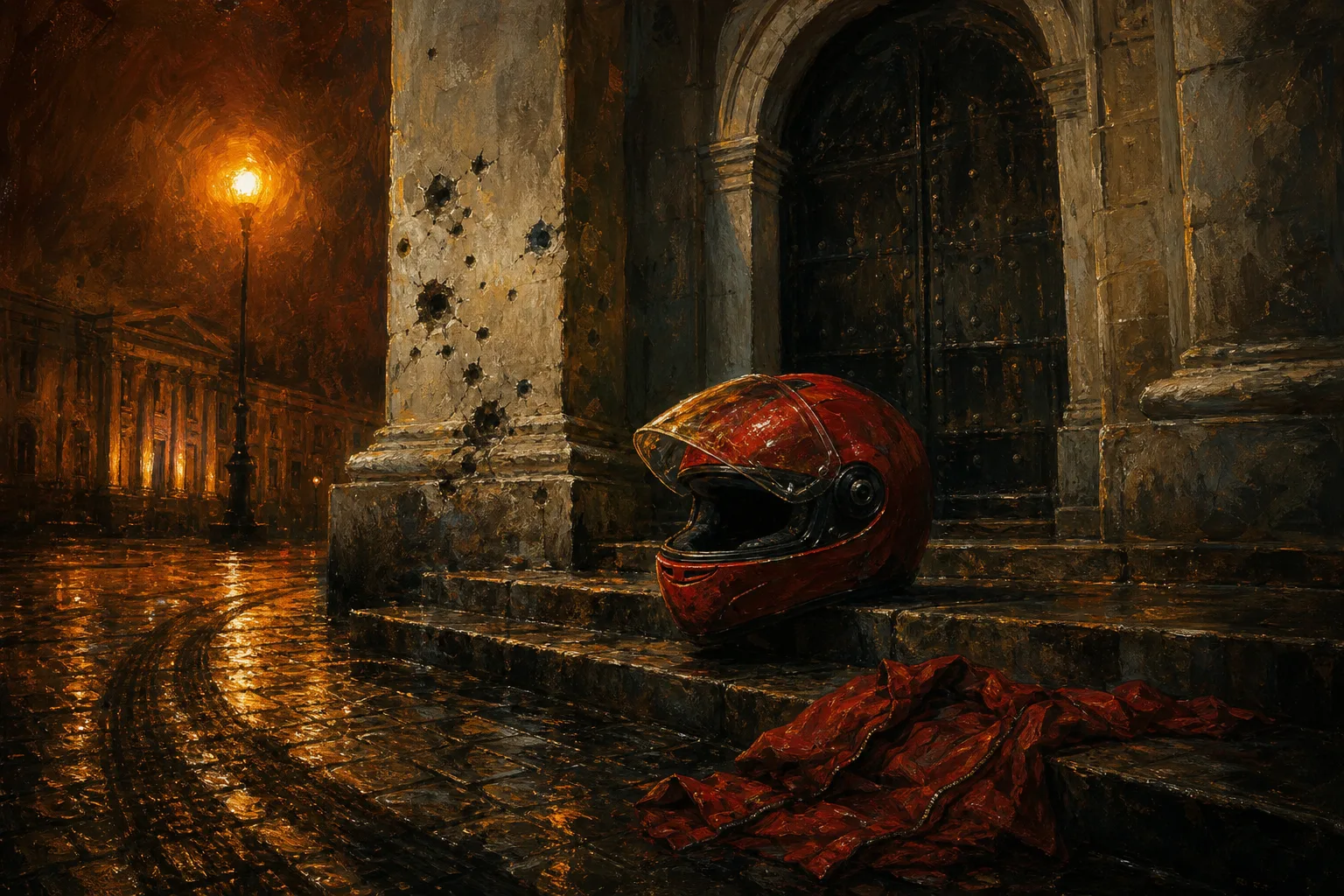
Tokyo arrives on a motorcycle, tearing straight into the police perimeter while the officers shout that Silene Oliveira is entering the zone. Inside, Rio and the others race for the door. Outside, bullets fly. The rescue has turned into a return, and the return turns into another disaster before anyone can breathe.
Moscow sees the danger first.
He moves to help open the door, and the gunfire catches him. Denver screams for his father. The Professor finally gets back on the line with Berlin, no longer the invisible hand of the job but a man whose delay has cost them blood. He tells Andrés that they have to get out as soon as possible because he has been discovered.
That ending is savage because Tokyo gets what she wants. She gets back to the crew. She gets back to Rio. She gets back to the red suits, the masks, the money, the people with city names.
The price is Moscow on the floor.
What works
Raquel and Sergio’s confrontation is the centerpiece because it refuses to make one feeling cancel another. She can love him and hate him. He can confess and still manipulate. The polygraph sequence gives her questions the force of a cross-examination and a breakup at the same time.
Mónica’s shift toward Stockholm is handled with the right unease. The name is romantic inside Denver’s mouth, but the circumstances remain ugly: pregnancy, coercion, fear, Arturo’s cruelty, and a legal trap closing around her.
Berlin’s return gives the Mint story its old menace without flattening Helsinki. Helsinki’s punishment of Arturo comes from grief and exhaustion. Berlin’s version turns it into ceremony. The contrast helps both men.
Tokyo’s final ride is reckless, emotional, and completely in character. She does not become cool because she chooses the motorcycle. She becomes desperate. That makes the ending hurt.
What stumbles
The convoy rescue asks the viewer to accept a lot very quickly: Serbian backup, explosives, inhibitors, police confusion, and Tokyo slipping away before Operation Cage can close. The rush is fun, but it leaves little room for the mechanics to breathe.
Berlin’s concentration-camp language is meant to show his cruelty and taste for domination, but it is still blunt enough to jolt the scene out of its own tension. Berlin is already frightening without reaching for that image.
Arturo’s bomb-vest panic also repeats a few beats after the first shock. His fear works. His attempt to reason through the bluff works. The scene circles the same sweat-and-explosion joke longer than it needs to.
What this sets up for Episode 14
The Professor has been exposed, Raquel has enough to take him to a judge, and Tokyo’s escape proves his contingency plans can still move even when he is trapped. That combination makes him more dangerous and more vulnerable than he has been all season.
Inside the Mint, Moscow’s shooting changes everything for Denver. The tunnel is almost through, Berlin is back in command, and Mónica now has a passport with a new name waiting beside a life she may not survive long enough to choose.
The robbery has entered its endgame, but the clean exit is gone. The open question is whether anyone can still leave the Mint with the person they came in trying to save.
Rating: 9.0/10
More episodes from Money Heist (La Casa de Papel) — Eight strangers, the Royal Mint of Spain, and a heist that became a movement — episode by episode. Jump to any episode in the season:
Where to go next
Reviewed by Mira Vance · QuizFandom Editor & Lead Reviewer. Every rating is an honest per-watch assessment from the desk that also writes the quizzes — not a press release rehash.