Money Heist Season 1 Episode 8 Recap: Raquel Walks Into Salva's Warehouse
Money Heist (La Casa de Papel), Season 1, Episode 8 Antena 3 / Netflix · Created by Álex Pina · 2017
The Mint crew gets ten minutes of triumph before Rio, Arturo, Raquel, and Ángel all pull the plan toward disaster.
Suspicion is already loose outside the Royal Mint.
Ángel Rubio (Fernando Soto) knows the pharmacy robbery should not have happened. He and Raquel were the only people who knew about Berlin’s medication trail in Toledo, and the records vanished before police could use them. Raquel Murillo (Itziar Ituño) wants another explanation. Ángel can feel the ugly answer forming anyway.
Inside the Mint, the robbers have dirt. Nairobi (Alba Flores) has the presses roaring. The crew has passed 400 million euros and found the path that may get them out alive.
For a few minutes, they celebrate like people who have forgotten where they are.
The plan has always depended on pressure, discipline, and time. Now all three start slipping at once.
Rio refuses Raquel’s deal over the phone
The police try to turn Rio (Miguel Herrán) because they know exactly where to press.
His parents have already spoken to him through the news. His real name, Aníbal Cortés, is public. Raquel calls through a hostage’s phone and offers a future: cooperation, prison benefits, maybe two years instead of a life swallowed by charges.
The Professor (Álvaro Morte) trained the crew for this, and that training plays out almost like a classroom exercise gone feral. In flashback, he tells them the police will look for weakness outside the building, not inside it. Family. Lovers. Fear. Regret. Once they are inside with six or eight crimes behind them, he says, no judge can hand them real freedom. Only he can.
Rio follows the lesson at first. He calculates the charges out loud: robbery, kidnapping, computer crimes, public disorder, shootings, injuries. He runs the numbers until Raquel’s offer sounds absurd. Then he asks for a presidential pardon on national television and signs off with a vulgar punchline.
It works tactically. It fails emotionally.
Tokyo (Úrsula Corberó) sees the part he cannot hide. Rio wanted the deal. He wanted time to stop and the last two days to become something that could be undone. Tokyo will not forgive that softness because she cannot afford her own. She tells him she trusts the Professor completely, then gives him the brutal version of loyalty: if he takes the deal and she sees him again, she will shoot him.
It is love delivered as a threat.
That keeps Tokyo from turning into a cool outlaw fantasy. Her devotion is real. So is her cruelty. Rio is not wrong to be scared, and Tokyo is not wrong that betrayal would kill the group. The problem is that both truths are now standing in a room with guns.
Berlin threatens Alison’s family
Berlin (Pedro Alonso) answers rebellion with theater, and Alison Parker (María Pedraza) becomes his next audience.
After Alison’s earlier escape attempt, Berlin calls in the hostage Mercedes and stages a foul little discussion about virginity, obedience, and taming. Nairobi is visibly disgusted. Alison refuses to play frightened. She reminds him that she is not an ordinary hostage. She is safe conduct.
Berlin has already prepared for that answer.
He opens a red booklet and starts naming her relatives: an aunt in Mali, cousins at elite schools, a sister in La Moraleja. Then he explains, calmly, how cheap a killer can be. Alison’s leverage collapses because Berlin has moved the threat outside the Mint, where her family is softer than her diplomatic value.
The scene is vile because Berlin never needs to shout. His cruelty stays formal. He can sound amused while telling a teenager that her family’s lives depend on her behavior. His illness is still in the room through the medication trail, but it does not soften him.
Nairobi’s reaction matters too. She is the production chief, the joyful engine of the printing floor, and one of the few people willing to push back on Berlin’s rot in real time. When Berlin tells her that she should have warned Alison to choose the right moment, Nairobi has to swallow rage because everyone in that room knows who holds power.
The Mint is making money. It is also making people smaller by the minute.
Arturo sends tools through the bathroom
Arturo Román (Enrique Arce) gets a chance to do one brave thing and immediately wraps it in Arturo behavior.
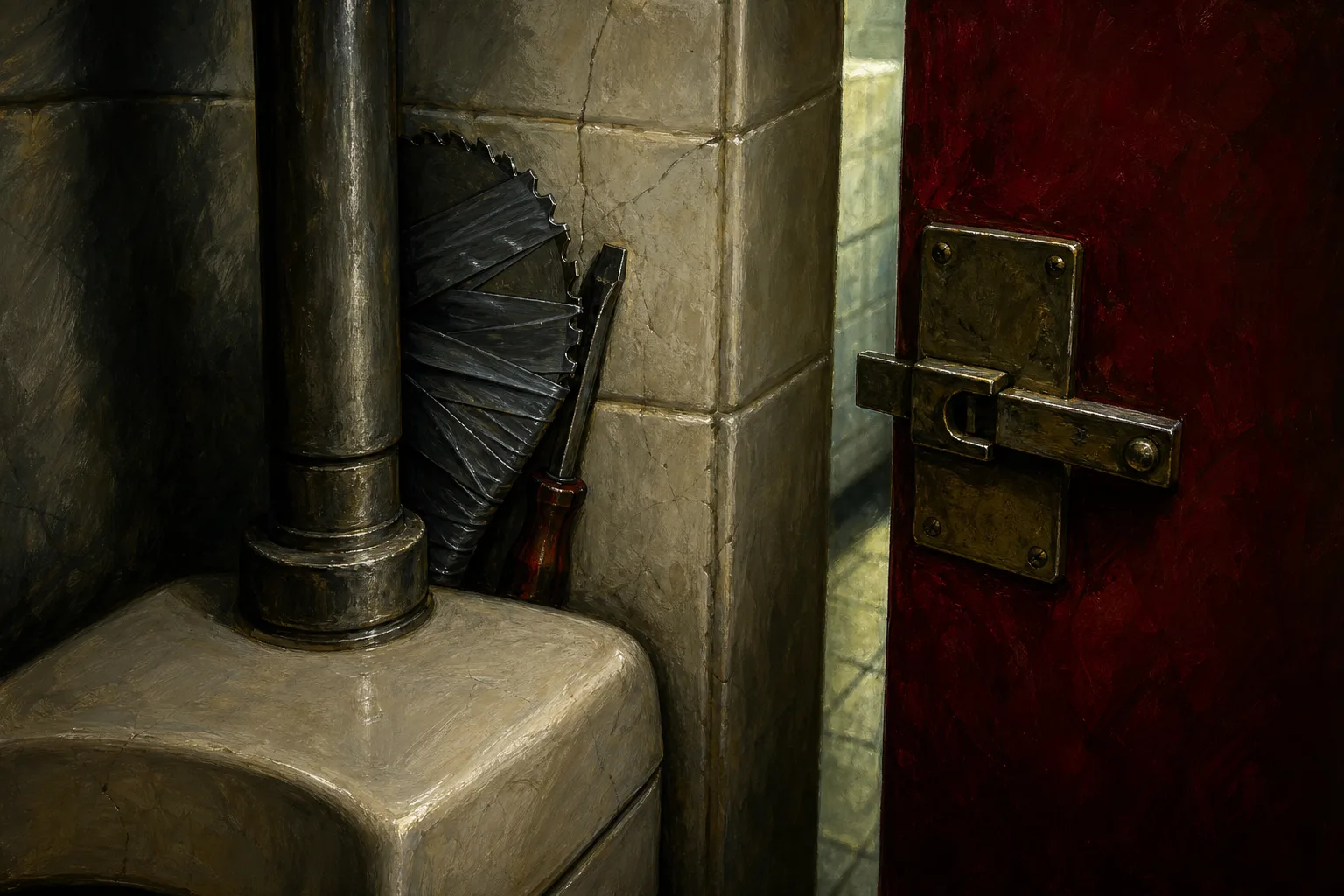
He finds Jacinto, one of the security guards locked below with the police officers, during a bathroom trip. Arturo has scissors and access to tools. Jacinto has trapped men in the basement and a way to turn those tools into weapons. Together, they build an escape plan through the second stall on the left.
The idea is not stupid. The execution is pure panic.
Arturo recruits Pablo, not with courage, but with manipulation. He wants Pablo to distract Helsinki (Darko Perić) while he steals saw blades, screwdrivers, and files. His pitch is homophobic, selfish, and cowardly in exactly the way Arturo often is: he can imagine another man’s humiliation as a reasonable price for his own hero moment.
Pablo refuses, but still gets dragged into the plan. Tools are hidden, passed, taped to bodies, and sent down to the basement guards. The escape group will move at dinner and gather in the warehouse hidden behind the coils.
Arturo also decides Mónica Gaztambide (Esther Acebo) has to be part of it because she is pregnant. That sounds like concern until you remember he has just rejected her pregnancy and mocked the idea of leaving his wife.
Mónica, meanwhile, is somewhere else entirely.
Denver (Jaime Lorente) brings her food with the anxious care of someone who has no idea how to do tenderness without joking through it. He buys gluten-free biscuits in case she is celiac. He brings sweets. He dances for her. She asks what a robber thinks about on the morning of a job, and he admits that he was terrified. In flashback, Moscow (Paco Tous) finds his son smoking before the heist and hears the fear Denver tries to hide with noise.
Denver tells Mónica she is no coward. She stole a phone, demanded that he shoot her, stood up to Berlin, kissed him, and chose him with a Dalí mask nearby. It is ridiculous, and it is kind.
That is what Arturo walks into later: Mónica with a life that no longer bends around him.
Raquel forces Salva to open the cider warehouse
Ángel’s fight with Raquel cracks open the outside investigation.
Raquel takes him off the case because the leaks point toward him. Ángel fires back with the truth she does not want: only the two of them knew about the pharmacy, and Salva has been close to her, close to the tent, close enough to hear things. Ángel has followed him. He has seen the fake cider operation, the junk car, the chemical smell, the bunk bed, the tarps.
Raquel hears jealousy because Ángel has spent years confusing loyalty, desire, and entitlement. He leaves the tent wrecked, then starts calling her voicemail in waves: apology, rage, humiliation, another apology.
While that happens, Raquel calls Salva from the cafe. The Professor is mid-crisis, but he goes. She turns the flirtation into a trap, asks him to look under the table, and reveals the gun. Either he takes her to the warehouse willingly, or they wait for a warrant.
He takes her.
The cider warehouse is built for this exact visit: bottles, plastic sheeting, a bad little workshop that looks embarrassing rather than criminal. Raquel searches, drinks the cider, and starts to feel ashamed. Salva looks harmless again because he arranged harmlessness down to the props.
Then Raquel gives him the information he needed without realizing it. She says she almost sent her ex-husband, Alberto, from CSI because Ángel described the place like a drug lab. The Professor hears danger in that one sentence. Alberto is now a loose end with forensic access and a reason to find what Raquel missed.
Ángel, meanwhile, gets Pilar’s call. The print from the patrol car matches the print on Salva’s spoon. He has the proof. He calls Raquel, but her voicemail is full.
By then she is in bed with the man he is trying to expose.
Arturo’s rescue plan turns into an assault
Arturo reaches Mónica and Denver at a terrible moment.
He sees them together and chooses revenge over escape. Tokyo frames the ugly joke of it: Arturo wanted to rescue his princess, but Mónica is not waiting inside his version of the story. She tells him Denver did not rape her. Arturo cannot process that answer because it leaves him with the truth he hates.
He sends her out, faces Denver, and attacks him with scissors.
Denver nearly caves his head in before Arturo gives him the one reason to stop: sixteen hostages are escaping through the loading area.
Berlin reacts fast. Tokyo goes for Nairobi. Rio and Denver go for Oslo and Helsinki. The hostages reach the loading area and find plastic explosive between them and freedom. Outside, Ángel is still trying to reach Raquel, shouting into a full mailbox that Salva is the man helping the robbers.
Raquel, missing the call, returns to the command post just as the crisis peaks.
Inside, the crew corners the escape group. Outside, Raquel has to decide whether the police enter. She orders the assault team in.
The final exchange is all collision: hostages on their knees, Helsinki exposed, rifles raised, robbers firing.
For the first time, the Professor is absent from the exact place where the plan needs him. He has two eyes, and both have been on Raquel.
What works
The split pressure works. Rio’s temptation, Ángel’s suspicion, Raquel’s warehouse visit, and Arturo’s escape plot all attack the same weakness: the crew cannot control what people want outside the official plan.
Raquel’s mistake comes from competence, not foolishness. Ángel’s jealousy makes him hard to trust, but his evidence is real. Salva’s warehouse looks harmless because the Professor prepared for her suspicion. Raquel follows a reasonable path and still lands in his bed while the proof dies in her voicemail.
Denver and Mónica also keep gaining weight. Their scenes are messy, funny, and dangerous. She is not healed because he is sweet to her. He is not innocent because he is gentle now. But beside Arturo’s control and Berlin’s threats, their connection feels like two frightened people making a small room where neither one has to perform.
What stumbles
Arturo’s homophobic plotting around Pablo is meant to expose him as pathetic and cruel, but the scene sits in that ugliness for a long time. It fits Arturo. It still leaves a sour aftertaste that the later escape mechanics do not fully wash away.
The Alison interrogation also pushes Berlin’s menace close to caricature before the family booklet pulls it back. His threat works because it is specific, but the virginity speech leading into it is blunt.
There is a lot of translated profanity here, and some of it lands clumsily in English. The intent is clear, especially in Ángel’s voicemails and Arturo’s meltdown, but the subtitle phrasing sometimes turns raw emotion into awkward noise.
What this sets up for Episode 09
The hostage escape has forced the first large firefight since the opening assault. Raquel has ordered entry without hearing Ángel’s proof, and the crew is shooting while the Professor is away from command.
Ángel now knows Salva is connected to the patrol car. The problem is getting anyone to listen before the Professor repairs the damage. His own behavior has made him look unstable, which means the truth is arriving in the least credible package possible.
Inside the Mint, Arturo has traded the escape plan for revenge and then betrayed the escape group to save himself from Denver. Mónica has seen the shape of Arturo’s love. Denver has seen how fast his private life can endanger everyone.
The next hour has to deal with bullets, blame, and the fact that Raquel came within inches of the Professor without knowing whose bed she had just left.
Rating: 8.8/10
More episodes from Money Heist (La Casa de Papel) — Eight strangers, the Royal Mint of Spain, and a heist that became a movement — episode by episode. Jump to any episode in the season:
Where to go next
Reviewed by Mira Vance · QuizFandom Editor & Lead Reviewer. Every rating is an honest per-watch assessment from the desk that also writes the quizzes — not a press release rehash.