Money Heist Season 4 Episode 2 Recap: Palermo Tries to Walk Out of the Bank
Money Heist (La Casa de Papel), Season 4, Episode 2 Netflix · Created by Álex Pina · 2020
Nairobi survives the table, Lisbon stays silent, and Palermo decides the bank no longer deserves him.
Money Heist Season 4 Episode 2 opens on the kind of happiness that only survives in flashback.
The crew is playing soccer at the monastery. They are loud, childish, sweaty, alive. Nairobi (Alba Flores) is shouting for the ball. Palermo (Rodrigo de la Serna) is fighting over contact. Tokyo (Úrsula Corberó) remembers it as one of those days that only becomes precious after the disaster arrives.
Then the sound of the past cuts back to the Bank of Spain, where Nairobi is open on a table and everyone is trying not to panic with their hands inside her chest.
This is the Bank of Spain heist in its purest Season 4 form: enormous and intimate at the same time. Gold is still being melted. Police are still outside. Lisbon is alive but trapped. The Professor is moving through Madrid in a Dalí mask. Inside the bank, the crew’s worst enemy may be the man who helped build the job.
Palermo does not want to follow.
He wants out.
Nairobi’s surgery continues while Tokyo remembers the monastery
The opening sequence keeps Nairobi’s surgery tied to the monastery soccer match, and the contrast is nasty in the right way.
At the monastery, they are arguing over fouls and penalties. In the bank, Tokyo and the others remove a piece of Nairobi’s lung while listening to the beeps of her vital signs. The past is all movement. The present is everyone standing as still as they can because one wrong twitch may kill her.
Tokyo’s narration treats the heist like a game already down several goals. Lisbon has been taken three kilometers from the tent. Nairobi may be dying under their hands. Palermo is about to score against his own team.
It is a blunt metaphor, in true red-jumpsuit fashion. The point lands because the crew is barely functioning. Tokyo says they remove part of Nairobi’s lung like robots, not even sure whether they are saving her or finishing the damage.
Nairobi survives this stretch, which gives the bank a breath without giving it relief.
Around her, the smaller fractures keep spreading. Rio (Miguel Herrán) is still carrying the damage of his torture. Denver (Jaime Lorente) handles that damage with all the grace of a man trying to defuse a bomb by kicking it. He tells Rio something is wrong with him, then wraps the thought in crude talk about Tokyo, masculinity, and torture.
It is ugly because it is meant to be ugly.
Stockholm, still called Mónica in the transcript and played by Esther Acebo, sees the damage immediately. Denver thinks he has diagnosed Rio. Stockholm hears a man using somebody else’s wound to feel smarter and tougher. When she says she no longer recognizes him, Denver tries to explain that calling Tokyo a Maserati does not make Stockholm a used car.
That is Denver in one sentence: sincere panic, terrible vocabulary, no brakes.
The breakup is quiet compared with the siege outside, but it matters. Stockholm does not make a speech. She just reaches the point where staying beside him feels impossible.
Palermo tries to leave through the manual door
Palermo says goodbye like a man quitting a dinner party, not a siege.
He thanks the hostages. He tells Matías he loves him dearly. He hopes his leadership has not been too traumatic. Then he walks toward the manual door because Tokyo’s coup has stripped him of the one thing he values more than loyalty: command.
Tokyo stops him with a gun.
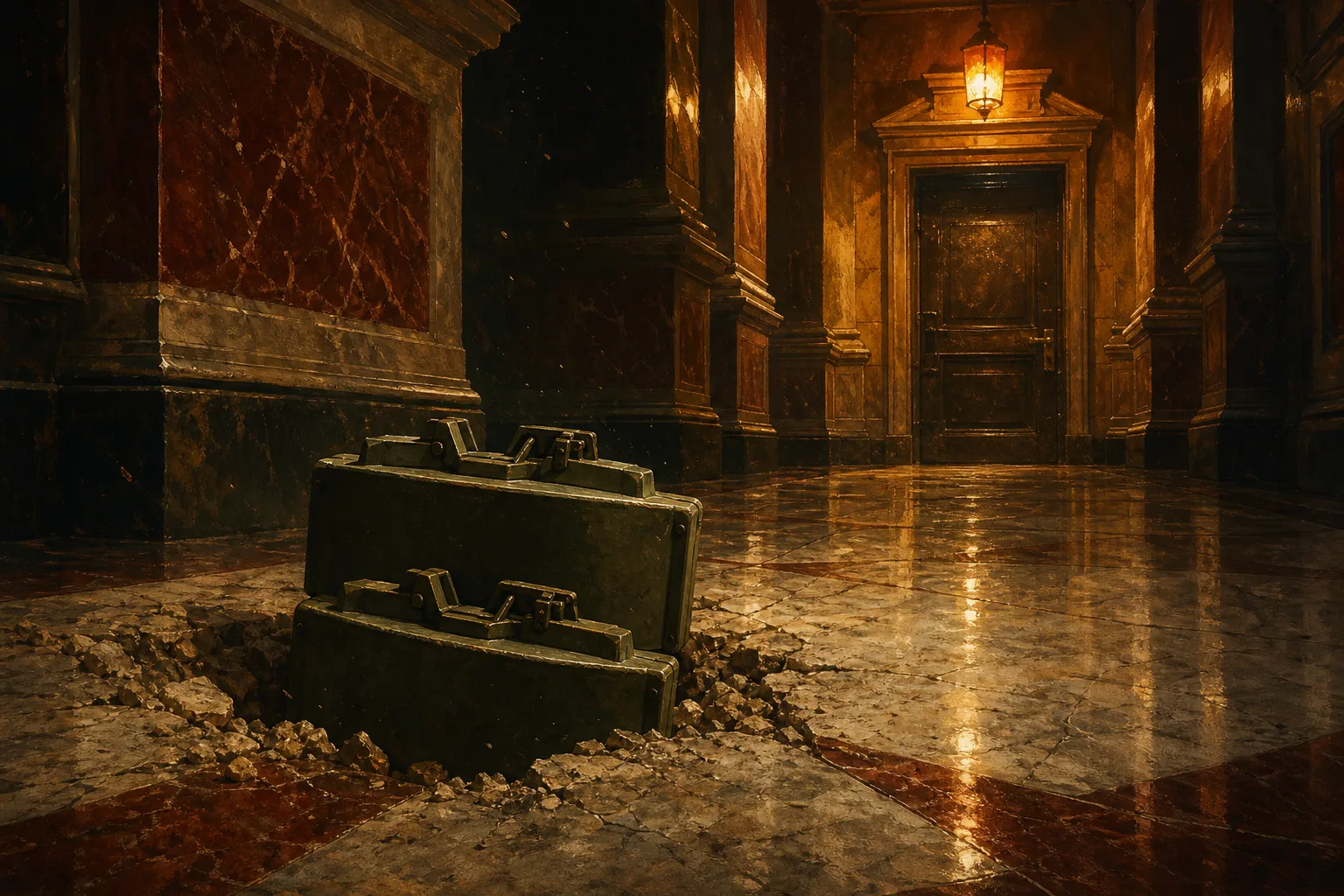
Palermo answers with claymore mines pointed at the room.
This is where Palermo becomes dangerous in a different register from Berlin. Berlin could wrap cruelty in ceremony. Palermo moves from grievance to action. He does not need the room to adore him. He needs the room to admit it cannot survive without him.
Tokyo can take his title. She cannot take his knowledge.
Helsinki (Darko Perić) is the one who blocks him in a way Tokyo cannot. He walks into Palermo’s line of fire and names the obvious: leaving the bank is treason. Palermo can call it self-preservation. He can say he has state secrets for safe passage. He can pretend he is not selling anyone out.
Helsinki does not let him have the cleaner word.
Leaving them alone in there is treason.
It hurts because Palermo and Helsinki are not only commander and soldier. There is desire, history, humiliation, and a very specific kind of love that Palermo keeps using as a knife. He mocks Helsinki as the “bearded princess” waving goodbye to a prince. Helsinki answers by putting his body in the way.
Then Palermo breaks just enough.
He lets Helsinki hold him. For one second, the whole exit attempt shrinks from mutiny to grief. Palermo is furious, abandoned, and too proud to ask for comfort without insulting the person offering it.
Tokyo still calls the Professor, and the Professor (Álvaro Morte) gives her the answer she does not want. Without Palermo, they cannot get the gold out. Without Nairobi, they are weaker. Without Lisbon, the command chain has already lost one of its minds.
Tokyo says she is still there.
The Professor says that is not enough.
It is harsh. It is also true.
Lisbon faces Sierra in the interrogation room
Lisbon (Itziar Ituño) is alive, which changes everything and fixes almost nothing.
Alicia Sierra (Najwa Nimri) does not rush the interrogation. She starts with time. Seventy years old when Lisbon gets out of jail. Paula at forty. Her mother dead so long the grave may be hard to find. It is a future laid out like paperwork.
Lisbon knows the law. Sierra knows which parts of the law the state will bend when nobody is looking.
The tent scenes work because Sierra is funny enough to stay unpredictable and cruel enough to make every joke feel unsafe. She mocks love, prison visits, and the Professor’s profile. She reads Lisbon as a woman who got smaller beside dangerous men, first Alberto and now Sergio.
Lisbon does not fold.
She also does not get to pretend the questions are painless. Sierra uses Alberto’s abuse, Paula, Mariví’s illness, the ambulance evidence, and Lisbon’s fear of abandonment like she has been handed a tray of instruments. She does not need all of them to be true in the way she frames them. She only needs one to find skin.
The Professor, meanwhile, is learning from outside the tent. Tokyo makes him replay the supposed execution. Did he see Lisbon’s body? Did he see anyone move it? Did the police publish her death? No, no, and no.
That is enough for him to believe she may be alive.
Marseille (Luka Peroš) tries to stop him from riding straight toward the Bank of Spain. He is right. The Professor is about to trade a plan for a feeling. Sergio answers with force, and Marseille answers with a fist.
The joke works because it is not really a joke. Marseille does not beat the Professor in an argument. He beats him because the Professor is about to get himself captured.
That is friendship in this universe: sometimes the only loyal thing left is a punch.
The Professor finds three clues outside the tent
Once the Professor reaches Madrid, the action returns to procedure.
He cannot see inside the tent, so he starts reading what is outside it. A police van from Huelva with mud on it. Ángel away from the search he should be leading. Sierra still on site hours after the truce. None of those details proves Lisbon is alive alone. Together, they point in one direction.
Lisbon has been moved to Madrid.
She is probably in the tent.
And Sierra is probably interrogating her.
That deduction is clean heist pleasure. The Bank of Spain plan is chaos, but the Professor can still make a map from street debris. He is not Superman, as Tokyo puts it. Sherlock Holmes will have to do.
Then comes the thing his deduction cannot stop yet: Sierra threatening Lisbon with the ambulance.
Alberto is examining it. Evidence could lead to Lisbon’s mother and daughter. Sierra offers to get there first and make the evidence disappear. Lisbon says there is nothing to find, which every investigator hears as an invitation.
Outside the bank, another loose end starts breathing.
Palermo has been tied up beside Gandía, the head of security. Gandía asks whether they are the good guys or the bad guys now that they are both restrained. Palermo answers with information. Handcuffs depend on the metacarpus. Dislocate the joint, and freedom becomes possible.
The song choice makes the whole thing almost rude: “Free” plays while Palermo plants the idea. He does not open Gandía’s cuffs. He does something worse. He gives a violent man permission to imagine the exit.
By the final scene, the Professor has Antoñanzas at gunpoint in his own home, looking for the next thread to Lisbon. Antoñanzas panics, cannot breathe, and still gets dragged into the Professor’s new plan. Back in the tent, Sierra gives Lisbon the deal cleanly: cooperate and maybe see freedom in five years, or refuse and face thirty.
Lisbon has to decide with exhaustion in her body, her family in the crosshairs, and the man she loves moving pieces outside a tent he cannot enter.
No one here is free.
Not even the people singing about it.
What works
Palermo’s attempted exit gives the bank a strong internal crisis while Nairobi is still fighting to live. The siege outside is loud, but the scariest problem inside is command. Tokyo can point a gun. Palermo can point at the part of the plan nobody else understands.
The Lisbon and Sierra material is sharp because Sierra does not play one note. She jokes, threatens, psychoanalyzes, lies, tells partial truths, and keeps circling the family pressure. Lisbon’s silence feels active, not blank.
The Professor’s deduction outside the Bank of Spain is satisfying heist work: van, mud, Ángel, Sierra, timing. The clues are simple enough to follow and specific enough to feel earned.
Nairobi’s surgery also keeps the stakes emotionally grounded. The monastery flashback risks sentimentality, but the present-day procedure is too grim to let nostalgia float away.
What stumbles
The Denver and Stockholm fracture works better as relationship fallout than as dialogue. Denver’s crude language around Rio’s torture exposes his immaturity, but the exchange spends a long time sitting in that ugliness.
The Berlin wedding flashback is thematically useful because Berlin (Pedro Alonso) talks about betrayal as a matter of circumstance, not love. Still, it arrives while Nairobi, Lisbon, Palermo, Rio, Denver, and Stockholm already have active crises on the table. It adds a clean idea to a crowded hour.
Amanda’s hostage-room material is also a little thin at this point. Her anxiety gives Stockholm a chance to show care inside the bank, but Amanda does not yet feel like a full person rather than another pressure gauge.
What this sets up for Episode 03
Palermo has lost command, but he has not lost influence. By telling Gandía how to escape handcuffs, he uses humiliation to seed a future disaster. The bank has enough enemies outside. Now it has one waking up inside.
Lisbon is alive, and the Professor knows enough to start reaching for her. That makes Sierra’s interrogation even more urgent. If Lisbon holds, the crew still has a chance. If Sierra breaks her, the Bank of Spain plan starts bleeding from the outside in.
Nairobi survives the table for now, but “for now” is doing a lot of work. Rio is damaged. Stockholm has left Denver stranded. Tokyo is in charge of a crew that does not fully believe in her command.
The war did not calm down after Episode 01.
It learned where everyone hurts.
Rating: 8.3/10
More episodes from Money Heist (La Casa de Papel) — Nairobi falls, Helsinki crushed, Alicia Sierra goes rogue — the heist's costliest stretch. Jump to any episode in the season:
Where to go next
Reviewed by Mira Vance · QuizFandom Editor & Lead Reviewer. Every rating is an honest per-watch assessment from the desk that also writes the quizzes — not a press release rehash.