Money Heist Season 4 Episode 5 Recap: Gandía Chains Tokyo and Splits the Crew
Money Heist (La Casa de Papel), Season 4, Episode 5 Netflix · Created by Álex Pina · 2020
Gandía weaponizes Tokyo, Manila steps out of cover, and Nairobi drags the gold room back to work.
Money Heist Season 4 Episode 5 starts years before the Bank of Spain turns into a concrete pressure cooker.
Moscow wants the Professor to meet Juanito.
That is the funny version of the request. The sadder version is that Moscow has a promise he cannot keep alone. His old friend’s child is out there with no work, no home, and no obvious way back to safety. Moscow asks Sergio Marquina, the Professor (Álvaro Morte), to bend one rule before the Royal Mint heist begins.
Sergio says no because of course he says no. The city names exist for a reason. The group cannot become a family employment office. Moscow already brought his son. Now he wants to bring his godchild too.
Denver (Jaime Lorente) hears that and explodes.
He does not yet know who Juanito has become. He only knows his father is asking for mercy and the thin man with the plan is refusing it over code names.
Then the present snaps back to Tokyo in chains.
Moscow asks the Professor to meet Juanito
In the flashback, the Professor is trapped by coffee, cookies, and Moscow’s terrible attempt at subtlety.
Moscow (Paco Tous) cannot ask cleanly. He circles, softens, adds details, and tries to make one more person sound small. Sergio hears the danger before he hears the need. Another outsider means another name, another memory, another point where the plan can leak.
Denver hears snobbery.
His answer is pure early Denver: loud, loyal, half-wrong, and too angry to notice when he has stumbled near a useful idea. He mocks the Royal Mint plan, says they could print bills downstairs with a printer, and tells the Professor what he can do with the name Denver. Berlin would call it stupid. The Professor calls it impossible. Moscow calls him embarrassing.
Then the joke turns.
Sergio and Moscow wait at the bus stop. The person they expect does not get off. The Professor is ready to leave. Moscow is scrambling for excuses.
Julia arrives.
Denver freezes because the memory in his head has not caught up with the woman in front of him. Julia, Manila (Belén Cuesta), gives him time without begging for it. Moscow recognizes her with immediate warmth. Denver fumbles, overcorrects, and finally says the thing that matters: she is beautiful.
Manila’s arrival is a reunion, not a reveal for gawking. Her father supports her. Moscow loves her. Denver is awkward because Denver is awkward, not because she owes him an explanation.
It also solves the old hostage problem.
The Professor worries that a hostage rebellion could happen if fear spreads. Berlin jokes that even Juanito could handle the job. Sergio realizes the answer is standing in front of him: an infiltrator among the hostages, with no direct contact unless things get ugly.
Years later, things are very ugly.
Gandía locks Tokyo inside the panic room
Tokyo (Úrsula Corberó) wakes up chained in Gandía’s bunker, and her narration does not dress it up.
She is a prisoner of one of their prisoners. She is tied down, disoriented, and fifteen minutes behind a man who has already begun hunting the people she loves. Gandía (José Manuel Poga) wants her alive because a missing Tokyo can do more damage than a dead one.
He explains the game like a man who thinks cruelty becomes intelligence if he numbers it.
First card: Tokyo is missing. The crew will search for her, split, panic, and make mistakes.
Second card: he tells everyone Palermo helped him escape.
That accusation lands because it is true. Palermo (Rodrigo de la Serna) gave Gandía the thumb-dislocation trick because Tokyo took command from him and his pride could not survive the insult. He calls the damage collateral. The word sounds even uglier once Nairobi and Helsinki’s names enter the room.
The Professor does not waste the crisis on a full trial. He strips Palermo of command, promises judgment later, and tells Denver to release him. That is the cold practical choice. A murderer is loose inside the bank, Tokyo is gone, Nairobi is still wounded, and the hostages need moving.
Palermo returns to the group with his usual mix of danger and theater. He calls the hostages lambs, the crew shepherds, and the library a place where Proust might stop bullets if pressed firmly enough against the chest.
Nobody laughs for long.
Gandía is moving through the bank with patience, and he has Tokyo to hear him count the damage.
Manila tells Denver to start calling her Manila
Manila’s present-day job has been to sit among the hostages and listen.
She has listened long enough.
When she tells Denver that Palermo really did help Gandía, he snaps back at her for not reporting sooner. Manila answers with the obvious truth: she was sent to watch hostages, not babysit the robbers. Then she looks at the room and does the math before Denver wants to do it.
Nairobi has been shot. Tokyo has been taken. Palermo cannot be trusted. Denver is next in line.
He hates hearing it because it is true.
Manila wants a gun, a vest, and the right to leave the hostage role. Denver refuses because orders are orders, but she keeps pushing. Even Matías has a gun, she says, and it is bigger than he is. The joke has teeth because she is not asking to pose. She is asking to be useful.
Then she says the line Denver has been avoiding.
Start calling me Manila.
He says she is still a hostage. She tells him he is still Dani if they are being honest, and he immediately retreats behind Denver. Both of them are hiding behind names that became survival tools. One is ready to claim hers out loud. The other is pretending command is not landing on his shoulders.
The hostage room gets uglier around them.
Arturo Román (Enrique Arce) notices Amanda’s anxiety and slides in with the fake warmth of a man who always finds the vulnerable person in the room. He offers comfort, veteran advice, and something to make her feel better. Stockholm (Esther Acebo) already knows what Arturo’s concern is worth, but Amanda does not have that history.
That small beat keeps the bank from becoming only a shooter maze. Gandía is the armed threat, but Arturo remains his own kind of contamination: needy, predatory, and always alert to a chance to turn panic into attention.
Nairobi gets the gold room moving again
The Professor sends Bogotá to bring Nairobi to safety and restart the gold work.
Nairobi (Alba Flores) has other plans.
She knows the men in the basement are scared because she is scared too. Bogotá (Hovik Keuchkerian) is scared. Palermo, Helsinki, Stockholm, Denver, and Rio are all scared. Gandía is scared most of all, she says, and that is why he will keep coming.
The speech works because Nairobi does not shame fear out of the room. She names it, then asks the workers what they plan to do with it.
They are welders. They are workers. They are her golden boys. They did not survive their own lonely lives to hide behind a trench until a banker with a gun decides how their story ends.
Nairobi is still pale, wounded, drugged, and running on almost no sleep. She also knows the gold operation cannot stop. The furnaces go back on. The music returns. She checks the grain sample and calls for the gas pressure to rise by two kilopascals. Amid the opera, somebody still has to get the diameter right.
Then Bogotá stops treating her like glass.
Their flirtation has been circling each other all season: his blunt admiration, her resistance, the ten-foot-pole insult that somehow worked as contact. Here, the injury makes him cautious. Nairobi calls that out too. If he changed his mind, he should say it.
He kisses her. She asks if that is what he calls a kiss.
For one short stretch, the bank lets them be ridiculous and alive.
Then the radio cuts in.
Denver and Rio walk into Gandía’s trap
Denver and Rio (Miguel Herrán) search room by room, sealing doors behind them, and somehow find time to argue about sex, friendship, trauma, and sofa etiquette.
Rio tries to explain why Stockholm calms him down. He has nightmares. He sweats. His heart races. After torture, he can only sleep when someone safe is near him. Denver hears betrayal because Denver is already terrified, jealous, and carrying too much command pressure for a man who still argues like a teenager with a grenade launcher.
The argument is absurd until it is not.
Gandía throws Tokyo’s voice at them from behind concrete. She screams for help, and the sound cannot reach them. Tokyo can hear them. They cannot hear her. Gandía has built the room into a cruelty box.
Then he plays his third card.
Blood.
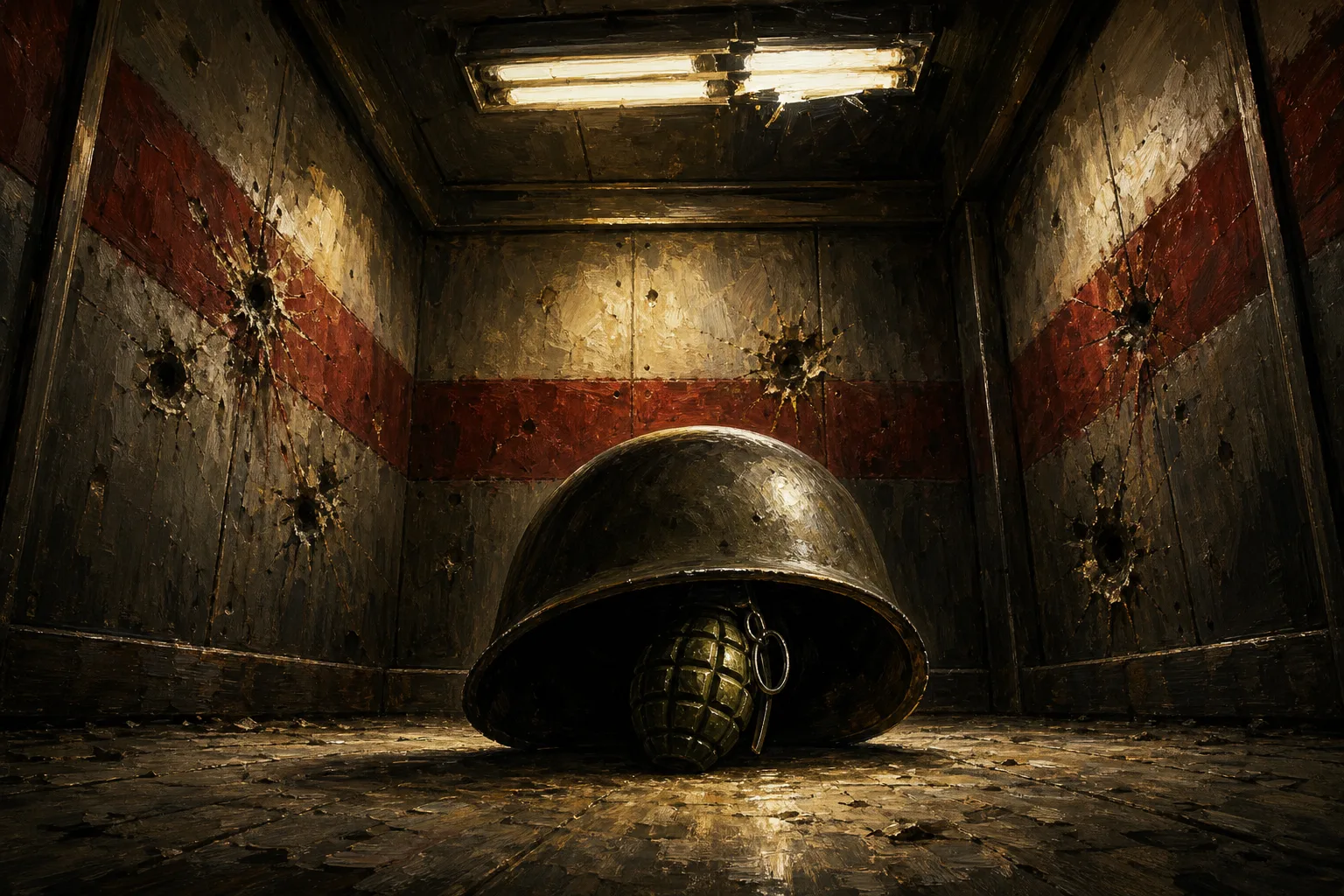
Denver and Rio step into the elevator trap. The grenade drops. Rio reacts fast enough to save them both, shouting at Denver to use his helmet and vest while they push down on the grenade together. The blast still leaves them exposed. Helsinki (Darko Perić) and Stockholm race toward the explosion, and Gandía catches them in a corridor with gunfire.
For a few minutes, the action becomes pure geography: elevator, corner, hallway, bunker, library, basement. The crew keeps shouting positions because survival depends on knowing where everyone is, and Gandía keeps turning the bank’s size against them.
Then the last line arrives from the dark.
Third time’s the charm.
Gandía is not trying to escape. He is enjoying the hunt.
What works
Manila’s introduction into the active crew is the strongest thread here. The flashback gives her warmth, history, and purpose, while the present lets her challenge Denver without turning her into a lesson. She wants the name, the weapon, and the work.
Nairobi’s basement scene also lands hard. She is wounded and exhausted, but she still knows how to lead without pretending nobody is afraid. The gold procedure gives the emotion a practical shape: music on, furnace hotter, grain size checked, everybody back to work.
Gandía’s three-card routine is blunt, but effective. Tokyo missing, Palermo exposed, blood spilled. He hurts the crew by understanding how quickly love, guilt, and suspicion can split them.
The Denver and Rio argument has the right amount of stupidity. Denver’s jealousy is ugly, Rio’s trauma is real, and both things can exist in the same hallway seconds before a grenade drops.
What stumbles
Gandía’s bunker scenes lean hard on menace and repetition. Tokyo’s fury keeps the scenes alive, but his taunting can circle the same point: he has control, she is tied up, and he wants her afraid.
Palermo’s betrayal also moves quickly from revelation to provisional release. The Professor’s choice makes tactical sense, but the emotional blast radius is so large that a little more silence around Nairobi and Helsinki would have helped.
Arturo’s Amanda thread is unpleasant by design, and it should be. Still, placing it beside Gandía’s violence crowds the middle stretch with predatory men circling trapped women. The bank feels dangerous, but the texture gets heavy.
What this sets up for Episode 06
Going into Episode 06, the crew is boxed into several emergencies at once.
Tokyo is still chained in the panic room. Gandía has proved he can move through the bank, split the robbers, and hit them from angles they cannot cover. Palermo is useful again but trusted by no one. Denver has command pressure landing on him whether he wants it or not. Manila is done waiting to be called in.
The gold keeps moving, which may be the only reason the heist still has a future.
But Nairobi is exposed, wounded, and pushing herself because nobody else can make the basement breathe like she can. Gandía has already called his third card blood.
The next one will not be cleaner.
Rating: 8.4/10
More episodes from Money Heist (La Casa de Papel) — Nairobi falls, Helsinki crushed, Alicia Sierra goes rogue — the heist's costliest stretch. Jump to any episode in the season:
Where to go next
Reviewed by Mira Vance · QuizFandom Editor & Lead Reviewer. Every rating is an honest per-watch assessment from the desk that also writes the quizzes — not a press release rehash.