My Royal Nemesis Episode 3 Review: “A Whole New Reality” — Was the Beef Destiny, or Was Cha Se-gye?
What happens — the short version (spoilers)
- Seo-ri fakes a fainting spell to escape a mob, then sees old footage of her younger self as a child actress and realizes people still remember her.
- She asks the absent Seo-ri whether she should carry on her dream, turning the borrowed life into a debt she chooses to honor.
- Se-gye keeps doing kind things, buying her medicine and feeding her Korean beef, then insisting it is all just business and charity.
- A flashback reveals Mun-do once rejected a young Se-gye who saw him as family, explaining why Se-gye treats trust as a trap.
- Seo-ri wins the company's model vote 52-48 and brawls with her old agency, then Se-gye walks in, reveals he now represents her, and they shake on the deal.
Episode 3 turns Shin Seo-ri’s second chance into something more emotional: a fight to honor a forgotten woman’s dream, a dangerous alliance with Cha Se-gye, and a slow-burn connection neither of them is ready to name.
Episode 3 is where survival starts turning into desire
Until now, Kang Dan-sim has mostly been fighting to stay alive.
Episode 1 ripped her out of Joseon at the moment of her execution and dropped her into Shin Seo-ri’s body, where every street, screen, car, mirror, and credit card looked like proof that she had been thrown into some punishment from heaven. Episode 2 deepened that shock by showing her the life she had inherited: a tiny room, thin walls, an exhausted grandmother, a failed acting career, and a young woman who kept writing down dreams no one else seemed to believe in.
Episode 3, “A Whole New Reality,” is the moment Dan-sim stops treating Seo-ri’s life as a strange vessel and starts feeling responsible for it.
That is what makes this episode hit harder than its chaos suggests. Yes, it is funny. Seo-ri fakes a fainting spell on public stairs. She steals Cha Se-gye’s card and spends it on snacks. She eats Korean beef like destiny personally grilled it for her. She gets into a full slap battle at an entertainment agency. But underneath all that, a painful question keeps surfacing:
If you are given another woman’s life, do you owe her only survival — or do you owe her the dream she never got to finish?
By the end, Seo-ri has her answer.
Seo-ri is still a survivor, but now she has something to protect
The opening chase is pure Seo-ri: shameless, clever, and impossible to predict. Cornered by people chasing the viral “Possessed Royal Consort girl,” she tells Se-gye she will signal before she faints and orders him to carry her. It is ridiculous. It is also brilliant.
This is what she has always known how to do. In Joseon, Dan-sim survived by reading power, danger, and weakness faster than everyone around her. In modern Seoul, she does the same thing with crowds, cameras, contracts, and scandal. When she realizes an unconscious woman can turn a mob into concerned bystanders, she drops like a tragic heroine and lets Se-gye scramble.
But Episode 3 refuses to let that be only comedy. Seo-ri’s performance instinct keeps saving her because performance has always been part of her survival. That matters even more when she sees old footage of Shin Seo-ri as a child actress in Sonagi.
The scene stops the episode cold in the best way. Dan-sim watches this little girl break hearts through a screen and realizes people still remember her. Not as a nobody. Not as a failed extra. Not as someone disposable. They remember her because she once had the power to make strangers cry.
That discovery lands right on top of everything Episode 2 showed us: Seo-ri’s diary, her “Sleep is for the dead” note, her promise to become a star, her desire to give her grandmother a better life. Suddenly, Dan-sim understands that this body did not belong to an empty person. It belonged to someone who fought too.
“Do you wish for me to carry on your dream?” she asks.
That line is the emotional center of the episode. Seo-ri’s dream becomes Dan-sim’s debt. And for someone who has been erased from history, stripped of status, and remembered only as a villain, the idea of honoring another forgotten woman’s name clearly shakes something loose in her.
This is no longer just rebirth. It is responsibility.
Cha Se-gye keeps pretending he is not worried, and it is getting embarrassing
The funniest lie in Episode 3 is not Seo-ri’s fake fainting.
It is Se-gye insisting, over and over, that he does not care.
This man buys digestive medicine because she gets nauseous in his car, then immediately tries to explain it away. He goes to retrieve his stolen card and ends up feeding her Korean beef. He notices she is broke, hungry, and living off snacks, then hides his concern behind insults about honest work. He says the contract is business. He says the beef is charity. He says the medicine is nothing.
Sir. Please.
What makes Se-gye so fun to watch is that his emotional firewall is technically strong but visibly overheating. He has built his whole identity around calculation: money, timing, leverage, risk, image. “Time is gold” works as a worldview, not a catchphrase. Everything must be priced, sorted, controlled, and converted into advantage.
Seo-ri breaks that system by being impossible to categorize. She is not simply a scammer, not simply a liability, not simply a marketing opportunity, and definitely not simply a woman he can dismiss. She irritates him because she keeps being right about him. She sees his worry before he admits it. She sees his loneliness even through the arrogance. She sees the softness he keeps trying to strangle before anyone else notices.
And that is why their scenes sparkle. Seo-ri calls him a degenerate like it is a curse. Se-gye calls her trouble like it is a diagnosis. But every insult is starting to sound dangerously like attention.
The beef scene is silly, romantic, and secretly devastating
The Korean beef scene should be too absurd to feel meaningful, but that is exactly why it works.
Seo-ri hears a radio quiz where the prize is beef. She loses. Later, after a long chain of nonsense involving a stolen card, snacks, carsickness, and Se-gye’s alleged “charity,” she ends up eating beef with him. To her, this is obvious: the beef she lost found its way back to her. Therefore, it must be destiny.
Se-gye mocks her logic, of course. Then he accidentally walks straight into the romantic thesis of the episode:
“If the beef was destiny, was I inescapable fate?”
That line is ridiculous. It is also the kind of ridiculous that makes a viewer pause and grin, because the writers planted every beat that led to it.
Since Episode 1, Seo-ri and Se-gye have kept colliding in ways that feel too pointed to be random: the street fight, the audition, the falling mannequin, the protection offer, the contract chase. Episode 2 made him start thinking about her when she was not around. Episode 3 makes him feed her, worry about her, defend her, and then panic when the radio practically screams love songs at him afterward.
The universe is not being subtle. Neither is the show.
But the reason it feels emotionally sticky is that food matters here. Seo-ri has been starving in more ways than one. She inherited a life of financial strain, loneliness, and tiny portions of hope. Her grandmother’s meal in Episode 2 was the first real warmth she received in the modern world. The beef in Episode 3 becomes something different: not family, not obligation, but care from a man who insists he is incapable of it.
Se-gye calls it charity because that is safer.
Seo-ri calls it fate because she knows a blessing when she tastes one.
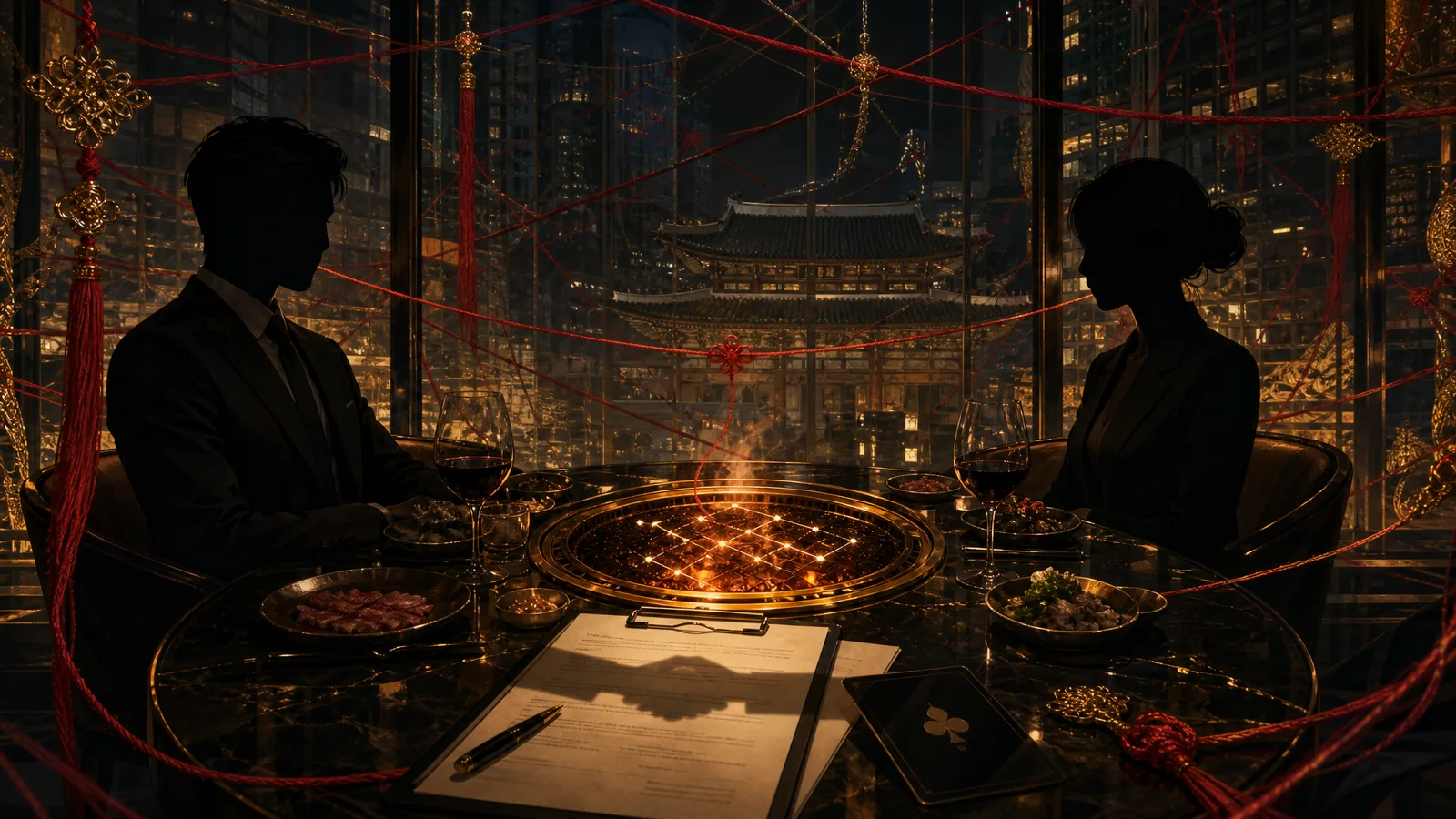
Mun-do’s betrayal explains why Se-gye treats trust like a trap
The corporate plot could have been cold, but Episode 3 uses it to expose Se-gye’s oldest wound.
Kaiserman Capital looked like support for Biojei’s Dynaestie launch. Then the truth lands: the fund is tied to Chail E&C, and Choi Mun-do is behind it. If Biojei’s stock drops low enough, Kaiserman can refix the conversion price or demand repayment. If the bonds convert, Mun-do can become Biojei’s largest shareholder.
It is a takeover with a rescuer’s nameplate.
That betrayal cuts because it is not new. The flashback shows young Se-gye being told Mun-do is family, someone like a brother, only for Mun-do to reject him cruelly. Adult Se-gye’s worldview — “you’re either an ally or an enemy, nothing in between” — suddenly feels less like arrogance and more like scar tissue.
He learned early that kindness can be staged. He learned that family can be political. He learned that people who smile at you may be sharpening the knife.
So when Seo-ri barges into his life with absolute sincerity and total chaos, of course he does not know what to do with her. She warns him of danger without asking permission. She offers protection without polish. She fights openly. She does not flatter him. She does not fear his money. She is somehow both suspicious and honest.
For a man like Se-gye, that might be more terrifying than an enemy.
Seo-ri’s old agency battle is where the episode gets its sharpest bite
The entertainment subplot gives Episode 3 its most satisfying emotional payoff.
Biojei’s internal vote between Yoon Ji-hyo and Shin Seo-ri is close — 52% to 48% — but Seo-ri wins. That matters because the staff are not just choosing a model. They are responding to presence. Seo-ri’s court-drama performance works because she is not imitating old power. She has lived it. Every command, glare, insult, and slap comes from a woman who once survived the palace.
But just as opportunity arrives, the modern world shows its own version of palace politics.
Doran Entertainment told Seo-ri they would not renew her contract, then suddenly claims control once Biojei wants her. The agency that treated her as disposable now wants to profit from her. Yoon Ji-hyo and the CEO try to humiliate her. They grab, threaten, and belittle her. They remind her she was “taken in” when she had nothing.
It is ugly because it echoes everything the show has already told us about both women inside this body.
Dan-sim was used, blamed, and written into history as a monster. Seo-ri was used, ignored, and left clinging to a dream people mocked. Different centuries, same cruelty: powerful people deciding a woman has value only when she can serve them.
So when Seo-ri fights back, the slapstick reads as catharsis.
And then Se-gye walks in.
The satisfying thing is that he does not save her by making her helpless. He steps in with legal force, business authority, and a perfectly arrogant smile: he is from Shin Seo-ri’s new agency, Biojei Entertainment.
It is a rescue, yes. But it is also a declaration. He is choosing her in public, in front of the people trying to block her. He is turning her from a discarded actress into someone represented, protected, and wanted.
Seo-ri reads the moment like a battlefield. When an enemy general extends his hand during wartime, maybe he does not want to fight.
So they shake hands.
Deal sealed.
And just like that, the contract becomes more than paperwork. It becomes an alliance.
The palace past makes the modern danger feel even more loaded
Episode 3 also deepens the Joseon timeline, and the emotional parallels are sharp.
We see Dan-sim’s first connection with the prince who saved her. He is called frightening names — the Ghost Prince, the blood-drinking Goblin Prince — but she is not afraid because he saved her. That detail matters. Dan-sim has always been surrounded by danger, but she remembers kindness with startling loyalty.
There is tenderness in the way she looks at him. There is also danger in how quickly her life is being arranged around men with power.
The reveal that she was placed near Grand Prince Cheongheon as “a useful snare” recontextualizes everything. She was not simply lucky or chosen. She was being positioned. Used. Watched.
Then the modern timeline mirrors it immediately. Mun-do looks at Seo-ri and Se-gye together and sees an opportunity. “A no-name actress and Cha Se-gye” becomes an amusing pair. Seo-ri becomes “the variable.”
That is chilling because it tells us this is not only a romance or a body-swap comedy. It is also a story about how women without backing get turned into tools by people who think they control the board.
But Episode 3 has spent too much time showing Seo-ri’s teeth for us to believe she will stay anyone’s pawn.
If they want to make her a snare, they should be careful. She bites.
Seo-ri and Se-gye are already fans of each other, and neither knows what to do about it
One of the sweetest beats this hour gives us is Seo-ri learning what a “fan” is.
A fan is someone who roots for you, worries about you, sends gifts, and supports your life from a distance. Seo-ri dismisses the idea at first because she is barely surviving herself. But the definition lingers because it quietly describes what is happening around her.
Shin Seo-ri still has people who remember her child acting. Her grandmother has always been her fan. The boarding house residents begin rooting for her in their chaotic way. Even Se-gye, against his will and better judgment, is starting to behave like someone who wants her to do well.
He worries. He feeds her. He chooses her campaign. He shows up at her agency. He gives her a hand when everyone else is trying to pull her down.
And Seo-ri, for all her insults, is starting to see him too. Not just as a degenerate or a useful shield, but as a lonely, wounded man who pretends not to care because caring has cost him before.
That is the slow-burn pleasure of Episode 3. They are not soft yet. They are not ready. They are still prickly, suspicious, and absurdly proud. But the emotional math is changing.
He needs her desperately.
She needs this chance desperately.
Neither of them fully understands that those two needs are becoming tangled.
Final verdict
“A Whole New Reality” is chaotic in all the right ways: part romantic comedy, part corporate betrayal, part entertainment-industry revenge, part palace tragedy echoing across time. But what makes it emotionally stronger than a simple hijinks episode is the way it ties Seo-ri’s future to Seo-ri’s past.
Dan-sim survived execution, historical erasure, and a world that called her evil. Shin Seo-ri survived abandonment, failure, poverty, and an industry that forgot her. Episode 3 brings those wounds together and lets this new Seo-ri decide she will not live as a doormat anymore.
Se-gye’s handshake at the end is thrilling because it works on every level. It is a business move, a rescue, a gamble, and a romantic spark wearing a notary’s coat. Seo-ri may call him a handsome lunatic, but she understands the meaning of his hand.
For once, someone is not throwing her away.
And for Se-gye, who thinks every person is either ally or enemy, Seo-ri may be the most dangerous thing of all: someone who becomes worth trusting.
Rating: 8.5/10 — funny, sharp, emotionally richer, and full of the kind of bickering chemistry that makes denial feel like foreplay.
More episodes from My Royal Nemesis — Joseon villainess in modern Seoul, episode by episode. Jump to any episode in the season:
Where to go next
Reviewed by Mira Vance · QuizFandom Editor & Lead Reviewer. Every rating is an honest per-watch assessment from the desk that also writes the quizzes — not a press release rehash.