Oasis Episode 2 Review: Helena wakes up drugged, Laura gets sold as a surname, and Celia finds the door the cameras missed
What happens — the short version (spoilers)
- Helena is found alive and medically cleared in the narrowest sense, but Ginés and the hotel quickly treat her drugged state as a credibility problem.
- Óliver jokes through the Laura Mendoza connection while Esperanza turns lunch with the Forts into another business-family play.
- Alicia demands cocaine in room 205, pulling Jaén into the client-money pressure that lets guests blackmail staff from both sides.
- Luis sends Helena back to work, and the boat trip turns Sofía, Maca, and Pablo's tension into another public rich-kid fight.
- Helena's Paris-shampoo clue points inside the hotel, while Celia gets Rafa to copy security-camera footage.
- Celia finds a cleaned room with another way in, calls Dani after discovering something, and the police line goes up around the resort.
Oasis* Episode 2 picks up the morning after the beach and turns resort security into denial. Helena is alive, disoriented, and medically cleared in one narrow sense, but the hotel would rather treat that as an inconvenience than a warning. The hour lets every system at the Oasis expose itself at once: police skepticism, guest entitlement, staff discipline, family matchmaking, and cameras that record a girl walking into danger without explaining who brought her there.
Helena wakes up after the beach, and Ginés turns her drugged body into a credibility problem
Episode 2 starts with earthquake narration, blunt but useful: the resort is a fault line that gave tiny warnings before it split. The first warning is Helena, found in the morning, confused and unable to account for the night.
She remembers leaving the beach to clear her head. After that, there is only a light, maybe a flashlight, and someone coming toward her. Dani pushes for the obvious next step: a hospital. Helena resists, which feels painfully believable. She is scared, embarrassed, and still trying to control the story of her own body before the resort turns it into gossip.
Deputy Inspector Ginés arrives with the National Police and asks to speak to Helena. Celia and Dani stay with her, but the interview still lands cold. The doctor confirms there are no signs of physical abuse, which is the only mercy the scene offers. Then Ginés names the part that makes everything uglier: Helena had alcohol in her blood and at least two illegal drugs in her system.
The way he uses that fact is nasty in a very institutional way. Helena has been harmed, or at least put in danger, and Ginés immediately treats her intoxication as a reason to doubt her. He asks who sold her the drugs. She says she has no idea. Without a useful answer, he seems ready to let the case evaporate.
Óliver jokes about Laura Mendoza’s name, and Esperanza turns lunch with the Forts into a family investment pitch
The episode cuts from Helena’s fog to another kind of control: Laura Mendoza at breakfast, being watched by people who know exactly what her last name is worth. Óliver meets Esperanza, Laura’s grandmother, and Esperanza is sharp, diabetic, unimpressed, and perfectly capable of making a golf instructor feel like furniture.
Jaén makes the class math explicit afterward. Laura is not only Laura. She is Laura Mendoza, and the last name is important. He says the label is what matters. Everyone around her keeps pretending romance, lunch, sport, and manners are natural social rituals. Underneath, she is being positioned.
Esperanza cancels Laura’s golf lesson without really asking and tells her to change because the Forts are arriving. The lunch is all soft power: investment talk, regional paella, polite flattery, and an obvious attempt to put Laura in Agustín Fort’s orbit. Laura’s boredom curdles into small sabotage when she undercuts the paella praise, and Esperanza smooths it over with that terrifying rich-person smile that means the punishment will come later.
Óliver is not presented as a pure escape fantasy. He is part of the staff world, and he needles Laura when she misses the lesson. But night golf gives her a little room to stop being useful. She admits her grandmother thinks she knows best, that Laura’s wants are treated as irrelevant, and that her parents died when she was little. Óliver’s answer is simple: maybe Esperanza’s control is love, or maybe it is fear.
Alicia demands cocaine in room 205, and Jaén learns that client money can blackmail staff from both directions
Jaén’s morning room-service run to Alicia’s room looks funny for about ten seconds. She clocks the room number herself: 205. Then she asks for a favor, and the scene stops being cute. She does not want a sandwich, weed, or plausible deniability. She wants cocaine.
Jaén tries to refuse. Alicia knows enough about his side business to threaten him with the manager, and she uses the room phone like a weapon. Both of them have leverage and both are minors in different kinds of trouble. Jaén can point out that her parents will understand exactly how she knows what she knows. Alicia can make his job evaporate before lunch.
Later, she gets into Jaén’s car with the drugs and keeps pushing. He is panicking because being caught with a client, and a minor, could ruin him. She treats the whole thing like a luxury-resort perk. Then Armando appears, catches enough of the situation to understand it is bad, and tells Jaén to move the car and get back to work.
Jaén spends the episode being squeezed from every side: by Luis as a boss, by guests as service, by Alicia as blackmail, and by his own bad choices as a dealer. The point is not absolution. It is who can make a mess and who has to clean it up.
Luis sends Helena back to work, and the boat trip turns Sofía, Maca, and Pablo into another public fight
Luis’s response to Helena’s morning is almost more chilling than Ginés’s. He is angry about what happened offsite and after hours, but once they are at the Oasis, he is the boss before he is Celia’s father or Helena’s protector. Helena is ordered to take a boat trip because a coworker is out. Celia objects, offers to go instead, and says plainly that Helena needs to lie down.
Luis does not bend. Helena goes.
The boat outing turns that cruelty into atmosphere. Guests pile on with champagne, noise, and the kind of cheer that treats service workers as scenery. Helena, Celia, and Dani are still trying to understand missing hours and a flashlight; the rich-kid group wants a day off.
Sofía and Maca’s collision in the water pushes the teen triangle into the open. Maca kicks Sofía with a fin and insists it was an accident. Sofía says she is fine, then very much is not. Pablo fails the moment by refusing to back Maca cleanly, and Leo ends up catching Sofía’s flirtation in the fallout.
It is messy, petty, and useful. Maca can be jealous and unfair. Sofía can enjoy the attention. Pablo can make everything worse by trying to look neutral. Around them, Helena is still carrying a medical mystery on a work shift she should never have been assigned.
Helena’s Paris-shampoo clue points back inside the hotel, and Celia sends Rafa after a fake seagull to copy the camera footage
The first real investigative break is not glamorous. Helena notices her hair smells wrong. Celia identifies the shampoo as the resort’s Paris-made product for clients, not staff. The implication is narrow but alarming: whatever happened to Helena involved the Oasis itself.
Dani gets to the practical question quickly. The resort has cameras everywhere, so one of them must have recorded something. Celia knows her father will never simply hand that over. The Oasis’s surveillance exists to protect the hotel, not the people inside it.
So they stage a small heist. Celia distracts Rafa at the rear gate with a story about a seagull stuck inside. Helena copies the files. Dani stalls as long as he can. The scene has a teen-caper rhythm, but it is precise about access: Celia can talk to Rafa because she is Luis’s daughter, Dani can risk more because he is a guest, and Helena has to work fast because staff get punished for touching the wrong system.
They barely get the footage. Then the hotel pulls them back into labor. Esperanza’s meeting needs water, snacks, discretion, and a car. Celia jokes, but the order is clear: We do not hear, see, or comment on anything. That line is half service policy, half resort constitution.
The footage shows Helena entering an unfinished area, and Celia finds a cleaned room with another way in
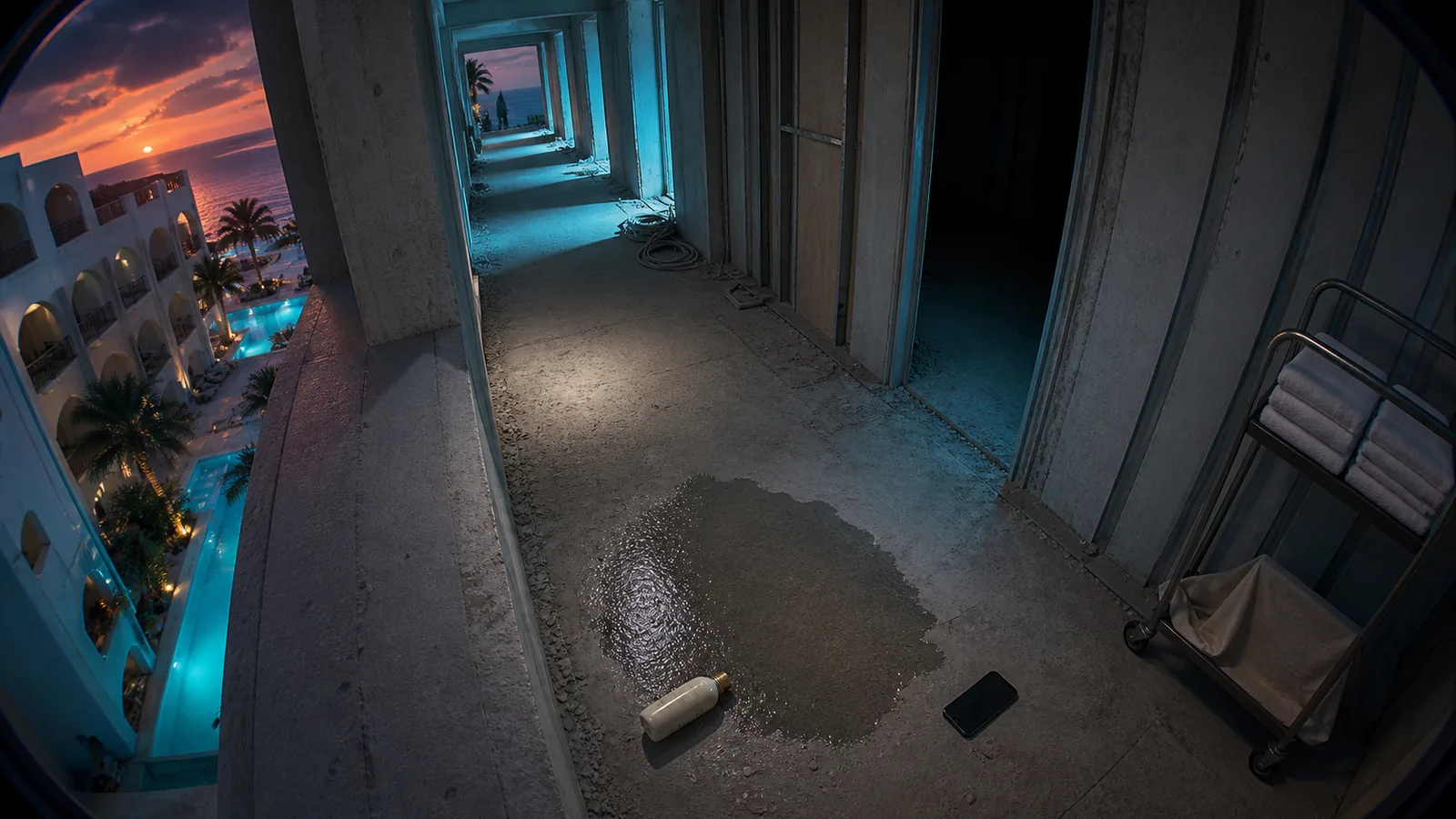
The copied footage changes the shape of the mystery. Helena appears on camera entering an unfinished renovation area. She does not remember doing it, and the recording does not show her coming back out. That is worse than a blank. It gives the group a door, a timestamp, and no answer.
They enter the renovation zone and find a part of the hotel that looks nothing like the brochure: unfinished, unused, and close to the vents and fans. The resort’s luxury shell suddenly has a serviceable horror-movie underside.
The detail that tightens the scene is the cleaned patch. Someone has cleaned there, even though Celia says she has never seen the room occupied and the footage did not show anyone else entering. The contradiction sits there: Helena went in, did not come out on camera, and yet evidence of cleaning remains.
Celia decides she has to check something. Dani offers to come, but she tells him to stay with Helena so she is not alone. It is a small choice and a costly one. The same loyalty that made Celia refuse to abandon Helena now sends her into the resort’s blind spot by herself.
Celia calls Dani after finding something, and the police line goes up around the Oasis
The final stretch is cut like the pilot’s opening promise paying its first debt. Celia moves alone through the hotel at night, lies to Luis that she is in her room, and realizes someone is nearby. The threat stays mostly offscreen. We hear her fear before we know anything useful.
Then Dani’s phone rings. Celia is begging him to answer. She says she found something, and then the call breaks into panic. By the time Dani hears enough, she is already running. Helena points him toward Celia’s house, Luis steps into the chaos, and the one clean fact left is ugly: Celia says someone is chasing her.
The episode ends with police tape, search crews, and earthquake narration about buried secrets, tracks in the sand, rocks that should not be where they are, and the possibility that someone will eventually start digging. It is not subtle, but Episode 2 makes the disappearance feel earned by the architecture of the resort.
Celia does not vanish because the plot needs a cliffhanger. She vanishes because she follows the hotel’s own evidence into a space the hotel would rather leave unregistered.
Tiny details worth clocking
- Ginés gives Helena his number, but only after making clear that her memory gaps and drug test have already damaged her usefulness to him.
- Alicia naming room 205 herself keeps the room number from being a background prop; the episode wants that location remembered.
- Rafa’s fake seagull errand is funny because Celia knows exactly how to use employee diligence against itself.
- The Paris shampoo clue is class-coded evidence: Helena can identify the product because she works around luxury she is not meant to use.
- Celia telling Dani to stay with Helena is the episode’s cruelest practical choice, because it is both decent and disastrous.
Final verdict
Oasis Episode 2 is a sharper hour than the pilot because it stops introducing the hotel and starts proving how it protects itself. The mystery mechanics are simple, but they work: a drugged girl, a client-only shampoo smell, copied security footage, an unfinished corridor, a cleaned room, and a phone call cut off mid-panic.
The class pressure gives the hour its bite. Helena is sent back to work after a night she cannot remember. Laura is arranged over lunch as if her surname were a family asset. Jaén gets blackmailed by a guest who understands that service workers can be threatened from above and below.
The weaker stretch is the boat drama, which occasionally tilts into familiar teen jealousy beats. Maca, Sofía, Pablo, and Leo are all doing useful character work, but the snorkeling fight has less charge than the hotel investigation around it. Even there, though, the placement matters. The resort keeps partying while one girl is trying to reconstruct the missing hours of another.
By the end, the Oasis feels less like a locked-room mystery than a locked-resort mystery: too many cameras, too many doors, too many people paid to look away, and one girl who starts digging before anyone powerful is ready.
Rating: 8.5/10 — A tighter, more suspicious second episode that turns Helena’s missing hours into a real resort mystery and makes Celia’s disappearance feel like the result of the Oasis’s own hidden machinery.
More episodes from Oasis — Resort secrets and a missing girl, episode by episode. Jump to any episode in the season:
Where to go next
Reviewed by Mira Vance · QuizFandom Editor & Lead Reviewer. Every rating is an honest per-watch assessment from the desk that also writes the quizzes — not a press release rehash.