Oasis Episode 7 Review: Jaén confesses, Dani and Helena expose Ginés, and the Oasis opens before Celia is found
What happens — the short version (spoilers)
- Jaén tells Helena he drugged her, and his best-kept-secret line sends her back toward the rooftop.
- Dani and Helena find Jaén's rooftop walkie, but Ginés chases them before they can reach Ortega.
- Maca refuses Pablo's apology, and their breakup curdles into champagne by the pool.
- Laura fails to open Esperanza's safe, and Óliver offers help for a small but meaningful price.
- Jon catches Felipe jewelry shopping, while Leo's room delivery exposes Maca's name.
- Ginés's trunk turns the drug hunt into evidence, but Celia remains missing until Aurora's snake cigarette breaks the official answer open.
Oasis* Episode 7 is the hour where the resort finally gives Dani and Helena something that looks like an answer, then immediately reminds them who controls the paperwork. Jaén's secret explains part of Helena's missing night without clearing the larger crime, and Ginés's trunk turns police procedure into another locked room full of hidden evidence. Around that, the teen plots keep mirroring the case in smaller, meaner ways: apologies that arrive too late, gifts delivered at the worst possible time, safe codes blocked by policy, and a hotel that would rather reopen than admit how little it knows.
Jaén tells Helena he drugged her, and the “best kept secret” sends her back to the rooftop
Episode 7 starts by turning Helena’s one remembered image into a person. The flashlight was in Jaén’s room, and the police are happy to make that enough. Helena is not. She asks to speak to him because the object matters, but so does the version of him she knew before the resort turned every worker mistake into possible evidence.
Jaén’s confession is ugly because it is not the clean villain monologue the police want. He says he saved her. Then he admits what that means: after Helena stumbled onto him with drugs on the beach, after she saw too much and was already altered, he gave her more so she would not remember. The line lands with the exact moral dirt it deserves. I had to drug you so you wouldn’t remember anything is not protection. It is a confession wearing the clothes of one.
Helena’s reaction is all panic and loyalty fighting inside the same breath. She tells the police she stole the drugs, tries to pull suspicion off Jaén, and still needs him to tell her where Celia is. He cannot. What he gives her instead is the phrase he thinks she will understand: his “best kept secret.” Alicia, of all people, makes the phrase useful. Jaén took her to watch the sunset on the roof, and Helena realizes he was pointing her back there.
That is the Oasis at its most suspiciously elegant. A romantic rooftop memory becomes an evidence locker.
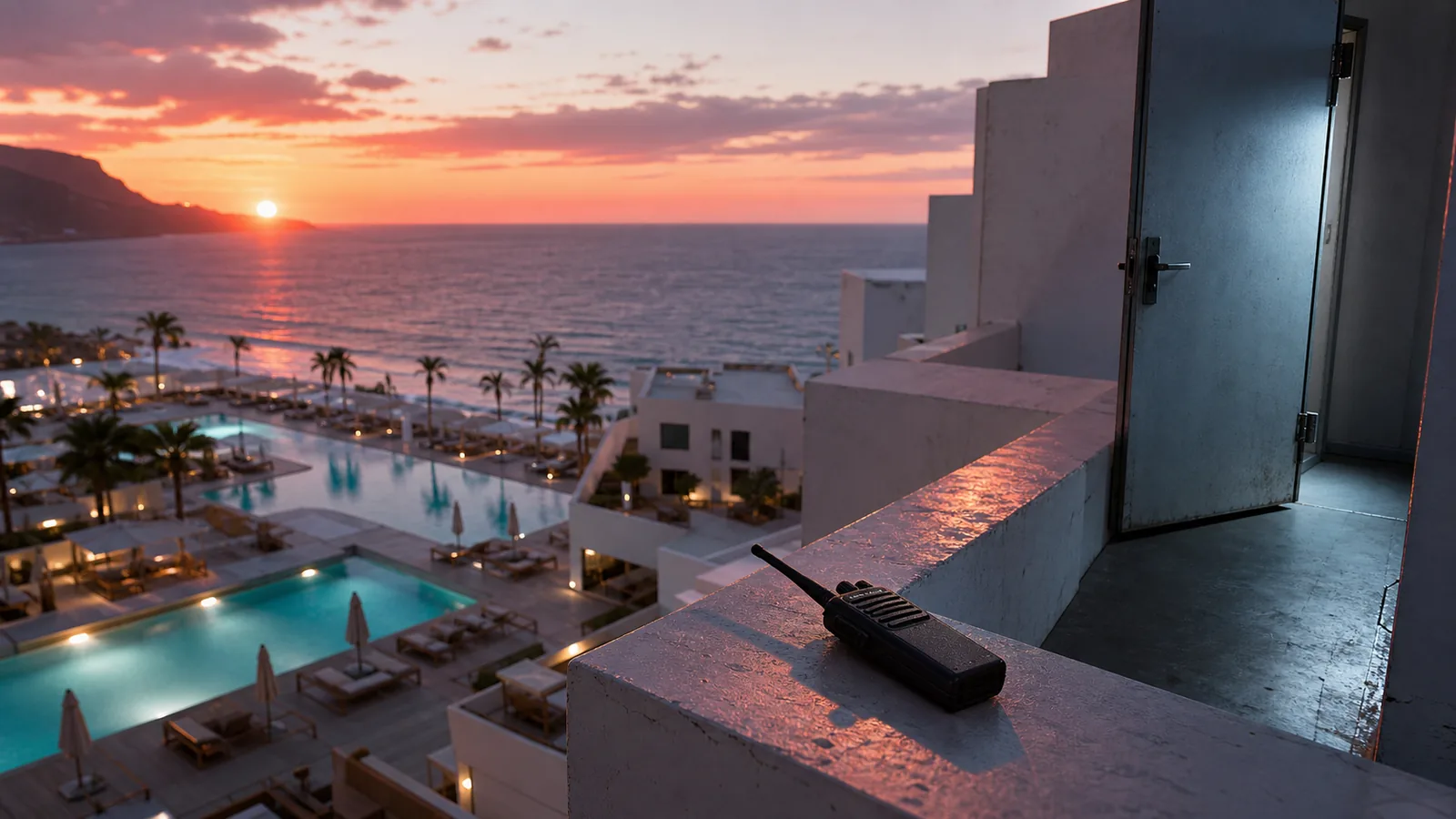
Dani and Helena find Jaén’s rooftop walkie, and Ginés chases them before they reach Ortega
The rooftop clue is small enough to feel real: an old resort walkie, the kind used before cell phones, hidden where Jaén used to drink beer and watch the sunset. Dani and Helena put the logic together quickly. If Jaén had the walkie and never handed it to the police, maybe he was not protecting himself from Celia’s case. Maybe he was protecting the clue from police who would bury it.
Then Ginés arrives.
The threat is blunt. Ginés sees what they are hiding, demands it, and turns the roof itself into pressure. Make sure you don’t fall would sound ridiculous anywhere except a luxury resort rooftop, with two frightened teenagers holding the one object a policeman badly wants back.
Dani and Helena try to get the walkie to Inspector Ortega, but the building keeps behaving like Ginés’s territory. Doors, storage rooms, master keys, staff corridors, police badges: every system that should make the hotel legible gives him another way to close space.
For once, the kids’ panic helps. They keep naming the pattern out loud: the walkie, the stockroom, the ceramic piece, the vases. They sound reckless, but they are also the only people in the room refusing the resort’s favorite move, which is to treat every hidden thing as unrelated until the adults decide otherwise.
Maca refuses Pablo’s apology, and the breakup turns into champagne by the pool
Pablo’s apology to Maca is almost respectable, which makes it more irritating. He says he is aware he cannot make everything right. He says he is not asking to get back together, only for forgiveness. He even lands on the least selfish version of the sentence: he does not want to keep hurting her.
Maca hears the trap inside all that decency. Pablo has cheated before, and she has forgiven him before, and the part she hates is not only him. It is the way she kept redirecting her anger at whoever stood nearest to his latest excuse. So she does the thing that has taken five episodes too long: she refuses the relationship without turning it into another performance for him to manage.
The poolside aftermath is lighter, but not softer. Champagne, no more boyfriends, and enough bite keep Maca from romanticizing Pablo’s concern. The scene lets Maca admit the annoying complication, that Pablo’s concern for her seemed real, without turning that into a reason to crawl back.
At the Oasis, even a breakup has a service rhythm. Sit down. Drink something expensive. Make it look like freedom before anyone notices the damage still on the table.
Laura fails to open Esperanza’s safe, and Óliver offers help for the smallest price
Laura’s plot has no police tape, but it belongs in this hour because it is also about locked evidence. She tries to get Esperanza’s room safe opened with a smooth little lie about an embarrassed grandmother forgetting the code. The desk stays polite and immovable. Resort policy says only the guest on the reservation can request it.
That phrase is the whole family problem in hotel language. Esperanza owns the reservation, the room, the safe, and the story Laura is allowed to tell about herself. Laura can stand at the desk with her full name and her perfect guest manners, and she still cannot open the box.
Óliver sees more than she wants him to. He catches the safe-code problem, guesses she does not trust her grandmother, and offers to help. Laura is braced for the obvious price because this resort has taught her to expect one. His price is smaller and therefore more dangerous: he wants to see her smile again.
It is a sweet line in a very unsweet context. Laura wants information because Esperanza has made care feel like surveillance. Óliver wants back into her trust after a file made him look like one more man treating rich girls as opportunity. The safe remains closed, but Laura still does not know which version of protection is worse.
Jon catches Felipe jewelry shopping, and Leo’s room delivery exposes Maca’s name
Jon’s thread is a slow humiliation staged through manners. He finds Felipe looking at jewelry and tries to turn it into a gift-for-Mom story. Felipe plays along, and the scene almost passes as awkward father-son small talk. Then Jon tells Leo what he really thinks: the jewelry is for another woman.
What makes the scene sharper is that Jon has a history for the suspicion. He says Felipe’s affairs have almost broken the family before, that Felipe promises to stop, and that the women are usually much younger. Leo listens from the worst possible seat. She knows enough to understand the shape of the truth, and she is close enough to Jon to feel what saying it would cost.
Then room service does it for her. A delivery arrives for Leo’s room, and Jon understands too quickly. He names Maca as the person sleeping with Felipe and realizes Leo already knew. Leo’s apology is tiny against the size of his embarrassment.
The Oasis keeps doing this with luxury objects. Jewelry is not romance. A room delivery is not generosity. They are paperwork with ribbon on it, and sooner or later the wrong person signs for the package.
The trunk turns Ginés’s private drug hunt into evidence, but Celia still stays missing
The confrontation with Ortega is the episode’s best procedural stretch because it keeps refusing catharsis. Dani and Helena accuse Ginés of hiding things and chasing them for the walkie. Ortega first hears the accusation as teenage hysteria, because of course he does. The clean institutional answer is that children do not barge into a police room and accuse an officer without evidence.
Then the evidence starts naming itself. The vase, the tag, the flashlight: three pieces tied to the drug-trafficking trail that Ginés had been holding back. He frames it as a parallel investigation, an attempt to save trouble and avoid inconclusive noise. That excuse is almost elegant, which makes Ortega’s response even more maddening. Ginés will be reported to the commissioner, but the room does not explode. The machine absorbs the scandal.
Only the trunk changes the temperature. The subtitles identify one final item as being found there, and Helena’s reaction tells us enough about its weight. She goes at Ginés, demanding to know where Celia is and what he did to her. The case has moved past Jaén as a convenient worker suspect, but it still has not produced Celia.
That gap is the hour’s most honest frustration. The police can arrest people. They can gather guests in a room. They can say “new lines of investigation” with a straight face. None of that is the same thing as finding the missing girl.
The police announce two arrests and reopen the Oasis, then Aurora’s snake cigarette breaks the answer open
The public announcement is pure resort theater. The police thank everyone for their patience, confirm two arrests connected to Celia’s disappearance, and ask for discretion. Luis follows by thanking the guests and promising that Celia will return home before announcing the part the room actually wants to hear: the lockdown is ending, and activities will be back to normal.
It is obscene in the calmest possible way. Jaén’s name inside that neat story does not make sense to the kids. Helena asks the only question that matters: what if they do not find Celia, or the suspects do not say where she is? The hotel has already moved on to reopening. The children have not.
For a few minutes, the episode lets them sit inside that fear. Dani tells Helena she could use some sleep. She says she does not know if she can. The near-quiet is brief, because the Oasis never lets evidence stay buried for long.
Aurora’s cigarette snaps the case sideways. Helena recognizes the snake-marked cigarette and asks where Aurora found it. The first answer points toward the interrogation room and Ginés. Then Aurora corrects the timing: Ginés had already been taken away, and there was a fresh one in the ashtray. So the cigarette did not come from him.
The final cry for help does not solve the case either. It does something more useful for this episode: it proves the neat police story was premature the second the hotel tried to sell it.
Tiny details worth clocking
- The apology note to Helena at the top points toward her missing-night damage before the hour names Jaén’s guilt.
- Jaén’s “best kept secret” phrase gets echoed by Alicia before Helena turns it into a rooftop clue.
- The rooftop walkie matters because it is old hotel infrastructure, not a modern phone or guest device.
- Laura’s safe scene is all policy language, which is exactly how Esperanza’s control keeps showing up in public.
- The snake cigarette clue changes because of timing: Aurora says Ginés had already been taken away before the fresh cigarette appeared.
Final verdict
Oasis Episode 7 is a strong suspect-flip hour, but its sharper move is showing how easily institutions can metabolize embarrassment. Jaén admits to something awful and still might not be the answer. Ginés gets exposed for hiding drug evidence and still exits through procedure. Luis reopens the hotel while Celia remains missing because normal operations matter more to the Oasis than moral clarity.
The side plots mostly earn their space because they rhyme with the case. Maca has to separate real concern from repeated harm. Laura needs a safe opened because family protection has become a locked box. Jon discovers that adult secrets do not stay adult just because they come wrapped as jewelry. The weakness is that the episode sometimes has to move fast through those side rooms to get back to the investigation, which leaves a few emotional turns feeling clipped.
Still, the hour’s central idea lands cleanly in the announcement scene. Two arrests make the guests calmer. The lockdown ending makes the resort breathe again. Dani and Helena are the only ones still acting as if Celia’s absence is the story, not the inconvenience around it.
Rating: 8.5/10 — A tense, skeptical investigation hour that cracks open the Ginés cover-up and keeps Celia’s disappearance alive, even when the Oasis is already trying to return to business.
More episodes from Oasis — Resort secrets and a missing girl, episode by episode. Jump to any episode in the season:
Where to go next
Reviewed by Mira Vance · QuizFandom Editor & Lead Reviewer. Every rating is an honest per-watch assessment from the desk that also writes the quizzes — not a press release rehash.