Signal Episode 13 Recap: Jae-han Comes Home Fifteen Years Too Late
Signal, Season 1, Episode 13 tvN · Written by Kim Eun-hee · 2016
Jae-han is found, Hae-young learns who fed him, and Inju becomes the case that swallowed everyone.
Park Hae-young (Lee Je-hoon) treats the police as a failed institution that happens to employ him. In Episode 13, that anger finally gets its shape.
Before Hae-young became a profiler, before he became the man who could read a suspect from a few missing details, he was a hungry boy in Inju with a framed brother, a broken family, and nobody willing to believe him.
Except one detective did.
Lee Jae-han (Cho Jin-woong) was already dead in the 2015 timeline. Now his remains have a name, his father has a body to bury, Cha Soo-hyun (Kim Hye-soo) has proof of the loss she has carried for 15 years, and Hae-young has to face the hardest part: the man on the other side of the radio was part of his life before he knew how to call that mercy.
Soo-hyun remembers the birthday meal before the funeral
In 2000, Jae-han is away from the office and Jung-jae is gone after the Hong Won-dong case. Jae-han has a resignation letter on his desk. Soo-hyun finds him at his father’s watch shop, where the old man is warmer to her in three minutes than Jae-han is in most of their partnership.
The scene is domestic in a way Signal rarely allows itself to be.
Soo-hyun notices the birthday mark on the calendar. Jae-han has forgotten his father’s birthday, or at least failed to prepare for it. She drags him to the market, confuses seaweed with kelp, and gets him cooking awkwardly for his father.
The meal is terrible and perfect. Jae-han’s father beams anyway. In the taxi afterward, drunk Soo-hyun asks Jae-han not to quit and gives him the praise he would never accept while sober: “If you don’t deserve to be a cop, nobody else in the world deserves to be one.”
That memory cuts directly into 2015.
The DNA results match. The bones belong to Lee Jae-han.
His father comes to the station and breaks in a way that is quieter than screaming. He asks where his son is. Then, when the truth settles, he thanks them. He can finally hold a funeral before he dies.
That is the cruelty of the discovery. Finding Jae-han gives his father a grave, Soo-hyun an answer, and the police a body they can no longer pretend away. It does not return the man who promised Soo-hyun they would talk after the weekend.
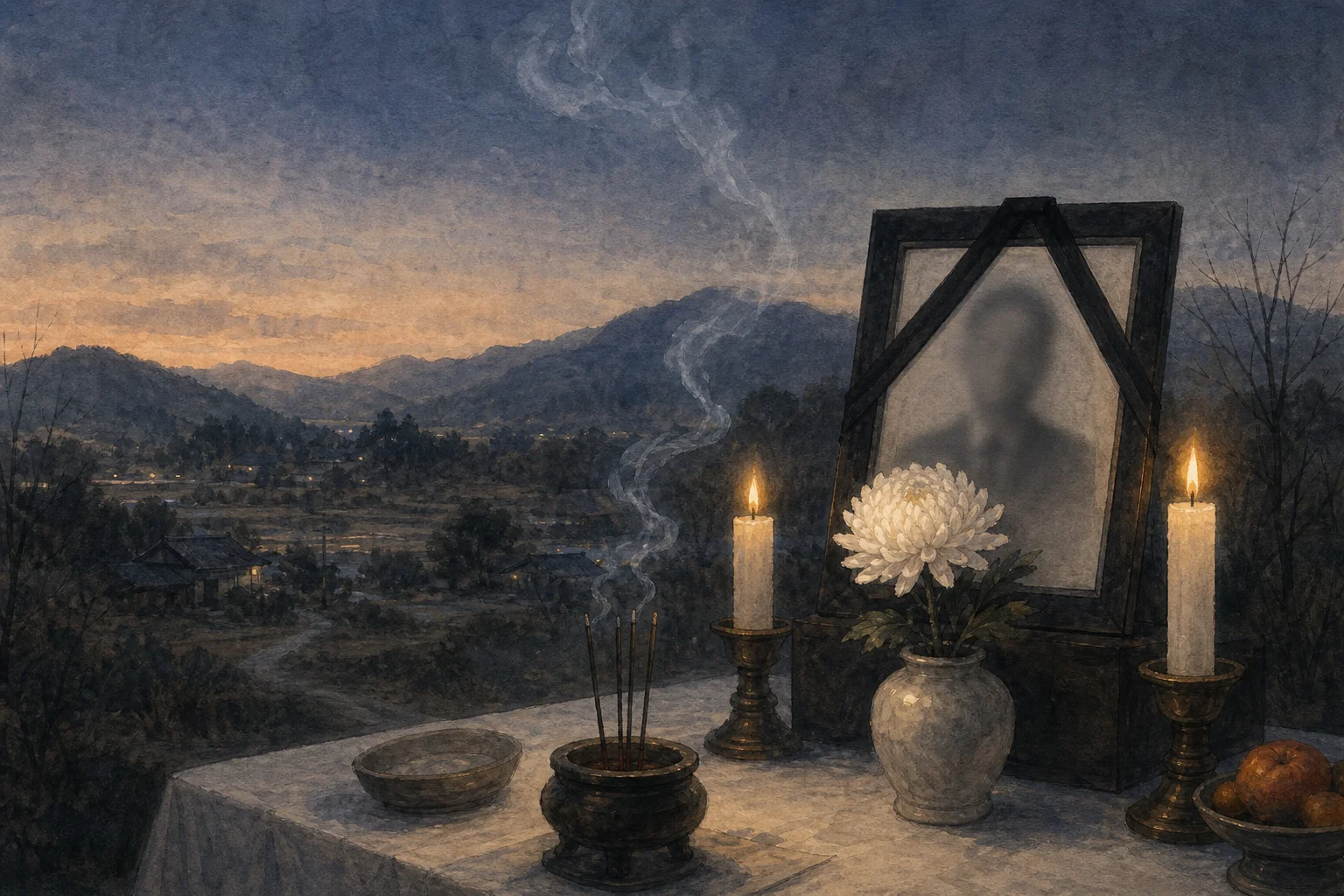
At the funeral home, Soo-hyun says they never even took a decent photo together.
Not one.
For 15 years, she ran to morgues whenever an unidentified body came in. She believed he must be dead because he would not abandon his father, his colleagues, or her without reason. She still imagined the door opening and Jae-han walking in late, calling her “point five” like nothing had happened.
That hope is almost worse than certainty.
Now he has come back as remains, under his own name, with no flowers and almost no visitors. Soo-hyun tells him he broke his promise. She waited for one weekend. He took 15 years.
Hae-young finds Jae-han’s name card at the porkhouse
Hae-young leaves the funeral with Soo-hyun’s regret in his ears: no photo, no keepsake, nothing solid from the person she waited for. Then he finds the small object Jae-han left in his own life.
It is a name card from The Original Porkhouse.
The porkhouse takes Hae-young back to Inju, to the boy he was after Park Sun-woo’s conviction. The case has already ruined the family. His father leaves with Hae-young. Sun-woo is branded a rapist, sentenced to juvenile detention, and treated as disposable because nobody important benefits from his innocence.
Hae-young remembers the courthouse. He remembers shouting that his brother did nothing. Nobody listens to a child when the file has already chosen its culprit.
Then Hae-young finds the piece he never had.
As a starving kid, he walked into The Original Porkhouse and ordered omurice. Jae-han sat nearby, saw the hunger, and paid the owner to feed him. He insisted he was not the boy’s father, almost embarrassed by the kindness.
Then he gave the owner money and asked her to feed the kid whenever he came back.
Hae-young grew up thinking he was alone. That word matters because he says it plainly in 2015. Alone was the hardest part. The shame around Sun-woo followed him into school. Boys mocked him with the Inju case, dragged his brother’s name into sexual cruelty, and pushed him until he fought back with everything he had.
That fight sends him toward the future we know.
Hae-young corners one of the boys who lied in the old case and learns that the police told him to lie. Instead of collapsing under the knowledge, he asks what he has to do to get into college. He wants a good school with cheap tuition. Someone suggests Police University. He rejects it immediately because the police framed his brother.
Then the idea stays.
He studies because power has already taught him its grammar. Sun-woo was framed because he had no money, no connections, and no protection. Hae-young decides to enter the room where those decisions are made.
The tragedy is that Jae-han helped him survive long before their radio partnership began. Hae-young has been speaking across time to the man who once paid for his meals and told a restaurant owner to keep him alive in small portions.
Jae-han follows the student council names in 2000
The 2000 timeline is already moving toward the Inju case before Hae-young can stop it.
Jae-han asks for the truth behind the 1999 Inju female student case. Hae-young wants him off it because the first transmission has already told him the outline of disaster: Jae-han called from 1989, warned him to stop his younger self, and then Hae-young heard a gunshot.
Jae-han hears the warning and refuses the escape route.
He tells Hae-young he is a homicide detective. He will see the case through. Then he repeats the moral rule that has always made him dangerous to men like Kim Bum-joo: if someone is guilty, rich or powerful or not, that person should be punished.
The Inju file begins with Kang Hye-seung and seven student council members. Rumors say she was involved with one of them. Jae-han pulls the school register. The names connect through family positions and Inju Cement. Money and local rank sit around the case like guards.
Kim Bum-joo understands what Jae-han might find. He orders Ahn Chi-soo to get the boys out of Inju for winter vacation. Send them to relatives, send them on trips, make them unreachable. The panic gives the cover-up away.
Jae-han narrows in on Lee Dong-jin, the student who wrote a post about “the House of the Willow Tree,” seven in-gan, and ten devils. Dong-jin is not innocent. He was there. But his guilt could not stay buried. He skipped school, visited Hye-seung at the hospital, and wrote the truth in code because he could not live like the others.
Jae-han gets him into an interrogation room and reads the post back to him.
The interrogation is careful with a subject that could have turned exploitative. Jae-han does not treat Hye-seung’s assault as a puzzle piece for cleverness. He asks Dong-jin where the first crime began, who pushed the others, and why a scapegoat was chosen.
Then the adults arrive.
Dong-jin’s father storms in because his son is a minor. Ahn Chi-soo tells Jae-han to follow formal procedure. The moment looks reasonable if you only read the rulebook. In context, procedure becomes a doorstop. Let the boy leave, delay the statement, let the families close ranks.
After Dong-jin is gone, Bum-joo and Ahn discuss what they need: someone with no money, no connections, no one who will make noise.
They choose Park Sun-woo.
Kang Hye-seung tells Hae-young Sun-woo saved her life
In 2015, Soo-hyun and Hae-young cannot go to the Wide-Area Squad. Kim Sung-bum escaped police custody by minutes after officers moved to arrest him. Someone warned him. Kim Bum-joo now controls the squad investigating Ahn Chi-soo’s murder. He also ran the Inju case in 1999.
Soo-hyun’s instinct is restraint. Hae-young’s instinct is forward motion. Both are right.
The Cold Case Squad starts over with the Inju file. The old conviction depends on witness statements. If those witnesses lied, Sun-woo was sacrificed. The statute of limitations has expired for the original assault, but the case now points toward Ahn’s murder, Jae-han’s death, and the police chain behind it.
The first task is finding Kang Hye-seung.
Hae-young has looked for her for years and failed. Soo-hyun pushes the search into field work. Gye-chul finds medical records: Hye-seung regularly visited a neuropsychiatrist. Hae-young profiles what survival might look like for her. She would avoid crowds, men, public transport, and police attention. She might work somewhere with mostly women customers and little conversation.
They find her at a cosmetics shop.
Hae-young tells her Park Sun-woo was his brother and asks whether Sun-woo was the main perpetrator in Inju. Hye-seung does not answer with a clean alibi first. She answers with grief.
Sun-woo was sincere to her.
He found her when she ran from home. He saw the bruises from her drunk father and did not lecture her into danger. He threw away her cigarette, worried about her, and offered to help her study so she could live on her own. After the assault and the public shaming, when she tried to die, he pulled her back and said, “It’s not your fault.”
No one else in Inju gave her that sentence when she needed it.
Then the police and the boys made her betray him. She was a child, terrified, threatened, and desperate to leave what she calls that hellhole. She identified Sun-woo because they told her everything would be over if she did.
Her apology does not undo the damage. It does something narrower and still necessary. It gives Sun-woo back his innocence in front of the brother who has carried it alone.
And it leaves the next question hanging in the room.
Who framed Park Sun-woo, and who was the real perpetrator?
What works
The funeral material hits because it refuses spectacle. Jae-han’s father thanking the police for finding his son is almost unbearable because his gratitude is sincere. Soo-hyun’s memory of waiting for the door to open gives 15 years of loyalty a physical shape.
The porkhouse reveal is just as strong. Jae-han feeding young Hae-young could have felt too neat as coincidence alone. Instead, it clarifies why these two men belong in the same story. Both are angry at the same kind of injustice. Both believe cold cases go cold because people quit on them. Both have been trying, from different years, to return Sun-woo’s name to him.
The Inju investigation also keeps its procedural spine. Names, school records, medical visits, fake addresses, witness statements, and the old absence of CIMS all matter. The radio connection gives the story its supernatural pressure, but the truth still has to be earned through documents and doors.
What stumbles
One stretch of backstory carries a lot: Jae-han’s funeral, Soo-hyun’s 15-year wait, Hae-young’s childhood, Sun-woo’s framing, Dong-jin’s interrogation, and Hye-seung’s testimony. The emotional material is strong enough to carry it, but the final third has to move very fast.
There is also a small convenience in how quickly the modern team locates Hye-seung once Gye-chul pulls the medical trail. Hae-young’s profile is sound, and the sequence respects her need to stay hidden, but the search compresses years of failure into one clean field sweep.
What this sets up for Episode 14
Episode 14 now has three live wires.
First, Hye-seung’s testimony can point Hae-young toward the real culprit behind Sun-woo’s framing. Second, Jae-han in 2000 is close enough to the student council cover-up that Bum-joo and Ahn already know he is a threat. Third, Soo-hyun knows the present-day police leak is protecting Kim Sung-bum and possibly Bum-joo himself.
The radio cuts out before Hae-young can stop Jae-han. That matters more than any warning he managed to give. Jae-han now knows the future is dangerous, and he still chooses the case.
That is who he is.
It is also why everyone who loves him keeps losing him.
Rating: 9.4/10
More episodes from Signal — Kim Eun-hee's time-bridge cold-case thriller, episode by episode. Jump to any episode in the season:
Where to go next
Reviewed by Mira Vance · QuizFandom Editor & Lead Reviewer. Every rating is an honest per-watch assessment from the desk that also writes the quizzes — not a press release rehash.