Ted Lasso S3E3 Review: Zava Arrives, Rebecca Visits a Psychic, Sam Opens Ola's
A Swedish demigod walks into Richmond two hours late, a green matchbook lands in Rebecca's hand, and Ted's home phone is answered by Dr. Jacob.
The third episode of the final season takes its name from a formation — 4-5-1, the shape Beard adopts to feed a single striker — and the formation is the joke: Richmond’s tactic this year is to hand the ball to one man and clear out of the way. The hour tests what that looks like for the people who are not that man. Phil Dunster’s Jamie steps back into midfield; Toheeb Jimoh’s Sam opens a restaurant the same week his teammate becomes a god; Rebecca pours her morning into a Mykonos no-show. The hour is busy with what it costs to make room for a star.
A locker room becomes a fan club, and a kit man finally gets his name said first
The pre-match scenes belong to the players, who have already started thinking of Zava the way Brett Goldstein’s Roy talks about Julie Andrews. Dani Rojas confesses he made love for the first time to Zava boots, will not let anyone correct the preposition, and then commits to having sex with Zava himself if it would help the team. Colin offers an unguarded “so sexy, eh?” Isaac calls it gay. Colin agrees, then qualifies: gay for Zava. Brendan Hunt’s Coach Beard glides through with a Norm Macdonald reference and the phrase “charisma unicorns,” which is the most charitable framing the episode will give the man it spends the rest of its time deflating.
The cold open has already given us the other side of Colin’s morning. He spends the night with a man, makes him coffee, drops him at the airport, and sits alone in his car telling himself he is strong and capable. The shot lasts two beats longer than it has to. The series files the moment without underlining it, which is exactly how Colin is filing it himself. The locker-room “sound a bit gay, bruv” lands differently when you have been in the car with him.
Zava arrives two hours late, walks past the cameras entirely, plants himself behind Rebecca’s desk eating her biscuits, and informs her that time is a construct “like gender and many of the alphabets.” Hannah Waddingham’s Rebecca asks him to get out of her chair with the tone of a woman who has been the only adult in three different rooms today. The new acquisition does not apologize, does not stand to greet Ted, and does the one thing the episode lets him keep: in the locker room, he asks for the kit man first. Will, a 25-year-old who has spent the morning being addressed by no one, is asked his name twice and told his passion is why Zava plays. The room then does a group breathing exercise. There is no me, there is no you, there is only the we and the us, and the we in us. Jason Sudeikis’s Ted, who built his pilot around teaching people Nathan’s name, watches a more theatrical version of his own playbook run on his own squad. He does not love it. He coaches around it.
Rebecca’s mother sends her a psychic, who is right twice and cruel once
The Tish sequence is the episode’s slow center. Rebecca arrives late to a session her mother has paid for, expects nothing, and is told three things. A green matchbook will matter. There is a shite in nining armor — a knight in shining armor — and the arrival is both right and wrong on timing. And she will have a family. She will be a mother.
Waddingham plays the room with the posture of someone who has booked an exit before the door closed. Jeremy Swift’s Higgins is not in the scene, and his absence is the point — there is no one for Rebecca to perform composure for. The first prediction is silly. The second is a riddle. The third is the cruelty. Rebecca’s “fuck you” is direct, and her exit line — that her mother could afford Tish because Tish has always been harmless, but this is dangerous, this is cruel — does what the show usually leaves Ted to do. It names the wound, on the way out, while the wound is still fresh. Waddingham gives Rebecca no relief on the line.
The episode does not let the prediction sit as a punchline. At Ola’s opening night, Sam thanks the table with branded matchbooks. They are green. James Lance’s Trent Crimm, who is shadowing the team for his book, is not in the scene to write it down. Rebecca holds the matchbook in her palm and does not speak. Keeley asks if she is okay. She is not okay. The hour rides off on her face, on a piece of party swag that her mother’s psychic saw three days early.
Sam opens a restaurant while his teammate becomes a god, and Jamie asks to be coached
Ola’s is the warm room the hour keeps cutting back to, and Jimoh plays the night with the slightly overcaffeinated energy of a man who knows the food is good and is praying the guests do too. Colin eats his moimoi and means his compliment. Isaac brings a wingman friend named Michael whose self-description is the funniest single line of the episode. Anthony Head’s Rupert is, mercifully, not on the call sheet. Nick Mohammed’s Nate is invoked only on a sports talk show, where George Cartrick names him as the real tactician of the league — a planted seed for later.
Two beats inside the restaurant carry the back half. The first is Jamie’s. Dunster’s read on him this season — petulance traded for self-awareness one inch at a time — gets its cleanest scene yet on the back step. Roy calls him a pre-Madonna, refuses correction on “prima donna,” builds a brief and aggressively wrong theory of Tina Turner, then offers him training. Jamie says he does not want to keep up with Zava, he wants to be better. Roy says fine, four a.m. tomorrow. Both men deliver the offer and the acceptance with the cadence of a deal closing. The “fragile little bitch” of the morning meeting is, by night, the one Richmond player willing to say the new arrangement is failing him and to do extra to fix it. The episode does not call this growth. It lets us see it.
The second beat is Roy and Keeley not happening. Juno Temple’s Keeley spends the hour absorbing a new shadow, Shandy, whose offer to take her shirt off and run across the pitch is the episode’s most efficient character introduction. Roy, ambushed into a non-conversation about interview duty, says nothing important and exits. Outside the restaurant, Sassy calls him the Marlboro Man, and the episode lets us assume the rest. It plays as relief for Roy and as a held note for Keeley.
Ted phones home, and the phone is answered
The match montage is loud. Zava scores from the halfway line in his debut. A scorpion kick against Burnley. A header against Palace. A bicycle goal at Old Trafford to steal three points off Manchester United. Six wins on the bounce, fueled by one man and his breathing exercises. Richmond chants his name. The eagle-among-penguins line in the commentary is the kind the league will be quoting all month.
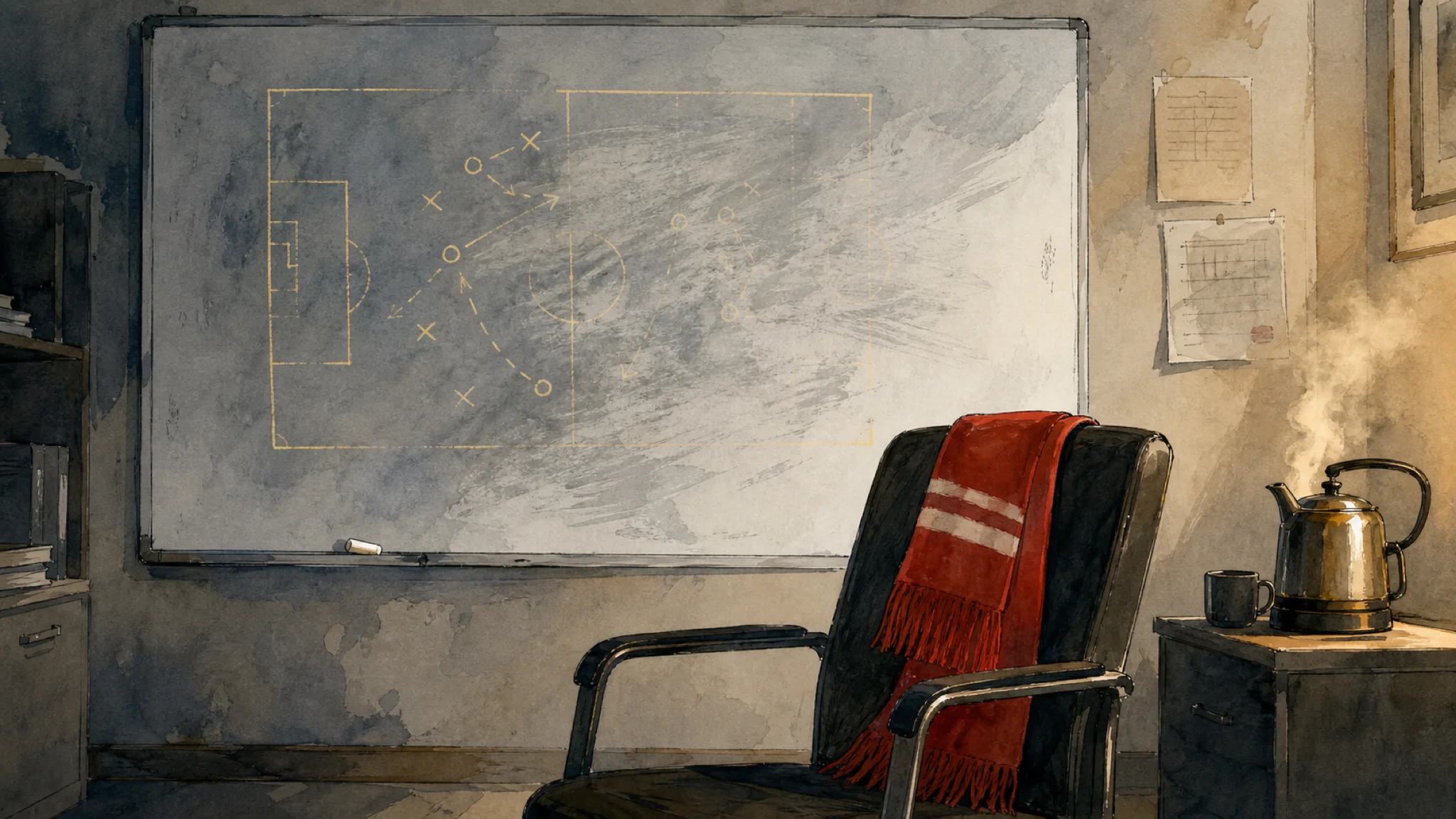
The quieter sequence sits inside the win streak. In the coaches’ office before the United fixture, Ted leaves his phone at home, cannot recall Michelle’s mobile, calls the landline instead, and reaches Henry’s mom on a morning the boy is being driven to soccer by Dr. Jacob. The doctor answers the phone first. Ted holds his face very still. Michelle takes the phone and says the words that are technically about scheduling — there is a lot to catch up on, can they talk later — while everything else in the conversation routes around what neither of them is saying. Henry asks his dad to tell Zava that his friends’ moms like his abs. Ted says he will. Sudeikis lets the camera have one half-second of the man before he resets his face for the locker room.
Sassy gets the line that the hour has been pointing at: y’all’s baggage just matches right up, don’t it. She is not wrong. The episode files the joke and moves on, because the show is not done with it.
What this episode argues
Star culture in football, and in pop culture generally, has often been treated as a problem of ego — the one big personality crowding out the smaller ones. The episode makes a quieter case. The cost of a star is not the locker-room friction. It is the silence around the people on the edges of the room. Will the kit man gets his name spoken first by the new arrival and reacts as if he has been waved at from a passing parade. Colin gets a morning the audience sees and the locker room never will. Sam opens a restaurant on the night the press is interested only in the man who texted himself in. Jamie, the loudest character in the show’s history, becomes the second loudest in his own dressing room and has the foresight to ask Roy for help rather than complain. None of those are stories the headline lets you tell. The hour tells them anyway.
The Tish thread does the same trick with grief. Rebecca’s mother sends her a psychic because she does not know what else to send. The prediction that wounds — that Rebecca will be a mother — is the one that Rebecca has been refusing to plan around for an entire season. The green matchbook is a cheap reveal on paper. Waddingham plays the cheapness as the cruelty. The point is not whether Tish is real. The point is that Rebecca has been carrying a wish she will not say out loud, and a near-stranger said it for her, and the universe sent her a piece of stationery to underline the sentence.
Verdict
This is the hour that finally lets Season 3 settle into its size. The first two episodes were busy assembling — Nate at West Ham, Rupert and Bex, Ted’s return — and this one spends its time on the smaller players the season needs to work. Will gets his minute. Colin gets his minute. Sam gets a restaurant. Jamie gets a 4 a.m. wake-up call. Rebecca gets a matchbook. The Zava bits are funny without being satisfying, which is exactly the calibration the year requires; Richmond is not going to win the league on a charisma unicorn, and the writers know it. Some plates spin badly — Shandy is introduced as a vibe, the West Ham cutaway is a placeholder, and Ola’s runs shaggy in a way next week will need to tighten. Waddingham and Dunster carry the hour, Sudeikis lets Ted be sad a half-second longer than the comedy requires, and the green matchbook is going to sit on someone’s mantel for the rest of the season.
Rating: 8.2/10
More episodes from Ted Lasso — Season 3 — Richmond's final lap and Nate's slow road back, episode by episode. Jump to any episode in the season:
Where to go next
Reviewed by Mira Vance · QuizFandom Editor & Lead Reviewer. Every rating is an honest per-watch assessment from the desk that also writes the quizzes — not a press release rehash.