Ted Lasso S3E7 Review: Total Football, a Trashed Restaurant, and a Croissant
Ted bets the season on a tactical overhaul, Sam's restaurant gets ransacked over politics, and Nathan picks up a courage map from his future wife.
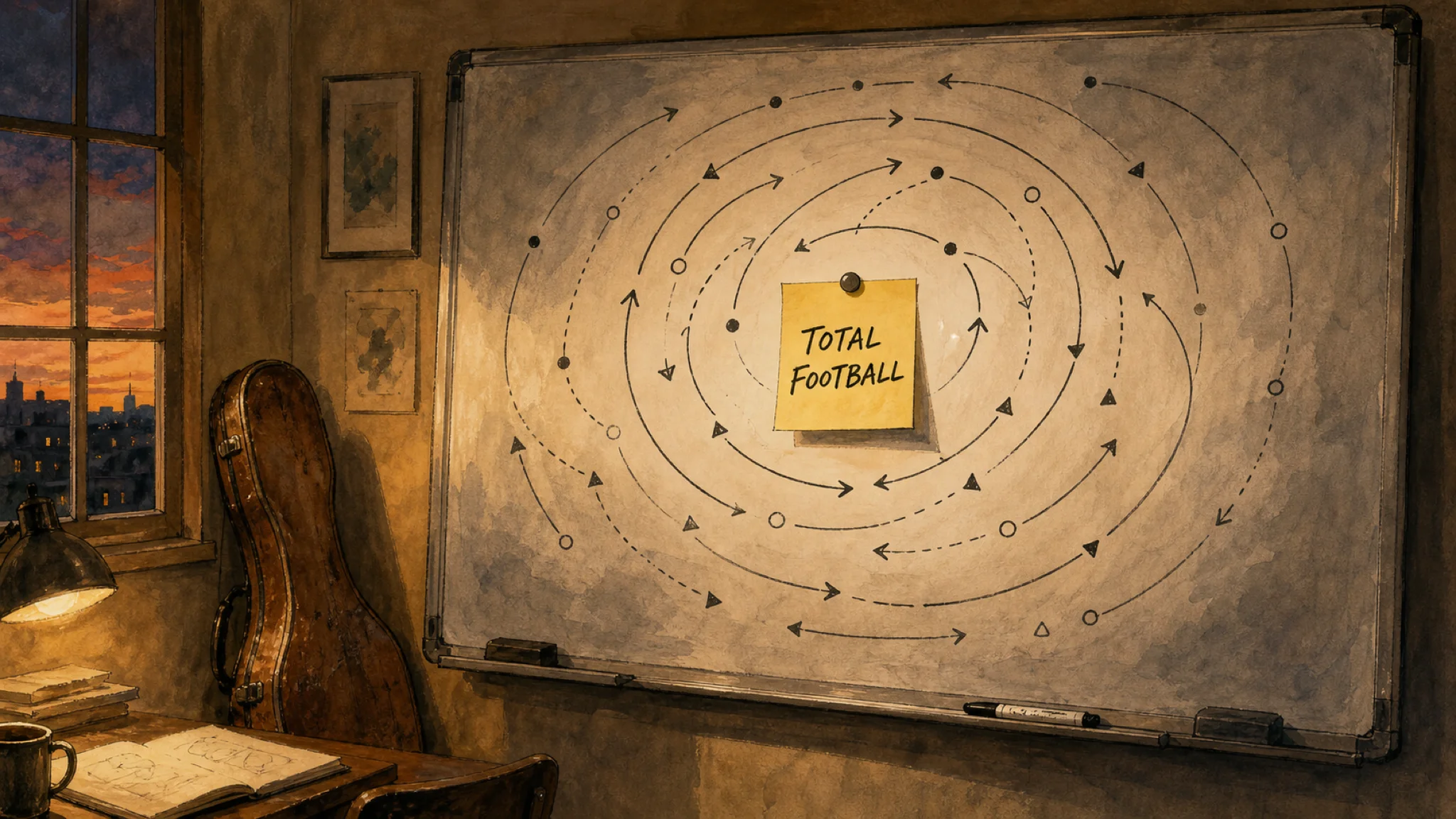
Total Football is a strange thing to put at the center of a Ted Lasso episode. The system asks every player to occupy every position, abandon the box they’ve been put into, and trust the teammate behind them to fill the empty space. The hour around it argues that the same instruction is what every other person on the show has been receiving for three seasons, and the price of refusing it is the damage Sam Obisanya finds at his restaurant in the second act.
Coach Beard explains a philosophy, and Ted ties it to dicks
The chalkboard sequence is one of the warmest twenty-minute openings the show has done. Brendan Hunt’s Coach Beard walks the squad through the lineage of Total Football, from the 1974 Dutch side through Johan Cruyff at Ajax to Pep Guardiola at Barcelona and Manchester City. The bit lands because Beard plays it as a true believer who has stumbled onto a system that finally has a name for what he was already thinking about during barbecue-sauce-related hallucinations. Jason Sudeikis’s Ted lets him have the lecture, then closes it by listing Total Football as jazz, Motown, Mamet, Pinter, Einstein, Curie, Gaga, and his mother proudly displaying her vibrator on the bedside table. The joke is silly. The thesis underneath is that the system the Greyhounds are about to learn belongs to the same family as every other discipline that asks people to throw off the constraints put on them by society and themselves.
The first practice goes badly, because it has to. Brett Goldstein’s Roy is appointed drill sergeant and runs the boys until Bumbercatch is throwing up whole Cheerios. Versatility day asks players to swap positions, which Isaac McAdoo greets by becoming Dani Rojas with a forced Spanish accent. James Lance’s Trent Crimm watches from a corner and asks Ted whether changing tactics mid-season for a system the squad can’t execute is a good idea. Ted’s answer, that it’s like taking a hike with Robert Frost and could go either way, is the kind of joke Sudeikis can deliver with a straight face because the character isn’t kidding himself about the risk.
The third concept, awareness, gets the episode’s signature gag. Ted runs the next training session with red string tied around every player’s penis. The thought, as he explains it, is that it’s hard to lose track of a teammate with a rope tied between dingdongs. The boys play half-speed Total Football until Jamie Tartt takes a hard tug from Colin and the entire backline goes down in sympathetic agony. The puppet-string image is broad. It is also the most literal rendering Ted Lasso has put on screen of what it has been arguing all season: what one person does in a system pulls everyone else with them.
Sam’s restaurant gets trashed, and his father gives him the line
The episode runs a quieter, harder track underneath all that. Toheeb Jimoh’s Sam has been worrying over mismatched spoons because his father is flying in from Nigeria. His chef Simi tells him no one cares about the spoons if the food is good. The kitchen is in good shape. The country is not. A refugee boat is approaching Portsmouth and the Home Secretary, Brinda Barot, gives a televised statement: “Go home. Britain is closed.” Sam puts up his own sign in the window of Ola’s — “Help make Britain better” — and pays for it by walking into his trashed restaurant the next morning. Window smashed, plates broken, mirrors cracked, the word “WANKER” sprayed where the menu used to be.
Sam plays the moment in the locker room with the brittleness Ted Lasso has been protecting for two seasons. Sam yells at Isaac about being late, then yells at the room. The world is full of evil people who do shitty things and he can’t deal with that, because he has to kick a little ball around, which those same people love him for until he misses a penalty or decides to fight back, and then they want to ship him back where he came from. It’s the first time Sam’s anger is allowed to sit in the room without softening. His father, played with extraordinary calm by Ola, arrives that afternoon and gives Sam the line this half-hour has been working toward: don’t fight back, fight forward. The advice is paired with a request to forgive the vandals, because nothing will piss them off more. The rage allowed, the response chosen — together they are what the half-hour is built to earn.
The restaurant gets put back together by the squad. Isaac’s cousin fixes the window. Jamie brings wine from his cellar. Bumbercatch tries to rewire the neon sign. Sam keeps the cracked mirrors. They’re a reminder that everything doesn’t have to be perfect, and if the food is good, who cares about the mirrors. The callback closes the loop with Simi’s earlier line, and the show lets it stand without underlining it.
Nathan’s map, Keeley’s love bomber, and the Lasso way
The B-stories all play the same chord from different positions. Nick Mohammed’s Nate is having dinner with his family when his sister asks if he is hooking up with girls left and right. He stammers his way into describing Jade, the hostess at A Taste of Athens, and asks how you can tell if a girl likes you or is just being nice to you. His mother answers with the same line his phone’s Siri gave him in the cold open: you can’t. Then she goes to the bedroom and brings out a map, hand-drawn by Nate’s father when he was a student. Distance between the places we were born, 4,125 miles. Distance between our dorms on campus, 1.3 miles. Distance between us on Friday at 8:00 p.m., hopefully one foot. The map is the kind of object Ted Lasso has earned the right to use without irony, because Nate’s mother delivers it as the gentle pep talk it is. The next scene is Nate at the hostess stand, asking Jade out and getting a yes. Mohammed plays the relief like a man who has remembered how to breathe.
Juno Temple’s Keeley spends the hour trying to tell Jack she likes her without telling her to stop. Jodi Balfour’s Jack drops a signed first edition of Sense and Sensibility on the kitchen counter (“Keeley, you go girl! Jane Austen”), pays for Keeley and Rebecca’s lunch from across town, and gets identified by Hannah Waddingham’s Rebecca as a love bomber. Rebecca is gentle about it. The Rupert example is the source material. He took her to a car showroom on their second date and asked which one she wanted, and she drove home in a Jaguar, because it felt nice to be taken care of for once. Sometimes shiny things tarnish. Keeley pushes back, then receives one more grand gesture and asks Jack to slow down. Jack does, sort of — the gift that day was a croissant. The compromise lands as funny because Balfour plays Jack’s defensiveness lightly. The show is filing the warning for later without raising its voice.
Rebecca’s other thread is the Dutchman she met in a canal. Keeley pulls the story out of her — no name exchanged, no sex, transcendent anyway — and gives her “love blind,” an emotional version of color blindness where red flags read as giant green just-fucking-go-for-it flags. Rebecca gives Keeley the look she has used for three seasons whenever someone says out loud what she already knew.
What this episode argues
The argument has three pieces, and the hour keeps moving them around the board until they look like one piece. The football part says that a player put in a box does not stop being a defender just because the diagram changes. Isaac has to be told that the box of a center back who was never allowed to take a corner kick has ceased to exist today, then kicks the ball into Coach Beard’s tea kettle on his first attempt. The romantic part says the same thing in a smaller register. Nate has been told for years he is the guy who waits, and the map is the gesture that gives him permission to be the guy who asks. The political part, the one carrying Sam’s plot, asks the question through Ola Obisanya. Anger weakens you. Fight forward. Forgive them.
The fourth principle Ted promises and refuses to name until the locker-room halftime is the one the others have been pointing at. Trent calls it sacrifice. Ted says no, not quite, even though it would close the speech neatly. He lets Jamie say what the rest of the squad cannot, which is that the system has been calibrated wrong because they have all been going to him instead of through him. Total Football is the agreement that the right idea often sits behind a couple of the wrong ones, and someone has to be willing to be the wrong one out loud first. Jamie, of all people, gets to be that someone.
Verdict
This is the cleanest piece of structural writing the third season has produced. The football tactic, the restaurant attack, the love bomber, and the map are not parallel plots. They are the same instruction given four times to four people who need to hear it in their own register, and the episode trusts the viewer to notice without pointing. Jimoh’s locker-room speech is the most volatile thing his character has done on the show, and the choice to let his father answer with stillness rather than counterargument is the right one. Mohammed plays Nate at the hostess stand with no defenses up, and the audition his face does between asking the question and receiving the answer is the best two seconds he gets in the season. Dunster’s Jamie at the tactics board is the payoff for an arc the show has been writing IOUs on since the pilot. The penis-string drill is the broad joke that keeps the hour from solemnity. Sudeikis sells the late-game pep talk through a story about Blue Collar Comedy Tour goatees because the show has always known that wisdom can wear a Foxworthy mustache.
Some seams show. The Brinda Barot framing is broad enough to read as politics-by-strawman, even though the strawman is doing real work for Sam’s plot. The Jack thread is gathering speed faster than the season has earned. Rebecca’s Dutchman material reads like a holding pattern between bigger swings. None of that is fatal. The closing image is Ola Obisanya cooking dinner for the entire squad inside the freshly repaired Ola’s, the neon sign humming back to life, and Sam keeping the cracked mirrors because the food is good and that is what matters. It is the best ensemble closing image the season has earned, and it lands because the half-hour spent forty minutes giving every character a different version of the same lesson and then trusting them to arrive at it on their own.
Rating: 8.8/10
More episodes from Ted Lasso — Season 3 — Richmond's final lap and Nate's slow road back, episode by episode. Jump to any episode in the season:
Where to go next
Reviewed by Mira Vance · QuizFandom Editor & Lead Reviewer. Every rating is an honest per-watch assessment from the desk that also writes the quizzes — not a press release rehash.