The Glory Episode 01 Recap: Dong-eun Names Her Dream
The Glory, Season 1, Episode 01 Netflix · Written by Kim Eun-sook · 2022-2023
A brutal premiere follows Moon Dong-eun from burned schoolgirl to adult planner, and every year in between has a purpose.
Moon Dong-eun (Song Hye-kyo) does not enter The Glory asking to be understood.
She enters an apartment full of photographs.
It is summer 2022, and she has moved into Eden Apartments, the place tied to Park Yeon-jin (Lim Ji-yeon) before Yeon-jin became a polished weathercaster with a rich husband, a child, and a life built far away from the gym where she once tortured a classmate. Dong-eun arranges the faces on her wall with a patience that feels almost devotional. Jae-jun. Sa-ra. Hye-jeong. Myeong-oh. Yeon-jin.
Then she imagines Yeon-jin walking through the door.
The fantasy is not messy. Dong-eun does not scream. She notices Yeon-jin’s shoes on the floor, corrects her manners, and tells her she has one more reason to kill her now: Yeon-jin should at least recognize who she is.
That is the chill of this first hour. The revenge has already begun before we understand the wound. Dong-eun is not deciding whether to strike back. She is explaining how she got close enough to choose the room.
Dong-eun moves into the apartment Yeon-jin grew up in
The Eden Apartments opening gives the adult revenge plot a strange quiet.
A neighbor talks about flowers: Angel’s Trumpet bending toward the ground, Devil’s Trumpet looking up at the sky, punished for being too proud. Dong-eun listens. She carries her things inside. She places the photos. She writes to Yeon-jin like someone addressing an old friend and an execution date at the same time.
It matters that Yeon-jin does not recognize her in Dong-eun’s imagination.
Seventeen years have passed, but the imbalance remains obscene. Yeon-jin ruined a body, a school life, a home, and a future, then walked forward cleanly enough to forget the face. Dong-eun has remembered every detail. Her hatred has not blurred; it has sharpened into schedule, real estate, profession, and proximity.
The imagined confrontation also tells us how Dong-eun fights now. She does not plead. She does not perform wildness. She speaks in the flat voice of someone who has already measured the distance between wanting and doing.
“I’m already here for you” is not a threat tossed out in anger.
It is a status update.
The police station sends Yeon-jin home first
The flashback to summer 2004 makes clear how many adults were required to make Yeon-jin feel untouchable.
At the police station, Yeon-jin is not treated like a girl accused of violence. She is treated like an inconvenience attached to a powerful mother. Chief Shin Yeong-jun takes the call, talks about procedure, and promises she will get off easy. Yeon-jin needles him about his relationship with her mother because she already knows the adults around her can be embarrassed into service.
Her teacher arrives, but not for Dong-eun. He slaps Dong-eun for going to the police. He calls it a small prank. He drags the rich children out as though the real problem is paperwork.
Yeon-jin’s mother makes the hierarchy even clearer in the car. She is not angry because her daughter burned another girl. She is disappointed that Yeon-jin could not handle someone she considers beneath them. She warns her daughter to stay close to Jae-jun and maybe Sa-ra, not Myeong-oh or Hye-jeong, because even cruelty has a class system in this circle.
That line is nasty in a different way from the violence.
It teaches Yeon-jin that punishment is for people without protection. It teaches her that the only mistake is losing control of the story. When she returns to the gym, she has no reason to believe anyone will stop her.
And no one does.
Yeon-jin makes Dong-eun check the curling iron
The gym sequence is almost unbearable because the cruelty is practical.
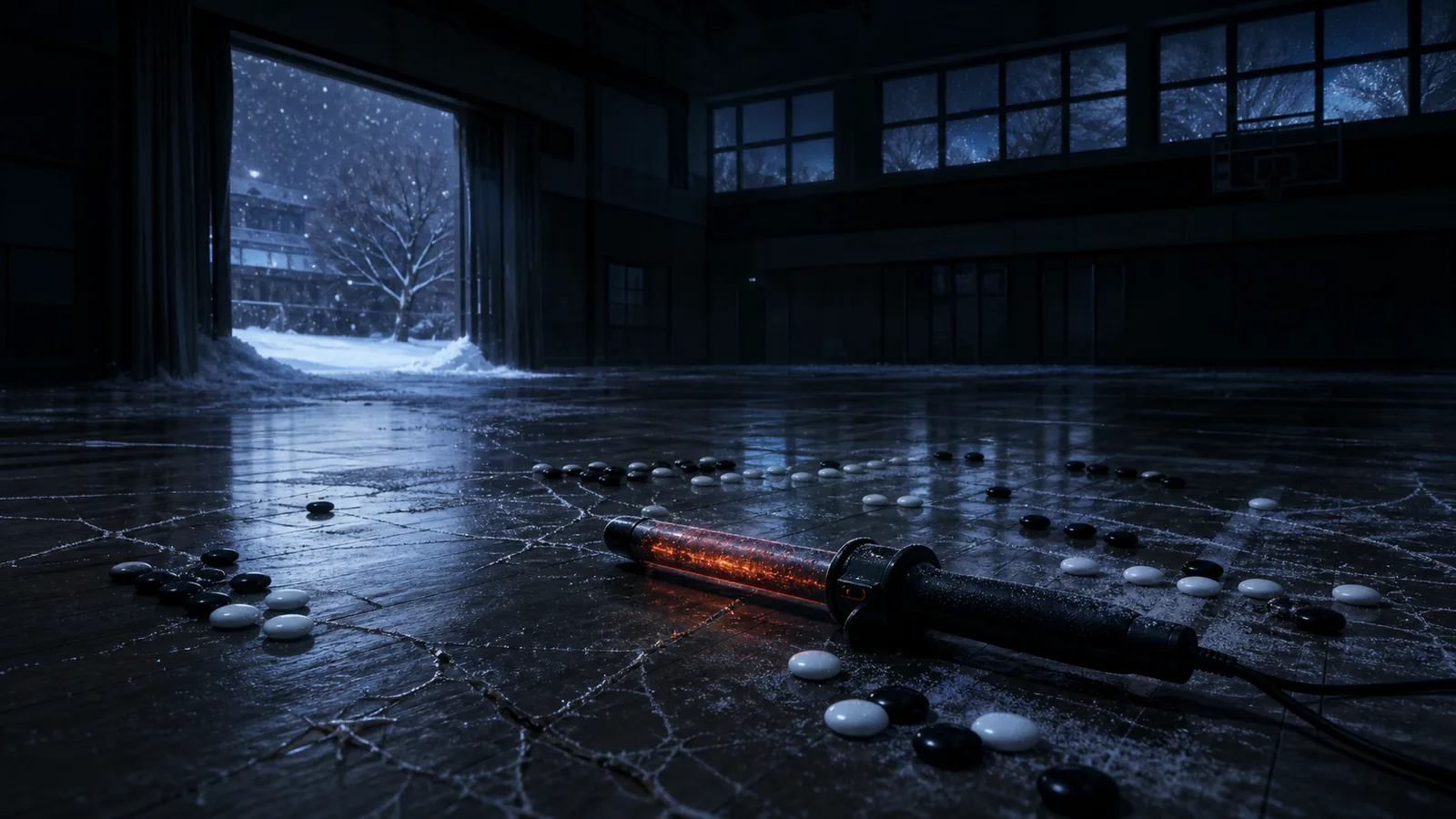
Yeon-jin wants to know if her hair iron is hot enough, so Dong-eun’s arm becomes the test surface. Myeong-oh holds her down. Jae-jun watches. Sa-ra and Hye-jeong stay inside the room. Dong-eun screams for help, and Yeon-jin answers with the lesson she has learned from every adult around them: no one is coming.
There is no euphemism available here. They burn her with a curling iron. They mock her motel life. They steal from her rice cooker. They force her to dance while they drink. They notice her legs and make that too into danger. Later, another girl, Gyeong-ran, is crying in the same kind of room, which means Dong-eun was not the only target. She was the one who became the record.
The health office scene makes it worse in a quieter way. The school nurse sees the burns and asks who did it. For a second, an adult seems to recognize the scale of the harm. Then the nurse gets a call from her mother, and Dong-eun takes the blame herself.
That answer is not confession. It is resignation.
Dong-eun has already learned that naming the attackers does not produce rescue. It produces retaliation.
So when adult Dong-eun later tells Ye-sol what hatred looks like, she does not explain it as an idea. She describes Yeon-jin’s darkening eyes, her curling smile, her hair, the face of a person having fun while another person breaks.
The premiere does not need to tell us Dong-eun is haunted. It lets us see what she had to memorize.
Dong-eun drops out and chooses Yeon-jin as her dream
Dong-eun’s attempt to leave school is another trap.
She lists the reason honestly: in-school violence by Park Yeon-jin, Lee Sa-ra, Choi Hye-jeong, and Son Myeong-oh, with the homeroom teacher watching. The teacher responds by beating her in the office. He asks whether anyone broke an arm or a leg, as if burns, terror, and humiliation do not count because she can still stand.
Then Yeon-jin’s mother buys the record.
Dong-eun’s mother signs the settlement letter and changes the dropout reason to maladjustment. The money is enough. The signature is enough. By the time Dong-eun returns to the motel, her mother has checked out and left the uniform behind.
This is the part that makes Dong-eun’s adult calm feel earned in the ugliest way. She was not failed by one bad teacher or one bad parent. She was passed from system to system until every door agreed to close.
At the pool, scarred, cramping, and exhausted, Dong-eun calculates the pharmacy opening time against the distance to the Han River. The thought is precise because Dong-eun is precise, even in despair. Freezing water becomes a kind of promised silence. No more itching. No more pain. No more wanting anyone to save her.
Instead, she returns to the group one more time and asks about Yeon-jin’s dream.
Sa-ra wants to paint. Jae-jun wants the golf course. Hye-jeong wants to be a stewardess. Myeong-oh wants to be rich. Yeon-jin wants marriage, children, money, and a neat life with no word honest enough to cover it.
Dong-eun’s answer is the first clean shape of the revenge plot: “It’s you.”
After that, the years become a march. Factory laundry. Cigarette burns visible on her arms and legs. GED results. Workbooks. College entrance. Education school. Coffee orders. Savings. Study. Not because college is a fresh start. Not because she wants a boyfriend, friends, or a normal young adulthood.
She needs to go somewhere.
By 2022, the somewhere is Ha Ye-sol’s classroom. Yeon-jin’s daughter looks at the world upside-down and believes rich women are main characters because fairy tales belong to people with money. Dong-eun corrects her gently and cruelly at once: in this story, Yeon-jin is the main character because this is not a fairy tale.
Then Yeon-jin delivers a weather report about fog, warning that sunny days have more accidents but foggy days have higher fatality rates.
Dong-eun is already standing in the fog.
What works
The premiere is controlled in a way that suits Dong-eun. It does not rush to the adult revenge fantasy before making us sit with the price of it. The burns, the stolen money, the police station, the school office, the motel, the factory years — each piece matters because revenge here is not a mood. It is the only shape Dong-eun can make from what survived.
Adult Dong-eun is frightening because she withholds nearly everything. Her face does not ask for pity. Her voice rarely rises. When she talks to Ye-sol, the danger comes from how gently she can place a terrible idea in front of a child without touching her.
Adult Yeon-jin also lands immediately, even with much of the runtime spent in the past. She has the polish of someone who has mistaken survival without consequence for innocence. The weathercaster smile is not a disguise; it is the life she has been allowed to live.
The younger timeline is blunt without feeling careless. The curling iron is not treated as symbolic decoration. The cigarette ash, the laundry, the stolen rice-cooker money, and the closed health office all stay physical and ugly.
What stumbles
There are a lot of names to carry at once: five tormentors, several adults, Yeon-jin’s mother, Dong-eun’s mother, a police chief, a teacher, a school nurse, a later factory coworker, and Ye-sol. The core is clear, but a few side faces pass quickly enough that first-time viewers may remember their function before their names.
There is also a slight neatness to the fog/weathercaster crosscut. Yeon-jin’s job turns the warning into public performance, but the language sits close to underlining a point already made with more force elsewhere.
Neither issue damages the premiere. They mostly show the cost of laying out a long revenge board in one opening hour.
What this sets up for Episode 02
Two immediate questions carry into Episode 02.
First: how did Dong-eun get from education school to Ye-sol’s homeroom? The premiere shows the destination and enough of the labor to believe it, but the exact path still matters. Dong-eun does not seem like someone who leaves a step to chance.
Second: what happens when Yeon-jin realizes the child she loves is now inside Dong-eun’s reach? The premiere is careful with Ye-sol. Dong-eun does not hurt her. She speaks to her, studies her, and uses her presence as the one room where Yeon-jin might feel fear.
That is already dangerous enough.
The last line of Dong-eun’s revenge logic is not balance. “An eye for an eye, a tooth for a tooth, a scar for a scar” would be too fair, she says. From here, the question is what unfair looks like when the victim has spent seventeen years learning patience.
Rating: 8.8/10
More episodes from The Glory — Kim Eun-sook's revenge thriller, episode by episode. Jump to any episode in the season:
Where to go next
Reviewed by Mira Vance · QuizFandom Editor & Lead Reviewer. Every rating is an honest per-watch assessment from the desk that also writes the quizzes — not a press release rehash.