The Master Cutter Episode 4 Review: "Episode 4" — Atoy Finds His Kept Room, Catches Emerson Poaching Customers, and Wakes Up to a Missing Saint Anthony
What happens — the short version (spoilers)
- Cita feeds Atoy, and Delfin's carefully preserved room turns ten years of absence into evidence he cannot ignore.
- Atoy visits Julie's grave and remembers her butterfly promise, softening the anger that still blocks him from Delfin.
- Emerson tries to poach customers using Sir Delfin's name, then mistakes Atoy for a client and gets sent away for barbecue.
- Delfin and Atoy reopen their old fight while Cita refuses to let either man hide behind pride.
- The church discovers Saint Anthony is missing, and Atoy catches Emerson with Mr. Chan as shop gossip becomes betrayal.
Episode 4 settles Atoy into Baclaran and makes the homecoming more uncomfortable than the firefight he just survived. The hour barely needs a conventional case at first: Delfin has kept his son's room clean for ten years, Julie's grave has not received the same care, Emerson is selling himself off the back of Sir Delfin's name, and Cita is still the only person willing to say the obvious out loud. By the end, the Saint Anthony thread stops being family memory and becomes public panic. The missing statue gives Atoy a case, but the real trail starts with all the things this house has refused to mend.
Cita feeds Atoy, and Delfin’s kept room turns the homecoming into evidence
Atoy begins the hour at the table, exactly where the show needs him after three episodes of islands, guns, and mission language. Cita thanks him for the gifts he has sent every Christmas and birthday, then tells him the part he has managed not to hear from far away: every time Delfin learns a gift arrived, he asks if Atoy might come home.
Atoy has rehearsed being unreachable. He shouldn’t have bothered, he says, because Delfin knows that is impossible. Cita does not let the distance stay noble. Delfin has headaches and vertigo now. He should see a doctor. The shop is aging around him. Atoy turns that into criticism of the place itself, but Cita has the counterargument ready. This shop has survived the test of time. The people inside it are harder to preserve.
Then she opens the room. Delfin has kept it tidy all these years, and the sight hits harder than any speech the father could give. The pilot introduced Atoy through professional absence: undercover, nameless, pretending not to remember. Baclaran gives him the opposite problem. His room has been waiting even when he was not.
Atoy visits Julie’s grave, and her butterfly promise sends him back toward Delfin
The grave scene is blunt in a way the show earns. Atoy can joke at his father even while speaking to his mother: Delfin keeps his room clean, yet cannot even take care of Julie’s grave. It is petty, grieving, and honest all at once. He apologizes for taking so long to visit, tells her he joined the army, and then lets Elaine enter the episode as memory. She reminds him of Julie, and she pushed him to come home and try to talk to his father.
Elaine is gone from the island, but the choice she pushed Atoy toward is still working on him. The show folds her into Julie’s old promise about butterflies: when Julie is gone, she tells young Atoy, she will show herself when he misses her or feels sad, so he will know everything will be okay. The adult Atoy is not asking for magic. He is asking for guidance.
He does not know how to face Delfin. Worse, he says it feels as if he no longer knows him. The show keeps the army hero outside his mother’s grave and lets him become a son with no field plan. Atoy can find a terrorist’s route, a child’s danger, a hidden radio path. He cannot yet find the sentence that gets him back into the same room as his father without drawing blood.
Emerson mistakes Atoy for a customer, insults Delfin, and gets sent for barbecue
Emerson is exactly the kind of Baclaran comic chaos the episode needs before the father-son tension locks the air. He arrives late on his day off, drops something at the shop, and immediately sees opportunity when Atoy stands outside like an unfamiliar customer. The shop is closed; Emerson’s side hustle is open. He offers his own service for five thousand pesos less, calls Delfin old, says the master cutter still messes up, and announces that he plans to take over once the old man is gone.
The joke gets sharper because Atoy lets him keep talking. Emerson wonders whether Delfin has a child at all, then guesses that if one exists, he may be a criminal, a scammer, or hideous because there is no picture in the shop. Atoy only has to stand there while Emerson builds his own trap out of discounts, gossip, and terrible customer service.
The reveal is beautifully stupid. Cita arrives, Emerson realizes he has just insulted Sir Delfin’s son to his face, and the flattery machine turns on. Suddenly Atoy looks like a soldier, a model, a nice guy, a man with an excellent beard. Atoy turns the local information system back on itself. Emerson is sent for barbecue, chicken intestines, drinks, milk tea, and two kilos of rice as a welcome gift. It is punishment by errand, and it is funnier than a beating would have been.
Delfin and Atoy reopen ten silent years while Cita refuses to let either man run
The mannequin is the match. Atoy starts tidying, something clatters, and Delfin comes in ready to turn touch into trespass. Who gave you the right to touch my stuff? is not only about the mannequin or the shop. It is about the son who has returned after ten years and is suddenly handling a life he chose not to share.
Delfin’s complaint is simple enough to be brutal. Atoy stayed in contact with Cita, but not with him. Most of the time, Delfin did not even know his son was in Mindanao. Atoy’s answer is just as hard: no one asked Delfin to look, and Delfin himself told him not to come back. Neither line is wrong. That is why the scene works. The father has been waiting in the room he kept clean; the son has been obeying the exile the father spoke in anger.
Cita walks in at the worst possible moment and becomes the hour’s adult again. Delfin complains that Atoy took things out on his mannequin. Atoy throws back the kind of line only this show would put in the middle of family trauma, telling him he can marry the mannequin for all he cares. Then Julie’s name enters the room. Delfin says Julie would not be pleased with Atoy. Atoy says the exact same thing about Delfin.
Cita refuses to let that be the ending. She tells Delfin to follow him upstairs because they only have each other now. When Delfin asks why he should comfort the son who ran away, Cita fires back with the episode’s most Baclaran version of moral clarity: the economy is already terrible, so this is no time to make things worse. It is funny because it is practical.
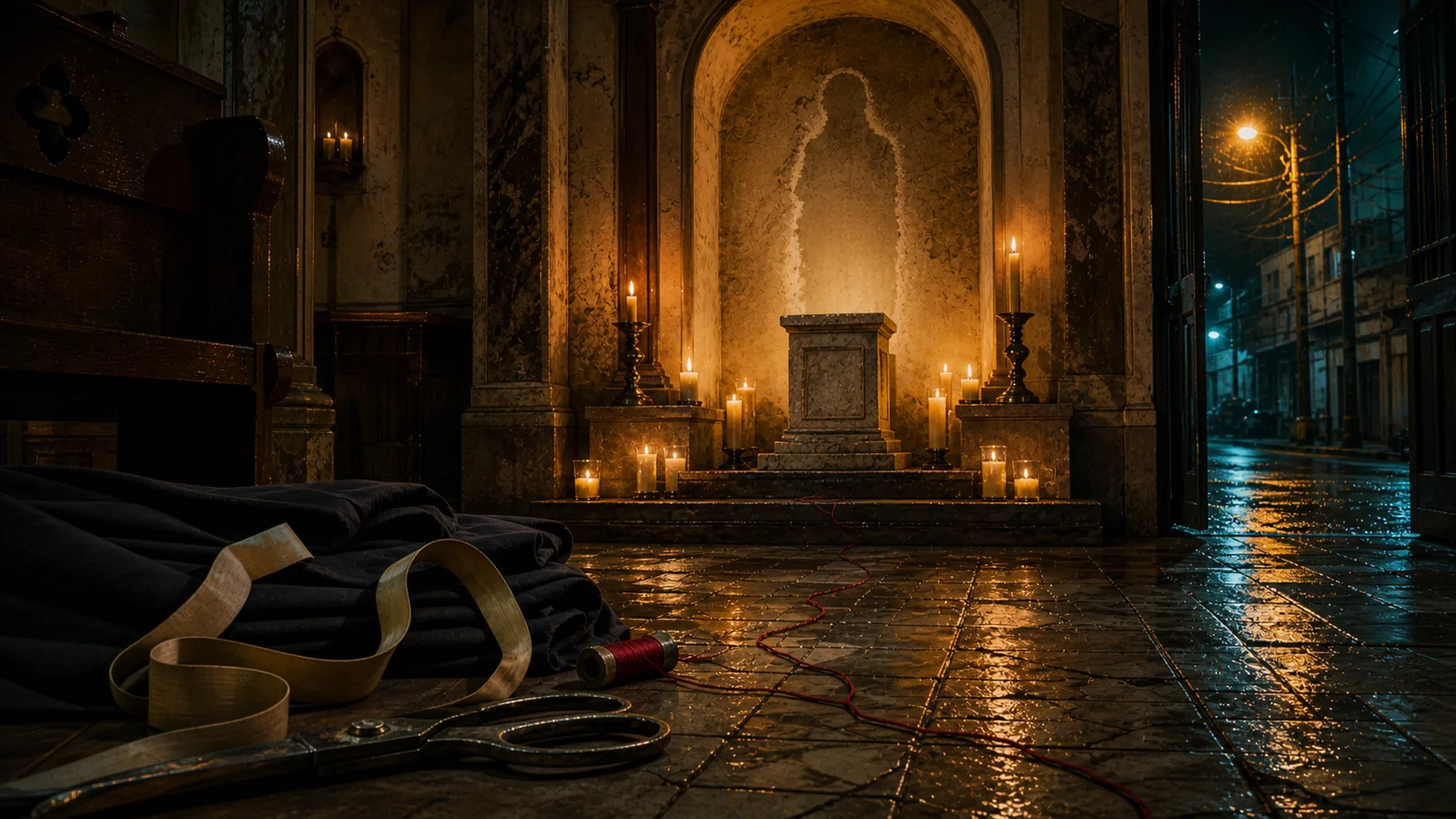
Julie’s church flashbacks ask father and son to find each other, just as Saint Anthony begins to disappear
The flashbacks translate the present fight into older, softer language. Young Atoy wants to take Julie for snacks at a new burger place, but only has money for a buy-one-get-one deal, not enough to include Delfin. Julie hears the real issue under the cheap-burger math. When Atoy asks what if Delfin did something terrible to them, she does not pretend Delfin is perfect. She only says neither parent is perfect, that she still loves him, and that Atoy should be patient because it cannot be easy for his dad either.
The episode withholds what Atoy believes Delfin did. Julie can ask for patience without erasing the wound, and young Atoy still ends up in the church, telling Father Peping he feels her presence there more strongly than at home. Even there, the show cannot resist neighborhood texture. The church is closing early because the staff need to polish the floor and attend barangay ballroom dancing later.
The family prayer that follows makes the Saint Anthony statue feel less like a prop and more like a witness. Julie brings Delfin and Atoy together before the saint and asks that, even if her husband and son do not understand each other, they find their way back. Delfin refuses the implication because he is still talking about treatment. Atoy notices how pale and exhausted she is. Then Julie collapses, and the prayer stays hanging over the present.
Someone carries Saint Anthony out while the church world is distracted, right beside Julie’s hope that this same saint might help father and son return together. The statue is missing before anyone knows it is a case. The absence has already been prepared emotionally.
Atoy catches Emerson with Mr. Chan, and Karla’s breakfast story turns gossip into a shop betrayal
The Emerson story could have stayed a gag, but Atoy follows the trail one step farther. He sees Emerson handing Mr. Chan a suit and pitching himself for the son’s wedding, promising cheaper groomsmen’s suits because Sir Delfin supposedly cannot handle it anymore. Atoy names the alley for what it is: Traitor’s Alley. Emerson tries to laugh it off, then realizes the son he insulted yesterday has caught the actual betrayal.
Again, Atoy chooses leverage over violence. Emerson begs him not to say anything because he does not want to lose his job and is supporting siblings in the province. The excuse does not make the betrayal harmless, but it keeps Emerson from becoming a cartoon villain. Baclaran is full of people hustling around the edges of loyalty because money is tight and everybody knows everybody’s business by breakfast.
Karla makes sure the business does not stay hidden. She asks Cita for one hundred pesos for a science group project, then identifies Mr. Chan as the old man with rotten teeth and thick glasses. She saw him with Emerson the night before. Emerson told him to go straight to him next time because Delfin was no longer capable. Delfin’s pride flares instantly. He is stronger than a horse, he says, and now there is a traitor to deal with.
The public emergency interrupts that smaller war. Father Peping asks Mel whether someone moved the Saint Anthony statue, then the church realizes no one did. The crowd gathers, chanting for Saint Anthony to be brought back, and Atoy hears the commotion with soldier reflexes still wired into him. Who was abducted? he asks. Nobody, he is told. The statue is missing.
Atoy has come home to a father he cannot read, a shop being picked apart by resentment, and a saint tied to his mother’s last hopes. Now Baclaran hands him a missing-person case that is technically an object. For the Master Cutter, that difference may not matter for long.
Tiny details worth clocking
- Cita thanking Atoy for gifts before naming Delfin’s hope makes the estrangement more complicated. Atoy stayed reachable to everyone except the one person who needed the call most.
- Delfin keeping Atoy’s room tidy while Julie’s grave looks neglected is a nasty little emotional imbalance. The living son gets preservation; the dead wife gets resentment leaking through maintenance.
- Emerson offering clothes for a statue before the Saint Anthony statue is stolen is probably accidental inside the scene, but it is a very neat rhyme for the episode.
- Atoy sending Emerson to buy barbecue, chicken intestines, milk tea, and rice turns military interrogation into neighborhood hazing without breaking the scene’s stakes.
- Father Peping closing church early for floor polishing and ballroom dancing makes the theft feel like it happened to a real parish, not a plot location.
Final verdict
“Episode 4” is quieter than the Cogon Island run, but no smaller. The show trades Merelli’s escape route for domestic geography: a preserved room, a grave, a tailoring table, a church, a food hub, an alley where Emerson tries to steal a customer. Atoy cannot solve Baclaran by announcing himself as Captain Padua. Everyone here already knows too much or not enough. His name works like evidence.
The hour does sag a little in its middle stretch. Emerson is funny, and the double use of his poaching scheme pays off, but the episode circles his cowardice long enough that Delfin’s deeper accusation has to fight for air. The missing-statue case also arrives so late that it plays more like the ignition for the next hour than a full mystery here.
Still, the emotional construction is sturdy. Julie’s butterfly promise, her church prayer, Delfin’s kept room, and Atoy’s reflexive question about who was abducted all point to the same scene in different clothes: Atoy knows how to respond when something is missing, but he freezes when what is missing is a decade with his father. The Saint Anthony theft gives him a trail. Whether it gives him a way back into the house is the better question.
Rating: 8.2/10 — a funny, bruised Baclaran reset that spends a little too long on Emerson’s side hustle but makes Atoy’s homecoming, Julie’s memory, and the missing Saint Anthony statue feel like one tangled case.
More episodes from The Master Cutter — Filipino action tailor drama, episode by episode. Jump to any episode in the season:
Where to go next
Reviewed by Mira Vance · QuizFandom Editor & Lead Reviewer. Every rating is an honest per-watch assessment from the desk that also writes the quizzes — not a press release rehash.