The Master Cutter Episode 5 Review: "Episode 5" — Atoy Faces Baclaran's Mob, Follows the Biscocho Trail, and Calls His Bond With Delfin Lost
What happens — the short version (spoilers)
- Emerson quits loudly, and the missing Saint Anthony statue becomes a public accusation against Delfin's newly returned son.
- The barangay wakes Atoy with mob certainty, while Emerson turns his grudge into a convenient pile of suspicion.
- Delfin searches Atoy's room and finds weapons instead of a statue, reopening the family fight Julie left behind.
- Atoy forces the crowd to deal with proof, then maps the church route through urine on the floor and a trail of Biscocho.
- Paldo shifts from accuser to suspect, while Father Peping calls for a vigil and Cita connects the missing saint to Atoy's broken bond with Delfin.
Episode 5 turns the missing Saint Anthony statue into Baclaran's first full test of Atoy as the Master Cutter. The hour starts with Emerson quitting loudly, the whole barangay deciding Delfin's newly returned son must be the thief, and Atoy waking up to a mob that has already confused gossip with proof. The case itself is funny in the show's exact register: urine on a church floor, dry Biscocho, and Paldo somehow becoming a more reasonable suspect than the trained soldier everyone blamed first. Underneath the noise, Delfin finally admits that Atoy knows about the old wound, and Cita has to sit with the fact that even Saint Anthony may not be able to find a father and son who keep losing each other on purpose.
Delfin calls Emerson a snake, and the missing Saint Anthony turns into a public charge against Atoy
The episode opens by letting the Emerson betrayal finish curdling. Delfin has already heard enough about Mr. Chan and the side hustle, but Emerson still tries to make poverty do the work of an apology. He has a sibling in the province. He needed cash. He is only getting by.
Delfin’s anger has years of shop debt under it. He taught Emerson to sew, lent him money, and gave him a place to become useful. Emerson answers by cutting straight into the wound everyone in the shop knows is there: now he understands why Atoy does not want to see Delfin. After that, the fight cannot stay a workplace blowup. Emerson quits, Delfin demands his buttons and zippers back, and betrayal sounds exactly as petty as it feels in Baclaran.
Then the church panic arrives with perfect local logic. Someone says a kidnapping happened at the church, only for the correction to be somehow funnier and more serious: no person was taken, but Saint Anthony of Padua is gone. The crowd immediately builds a theory out of timing, superstition, basketball grudges, and the fact that Atoy has just returned. The patron of lost things is missing before the fiesta, and the easiest suspect is the man Baclaran has not yet decided belongs there again.
The crowd wakes Atoy, and Emerson turns his own grudge into evidence
Atoy wakes to chants outside the house, which is a very different kind of alarm than gunfire. The episode even scores his tailoring-shop world against his soldier reflexes: sewing machines, snips, a gun cocking, then the crowd calling for him like the missing statue might fall out of his pocket if they yell long enough.
The accusation is absurd, but it has ingredients. Atoy was one of the last people at the church before it closed, he is newly back, and Emerson has a personal reason to feed the fire. Emerson calls him a traitor for telling Delfin about the poached customer, and the barangay takes the word because it already wants a shape for its fear. Atoy’s answer is pure house style: the dogs could be outsiders too, so maybe they should be questioned.
What keeps the scene from becoming only farce is Atoy’s mother. He reminds Father Peping that Julie donated the statue. If anyone in the crowd has a claim on Saint Anthony, it is the son of the woman who gave him to the church. Baclaran hears that and still pushes. The place that knows Atoy’s childhood can also forget it in five seconds when a chant gets going.
Delfin searches Atoy’s room, finds weapons instead of a statue, and reopens the ten-year fight
Delfin’s private question is worse than the mob’s public one. Once he gets Atoy inside, he asks if he really took the statue. Atoy hears the doubt before he hears the words. After all the talk about home, the first thing his father does with the crowd outside is wonder if the crowd might be right.
The timeline gives Delfin something to hold onto. Father Peping last saw Atoy at the church around five, and Atoy came home at nine. Four hours missing. Atoy says he walked around until he was tired enough to avoid seeing or talking to Delfin. It is such a clean, ugly confession that the statue almost drops out of the scene. Atoy did have an alibi problem, but his real motive was avoidance.
Then the search gets meaner. The crowd tries to push into the house, Father Peping’s presence does not calm them, and Atoy finally opens his things because he knows the statue is not there. What Delfin finds is Atoy’s collection of weapons. He asks whether his son is a murderer. Atoy asks why Delfin always sees the worst in him. Neither man is talking about the statue anymore. They are back inside the same old sentence: Delfin thinks Atoy changed because he rebelled; Atoy says people change for reasons.
The flashback gives the reason only in pieces, which is the right choice. Young Atoy is on his way home, Julie thinks Delfin is meeting a client, and Atoy sees enough to accuse his father of failing as a husband worse than he failed as a father. When Father Peping walks in, Atoy turns confession into a blade. The episode still does not spell out the whole past mistake, but Delfin’s later apology to Julie makes the wound legible. Atoy has not been dramatic for ten years. He has been carrying evidence.
Atoy embarrasses the barangay with due process, and Delfin admits Julie’s old wound is catching up
Delfin goes back outside and tells the crowd he found nothing. The accusation should die there. Instead, Baclaran keeps performing suspicion. People chant, make faces, call each other accomplices, and briefly decide good looks have evidentiary value. The same community that can feed you, defend you, and remember your mother can also turn into a jury before breakfast.
Atoy cuts through it by asking the questions no one bothered with. Did they go to the police? Did they talk to the church staff? Did they ask the person who closed the church? They did not. They barged in, accused him, and then treated the absence of proof as a reason to invent buried proof. His insult about Paldo’s nails being bigger than his brain is childish, effective, and frankly deserved.
While Atoy redirects the crowd toward the church, Delfin collapses into the part of the hour he cannot solve with authority. He apologizes to Julie’s memory, says his past mistakes are catching up with him, and admits their son already seems to know what he did to her. When Cita finds him, he can finally say the thing he has been circling since Atoy returned. He hurt his own child without realizing it, and now he does not know how or when to face him.
The old secret stays half-covered, but Delfin’s recognition is clear. His punishment lasted longer than his anger. He does not want to lose Atoy again. Wanting still leaves him outside the room, unsure how to enter.
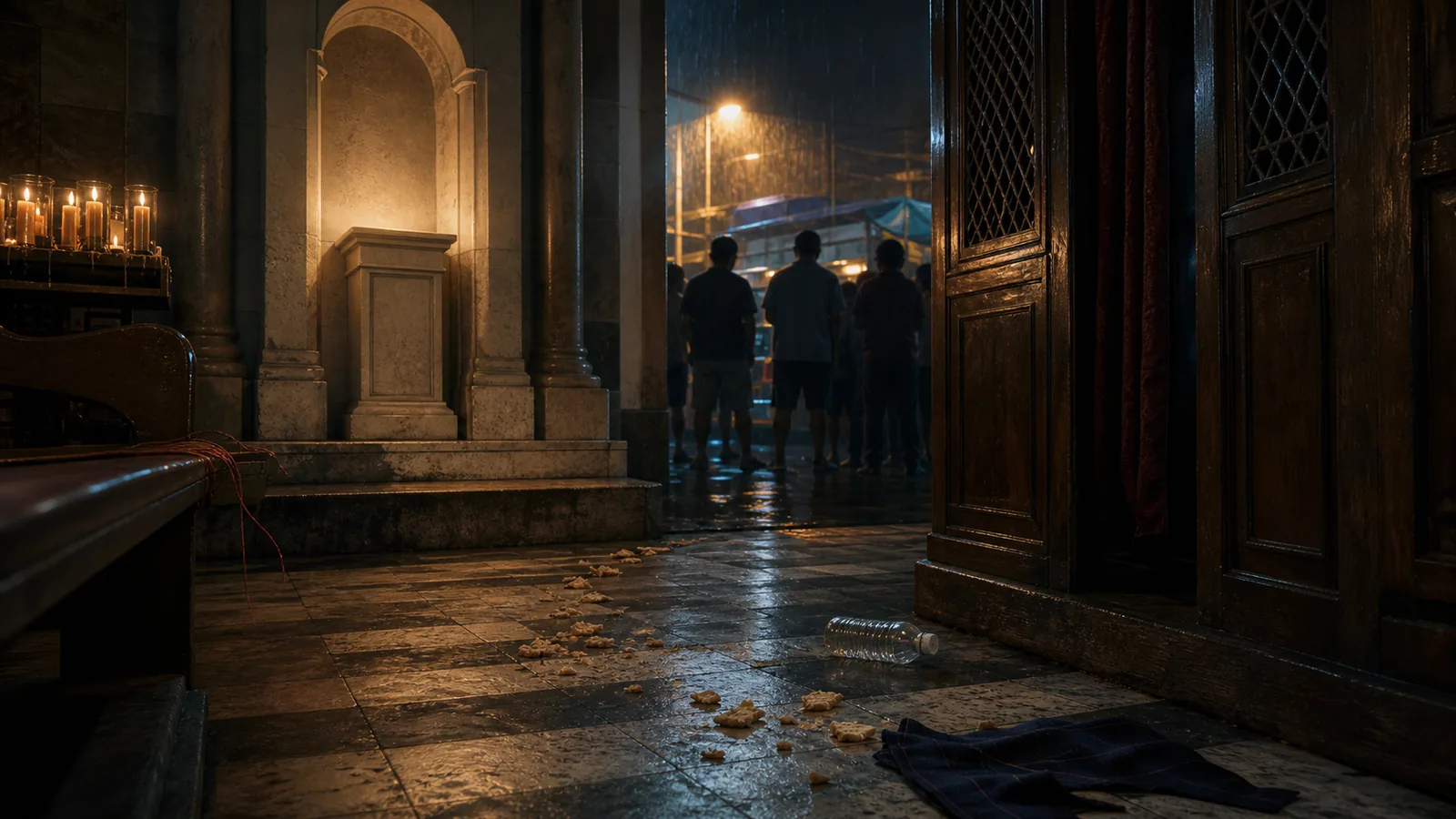
Atoy maps the church route, finds urine and Biscocho, and turns Paldo from accuser into suspect
The actual mystery is almost beautifully ridiculous. The chairman has already reported the missing statue, but the police see it as low priority. There was no break-in. The main door was locked from outside. The office door was locked from inside and not forced. Miss Siony suggests Saint Anthony may have left on his own because church attendance is down, and someone else upgrades that into a ghost theory. Atoy has to remind them that they are looking for a saint, not a ghost.
Once the noise clears, the logic is simple. If no one broke in, the thief was already inside. If the thief was already inside, he waited for closing, hid where Ryan and Boni would not notice, took the statue, passed through the office door, and locked up behind him. The confession box becomes the hiding place because it fits the sightlines and the timing.
The clues are the kind only this show would let carry a church mystery. There is urine, because the thief hid long enough to need relief and could not risk the office restroom. There is water, because he planned to wait. There is food, because waiting takes time. The food is dry, old, sugared bread: Biscocho. The case narrows from sacred theft to a snack trail, and somehow the shift works because Baclaran has always solved itself through gossip as much as evidence.
A witness supplies the turn: someone was eating Biscocho yesterday and refused to share. Paldo has a girlfriend from Bacolod who brought him some. Suddenly the man who helped point the crowd at Atoy is emptying his own bag while everyone chants at him. He admits the Biscocho is his, but swears he did not take the statue. Atoy does not call that innocence. He only says no criminal is going to confess with proof staring at him. After being the target of mob certainty, he is still willing to use it when the trail points elsewhere.
Father Peping asks for a vigil, and Cita links the lost statue to Atoy’s lost bond with Delfin
Father Peping wants the community to pray. Atoy, still full of fresh contempt for the crowd that accused him, does not put much faith in vigils. The priest answers with Mark, all things being possible for one who believes, and the line lands less as a sermon than as the show’s running dare. Atoy is excellent with footprints, locks, routes, and food crumbs. Belief is the part he still treats like an inefficient method.
Cita gets the quieter ending. She did not see Atoy at church, but he was watching from plain sight, and she is proud that he used soldier skills in service of the patron. Her point is almost too neat, so the episode lets her cry through it. The saint people pray to when someone or something is missing has gone missing himself. Atoy, of all people, has been handed the job of finding him.
Then she makes the Saint Anthony rhyme plain. Maybe when the statue comes back, the missing pieces in Atoy’s life can come back too, including his broken relationship with Delfin. Atoy does not soften. My relationship with my dad is as lost as the saint who disappeared is blunt, and he means it. Cita apologizes because she cannot fix what Julie prayed for. Atoy tells her none of this is her fault. For once, the tracker is not pretending the trail is hard. He is saying he does not believe there is a trail at all.
Tiny details worth clocking
- Emerson quitting only after insulting Delfin about Atoy makes his betrayal feel smaller and uglier than simple customer poaching.
- The crowd treating the statue as “kidnapped” keeps the Saint Anthony case in the show’s missing-person language even though the victim is an object.
- Atoy’s four-hour walk is a clean little character beat. He was not building an alibi; he was exhausting himself so he could avoid his father.
- The church clue chain goes from lock logic to confession box to urine to Biscocho, which is exactly the kind of sacred-and-street-level mix this show does best.
- Cita apologizing for not being able to help Atoy and Delfin says a lot about her place in the family. She has carried the middle for years, and even she knows the middle has limits.
Final verdict
“Episode 5” is rougher than Episode 4, and mostly better for the friction. The missing-Saint-Anthony case gives the show a proper Baclaran mystery, and the hour has fun with how quickly community concern becomes community prosecution. Atoy being accused, cleared, and then asked for help in the same day is funny because it is plausible. People want the Master Cutter only after they are done treating him like the thief.
The weak spot is Paldo. The Biscocho trail is entertaining, and the Bacolod-girlfriend detail gives the clue its local bite, but the episode leans so hard on Paldo’s suspiciousness that the mystery briefly flattens into everybody shouting at the latest convenient target. After the hour has just criticized mob thinking, it could use one more beat of Atoy resisting the crowd’s hunger instead of borrowing it.
Still, the family material gives the case weight. The strongest scene comes away from the Biscocho, with Delfin telling Julie that his past mistakes are catching up and that Atoy knows. The statue mystery and father-son story stitch together there. Saint Anthony can be found through a route, a lock, a hiding place, and a snack. Delfin and Atoy will take something harder than tracking. They will need somebody to stop treating proof like punishment.
Rating: 8.1/10 — a lively, sharp-edged church mystery that occasionally swaps one mob suspect for another, but uses the missing Saint Anthony case to expose how lost Atoy and Delfin still are with each other.
More episodes from The Master Cutter — Filipino action tailor drama, episode by episode. Jump to any episode in the season:
Where to go next
Reviewed by Mira Vance · QuizFandom Editor & Lead Reviewer. Every rating is an honest per-watch assessment from the desk that also writes the quizzes — not a press release rehash.